Long-Term Airbnb vs Lease: Pros and Cons in Italy
Arriving in Italy and realizing you need an official registered lease to get your residency, but landlords won’t rent to you without a residency, is a maddening catch-22. I spent my first two months bleeding cash in a short-term rental just trying to crack this system. This guide breaks down whether a long-term Airbnb or a traditional lease is your best survival strategy.
Disclosure: This post may contain affiliate links. We may earn a commission at no extra cost to you if you make a purchase through these links. Read full disclosure.
The Illusion of Ease with Long-Term Airbnbs
Bureaucratic Roadblocks for Residency
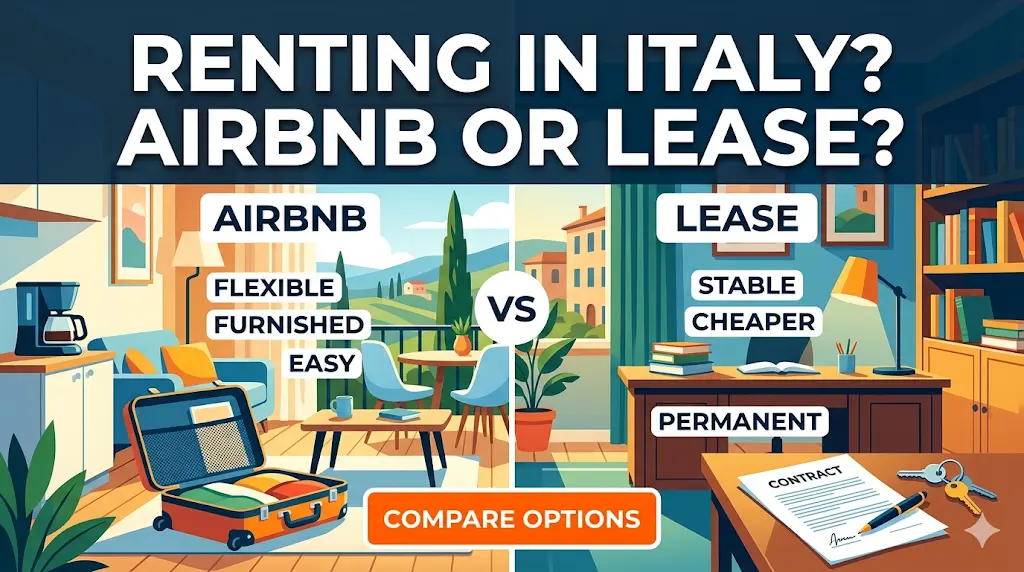
When you first land in Italy, booking a long-term Airbnb feels like the safest and most logical choice. You pay with your foreign credit card, the electricity and gas are already connected, and the apartment is fully furnished down to the espresso spoons. You avoid the immediate shock of dealing with Italian real estate agents and skip the massive upfront security deposits. However, within a few weeks, you will hit a massive, impenetrable bureaucratic wall: the Residenza.
To live legally long-term in Italy, you must officially register your permanent address at the local town hall (Anagrafe). This process is absolutely mandatory for opening a local bank account, buying a vehicle, or accessing the public healthcare system. To get your Residenza, you must present a legally registered rental contract. Airbnb hosts operate under a short-term tourist rental classification (locazione turistica). They will almost universally refuse to let you register your residency at their property because doing so fundamentally changes their tax liabilities and grants you intense tenant rights that prevent them from easily removing you.
Without this registered contract, you are entirely paralyzed in the eyes of the Italian state. Your immigration paperwork will stall, and you will be blocked from integrating into local society. You cannot simply bypass this requirement; the local municipal police (vigili) will physically visit the address unannounced to verify you live there before approving your status. Navigating this exact catch-22 is one of the most stressful parts of Navigating Italian Bureaucracy Comune and Prefettura.
The Cost Premium and Lack of Protections
Beyond the severe residency blockade, you are paying an extortionate tourist premium for the illusion of convenience. A month-to-month Airbnb in a major hub like Rome, Milan, or Florence will easily cost double or triple what a local tenant pays for an identical apartment in the exact same building. You are subsidizing the host’s platform fees, their commercial cleaning costs, and their daily municipal tourist taxes.
Furthermore, you possess absolutely zero legal protections as a tenant. In the eyes of Italian civil law, you are merely a transient guest. The host has the absolute power to cancel your extension request, drastically inflate the monthly price during peak summer tourist seasons, or ask you to vacate the premises with minimal notice. You are entirely at the mercy of the platform’s algorithm and the host’s whims.
If a pipe bursts or the air conditioning fails in the middle of August, the host has no legal obligation under the rigorous Italian housing code to rehouse you or fix it immediately, unlike a registered landlord. When you are meticulously calculating your financial runway and reviewing the Cost of Living in Italy 2026 Budgeting for Expats, relying on short-term vacation platforms for permanent housing will violently destroy your savings and leave you in a constant state of housing insecurity.
The Brutal Reality of Standard Italian Leases
Bureaucracy and Empty Apartments
For expats who want to plant deep roots and integrate fully, the contratto a canone libero (the standard 4+4 lease) is the holy grail. This legally registered contract gives you the immediate right to establish your residency and grants you absolute legal protection for up to eight years. However, unlocking this achievement as a newly arrived foreigner is brutally difficult.
Local landlords demand overwhelming proof of financial stability. Because you do not have an Italian credit history, they will often demand an Italian employment contract (a tempo indeterminato). If you are a freelancer or remote worker, they might demand a Fideiussione Bancaria (a bank guarantee) locking up a year’s worth of rent in escrow. Furthermore, you will be hit with massive upfront costs: a three-month security deposit, the first month’s rent, and a real estate agency fee that equals 10% to 15% of the annual rent plus 22% VAT.
If you manage to secure the lease, you will face the ultimate shock: traditional long-term Italian apartments are rented vuoto (completely empty). This does not just mean the apartment lacks a sofa and a bed. In Italy, vuoto frequently means there are no kitchen cabinets, no sink, no appliances, and literally just bare wires hanging from the ceiling where light fixtures should be. You will have to build the apartment from scratch and navigate the exhausting bureaucracy of transferring the utility meters into your own name, a process completely demystified in Setting Up Utilities in Italy. For a deep dive into the legal clauses you must watch out for, you must review Signing an Italian Rental Contract.
Long Commitments and Rigid Eviction Laws
The 4+4 lease provides incredible stability, but it is effectively a bureaucratic prison if your circumstances change. If you sign this lease and your job suddenly transfers you to another city, you cannot simply pack your bags and hand over the keys. Breaking a standard Italian lease early requires providing a mandatory six months’ notice via a registered physical letter (disdetta tramite raccomandata). You are legally on the hook for half a year of rent after you decide to leave.
Landlords love the rigidity of the 4+4 contract because Italian eviction laws are notoriously slow and heavily favor the tenant. Removing a non-paying tenant (sfratto per morosità) requires formal court hearings and can easily take over a year to execute. Because of this massive risk, landlords are deeply paranoid and incredibly hesitant to rent to foreigners who might suddenly flee the country.
This rigidity goes both ways. If you get trapped with a terrible landlord who refuses to fix a broken boiler in the middle of winter, your only recourse is a lengthy, stressful legal battle. You cannot simply withhold your rent, as that is strictly illegal in Italy. Understanding your rights and how to escalate maintenance disputes formally is essential, which is why you must review Filing a Complaint Italian Landlord or Agency before committing to a four-year contract. You must also ensure the landlord provides proper invoicing to protect your deposit, as detailed in Rent Receipt Requirements Cedolini for Italian Tenants.
Finding the Middle Ground for Expats
The Transitional Contract Lifeline
You do not have to choose between an overpriced tourist trap and committing to a four-year empty concrete box. The absolute best solution for new expats is the contratto transitorio (transitional contract). This is a legally registered lease specifically designed to last anywhere from 1 to 18 months. It is heavily utilized by visiting professors, temporary workers, and digital nomads who can document a temporary need to be in the city.
The contratto transitorio gives you the legal documentation necessary to establish your residency—provided the municipal rules allow it and the landlord agrees—while keeping your commitment wonderfully short. However, finding these specific contracts on standard Italian classified websites is a nightmare filled with outdated ads and outright scams. This is exactly why veteran expats rely so heavily on Spotahome.
Spotahome acts as a verified digital intermediary specializing in mid-term to long-term rentals. You can explicitly filter their platform for fully furnished apartments where landlords proactively offer registered transitional contracts. Booking a mid-term rental through Spotahome allows you to bypass the massive Airbnb tourist markup, avoid the staggering upfront costs of local real estate agencies, and secure the legal paperwork you desperately need. Most importantly, it shields you from fake local classified ads, a danger we outline heavily in Avoiding Rental Scams on Italian Housing Websites.
Managing Logistics During the Housing Hunt
When you are on the ground trying to view apartments, communicating with local landlords, and translating complex Italian lease documents, you must have uninterrupted internet access. Do not rely on spotty cafe Wi-Fi to send a massive security deposit via bank transfer. Before I even began my housing hunt, I downloaded a data eSIM from Airalo.
Having Airalo active on my phone the moment I landed meant I had seamless local cellular data to use Google Maps, translate contracts on the fly, and securely access my banking apps during critical property viewings. Relying on Airalo ensures you are never digitally stranded when an aggressive real estate agent tries to rush you into a signing decision.
Once you secure your mid-term Spotahome apartment or your permanent lease, you will still need to outfit the space. Even furnished apartments often lack high-quality linens, proper heating elements, or small appliances. Instead of dragging heavy items across uneven cobblestones on a crowded bus, I relied entirely on Amazon Italy. You can order everything from electric kettles to heavy winter duvets and have them delivered directly to your new door via Amazon Italy. Keeping your connectivity active with Airalo and outsourcing your heavy lifting to Amazon Italy transforms the chaotic Italian housing transition into a manageable, structured process. Be sure to finalize your official tax identity before signing any documents by reviewing Checking Your Italian Tax Code Codice Fiscale Status.
| Feature | Long-Term Airbnb | Spotahome (Transitional Contract) | Standard 4+4 Lease |
| Duration | Month-to-Month | 1 to 18 Months | 4 Years + 4 Year Renewal |
| Cost Profile | Extremely High (Tourist Premium) | Moderate (Fair market value) | Lowest (Standard market rent) |
| Residenza Eligible? | No | Yes (Usually) | Yes (Absolute legal right) |
| Furnishing Status | Fully Furnished | Fully Furnished | Vuoto (Completely Empty) |
| Best For | First 30 days upon arrival | Expat transition and first year | Permanent, long-term settlement |
References
Primary sources (official)
- Agenzia delle Entrate – Guida Affitti e Tipologie di Contratto – https://www.agenziaentrate.gov.it/portale/documents/20143/3015794/GUIDA+AFFITTI+17+OTTOBRE+INTERNET+%281%29.pdf
- Ministero dell’Interno – Iscrizione Anagrafica (Residenza) – https://www.interno.gov.it/it
- Agenzia delle Entrate – Nota Metodologica Locazioni Immobiliari – https://www.agenziaentrate.gov.it/portale/documents/20143/1144826/Nota_Metodologica_20230608_locazioni.pdf
Other helpful sources
- Residaro – Your Guide to Rent in Italy Long Term – https://residaro.com/blog/rent-in-italy-long-term
- Uniplaces – Renting Laws for Expats in Italy: Your Ultimate Guide – https://www.uniplaces.com/city-explorer/renting-laws-for-expats-in-italy-your-ultimate-guide/
Disclaimer
The information provided in this article is for educational and informational purposes only and does not constitute official legal, real estate, or tax advice. The ability to register an official Residenza on a contratto transitorio is subject to the specific administrative regulations of individual Italian municipalities (Comuni) and the explicit agreement of the property owner. Short-term tourist rentals (locazioni turistiche) do not confer long-term tenant rights under the Italian Civil Code. Always consult a registered Italian real estate attorney or a local tenants’ union (such as SUNIA) to review the specific clauses of your lease agreement before transferring any security deposits or agency fees.