Moving to Italy from Canada: East vs West Coast Container Costs
The thought of moving your entire life from the vast stretches of Canada to the sun-drenched, bureaucratic labyrinth that is Italy can feel utterly overwhelming. You’re not just changing countries; you’re traversing oceans, cultures, and an administrative system that often seems designed to test your patience. One of the biggest hurdles, and frankly, one of the most anxiety-inducing, is figuring out how to get all your beloved possessions there without breaking the bank or losing your mind. This guide is here to untangle the complexities of container shipping costs when moving to Italy from Canada, particularly highlighting the differences between departing from the East and West Coasts, and crucially, how to simplify this monumental task.
Disclosure: This post may contain affiliate links. We may earn a commission at no extra cost to you if you make a purchase through these links. Read full disclosure.
The Allure of La Dolce Vita and the Shipping Headache
Let's be honest, Italy calls to us with its irresistible charm – the food, the history, the slower pace of life, the sheer beauty of it all. But beneath that romantic veneer lies a logistical reality that can quickly turn sweet dreams into a series of stress-induced headaches, especially when it comes to international moving. Understanding the nuances of shipping your household goods is paramount.
Why Italy? The Expat Dream Meets Practicality
For many Canadians, the decision to move to Italy is born from a desire for a different quality of life. Perhaps it’s the lure of a more family-centric culture, the chance to live amidst ancient ruins, or the simple pleasure of an espresso at a bustling piazza. You might be moving for work, retirement, or simply for an adventure of a lifetime. Whatever your reason, you've likely envisioned your new life filled with aperitivi and passeggiate, not paperwork and shipping manifests.
However, the reality of uprooting your home requires confronting some distinctly un-romantic details. You’ve accumulated a life in Canada – furniture, books, kitchenware, perhaps even a beloved bicycle or a collection of hockey memorabilia. The question quickly becomes: what do I take, and how do I get it there without remortgaging my future? This is where understanding container shipping becomes critical. While you're dreaming of Italian piazzas, the practicalities of a move demand attention to details like visas, which you can learn more about in our Ultimate Guide to Visas and Immigration in Italy, and how to eventually register for residency, detailed in our guide on Registering Residency in Italy (Residenza and Anagrafe).
The Canadian Divide: East vs. West Coast Logistics
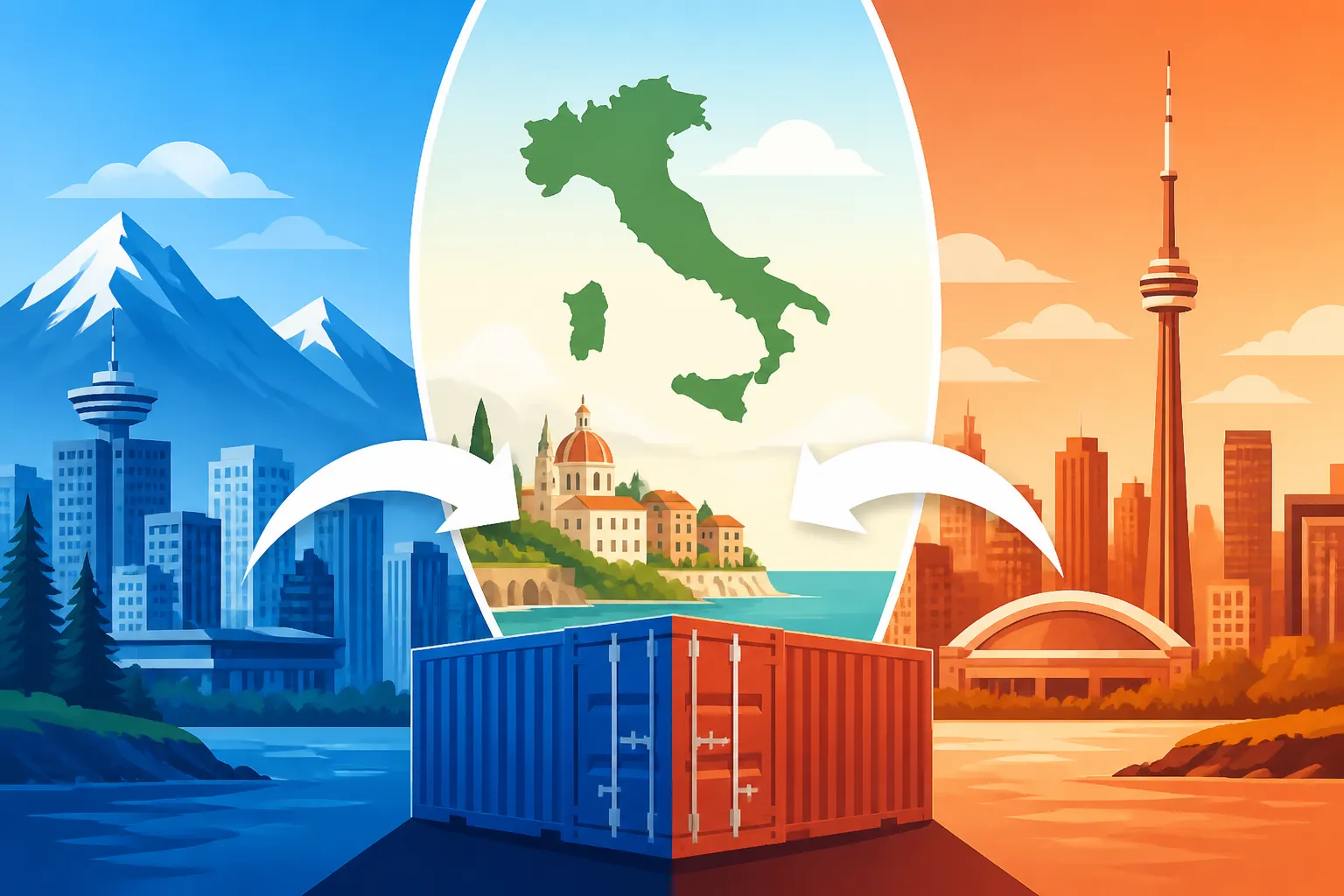
Canada is massive, stretching from the Atlantic to the Pacific. This geographical reality has a significant impact on international shipping costs and transit times. Shipping from Vancouver to Genoa is a very different beast than shipping from Montreal to Livorno.
When you're packing up your life, where you're located in Canada will heavily influence your shipping options, costs, and even the availability of certain services. Generally speaking, the more direct the route to a major port with established international shipping lanes, the more cost-effective and efficient your move will be. This means if you're residing closer to the East Coast, you're likely looking at different price points and transit expectations compared to someone packing up on the West Coast. These differences aren't just about fuel costs; they involve port fees, trucking distances to the port, and the frequency of vessel departures from specific Canadian harbors to Italian destinations.
Understanding Container Shipping: Your Options to Italy
When you’re sending your entire household across the Atlantic, you’re primarily looking at ocean freight. This usually involves large metal containers, but how much of that container you fill and how you pay for it varies significantly.
Full Container Load (FCL): Your Entire Life in a Box
If you're moving a substantial household – say, a three-bedroom home or more – or if you simply prefer the security and dedicated space of having your own container, then a Full Container Load (FCL) is your go-to. This means you book an entire 20-foot or 40-foot container for your exclusive use.
The biggest advantage of FCL is speed and security. Your goods aren't consolidated with anyone else's, meaning fewer handling points and usually a quicker journey from port to port. It also minimizes the risk of damage or loss that can sometimes occur when items are re-palletized or shuffled around with other shipments. The downside, of course, is the cost. You’re paying for the entire container, regardless of whether you fill it to the brim or not. For a large move, however, the per-item cost can be lower than if you were to ship each piece individually via LCL. It’s also often the preferred choice if you’re shipping a car along with your household goods, as the vehicle can be safely secured inside the container. This option gives you the freedom to pack your belongings as you see fit, without worrying about other people’s items influencing your space.
Less than Container Load (LCL): Sharing the Space and Cost
For those with smaller households – a one or two-bedroom apartment, or just a selection of essential items – Less than Container Load (LCL) shipping is often the more economical choice. With LCL, your belongings share space within a container with other people’s goods, and you only pay for the volume your items occupy (measured in cubic meters or cubic feet).
The main benefit here is cost-effectiveness for smaller shipments. You're not paying for unused space. However, this comes with certain trade-offs. LCL shipments generally take longer than FCL, as the container must be fully loaded with multiple shipments before it can depart. Once it arrives at the destination port in Italy, it then needs to be unloaded and the individual shipments sorted, adding more time to the overall process. There's also a slightly higher risk of damage due to increased handling as items are loaded, unloaded, and re-sorted. However, reputable international movers, like those found through Sirelo, take great care in properly packing and securing LCL shipments to mitigate these risks. This option works well for expats who are planning to furnish their new Italian home with local finds, as outlined in our guide on Furnishing an Italian Apartment: Stores, Delivery, and Budget Tips, but still want to bring over some sentimental items.
Smaller Shipments and Air Freight: When Less is More (and More Expensive!)
Sometimes, a full or even shared container isn't necessary or practical. For very small, urgent, or high-value items, air freight might be an option. However, be prepared for a significantly higher price tag. Air freight is priced by weight and volume, and the costs escalate quickly. It’s generally reserved for essential documents, irreplaceable personal items, or things you simply can’t live without for several weeks.
For those few boxes of irreplaceable books or sentimental artwork, air freight might provide the peace of mind of quicker delivery. But for most household goods, the cost per kilogram makes it prohibitive. Another option for just a few boxes is international courier services, though these too can be costly. It’s important to weigh the urgency and value of your items against the expense. Most expats eventually realize that less is often more when it comes to international moves; many embrace the opportunity to declutter and start fresh in their new Italian home. Remember, while you might be tempted to bring everything, setting up utilities and a bank account are immediate priorities, so perhaps those essentials can fly with you. You can find more details on banking in our guide, How to Open a Bank Account in Italy.
The East Coast Advantage: Pricing and Ports
If you’re moving from provinces like Ontario, Quebec, Nova Scotia, or New Brunswick, you’ll typically utilize East Coast ports. The proximity to Europe often translates into more frequent sailings and potentially slightly shorter transit times compared to the Pacific route.
Key Departure Ports: Halifax, Montreal, Toronto (as inland port)
When shipping from Eastern Canada to Italy, three major hubs usually come into play:
- Halifax, Nova Scotia: As a major deep-water port on the Atlantic, Halifax is a crucial gateway for international shipping. If you're located in the Maritime provinces or even eastern Quebec, your goods might be trucked here. Halifax sees regular container traffic to European destinations, making it a reliable point of departure.
- Montreal, Quebec: Montreal is another vital port, particularly for those in Quebec and Eastern Ontario. Situated on the St. Lawrence River, it's a bustling hub for both domestic and international freight. Its strategic location means it has frequent sailings, and many international shipping lines operate directly from here.
- Toronto, Ontario (as an inland port): While not a sea port itself, Toronto serves as a significant inland logistics hub. Goods from Toronto and surrounding areas are typically trucked to either Montreal or Halifax for container loading and ocean transit. This inland leg adds to the overall cost and time but is unavoidable for residents of this densely populated region.
The choice of port often depends on your specific location and the shipping company's network. Reputable moving companies, which you can easily compare using a service like Sirelo, will assess the most efficient and cost-effective route from your Canadian address to your new home in Italy.
Estimated Costs from Eastern Canada to Italy
Now for the numbers – and remember, these are broad estimates. International shipping costs are dynamic, influenced by fuel prices, global demand, container availability, and the specific route. Always get multiple, up-to-date quotes!
- 20-foot Full Container Load (FCL): For a 20ft container (roughly enough for a 1-2 bedroom apartment with some furniture), you could expect costs ranging from CAD 7,000 to CAD 12,000. This generally includes port-to-port shipping, but not necessarily door-to-door, customs, or Italian inland delivery.
- 40-foot Full Container Load (FCL): A 40ft container is suitable for a larger home (3-4 bedrooms or more). The cost might range from CAD 9,000 to CAD 16,000. Again, this is typically port-to-port.
- Less than Container Load (LCL): LCL is usually priced per cubic meter. For smaller shipments, you might expect to pay between CAD 200 to CAD 400 per cubic meter. A typical small apartment might be 5-10 cubic meters, putting the cost in the CAD 1,000 to CAD 4,000 range for shipping alone. However, remember there are minimum charges and additional fixed fees (terminal handling, customs clearance, etc.) that make very small LCL shipments sometimes less efficient than you might initially think.
These figures do not include packing services, marine insurance, Italian customs duties, or final delivery to your Italian address, which can add significant amounts. It’s crucial to get a comprehensive quote, and platforms like Sirelo specialize in connecting you with movers who provide transparent breakdowns.
Transit Times and Seasonal Factors for East Coast Departures
From East Coast ports, ocean transit times to major Italian ports like Genoa, Livorno, or Naples typically range from 3 to 6 weeks. This is just the time on the water. You need to factor in additional time for:
- Packing and loading: 1-3 days
- Transit to the Canadian port: 1-5 days (depending on your location)
- Port dwell time: 3-7 days (waiting for the vessel)
- Customs clearance in Italy: 3-10 days (or more, if there are issues)
- Inland delivery in Italy: 1-7 days (depending on your final destination and accessibility)
Therefore, a realistic door-to-door timeline for an FCL shipment from Eastern Canada to Italy is often 5 to 9 weeks. For LCL, add another 1-3 weeks due to consolidation and deconsolidation, pushing it to 6 to 12 weeks.
Seasonal demand can also play a role. Peak moving seasons (summer months, especially July and August) and holidays can cause delays and sometimes drive up prices. Planning your move during off-peak times might offer slightly better rates and smoother logistics. Always discuss estimated timelines with your chosen mover and build in extra buffer time – bureaucracy in Italy, as many expats discover, operates on its own unique clock.
Navigating the West Coast Route: Pacific to Mediterranean
For those moving from British Columbia, Alberta, Saskatchewan, or Manitoba, the West Coast offers a different set of challenges and opportunities. While further from Europe, established shipping routes connect Vancouver to global networks.
Major Departure Ports: Vancouver
The primary, indeed almost exclusive, international container shipping port for Western Canada is Vancouver, British Columbia. Its strategic location on the Pacific coast makes it a vital gateway to Asia, but it also handles significant traffic to Europe, usually via the Panama Canal or sometimes even via trans-Pacific and Suez Canal routes (though less common for direct Italy-bound shipments).
If you're located further east in the prairies, your goods will be transported by rail or truck to Vancouver. This inland journey is often the most significant additional cost and time factor for Western Canadian movers. While efficient rail networks connect the prairies to Vancouver, the sheer distance means you need to account for this leg in both your budget and timeline. The port of Vancouver is well-equipped to handle large volumes of container traffic, so once your goods are there, they're typically integrated into established international shipping schedules.
Estimated Costs from Western Canada to Italy
The costs from Western Canada are generally higher than from the East Coast, primarily due to the longer inland transportation to Vancouver and the extended ocean route.
- 20-foot Full Container Load (FCL): For a 20ft container from Western Canada to Italy, expect a range of CAD 8,500 to CAD 14,000. This figure often includes the intermodal transport to Vancouver, but clarify this with your chosen moving company.
- 40-foot Full Container Load (FCL): A 40ft container from the West Coast might cost between CAD 10,500 to CAD 18,000. Again, ensure the quote specifies whether the inland Canadian transport is included.
- Less than Container Load (LCL): LCL from Western Canada might range from CAD 250 to CAD 450 per cubic meter, making a small apartment shipment (5-10 cubic meters) fall into the CAD 1,250 to CAD 4,500 range for shipping. Similar to the East Coast, fixed fees on top of the cubic meter rate are standard.
These estimates are for port-to-port. As always, use a service like Sirelo to get detailed quotes from multiple reputable movers to compare the full, all-inclusive costs. These quotes should explicitly break down inland transportation, ocean freight, and destination charges.
Transit Times and Logistical Challenges for West Coast Shipments
The journey from Vancouver to Italy is considerably longer. Ocean transit via the Panama Canal typically takes 4 to 7 weeks. Add to that the significant time for inland transport to Vancouver, port dwell times, and Italian customs/delivery, and the overall door-to-door timeline can be quite extended.
- Inland transport to Vancouver: 3-10 days (by rail from prairies)
- Port dwell time: 3-7 days
- Ocean transit: 4-7 weeks
- Customs clearance in Italy: 3-10 days
- Inland delivery in Italy: 1-7 days
Realistically, expect an FCL shipment from Western Canada to Italy to take 7 to 12 weeks door-to-door. LCL shipments, with their added consolidation and deconsolidation phases, could stretch to 8 to 15 weeks.
The main logistical challenge from the West Coast is the longer and more expensive inland leg to the port. Weather conditions across Canada, especially during winter, can affect rail and road transport, potentially causing delays. When planning your move, ensure you choose a mover that is experienced with long-distance Canadian logistics and international shipping. Don't forget that once your belongings arrive, you'll still need to sort out other aspects of living in Italy, like understanding Italy's Tax System: A Guide for Foreigners, and getting your Italian Health Card (Tessera Sanitaria).
Beyond the Container: Hidden Costs and Italian Red Tape
Just getting your container across the ocean is only half the battle. There’s a whole other layer of costs and bureaucratic hurdles waiting for you in Italy. Ignoring these will lead to unpleasant surprises!
Customs, Duties, and Taxes in Italy: The Unavoidable Fees
Ah, Italian customs! This is where many expats discover that moving internationally isn't just about shipping; it's about navigating a labyrinth of regulations. When your household goods arrive in Italy, they are subject to customs clearance.
- Duties and VAT (IVA): For most personal household effects that you have owned and used for at least six months in Canada, and which are being imported as part of your trasferimento di residenza (transfer of residency) into Italy, you can usually import them duty and VAT-free. However, there are strict rules for this. You must be able to prove you are genuinely transferring your residency (often requiring your Italian residence permit – permesso di soggiorno – and proof of registration at the comune), and you generally cannot sell these items within 12 months of importing them. If you fail to meet these conditions, or if you're importing new items, gifts, or items clearly for commercial use, you will be liable for duties (based on the item's classification) and VAT (currently 22% in Italy) on the declared value.
- Documentation: Prepare for extensive paperwork. You’ll need a detailed packing list (often translated into Italian), proof of residency in Italy, your codice fiscale, and various declarations stating the goods are for personal use and have been owned for over six months. Any discrepancies or missing documents can lead to significant delays and storage fees at the port or customs warehouse. This is where a reliable international mover, like those vetted by Sirelo, becomes invaluable, as they can guide you through the precise documentation required by Italian customs.
It's absolutely critical to clarify these points with your moving company and, if necessary, consult with a customs broker. Don’t assume anything will sail through without scrutiny.
Delivery to Your Doorstep in Italy: Last-Mile Challenges
Once your container clears customs, it still needs to get to your new Italian home. This "last mile" can sometimes be the trickiest part, especially if you’re moving to a charming but geographically challenging location.
- Access Issues: Many Italian towns and cities, particularly historic centers (centri storici), have narrow streets, limited access zones (ZTLs – Zone a Traffico Limitato), and pedestrian-only areas. A full-sized container truck simply won't fit. This means your goods might need to be transferred to smaller vans for final delivery, which adds time and cost.
- Unloading and Placement: Does your new apartment have stairs? Is there an elevator? Is it on the fifth floor of a building with no easy parking? All these factors influence the cost and complexity of getting your items into your home. Movers will often charge extra for difficult access, stairs, or long carries.
- Storage: If your new home isn't ready or if customs delays are prolonged, you might incur storage fees at the port or a warehouse. It’s always a good idea to have a contingency plan for a few days or weeks of storage, just in case. When you're budgeting for this move, remember that managing your finances effectively is key. Our guide, Money Matters in Italy: Banking and Finance for Expats, can help you prepare.
Insurance and Unexpected Delays: Planning for the Worst
Things can and sometimes do go wrong with international moves. That's not meant to scare you, but to encourage preparedness.
- Marine Insurance: Standard shipping rates often only cover minimal liability, usually based on weight, which is almost always far less than the actual value of your belongings. It is highly, highly recommended to purchase comprehensive marine insurance. This will cover your goods against loss, theft, and damage during transit. The cost is typically a percentage of the declared value of your goods (e.g., 1-3%). Consider it an essential investment for peace of mind.
- Unexpected Delays: Customs inspections, port congestion, adverse weather, labor strikes in Italy, or even unexpected paperwork requests can all cause delays. These delays can lead to additional costs like demurrage (fees for exceeding allotted free time at the port) or storage fees. While you can't prevent every delay, having a buffer in your timeline and budget, along with comprehensive insurance, will help mitigate the impact. Remember to get your Codice Fiscale as early as possible, as it's essential for virtually all administrative processes and can help smooth out many bureaucratic steps. Learn how to get it in our guide, How to Get a Codice Fiscale in Italy (and Why You Need One).
Choosing the Right Moving Partner (and why Sirelo shines)
This isn't a DIY project. International moving requires expertise, and choosing the right moving company is the single most important decision you'll make in this entire process.
Vetting International Movers: What to Look For
Selecting an international moving company is not like picking a local moving service. The stakes are much higher, and the complexity is multiplied. Here's what to prioritize when vetting potential partners:
- Experience in Canada-Italy Routes: Look for companies with a proven track record of shipping specifically from Canada to Italy. They will be familiar with the customs regulations of both countries, the best shipping lanes, and common challenges. An experienced mover will anticipate potential roadblocks and guide you through them.
- Accreditation and Reputation: Check for memberships in international moving associations like FIDI (Fédération Internationale des Déménageurs Internationaux) or IAM (International Association of Movers). These organizations uphold high standards for professionalism, service quality, and ethical conduct. Read reviews, but remember to look for patterns rather than just isolated complaints.
- Comprehensive Services: Does the company offer door-to-door service, including packing, loading, customs clearance, and delivery to your new home in Italy? Do they offer marine insurance? A full-service mover simplifies your life immensely, as they handle all the logistical headaches.
- Transparency in Pricing: A good moving company will provide a detailed, itemized quote that clearly separates the costs for packing, transportation, port fees, customs clearance assistance, insurance, and destination services. Be wary of quotes that seem too low or lack specific breakdowns, as they often hide unexpected charges.
- Communication: Effective communication is paramount. You need a company that is responsive, clear, and able to provide updates on your shipment's status. Language barriers can sometimes be an issue, so look for movers with multilingual staff or clear processes for international communication.
This due diligence takes time and effort, but it's time well spent. A professional mover can save you significant stress, time, and money in the long run.
How Sirelo Simplifies the Process for Canadian Expats
This is precisely where Sirelo comes in as a game-changer for Canadian expats moving to Italy. Instead of spending countless hours researching and contacting individual moving companies, Sirelo acts as your trusted intermediary.
Here’s how Sirelo simplifies what can otherwise be a frustrating process:
- Connecting You with Vetted Movers: Sirelo has a network of pre-screened, reputable international moving companies that specialize in routes like Canada to Italy. You don't have to guess if a company is reliable; Sirelo does the initial vetting for you.
- Streamlined Quote Requests: You provide your moving details once, and Sirelo sends this information to multiple qualified movers in their network. This means you receive several competitive quotes without having to repeat your information over and over again. It's a massive time-saver.
- Cost Comparison Made Easy: With multiple quotes in hand, you can easily compare pricing, services included, and timelines from different companies, all in one place. This transparency empowers you to make an informed decision and often helps you secure a better deal than if you were contacting companies individually.
- Expert Advice and Resources: Beyond just quotes, Sirelo offers a wealth of resources and advice on international moving, similar to what you’re reading now. They understand the complexities of moving from Canada to Italy and provide valuable insights into the process.
- No Obligation: Using Sirelo to request quotes is free and comes with no obligation. You can explore your options without any pressure.
By using Sirelo, you're not just finding a mover; you're finding the right mover, saving yourself a tremendous amount of stress and ensuring your belongings are in capable hands for their long journey to Italy.
Getting Multiple Quotes: Your Best Strategy
To underscore the previous point: always, always get multiple quotes. The difference in pricing and services between international moving companies can be substantial, sometimes thousands of dollars for the same route and volume.
When comparing quotes, don't just look at the bottom line. Carefully examine what is included in each quote:
- Door-to-door vs. Port-to-port: Ensure clarity on pick-up and drop-off points.
- Packing and unpacking services: Are they included, or extra?
- Customs clearance assistance: How much support will they provide?
- Insurance: What level of coverage is offered, and what are the premiums?
- Taxes and duties: While the mover can't predict these precisely, they should outline potential charges and advise on documentation.
- Estimated transit times: Compare the full door-to-door estimates.
- Additional fees: Are there charges for shuttle services (if a large truck can't access your street), storage, or difficult access?
This detailed comparison will not only help you save money but also prevent frustrating surprises down the line. Leveraging platforms like Sirelo is arguably the most efficient way to gather and compare these vital pieces of information, ensuring you’re prepared for the financial realities of your move, including factors that influence the overall Cost of Living in Italy 2026: Budgeting for Expats.
| Feature / Aspect | East Coast (e.g., Montreal/Halifax) to Italy | West Coast (e.g., Vancouver) to Italy |
|---|---|---|
| Primary Ports | Montreal, Halifax | Vancouver |
| Inland Transport | Shorter for residents of Eastern Canada | Longer for residents of prairies, adds cost/time |
| 20ft FCL Cost Est. | CAD 7,000 – 12,000 | CAD 8,500 – 14,000 |
| 40ft FCL Cost Est. | CAD 9,000 – 16,000 | CAD 10,500 – 18,000 |
| LCL Cost Est. (per m³) | CAD 200 – 400 | CAD 250 – 450 |
| Ocean Transit Time | 3 – 6 weeks | 4 – 7 weeks (via Panama Canal) |
| Door-to-Door Est. | 5 – 9 weeks (FCL), 6 – 12 weeks (LCL) | 7 – 12 weeks (FCL), 8 – 15 weeks (LCL) |
| Pros | Generally lower costs, shorter transit, more frequent sailings | Access for Western Canadian residents to international shipping |
| Cons | Still significant international logistics | Higher costs, longer transit due to distance |
Note: These are estimated ranges and can vary significantly based on current market conditions, specific locations, and services required. Always obtain specific quotes from reputable movers via Sirelo for accurate pricing.
Disclaimer
Please note that the information provided in this article is for general guidance only. International moving regulations, customs duties, and shipping costs are subject to change without notice and can vary significantly based on individual circumstances, chosen service providers, and governmental policies. It is essential to consult with reputable international moving companies and relevant authorities for the most accurate and up-to-date information pertaining to your specific move to Italy.