Moving to Italy from Greece and the Balkans: Adriatic Ferry Routes
Picture this: your sofa is wrapped in Thessaloniki, your lease ends Friday, and the job in Bologna starts Monday. Between you and Italy lies the Adriatic Sea, a handful of ferry ports and two very different customs regimes. This guide explains the ferry corridors, the paperwork and the mover selection so your belongings arrive on time and intact.
Disclosure: This post may contain affiliate links. We may earn a commission at no extra cost to you if you make a purchase through these links. Read full disclosure.
Why the Adriatic Changes How You Plan a Move to Italy
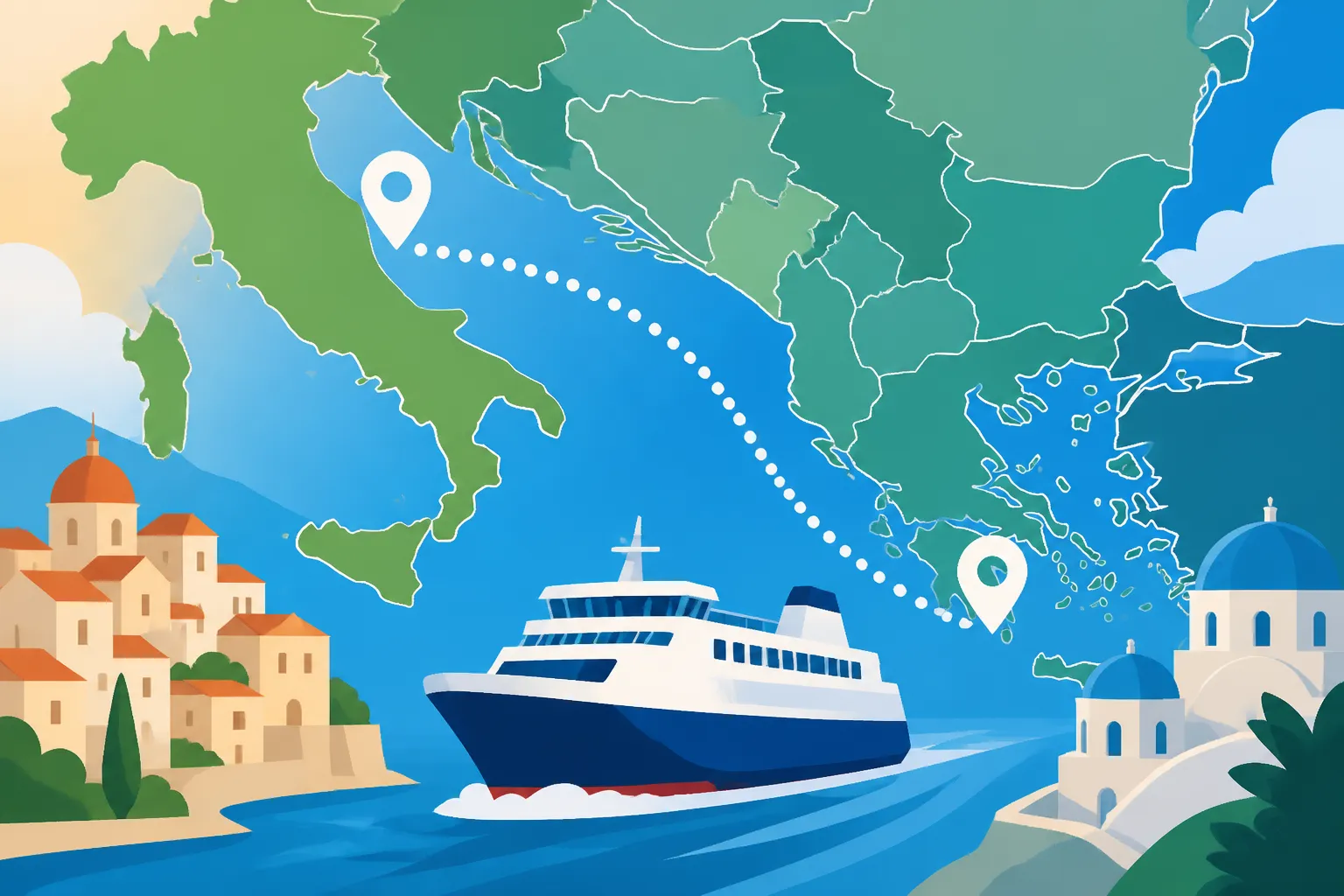
Most people moving to Italy from Western Europe think in road kilometres: load a truck in Lyon or Munich, drive through a tunnel, unload in Turin. Moving from Greece or the Balkans is different. Unless you start in Slovenia, or in northern Croatia near Trieste, your household goods will almost certainly cross water. That one fact affects your quotes, your timeline, your insurance and sometimes your customs paperwork.
I moved my own household from Athens to central Italy, and I remember assuming the ferry would be a small detail. In practice it set the whole schedule. Movers book truck space on specific sailings. Those sailings change with the season. A missed connection at Patras can add days you never planned for.
The Main Ferry Corridors at a Glance
The Adriatic and Ionian crossings fall into a few clear corridors. Which one your mover uses depends on where you start, where you are going in Italy, and which operators carry freight on that route in your moving month. Operators such as Minoan Lines, Superfast Ferries, Anek Lines, Grimaldi, Jadrolinija, Ventouris and Adria Ferries have served these routes. Schedules and frequencies change, so your mover or the operator’s own timetable is the only reliable source for a specific date.
| Departure Port | Country | Typical Italian Arrival Ports | Customs Status on Arrival | Best Suited For |
|---|---|---|---|---|
| Patras | Greece | Ancona, Bari, Venice on some schedules | Intra-EU, no customs declaration | Athens, Peloponnese, western Greece |
| Igoumenitsa | Greece | Brindisi, Bari, Ancona | Intra-EU, no customs declaration | Thessaloniki, Epirus, northern Greece |
| Durrës | Albania | Bari, Ancona | Non-EU, import formalities apply | Tirana and central Albania |
| Vlorë | Albania | Brindisi | Non-EU, import formalities apply | Southern Albania |
| Bar | Montenegro | Bari | Non-EU, import formalities apply | Montenegro, and often Serbia by road to the coast |
| Split | Croatia | Ancona | Intra-EU, no customs declaration | Dalmatia, and Bosnia by road to the coast |
| Zadar | Croatia | Ancona | Intra-EU, no customs declaration | Northern Dalmatia |
| Dubrovnik | Croatia | Bari | Intra-EU, no customs declaration | Southern Dalmatia, Herzegovina |
You do not have to start at the port closest to home. A family moving from Skopje, for example, might be routed via Thessaloniki and Igoumenitsa. Another mover might drive them to Durrës instead. The difference is not trivial: one route stays inside the EU from the Greek border onward, while the other adds a non-EU sea leg. For Albanian origins, see Moving to Italy from Albania and Tunisia: Short Mediterranean Crossings, which looks closely at those shorter crossings.
If you are travelling yourself and want to understand the passenger side of these routes, the guide on Italy to Greece: Adriatic Ferries From Ancona, Bari, and Brindisi works well alongside this one.
Greece and Croatia Versus the Non-EU Balkans
This is the distinction that catches people out. Greece and Croatia are EU member states. Your belongings move from one part of the single market to another, so there is no import declaration at the Italian port. Albania, Montenegro, Serbia, North Macedonia, Bosnia and Herzegovina and Kosovo sit outside the EU. Goods arriving from them enter the EU customs territory at the Italian port, and the Agenzia delle Dogane e dei Monopoli is involved.
Take a hypothetical case. Marko lives in Novi Sad and is moving to Milan. If his mover drives north through Croatia and Slovenia, the goods enter the EU at the Croatian land border. If the mover sends the truck to Bar in Montenegro and onto the Bari ferry, entry happens in Italy. Either way, someone has to file the paperwork. The question is where, by whom, and how that affects the timeline. A competent mover will explain this clearly. A weak one will shrug and tell you to sort it out when the truck lands.
The money is different too. A Greek or Croatian mover quotes in euros. A Serbian mover may quote in Serbian dinars or in euros. Albanian firms may use the lek. Bosnian firms use the convertible mark (konvertibilna marka), and North Macedonian firms the denar. Montenegro and Kosovo use the euro. When you compare offers, convert everything to one currency on the same day. Also confirm which currency the final invoice will be issued in.
Comparing Removal Options Across the Adriatic With Sirelo
Finding a mover is where most people waste the most time. The Balkans and Greece have plenty of local removal firms, but many only handle domestic work. Others subcontract the international leg to a partner they have never met. My first round of calls in Athens produced three quotes. One was oddly cheap, one was oddly vague, and one came from a firm whose “Italian partner” turned out to be a single van in Puglia.
This is where Sirelo earns its place. Sirelo is a moving comparison platform. You describe your move once, and it connects you with international removal companies that can handle your route. You then compare their offers side by side instead of chasing each firm separately. For a cross-Adriatic move, that matters. You need firms that actually run the Patras, Igoumenitsa, Durrës or Split corridors, not firms that will improvise.
How Sirelo Works for a Greece or Balkans Move
The process is simple. Do it early, ideally while you are still deciding your exact moving date.
- Enter your origin city, your Italian destination and your approximate moving window on Sirelo’s request form.
- Describe your volume as honestly as you can. List the large items, such as wardrobes, beds, a piano or a motorbike, and say whether you need packing.
- Mention access details on both ends. Note a fourth-floor walk-up in Piraeus or a narrow street in Bari Vecchia now, not on moving day.
- Receive offers from removal companies matched to your route, and review each company’s profile and customer reviews on Sirelo.
- Shortlist two or three firms and ask each the same set of questions about ferry routing, customs handling and insurance.
- Request a survey, either in person or by video, before you accept any binding quote.
Imagine Eleni, a graphic designer moving from Thessaloniki to Bologna. She submits one request on Sirelo and gets offers from a Greek international mover, a pan-European groupage specialist and an Italian firm with a Greek partner. The Greek firm plans to sail Igoumenitsa to Ancona, which is a sensible choice because Ancona is only a few hours by road from Bologna. The groupage firm plans to consolidate her goods in Athens and sail from Patras. That means a slower but potentially cheaper part-load. Without the comparison, Eleni would have accepted the first quote that arrived and never known the alternatives existed.
Sirelo also publishes guides and reviews on international moving. Reading reviews from people who did a similar route is a good reality check before you sign. Check Sirelo’s own pages for how the service currently works and which countries it covers. The platform describes its own terms better than any second-hand summary.
Reading Quotes Priced in Different Currencies
Once the offers arrive, the real work starts. Cross-Adriatic quotes vary a lot in what they include. One firm builds the ferry ticket for the truck into the price. Another lists it separately. A third leaves it vague and later bills you a “maritime supplement.” The line-by-line checks in Comparing International Removal Quotes for Italy: Line Items That Hide Costs apply here twice over.
| What to Check | Why It Matters on an Adriatic Route | Question to Ask the Mover |
|---|---|---|
| Ferry crossing for the vehicle | Freight fares change by season and route | Is the truck’s ferry passage included in this price? |
| Port and handling charges | Ports can charge for freight handling | Are any port fees billed separately? |
| Customs clearance | Applies to non-EU origins only | Who files the import paperwork in Italy, and is the fee included? |
| Quote currency | Dinar, lek, denar, convertible mark or euro | Which currency will appear on the final invoice? |
| Delivery access in Italy | Historic centres often restrict trucks | Is a shuttle van or permit for a restricted zone included? |
| Storage if the sailing slips | Weather and strikes can delay crossings | What happens, and what does it cost, if the ferry is cancelled? |
Delivery-end surprises are their own category. Many Italian historic centres sit inside restricted traffic zones, and old buildings rarely have lifts large enough for furniture. Read Hidden Costs in Italian Moving Quotes: ZTL Permits, Stairs, and Access Fees before you accept a quote. Ask every firm on your Sirelo shortlist how they handle the final stretch to your door.
Groupage, Part-Load, or Dedicated Truck
On these routes your goods almost always travel by road and then by ferry, with the truck or trailer driven or towed onto the ship. Full sea-container shipping is rare for Greece or Balkans origins, because the distances are short. Still, Road Freight vs Sea Freight to Italy: When Each One Makes Sense is useful background if a firm proposes containerising.
The real choice is between a dedicated vehicle and groupage. With a dedicated vehicle, your goods travel alone, on your dates. Groupage shares space with other households, so it is cheaper, but you wait for the truck to fill and for the mover’s route to suit everyone aboard. Groupage generally makes sense for a student or a single person with a modest volume. A dedicated truck suits a family moving a full house. The break-even logic is explained in Full Load vs Groupage to Italy: Cost Break-Even by Cubic Metre.
Here is the pros and cons breakdown I wish someone had given me.
| Option | Pros | Cons | Who It Suits |
|---|---|---|---|
| Dedicated truck | Fixed dates, direct route, less handling | Highest total price | Families, tight start dates, fragile items |
| Groupage or part-load | Lower price for small volumes | Flexible delivery window, more handling | Students, singles, flexible movers |
| Self-drive van on the ferry | Full control, you travel with your goods | Driving, loading and paperwork are all yours | Small volumes, people bringing a car anyway |
| Courier or pallet freight | Good for a handful of boxes | Not practical for furniture | Top-up shipments of books or kitchenware |
Whichever option you choose, ask about insurance before booking. On international road moves, the carrier’s basic liability under the CMR Convention is limited and calculated by weight, not by what your belongings are worth to you. Proper transit cover is a separate product. Moving Insurance for Shipments to Italy: Coverage, Valuation, and Claims covers how valuation and claims work. Ask each Sirelo-matched mover exactly what cover they offer for the ferry leg.
Paperwork on Both Sides of the Water
Paperwork is where Adriatic moves get stressful, mostly because people do not know which rules apply to them. The answer depends almost entirely on where your goods start.
Moving From Greece or Croatia
If your move begins in Greece or Croatia, the customs side is pleasantly quiet. Goods moving within the EU do not need an import declaration at Ancona or Bari. You still need a detailed inventory for the mover and for insurance. You also need your identity documents and proof of your Italian address for the delivery.
The Italian side of settling in still matters, especially for timing. You will want a codice fiscale early. You will also want your residency registration at the comune moving forward. Both affect utilities, leases and later your car. Sequencing Your Codice Fiscale and Residency Before the Container Lands shows how to line these steps up so the truck is not waiting while you queue at an office.
A realistic scenario: Ivana is moving from Split to Pesaro. Her mover sails Split to Ancona overnight, clears the port without any customs formalities, and reaches her flat the next morning. Her only friction is the building. It has no lift and sits on a street where trucks cannot stop for long. The mover had planned for this when quoting, because she flagged it in her original Sirelo request.
Moving From the Non-EU Balkans
If your belongings leave from Albania, Montenegro, Serbia, North Macedonia, Bosnia and Herzegovina or Kosovo, they enter the EU from outside. Italy offers relief from import duties on personal effects when you transfer your residence. The conditions are strict: the goods must be personal and used, you must have owned them for a minimum period, and you must be genuinely moving your normal residence to Italy. The full mechanics are in Trasferimento di Residenza: The Italian Duty Exemption for Personal Effects. The bigger picture is in EU vs Non-EU Moves to Italy: Why Customs Treats Them Completely Differently.
In practice, expect to gather documents like these:
- A valid passport, plus your Italian visa or residence permit if you are not an EU citizen.
- Evidence that you lived outside the EU for the qualifying period, such as a deregistration certificate or utility records from your Balkan home.
- Evidence of your new Italian residence, such as a registered lease, a property deed or a residency registration.
- A detailed, itemised inventory, usually in Italian or with an Italian translation. Your mover will often prepare it.
- Any declarations required by the Italian customs office handling your arrival port.
Ask your mover directly who will act as the customs broker at the Italian port, and whether that fee is in the quote. A good international firm has done this many times at Bari and Ancona and will tell you exactly what they need from you, and when. A firm that seems unsure is a red flag, however attractive the price.
Keep your inventory honest. Declaring “used household goods” for a box of brand-new appliances is the fastest way to turn a smooth clearance into an inspection. Exemption conditions and required documents can change, so confirm the current list with your mover and the customs office before you pack.
Bringing Your Car on the Ferry
Many people moving from Greece or the Balkans bring a car, and the ferry makes that easy. You can drive aboard at Patras, Igoumenitsa, Durrës, Bar or Split and drive off in Italy. Sometimes the car even travels with the household goods inside a car-carrying arrangement.
What you carry on board is your home country’s paperwork. A Greek car travels with its Greek registration certificate, the adeia kykloforias. A Croatian car carries its prometna dozvola. Serbian vehicles carry the saobraćajna dozvola, and Albanian ones the leja e qarkullimit. You also need valid insurance that covers driving in Italy, and the ferry operator may ask for the registration document when you check in.
Once you become resident in Italy, the foreign plates are only a temporary arrangement. Italy expects residents to re-register foreign-plated vehicles within a limited window. The process runs through the Motorizzazione Civile and the vehicle registry. It includes technical checks, and for cars from non-EU countries, import formalities. Shipping a Car to Italy: Registration, Revisione, and Import Costs walks through it step by step. Check the deadline that applies to you with the Motorizzazione or an ACI office soon after you register residence, and before your first long summer drive back home.
A Step-by-Step Timeline for an Adriatic Move
Here is how I would plan an Adriatic move now, knowing what I know. Timings are approximate. Ferry season and your mover’s schedule will shift them.
- Start several months out by deciding your Italian city and your rough moving window. Remember that summer brings peak tourist traffic on Adriatic ferries, which can tighten freight space.
- Submit your move details on Sirelo as soon as you know your volume and dates. Gather offers from international movers who work your corridor.
- Shortlist firms and book video or in-person surveys. Ask each one which departure port and Italian arrival port they plan to use.
- Confirm whether your move is intra-EU or a non-EU import. If it is non-EU, start collecting the residence-transfer documents straight away.
- Request your codice fiscale and start your residency steps in Italy, so you have proof of address ready for customs and the delivery.
- Accept a binding quote that spells out the ferry, the port fees, the customs handling, the currency, the insurance and the delivery access in writing.
- Arrange transit insurance that reflects the real value of your belongings, not just basic carrier liability.
- Prepare your car documents, foreign registration and insurance, if you are driving aboard yourself.
- Pack, or supervise the packers, and check the inventory line by line before you sign it.
- Track the sailing. If weather or a strike cancels it, ask the mover for the revised plan in writing.
- Be present, or have someone authorised, at delivery. Check items against the inventory and note any damage on the delivery document before signing.
- Start re-registering your car and updating your address with the relevant offices once you are settled.
From Arrival Port to Front Door
The ferry is only the middle of the journey. From Bari, Brindisi or Ancona, your truck still has to reach your new home. In Italy that last stretch can be the hardest part. Historic centres restrict heavy vehicles. Streets in towns like Lecce, Ascoli Piceno or Trastevere in Rome were laid out long before removal trucks existed. Many condominio buildings have house rules about when furniture can move and whether the courtyard can be used.
Tell your administratore di condominio or landlord your delivery date in advance. Ask whether the building has rules about lifts, stairwells or moving hours. If a municipal permit is needed to park the truck or enter a restricted zone, find out whether your mover handles it or whether you must apply at the comune. Delivery Day in an Italian Building: Narrow Streets, Lifts, and Permits has a detailed checklist for this final day.
One last piece of advice from experience: leave a buffer. Do not book your first Italian workday for the morning after the scheduled ferry. Adriatic crossings are usually reliable, but winter weather and occasional port strikes do happen. A single day of slack turns a disaster into a mild inconvenience.
If you take only one action today, put your details into Sirelo and see which international movers actually serve your route. Compare their ferry plans, their customs handling and their insurance side by side. You will understand your Adriatic move far better within a few days than you would after weeks of cold calls, and you will cross the water knowing exactly who is carrying your life to Italy.
Disclaimer
This article is for general informational purposes only and does not constitute professional advice. Laws, prices and regulations vary by location and change over time. Consult a qualified professional for guidance on your specific situation.