Smart Home and IoT in Italy: Connectivity
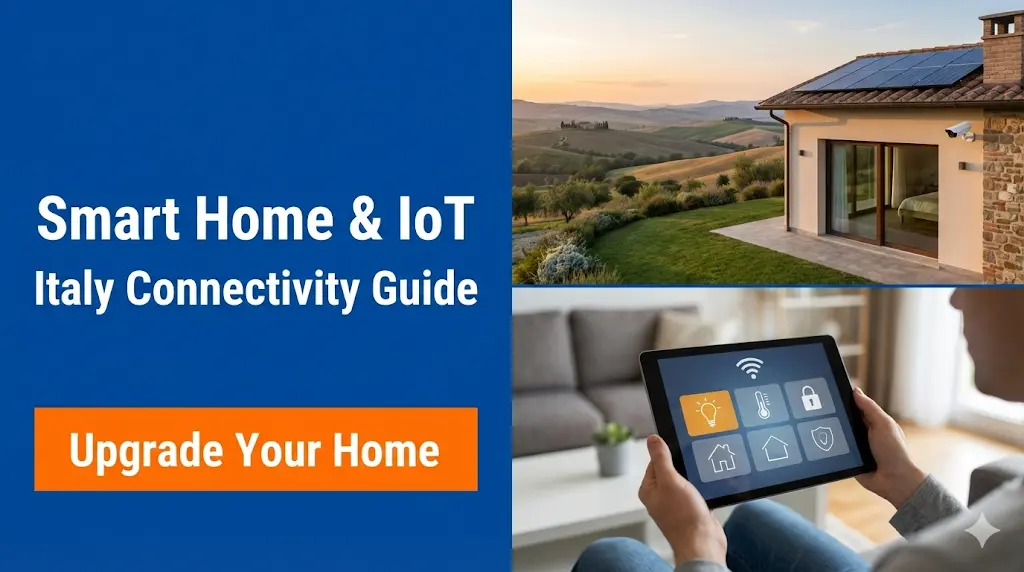
Transforming your historic Italian property into a modern smart home is completely achievable. This guide covers navigating local broadband connectivity, adapting to Italy’s unique electrical power limits, choosing the right IoT protocols to bypass thick walls, and securing compatible hardware.
Disclosure: This post may contain affiliate links. We may earn a commission at no extra cost to you if you make a purchase through these links. Read full disclosure.
Introduction
Moving to Italy often means embracing a lifestyle deeply rooted in history, where centuries-old stone farmhouses, rustic villas, and Renaissance-era city apartments offer an unparalleled aesthetic. However, living in a historic home does not mean you have to sacrifice modern conveniences. The integration of Smart Home technology and the Internet of Things (IoT) is rapidly transforming the Italian domestic landscape, bridging the gap between ancient architecture and cutting-edge automation.
Whether you want to control your heating remotely before arriving at your Tuscan retreat, monitor security cameras from your smartphone, or simply command your espresso machine with your voice, establishing a reliable smart home ecosystem in Italy requires a specific strategic approach. The Italian market for smart home devices is booming, with a strong focus on energy efficiency, remote property management, and integrated security solutions. However, expatriates attempting to set up these systems often encounter unexpected hurdles. From navigating the notorious national restrictions on residential electrical power to finding ways to push a Wi-Fi signal through walls that were built before the invention of electricity, setting up an IoT network in Italy is a unique challenge.
This comprehensive guide will walk you through everything you need to know about Smart Home and IoT connectivity in Italy. We will explore the current state of Italian broadband infrastructure, explain how to optimize your network for thick stone walls, and detail the specific electrical nuances you must account for when installing smart devices. By understanding the local technological landscape and choosing the right combination of mesh routers, protocols, and Italian-tailored smart appliances, you can seamlessly integrate 21st-century connectivity into your beautiful, historic Italian home.
The State of Internet Connectivity in Italy
The foundation of any functional smart home is a robust, reliable, and high-speed internet connection. In recent years, Italy has made massive strides in upgrading its national telecommunications infrastructure, largely driven by the government’s “Italian Strategy for Ultra Broadband” and substantial European Union investments.
Fiber Optic Expansion (FTTH and FTTC)
If you are relocating to a major urban center such as Milan, Rome, Turin, or Florence, you will likely have access to Fiber-to-the-Home (FTTH) connections. FTTH provides gigabit speeds (up to 1 Gbps or even 2.5 Gbps download), which is more than sufficient to support dozens of bandwidth-heavy IoT devices, 4K streaming, and remote work simultaneously.
However, in many suburban areas, smaller towns, and historic city centers where excavating ancient streets is prohibited, you will encounter Fiber-to-the-Cabinet (FTTC). In an FTTC setup, fiber optic cables run to a neighborhood street cabinet, but the final connection to your specific apartment relies on legacy copper telephone wires. While FTTC still provides very respectable speeds (typically between 100 Mbps and 200 Mbps), the actual speed you receive will depend heavily on the physical distance between your home and the street cabinet.
Fixed Wireless Access (FWA) and 5G
For expats who purchase rural farmhouses or countryside villas, laying physical fiber cables is often impossible. In these regions, Fixed Wireless Access (FWA) is the dominant solution. FWA utilizes a small antenna installed on your roof to receive a high-speed broadband signal from a nearby radio tower. Major providers like Eolo and Fastweb specialize in these connections, offering stable speeds that easily support basic smart home functionalities like smart thermostats and lighting. Additionally, Italy’s 5G mobile network is expanding rapidly, offering a viable backup for smart home hubs equipped with SIM card slots for failover protection.
Before purchasing expensive smart home hubs, it is crucial to establish a stable primary connection. You can compare local ISPs and evaluate your property’s specific coverage options by consulting our guide on Choosing an Internet and Phone Provider in Italy.
Navigating Italian Electrical Systems for Smart Devices
The most critical factor that catches expats off guard when setting up a smart home in Italy has nothing to do with the internet; it has everything to do with electricity.
The 3kW Household Power Limit
In many Western countries, a standard residential home can draw a massive amount of electrical current simultaneously. In Italy, the standard residential electrical contract (Potenza Impegnata) is commonly capped at just 3 kilowatts (kW).
If you attempt to run a smart washing machine, a smart dishwasher, and an electric kettle at the exact same time, you will exceed this 3kW limit. When this happens, the main breaker will trip, instantly cutting off power to your entire home. For a smart home relying on constant power to maintain network connectivity, a tripped breaker means your security cameras go offline, your smart locks lose their primary power, and your smart thermostats reset.
To prevent this, you must strategically manage your smart appliances. Many smart plugs and smart energy monitors available in Italy feature built-in load-shedding capabilities. You can program your smart home hub to automatically pause the charging of an electric vehicle or turn off a smart water heater if the total household consumption approaches 2.8kW. Alternatively, you can contact your energy provider to legally upgrade your power limit to 4.5kW or 6kW, though this permanently increases your fixed monthly distribution fees. Understanding how to manage and upgrade these contracts is fully detailed in Italian Utilities: Electricity, Water, Gas, Internet.
Voltage and Plug Types
Italy operates on a 230V system at 50Hz. If you bring smart devices (like high-end routers, smart speakers, or smart kitchen displays) from North America that are rated strictly for 110V, plugging them into an Italian wall without a heavy step-down transformer will instantly destroy them. Furthermore, you must adapt to the physical plugs. Italy uses the Type C (Europlug), the Type L (the historic Italian three-pin standard in 10A and 16A sizes), and the Type F (Schuko) plug. Smart plugs imported from other countries will not physically fit into these sockets without adapters, which can look unsightly and create fire hazards when chained together. For a deeper dive into the physics of Italian sockets, read Electrical Outlets and Appliances: What to Expect.
Essential Smart Home Categories for the Italian Lifestyle
When prioritizing which IoT devices to install in your Italian home, it helps to focus on solutions that directly address the realities of the local climate and economy.
Smart Thermostats and Climate Control
Energy costs in Italy, particularly natural gas used for traditional radiator heating, are among the highest in Europe. A smart thermostat is undeniably the single best IoT investment an expat can make. Brands like Netatmo (which integrates heavily with Italian manufacturer BTicino), Tado, and Google Nest are incredibly popular. These devices learn your schedule, utilize geofencing to turn off the heating when you leave the house, and allow you to monitor your consumption remotely. In a country where homes are often drafty and poorly insulated, micro-managing your heating schedule can save you hundreds of euros annually. To understand how these devices can impact your bottom line, review Energy and Utility Costs in Italy: Monthly Expenses.
Furthermore, the Italian summer can be blisteringly hot, and many homes utilize decentralized split-unit air conditioners rather than central HVAC systems. Smart infrared blasters (like those from Sensibo or Tado) can be mounted on the wall to communicate with your older “dumb” AC units, allowing you to turn on the air conditioning from your smartphone while you are on the train home from work.
Smart Lighting and Automated Shutters
Italian homes are famous for their heavy exterior window shutters (tapparelle or persiane), designed to block out the intense midday sun. Motorizing these shutters and connecting them to a smart home ecosystem allows you to automate your home’s natural cooling process. You can program the shutters to automatically close on the south-facing side of the house at 1:00 PM, keeping the interior cool without using electricity for air conditioning.
For smart lighting, replacing physical wall switches is often a better strategy than buying individual smart bulbs, especially given the diverse array of ornate Italian chandeliers and fixtures. The Italian brand BTicino offers a wildly popular “Living Now” series—a modular, smart electrical switch system that replaces traditional Italian wall plates. This allows you to control lights, shutters, and power sockets via Wi-Fi without changing the historic aesthetic of the room.
Security and Access Control
Security is a top priority for second-home owners and expats who travel frequently. IoT security systems in Italy typically feature a mix of Wi-Fi-enabled outdoor cameras, smart motion sensors, and connected video intercoms (videocitofoni). Because historic apartment buildings often have heavy, shared front gates, smart intercom systems allow you to see who is ringing your doorbell and remotely buzz them in to deliver a package, even if you are currently sitting in a cafe halfway across the world.
Overcoming Connectivity Challenges in Historic Buildings
The greatest physical hurdle to IoT connectivity in Italy is the architecture itself. Properties built in the 18th or 19th centuries feature solid stone or brick walls that can easily be three feet thick. These ancient materials act as an impenetrable fortress against modern radio waves, effectively killing a standard Wi-Fi signal dead in its tracks.
If you place your primary ISP router in the living room of a traditional Tuscan villa, the signal will likely not reach the bedroom located just one wall away, rendering Wi-Fi-based smart devices completely useless. To combat this, you must adopt specific network strategies.
Mesh Wi-Fi Systems
A single, powerful router is rarely enough for an Italian home. You must invest in a Mesh Wi-Fi system (such as Eero, Netgear Orbi, or TP-Link Deco). A mesh system uses multiple “nodes” placed strategically throughout the house to blanket the property in a seamless Wi-Fi network. For thick stone walls, a wireless mesh might still struggle, so the ideal solution is a “wired backhaul”—running physical ethernet cables through the wall conduits to connect the mesh nodes directly to each other, ensuring zero speed degradation.
Low-Power IoT Protocols (Zigbee, Z-Wave, and Thread)
Relying entirely on Wi-Fi for all your smart devices is a mistake in a historically built home, as too many devices will crowd the network and drop connections. Instead, you should utilize devices that communicate via low-power mesh protocols like Zigbee, Z-Wave, or the newer Thread standard.
These protocols operate differently than Wi-Fi. Every device you plug into the wall (like a smart plug or a smart light switch) acts as a repeater. The signal “hops” from device to device, navigating around thick walls and corners until it reaches the central hub. This creates a self-healing, incredibly resilient network perfectly suited for the challenging layouts of Italian architecture.
Popular IoT Protocols and Their Use in Italy
To help you structure your smart home, refer to the following comparison of connectivity protocols and how they fare in the Italian residential environment.
| Protocol | Power Consumption | Range / Wall Penetration | Best Used For in Italy |
| Wi-Fi (2.4 GHz) | High | Poor through thick stone walls. | Security cameras, video intercoms, smart TVs. |
| Zigbee | Very Low | Excellent (creates a mesh network hopping from device to device). | Smart bulbs, automated shutter switches, motion sensors. |
| Z-Wave | Very Low | Excellent (operates on a lower frequency, better wall penetration than Zigbee). | Security systems, smart door locks, flood sensors. |
| Thread / Matter | Very Low | Excellent (future-proof mesh standard, highly responsive). | Interoperable smart home sensors, newer smart plugs. |
| Bluetooth LE | Low | Very Poor (short range only). | Initial device setup, localized smart locks. |
Local vs Imported Smart Devices
When outfitting your home, it is incredibly tempting to pack your suitcase full of smart home gadgets purchased cheaply in your home country. However, buying local European/Italian devices is vastly superior for several reasons.
First, as mentioned, is electrical compatibility. Second is the issue of server locations and data privacy. The European Union enforces the General Data Protection Regulation (GDPR), which strictly governs how tech companies handle your personal data. Devices manufactured for the European market must comply with these laws, ensuring your security camera footage and microphone recordings are stored securely on European servers.
Third, many smart devices are region-locked. A smart hub purchased in the United States may refuse to connect to European cloud servers, or a smart thermostat designed for an American forced-air HVAC system simply will not possess the wiring terminals required to control an Italian radiant water boiler.
Finally, local integration is key. Prominent Italian brands like Vimar and BTicino design their smart switches to fit perfectly into the rectangular scatola 503 (the standard Italian recessed wall box used by electricians). Attempting to retrofit a square, American-style smart switch into an Italian wall box requires destroying the plaster and masonry, turning a simple DIY project into an expensive renovation.
Integrating Voice Assistants in an Italian Household
Voice assistants like Amazon Alexa, Google Assistant, and Apple’s Siri are fully functional and immensely popular in Italy. However, expats must make a strategic choice regarding language settings.
You can easily set your voice assistant to operate in English, allowing you to seamlessly command your Italian smart home in your native tongue. However, if you are attempting to use the assistant to listen to local Italian radio stations, ask for directions to local businesses with Italian names, or dictate text messages to Italian friends, the English-language AI will often mangle the pronunciation and fail to execute the command.
Many expats choose to set their smart speakers to Italian. Not only does this force the device to correctly recognize local addresses and media, but it also serves as a fantastic daily language-learning tool. Issuing commands like “Alexa, accendi le luci in cucina” (Alexa, turn on the kitchen lights) or “Ehi Google, abbassa le tapparelle” (Hey Google, lower the shutters) integrates language practice directly into your daily routine.
Conclusion
Establishing a Smart Home in Italy is a brilliant way to enhance the comfort, security, and energy efficiency of your property. While the juxtaposition of installing advanced IoT sensors inside a building constructed centuries ago presents undeniable challenges, the solutions are readily available.
By securing a stable FTTC or FWA broadband connection, deploying a resilient Zigbee or Thread mesh network to bypass thick stone walls, and actively managing your devices to respect the strict 3kW household power limit, you can create a flawless automated ecosystem. Investing in local European hardware ensures electrical safety, data privacy, and aesthetic harmony with Italian design standards. Ultimately, a thoughtfully connected home allows you to spend less time worrying about utility bills and manual maintenance, and more time fully embracing the unparalleled joy and beauty of living in Italy.
References
Primary sources (official)
- AGCOM (Autorità per le Garanzie nelle Comunicazioni) – Official Italian telecommunications regulator, providing data on national broadband infrastructure, fiber optic coverage maps, and consumer internet rights: https://www.agcom.it/
- Ministero delle Imprese e del Made in Italy (MIMIT) – The government ministry overseeing the “Italian Strategy for Ultra Broadband” and national 5G/IoT rollout initiatives: https://www.mimit.gov.it/
Other helpful sources
- BTicino Smart Home Solutions – Official portal for Italy’s leading manufacturer of modular smart electrical systems, connected thermostats, and Netatmo integrations: https://www.bticino.com/products/smart-home-solutions
- Spherical Insights – Italy Smart Home Market Report (Insights on IoT adoption, retrofit installations, and regional energy management trends): https://www.sphericalinsights.com/reports/italy-smart-home-market
Disclaimer
The information provided in this article is intended for educational and informational purposes only and does not constitute professional electrical, telecommunications, or structural engineering advice. Italian internet speeds, IoT protocol compatibility, and regional electrical standards are subject to change. Always consult with a licensed Italian electrician (elettricista) before modifying your home’s wiring, installing in-wall smart switches, or upgrading your residential power contract to accommodate high-draw smart appliances.