Online and Mobile Banking Options for Expats in Italy
Discover the best online and mobile banking solutions for expats living in Italy. This comprehensive guide covers digital neo-banks, traditional banking apps, hidden fees, essential payment networks like PagoPA, and tips for managing your finances effortlessly abroad.
Disclosure: This post may contain affiliate links. We may earn a commission at no extra cost to you if you make a purchase through these links. Read full disclosure.
The Digital Transformation of Italian Banking
Italy has historically been known as a cash-centric society, where daily transactions at local cafes, open-air markets, and family-owned trattorias were predominantly handled with physical currency. However, the Italian banking landscape has undergone a radical digital transformation over the past decade. Propelled by government initiatives to reduce tax evasion, modernize financial infrastructure, and align with broader European Union digital standards, electronic payments and mobile banking have become the new norm.
For expatriates relocating to the peninsula, this digital shift is incredibly beneficial. The days of spending entire mornings waiting in line at a local bank branch, navigating complex bureaucratic procedures in broken Italian, are largely behind us. Today, a robust ecosystem of mobile-first neo-banks and highly modernized traditional banking applications allows residents to manage their entire financial lives directly from their smartphones.
Understanding this digital ecosystem is the first critical step toward a successful relocation. Your Italian bank account is not just a repository for your salary; it is your gateway to everyday life. You will need it to set up direct debits for utilities, pay municipal taxes, receive healthcare reimbursements, and integrate with state identity systems. Choosing the right mobile banking provider can save you hundreds of euros in hidden fees and countless hours of administrative frustration.
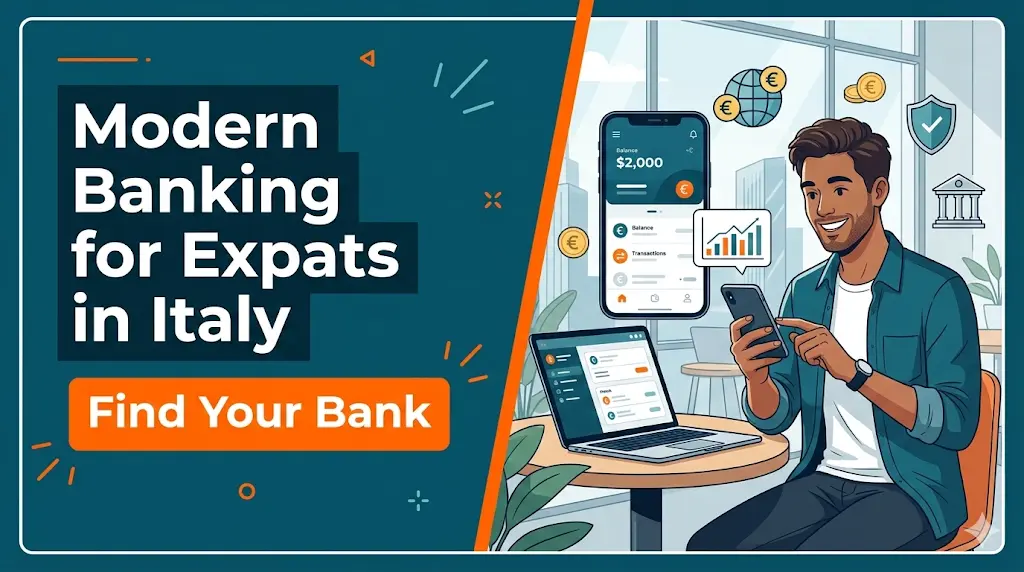
Why Expatriates Need Mobile Banking in Italy
Relocating to a new country introduces a host of logistical challenges, and financial management is often the most complex. Expatriates have unique banking needs that local citizens typically do not face. You may be receiving a salary in euros but paying student loans in dollars, or you might need to transfer funds frequently between your home country and your new Italian life.
Traditional brick-and-mortar banks in Italy, while reliable, can present significant hurdles for expats. Customer service at physical branches is rarely offered in English, especially outside of major metropolitan hubs like Milan or Rome. Furthermore, traditional banks often require extensive physical documentation, wet signatures, and multiple in-person appointments just to open a basic checking account.
Mobile banking eliminates these friction points. Digital-first banks offer seamless account opening processes that rely on biometric verification and digital document uploads. Their user interfaces are inherently multilingual, ensuring you completely understand your financial standing without needing a translator. Additionally, mobile banks generally offer far more transparent fee structures, particularly regarding international transfers and currency exchange. Establishing a modern digital account is a foundational element of Managing Your Budget in Italy: Banking, Currency, and Transfers, allowing you to seamlessly bridge your international financial obligations with your local Italian expenses.
Top Digital Neo Banks for Expats in Italy
Neo-banks are financial technology companies that operate entirely digitally, without any physical branches. They have disrupted the European banking market by offering low-cost, highly intuitive mobile applications. For expats in Italy, a few key players stand out from the crowd.
Revolut
Revolut has become a dominant force in the European digital banking sector. It is incredibly popular among expats and frequent travelers due to its multi-currency capabilities. Revolut allows you to hold, exchange, and transfer dozens of different currencies at the mid-market exchange rate directly within the app.
While Revolut is headquartered outside of Italy, it offers localized services that make it highly functional for Italian residents. You can easily set up SEPA (Single Euro Payments Area) direct debits for your Italian utility bills. The app provides instant push notifications for every transaction, built-in budgeting tools, and the ability to generate virtual disposable debit cards for secure online shopping.
N26
N26 is a German digital bank that has built a massive user base in Italy. Known for its sleek interface and user-friendly experience, N26 offers a fully functional Italian IBAN (International Bank Account Number) for residents. Having an Italian IBAN starting with “IT” is highly advantageous, as some antiquated Italian utility companies and government portals still exhibit “IBAN discrimination” and hesitate to accept foreign European IBANs, despite it being illegal under EU law.
N26 offers a free standard tier that is perfect for everyday transactions, as well as premium tiers that include comprehensive travel insurance, priority customer support, and free ATM withdrawals worldwide. The entire account opening process takes mere minutes and can be completed entirely in English.
Wise
Formerly known as TransferWise, Wise is not a traditional bank but rather an electronic money institution. However, their multi-currency account operates much like a standard mobile bank. Wise provides you with local account details for various currencies, including a European IBAN for euros.
Wise is the absolute gold standard for expats who need to move money across borders frequently. Their transparent fee structure and commitment to using the real mid-market exchange rate ensure you never lose money to hidden banking markups. For a deeper analysis of how these modern platforms stack up against legacy institutions, reviewing the Best Bank Accounts for Expats in Italy: Fees and Benefits will help you align your specific financial needs with the right provider.
Traditional Italian Banks with Excellent Mobile Apps
While neo-banks offer incredible convenience, there are distinct advantages to banking with a traditional Italian institution. If you plan to apply for a mortgage, require complex investment products, or need to deposit physical cash and checks, a traditional bank is necessary. Fortunately, several legacy banks have heavily invested in their digital infrastructure.
FinecoBank
Fineco is widely considered the pioneer of direct, digital-first banking in Italy. While it holds a full banking license and is deeply integrated into the traditional Italian financial system, it operates primarily online and through its award-winning mobile app.
Fineco offers a hybrid approach: you get the robust financial products of a traditional bank—including advanced trading platforms, mortgages, and personal loans—with the low fees and intuitive design of a neo-bank. They also offer multi-currency accounts, which is a rare and highly valuable feature among traditional Italian banks. Their customer service is available via phone and chat, and they maintain a network of physical financial advisors across the country.
Intesa Sanpaolo
Intesa Sanpaolo is Italy’s largest banking group. While historically reliant on its massive network of physical branches, its mobile application has been thoroughly modernized. The Intesa app offers a highly secure, feature-rich experience.
One of the major benefits of using a massive traditional bank like Intesa Sanpaolo is deep integration with Italian state bureaucracy. You can generate your SPID (Public Digital Identity System) directly through their platform, effortlessly pay local taxes, and access an unparalleled network of free ATMs across the entire peninsula.
UniCredit
UniCredit is another pillar of the Italian banking establishment that has successfully transitioned to the mobile era. Their mobile banking app is robust, offering seamless integration with Apple Pay and Google Pay, comprehensive expense tracking, and instant peer-to-peer transfers via the BANCOMAT Pay network. UniCredit also offers specific account packages tailored to young professionals and students, which waive many of the standard monthly maintenance fees.
Comparing Top Online Banking Providers
To help you make an informed decision, the following table compares the key features of the most popular mobile and online banking options utilized by expats in Italy.
| Bank Provider | Type of Bank | Provides Italian IBAN | Multi-Currency Features | Best Suited For |
| N26 | Digital Neo-Bank | Yes | No (Euro primary) | Everyday local spending, English UI |
| Revolut | Digital Neo-Bank | No (LT IBAN usually) | Yes (Excellent) | Frequent travelers, holding multiple currencies |
| Wise | Electronic Money | No (BE IBAN usually) | Yes (Unmatched) | Expats transferring funds from abroad |
| FinecoBank | Hybrid / Traditional | Yes | Yes (USD, GBP, CHF) | Long-term residents needing investments & trading |
| Intesa Sanpaolo | Traditional | Yes | No | Full integration with Italian bureaucracy |
Essential Features to Look For in an Italian Banking App
When evaluating a mobile banking app for your life in Italy, you must look beyond basic balance checking and money transfers. The Italian financial ecosystem utilizes specific payment networks and administrative forms that your app must support.
Integration with PagoPA
PagoPA is the national electronic payment system used for all transactions with the Italian public administration. Whether you are paying a speeding ticket, your child’s public school lunch fees, municipal waste taxes, or healthcare co-pays, you will receive a PagoPA notice featuring a QR code.
A high-quality Italian mobile banking app will have a dedicated PagoPA scanner. You simply open your banking app, scan the QR code on the government notice, and the exact payment details are populated instantly. This eliminates the need to visit a post office or a tobacco shop to pay your public bills.
The F24 Tax Form Capability
The F24 is the unified payment form used in Italy to pay almost all taxes, including income tax (IRPEF), regional taxes, and property taxes. As a resident, you will inevitably encounter an F24 form. If you own property, you will use it to pay your IMU (municipal property tax).
Traditional Italian banking apps and hybrid banks like Fineco allow you to fill out and submit F24 forms directly within the mobile interface. This is a massive time-saver and ensures your tax payments are recorded instantaneously. Understanding how to execute these payments digitally is crucial when navigating Property Taxes in Italy: IMU, TASI, and More Explained.
CBILL and MAV Payments
In addition to PagoPA, you will frequently encounter CBILL and MAV payment slips. These are standardized interbank payment systems used to pay utility bills, university tuition, and condominium fees. Your chosen mobile bank must support these specific Italian payment protocols; otherwise, you will be forced to pay them in cash at third-party locations, incurring unnecessary commission fees.
Navigating Italian Banking Fees and Hidden Costs
One of the biggest shocks for expats from countries with free checking accounts is the prevalence of banking fees in Italy. Even with mobile banking, you must be vigilant about how your provider structures its costs.
Understanding the Imposta di Bollo
The Imposta di Bollo is a mandatory state stamp duty levied on financial accounts. By Italian law, if your bank account has an average daily balance (giacenza media) exceeding 5,000 euros over the course of the year, you are subject to a flat tax of 34.20 euros annually.
This tax applies to both traditional and digital bank accounts. Some premium neo-bank accounts or promotional traditional accounts will offer to absorb this cost on your behalf, but typically, the bank will automatically deduct this amount from your balance in quarterly or annual installments.
Maintenance Fees and Withdrawal Limits
Traditional banks often charge a canone mensile (monthly maintenance fee) ranging from 2 euros to 10 euros. While neo-banks like N26 and Revolut offer free basic tiers, they monetize through other avenues, such as charging fees for ATM withdrawals that exceed a certain monthly limit or charging for physical card delivery.
When choosing a bank, carefully review the fees for withdrawing cash at ATMs that belong to other banks. In Italy, withdrawing cash from a competitor’s ATM can incur a fee of 1.50 to 3.00 euros per transaction if your mobile banking plan does not explicitly offer free universal withdrawals.
Local Mobile Payment Apps Satispay and Bancomat Pay
Beyond full-fledged banking apps, Italy has developed a robust ecosystem of secondary mobile payment applications that are wildly popular for daily micro-transactions.
The Rise of Satispay
Satispay is an independent Italian mobile payment network that has achieved massive adoption across the country. It is not a bank account; rather, it connects directly to your existing Italian IBAN via a direct debit mandate. You set a weekly budget, and Satispay automatically tops up your app balance from your bank account.
Satispay allows you to pay for goods and services simply by scanning a QR code at the cash register or selecting the merchant from a geolocation list on your phone. It is accepted everywhere from large supermarkets to independent espresso bars and local farmers’ markets. Because Satispay charges merchants zero fees for transactions under 10 euros, local vendors highly prefer it over standard credit or debit cards.
Bancomat Pay
Bancomat Pay is a service integrated directly into the mobile apps of most traditional Italian banks. It leverages the national Bancomat debit network to allow instant, peer-to-peer money transfers using only a mobile phone number, similar to Zelle in the US or Swish in Sweden. It is the perfect tool for splitting a restaurant bill with Italian friends without needing to exchange IBANs. Navigating these local payment customs is a key component of understanding Money Matters in Italy: Banking and Finance for Expats.
How to Open an Online Bank Account in Italy
The process of opening an online bank account has been radically simplified, but it still requires strict adherence to Italian regulatory and anti-money laundering laws.
Essential Documentation
To open an account via a mobile app, you must have your documentation ready before you begin the process. You will generally need:
- A Valid Identity Document: A passport is universally accepted. EU citizens can use their national ID cards.
- Codice Fiscale: Your Italian tax identification number. This is non-negotiable. You cannot open a bank account in Italy without this alphanumeric code.
- Proof of Address: You may be asked to provide a recent utility bill or a registered rental contract.
- A Smartphone with a Camera: The app will require you to take clear photos of your documents and record a short video selfie to verify your identity.
Resident versus Non Resident Accounts
When opening an account, traditional Italian banks strictly differentiate between residents and non-residents. If you have not yet registered your residency with the local municipal registry office (Anagrafe), you are legally required to open a “non-resident” account, which often features higher fees and restricted services.
Digital neo-banks tend to be more flexible, often allowing you to open an account based on your legal residency in another European country.
Security and Fraud Prevention in Italian Digital Banking
Security is a paramount concern when managing your finances through a smartphone. The Italian and European regulatory frameworks mandate stringent security protocols to protect consumers.
PSD2 and Strong Customer Authentication
Under the European Union’s Revised Payment Services Directive (PSD2), all banking apps operating in Italy must utilize Strong Customer Authentication (SCA). This means that logging into your account or authorizing a transaction requires at least two independent authentication factors. Typically, this involves a password or PIN combined with a biometric marker, such as Face ID or a fingerprint scan. This dual-layer security ensures that even if your phone is stolen, your funds remain inaccessible.
The Interbank Deposit Protection Fund (FITD)
When choosing a mobile banking provider, it is crucial to verify that your funds are protected by a recognized deposit guarantee scheme. In Italy, traditional banks and fully licensed hybrid banks like Fineco are members of the Fondo Interbancario di Tutela dei Depositi (FITD). This government-backed fund guarantees your deposits up to 100,000 euros per depositor, per institution, in the event of a bank failure.
Digital neo-banks operating under foreign European banking licenses (such as N26 under a German license or Revolut under a Lithuanian license) are protected by the equivalent deposit guarantee schemes of their respective licensing countries, which also mandate the same 100,000 euro protection under EU law.
Conclusion
The shift towards online and mobile banking has dramatically improved the expatriate experience in Italy. By bypassing the bureaucratic hurdles of traditional physical branches, you can manage your wealth, execute international transfers, and handle daily expenses with unprecedented ease. Whether you opt for the multi-currency brilliance of a neo-bank like Revolut, the comprehensive hybrid services of Fineco, or the deep bureaucratic integration of Intesa Sanpaolo, ensuring your chosen app supports vital Italian systems like PagoPA and F24 forms is essential.
By understanding the local fee structures, utilizing secondary payment networks like Satispay, and keeping your documentation up to date, you can achieve complete financial fluency in your new Mediterranean home.
References
Primary sources (official)
- Banca d’Italia (Bank of Italy): The central bank of Italy, responsible for ensuring the stability and efficiency of the financial system and payment services. https://www.bancaditalia.it/
- PagoPA: The official platform of the Italian public administration for secure and transparent electronic payments. https://www.pagopa.gov.it/
Other helpful sources
- Satispay Official Website: Information regarding the independent mobile payment network widely used across Italian retail and peer-to-peer transactions. https://www.satispay.com/
Disclaimer
The information provided in this article is for general informational and educational purposes only and does not constitute professional financial, tax, or legal advice. Banking fees, regulations, tax implications, and app features in Italy are subject to frequent changes by individual financial institutions and government legislation. Always read the specific terms and conditions provided by your chosen banking provider and consult with a certified financial advisor or Italian commercialista to verify how banking regulations apply to your personal circumstances.