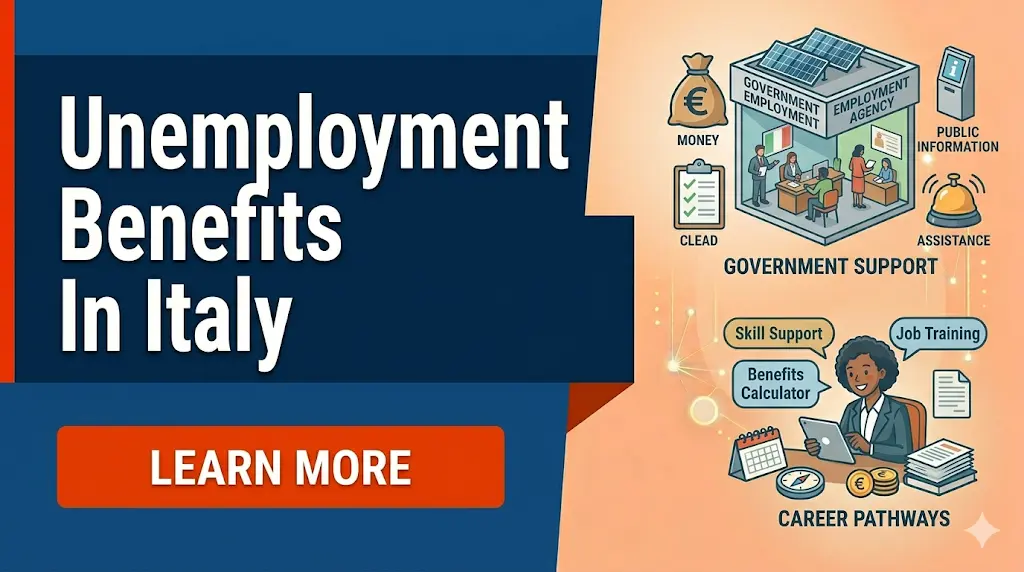
Unemployment Benefits (Cassa Disoccupazione) in Italy
I remember staring at my final Italian paycheck, panicking about how I’d cover rent in Milan after my company downsized. Navigating the Italian unemployment system as a foreigner feels like deciphering ancient hieroglyphs. It’s frustrating and bureaucratic, but it is entirely possible to claim the money you’ve earned. This guide demystifies Italian unemployment benefits so you can secure your financial safety net.
Disclosure: This post may contain affiliate links. We may earn a commission at no extra cost to you if you make a purchase through these links. Read full disclosure.
Understanding the Types of Unemployment Benefits
When expats talk about “Cassa Disoccupazione,” they are usually referring to the national unemployment insurance scheme administered by INPS (the National Institute for Social Security). Italy does not have a one-size-fits-all unemployment program. Instead, the specific benefit you qualify for depends entirely on the type of work contract you held before losing your job. If you aren’t sure how your contract was classified, reviewing the Types of Italian Employment Contracts Contratti di Lavoro will give you a baseline understanding of your status.
The Standard Employee Allowance NASpI
For the vast majority of expats working under standard subordinate employment contracts (either fixed-term tempo determinato or permanent tempo indeterminato), the safety net is called NASpI (Nuova Assicurazione Sociale per l’Impiego). This is the primary monthly unemployment allowance for dependent workers.
To be eligible for NASpI, the loss of your job must be involuntary. If your employer fires you, downsizes your department, or if your fixed-term contract simply reaches its natural end date, you are covered. However, if you voluntarily resign because you are tired of your boss or want to travel, you forfeit your right to NASpI. The only exception to the resignation rule is if you resign for “just cause” (giusta causa)—such as prolonged non-payment of wages, severe harassment, or a drastic deterioration of your working conditions that forced you to leave.
Proving “just cause” is heavily bureaucratic. The termination letter from your employer will state the official reason for your departure. Because this document is written in dense legal Italian, it is easy to misinterpret exactly what your HR department has submitted to the state. I found that studying legal and workplace terminology with ItalianPod101 was crucial for understanding exactly what I was signing during my exit interview, preventing me from accidentally waiving my right to unemployment support.
Support for Freelancers and Researchers DIS COLL
Italy recognizes that not everyone is a traditional employee. If you were working as a coordinated and continuous collaborator (a Co.Co.Co contract), a research fellow, or a PhD student on a university scholarship, you do not qualify for NASpI. Instead, you are covered by a parallel system known as DIS-COLL.
DIS-COLL serves the exact same purpose as NASpI but is tailored for the “parasubordinate” workers who are exclusively enrolled in the INPS Gestione Separata (Separate Pension Scheme). Many expats who come to Italy for academic research or highly specialized contract work fall into this category. The rules for DIS-COLL are slightly more lenient regarding contribution history, recognizing the precarious nature of academic and freelance contract work. However, just like NASpI, you cannot claim DIS-COLL if you simply decided to quit your project early. If you were operating fully independently with your own VAT number, you fall under different rules entirely; you can review the financial expectations for independent workers in Acceptable financial proof for Italy self employment visa.
Eligibility and Navigating the INPS Bureaucracy
Required Contributions and Work History
The Italian government does not hand out unemployment benefits simply because you live in the country; you must have paid into the system to take money out of it. To qualify for NASpI in 2026, you must meet two very specific contribution requirements. First, you must have accrued at least 13 weeks of social security contributions in the four years immediately preceding your job loss. Second, you must have worked at least 30 actual days in the 12 months prior to your dismissal.
For DIS-COLL, the barrier to entry is lower. You only need to have accrued at least one month of contributions in the period between January 1st of the year prior to your dismissal and the actual date of dismissal. Keeping track of your contributions requires accessing your personal INPS portal (Fascicolo Previdenziale). Navigating the INPS website is notoriously difficult for non-native speakers. The menus use highly specific administrative language. Using ItalianPod101 to build up your bureaucratic vocabulary makes a massive difference here, allowing you to independently verify that your former employer actually paid the taxes they owed you.
Submitting Your Application
The clock starts ticking the moment your employment ends. You have exactly 68 days from the date of your dismissal to submit your NASpI or DIS-COLL application. If you apply within the first eight days, your benefits are calculated from the eighth day after dismissal. If you apply after the eighth day, your benefits begin on the day following your application submission. It is always in your financial best interest to apply immediately.
You must submit your claim electronically through the INPS web portal, which requires a digital identity (SPID, CIE, or CNS). If you do not have a SPID or find the online portal completely impenetrable, you have the right to seek help from a Patronato. A Patronato is a state-subsidized labor union office that assists citizens and expats with social security claims, usually free of charge.
When you sit down with a representative at the Patronato, they will likely not speak English. The clerks at these offices are incredibly helpful but severely overworked. I relied heavily on the conversational skills I practiced with ItalianPod101 to explain the timeline of my job loss to the clerk, ensuring my application was filed correctly on the first try. Before you even lose your job, understanding how local offices work is vital; read up on Navigating Italian Bureaucracy Comune and Prefettura to prepare yourself for these institutional interactions.
Calculating Your Payout and Duration
How the Benefit Amount is Determined
The most stressful question expats face is: “How much will I actually get paid?” Neither NASpI nor DIS-COLL will replace your entire salary, so you will need to adjust your budget immediately. If you need help recalibrating your expenses, review our breakdown on the Cost of Living in Italy 2026 Budgeting for Expats.
The calculation is based on your average monthly salary subject to social security contributions over the last four years. In 2026, if your average monthly salary was below a specific threshold (historically hovering around €1,436), your benefit will be 75% of that average salary. If your average salary was higher than that threshold, your benefit will be 75% of the threshold amount, plus 25% of the difference between your actual salary and the threshold.
Regardless of how much you earned as an executive or senior developer, there is a hard legal cap. The maximum payable amount for NASpI and DIS-COLL is generally capped at around €1,562 gross per month. This payout is considered taxable income, meaning it will count toward your annual tax return. If you were accustomed to a high salary, this sharp drop requires immediate financial discipline.
The Tapering Effect over Time
Italy’s unemployment system is designed to incentivize a rapid return to the workforce. To achieve this, the government applies a tapering mechanism (decalage) to your monthly payments.
For NASpI and DIS-COLL recipients, the benefit amount drops by 3% every single month starting from the first day of the sixth month of receipt. If you are aged 55 or older, this 3% monthly reduction is delayed and begins on the eighth month.
The duration of your benefits is directly tied to your work history. For NASpI, you receive benefits for a number of weeks equal to half the number of weeks you contributed in the past four years, up to a maximum of 24 months. For DIS-COLL, the duration equals the months of contributions credited in the reference period, capped at a maximum of 12 months.
| Benefit Type | Qualifying Contract | Max Duration | Amount Tapering (Decalage) |
| NASpI | Subordinate Employees | 24 Months | -3% per month starting month 6 |
| DIS-COLL | Co.Co.Co, PhD, Researchers | 12 Months | -3% per month starting month 6 |
Obligations While Receiving Benefits
The Declaration of Immediate Availability
Claiming unemployment in Italy is not passive; it requires active participation in the labor market. When you submit your NASpI or DIS-COLL application through INPS, it automatically acts as a Declaration of Immediate Availability for work, known as the DID (Dichiarazione di Immediata Disponibilità).
The DID is your legal promise to the state that you are physically present in Italy, unemployed, and ready to accept a suitable job offer. If you leave Italy for an extended holiday or move back to your home country without notifying INPS, you risk having your benefits revoked and facing heavy fines. Your residency status is intrinsically linked to your ability to claim these funds. If you let your immigration documents expire during this period, your payments will stop. Be sure you know the Consequences of losing your permesso di soggiorno card to avoid a sudden suspension of your income.
Signing the Personalized Service Agreement
Within 15 days of submitting your NASpI or DIS-COLL application, you are legally required to make an appointment with your local Centro per l’Impiego (Job Center). Here, you must sign a Personalized Service Agreement (Patto di Servizio Personalizzato).
This agreement defines your mutual obligations with the Job Center. You will be required to participate in mandatory job orientation sessions, vocational training workshops, and regularly prove that you are applying for jobs. If you skip these appointments without a valid medical reason, your unemployment benefits will be slashed or terminated entirely.
You will be asked detailed questions about your past job duties and your target industries during your initial profiling interview at the Job Center. Listening to career-focused dialogues on ItalianPod101 will prepare you to answer these questions smoothly, ensuring the job center correctly categorizes your skills. The staff will also expect you to have a localized CV ready. To ensure your digital presence is up to local standards, read our strategies on Using LinkedIn to Find Jobs in Italy.
If the Job Center finds you a “suitable” job offer and you refuse it without just cause, you will lose your NASpI. A “suitable” offer is defined by law based on your previous salary, the distance from your home, and your professional background. This forces expats to be highly proactive in their own job hunt rather than relying on the state’s placements.
Maintaining Your Legal Status During Unemployment
Losing your job as a non-EU citizen creates immense anxiety regarding your immigration status. The good news is that under Italian law, losing your job does not mean you immediately lose your residence permit. Your Permesso di Soggiorno per Lavoro Subordinato remains valid until its original expiration date, even if you are unemployed.
If your permit expires while you are still receiving NASpI, you have the right to convert it into a “Permit for Expectation of Employment” (Permesso per Attesa Occupazione), which is valid for up to one year. This gives you a legal grace period to find a new employer. Knowing exactly How long after entry to apply for a residence permit in Italy helped you get set up initially, but understanding how to renew it under “Attesa Occupazione” is the key to surviving a job loss.
Throughout this stressful transition, maintaining your language studies is your best defense against long-term unemployment. During my job search phase, utilizing ItalianPod101 to practice interview questions helped me regain my confidence and ultimately secure a new role that matched my skills. Once you land that new job, you will be in a strong position to advocate for yourself; review Negotiating Your Salary Is It Common in Italy so you don’t undervalue your experience in your next contract.
References
Primary sources (official)
- INPS (National Social Security Institute) – NASpI Information – https://www.inps.it/it/en/inps-comunica/diritti-e-obblighi-in-materia-di-sicurezza-sociale-nell-unione-e/per-i-cittadini/prestazioni-per-la-disoccupazione–naspi-e-dis-coll-e-rimpatriati.html
- Ministero del Lavoro e delle Politiche Sociali – https://www.lavoro.gov.it/
- ANPAL (National Agency for Active Employment Policies) – https://www.anpal.gov.it/
Other helpful sources
- Your Europe – Social Security Rights in Italy – https://employment-social-affairs.ec.europa.eu/
- Refugee.info Italy – Social Benefits and Financial Support – https://italy.refugee.info/en-us/articles/33169253077277
Disclaimer
The information provided in this article is for educational and informational purposes only and does not constitute official legal, financial, tax, or immigration advice. Italian social security regulations, including NASpI and DIS-COLL eligibility, benefit caps, and Permesso di Soggiorno renewal rules, are highly complex and subject to frequent legislative updates by INPS and the Ministry of Labour. Always consult directly with a qualified Italian labor lawyer, an official Patronato, or the appropriate government portals regarding your specific employment termination and benefit eligibility.