Working Holiday Visas vs Digital Nomad Visas in Italy
Choosing between a Working Holiday Visa and the new Digital Nomad Visa is crucial for your Italian journey. This guide compares eligibility, work rights, and application processes to help you decide which pathway best suits your professional and travel goals.
Disclosure: This post may contain affiliate links. We may earn a commission at no extra cost to you if you make a purchase through these links. Read full disclosure.
Exploring New Horizons in the Bel Paese
Italy has long been a magnet for those seeking to blend professional ambition with an enviable quality of life. Whether it is the fast-paced innovation of Milan or the sun-drenched coastal towns of Puglia, the desire to live and work in the Mediterranean is a common aspiration for global citizens. The Italian government has expanded the toolkit for international talent, offering more nuanced pathways for those who don’t necessarily fit the mold of a traditional corporate transferee.
For many, the primary challenge is not finding the motivation to move, but identifying the correct legal framework to support that move. Two of the most talked-about options today are the Working Holiday Visa and the recently implemented Digital Nomad Visa. While they might seem similar at a glance—both allowing for a year-long stay with some form of work—they serve entirely different demographics and career stages. Understanding these differences is the first step in Navigating Italian Bureaucracy: Comune and Prefettura as you transition from a dreamer to a resident.
The choice you make will dictate your tax obligations, your ability to switch to other permit types, and even which countries you can technically work for while on Italian soil. As we dive into this comparison, it is essential to keep your long-term goals in mind: are you looking for a brief cultural immersion with side-gigs, or are you looking to establish a remote base for a high-level career?
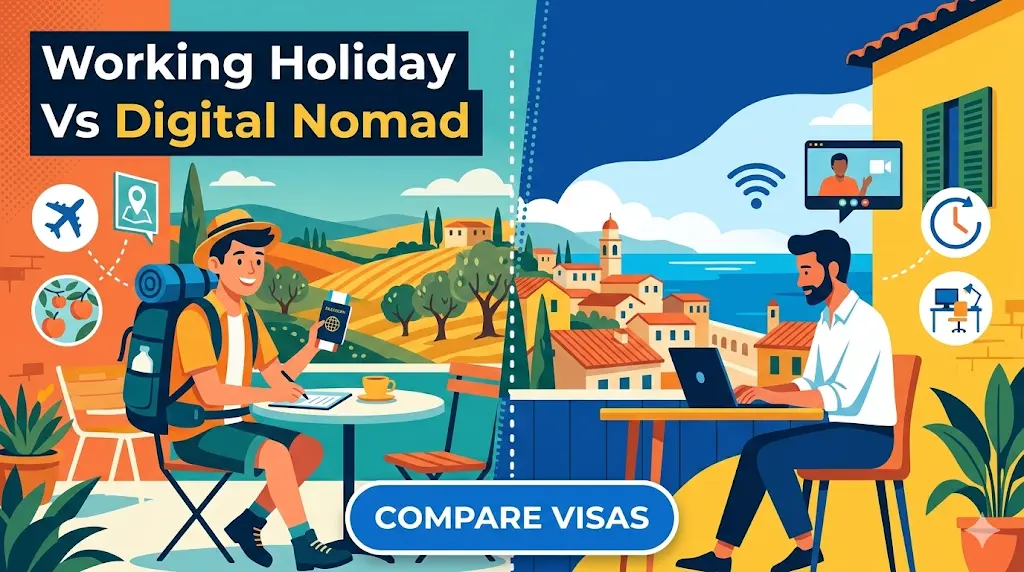
The Working Holiday Visa: Cultural Exchange and Side Hustles
The Working Holiday Visa (WHV) is primarily a cultural exchange program. It is designed for young people who want to experience the Italian way of life, learn the language, and supplement their travel funds with temporary work. Italy has bilateral agreements with several countries, including Australia, Canada, New Zealand, and South Korea, to facilitate this unique exchange.
Eligibility and Age Constraints
The most defining characteristic of the WHV is the age limit. Typically, applicants must be between 18 and 30 (or 35 for certain nationalities like Canadians). This visa is a “once-in-a-lifetime” opportunity; you generally cannot apply for it a second time. Because the focus is on travel, the government expects you to have a certain amount of savings before arrival to ensure you are not solely reliant on the Italian labor market.
Work Limitations and Scope
On a Working Holiday Visa, your primary purpose is tourism. However, you are permitted to work to fund your travels. There are strict limits: you generally cannot work for the same employer for more than six months, and the total duration of work is often capped at six months out of the 12-month stay. This makes the WHV ideal for roles in hospitality, tourism, or seasonal agriculture. If you find that you have a specific technical skill, you might eventually look into Tech Jobs in Italy: Hotspots and Salary Overview for a more permanent move, but the WHV is not designed for long-term career building.
The Application Spirit
The application for a WHV is usually straightforward and handled at the Italian consulate in your home country. It requires proof of funds, a return ticket (or funds to buy one), and medical insurance. It is a fantastic bridge for those who are still Learning Italian: Language Courses and Tests for Expats and want to practice their skills in a low-pressure environment like a Roman cafe or a Tuscan vineyard.
The Digital Nomad Visa: Remote Mastery in the Mediterranean
Introduced to cater to the modern mobile workforce, the Italy Digital Nomad Visa is a game-changer for high-skilled professionals. Unlike the WHV, this visa is not about “working to travel”; it is about “traveling while working” at a high level. It targets individuals who perform highly qualified work using technological tools and can work autonomously for a company located outside Italy or for their own foreign-based business.
Requirements for Highly Qualified Workers
The Digital Nomad Visa is not open to everyone. To qualify in 2026, applicants must demonstrate they are “highly qualified.” This typically involves showing a university degree or significant professional experience in a specialized field. Furthermore, there is a substantial income requirement—often set at around €28,000 to €30,000 annually—to ensure that the nomad contributes to the local economy without competing for local jobs.
Tax Regimes and Professional Setup
One of the most complex aspects of the Digital Nomad Visa is the fiscal implication. Nomads are expected to be tax-compliant. Depending on your situation, you might need to look into Freelancing in Italy: Registering for Partita IVA if you are a self-employed professional working with multiple clients. The Digital Nomad Visa allows for a renewable one-year stay, and unlike the WHV, it can often be a pathway to long-term residency if certain conditions are met.
Freedom of Employment
The greatest advantage here is the lack of a “local employer” requirement. You can keep your Silicon Valley salary while paying Sicilian rent. You are not limited by the six-month employer cap of the WHV, allowing for deep professional continuity. This visa is perfect for software developers, consultants, and digital creators who want to make Italy their home base for a year or more.
Side-by-Side Comparison: WHV vs. Digital Nomad Visa
Choosing the right path depends on your nationality, age, and income level. The following table summarizes the key differences as of 2026.
| Feature | Working Holiday Visa | Digital Nomad Visa |
| Primary Purpose | Cultural Exchange & Tourism | Remote Professional Work |
| Age Limit | 18–30 (sometimes 35) | No Age Limit |
| Nationality | Restricted to Treaty Countries | Open to All Non-EU Nationalities |
| Income Requirement | Basic Savings (approx. €3,000) | High Annual Income (approx. €28k+) |
| Skill Level | No specific requirement | “Highly Qualified” (Degree/Exp) |
| Work Rights | Max 6 months total; max 6 per employer | Unlimited Remote Work |
| Renewability | No (One-time use) | Yes (Renewable) |
| Health Insurance | Mandatory Private Insurance | Mandatory (Public or Private) |
Financial Planning for Your Italian Stay
Regardless of which visa you choose, Italy’s financial landscape requires careful navigation. You will need to manage currency transfers, local banking, and eventually, the Italian tax man.
For those on a Digital Nomad Visa, the “pre-payment” of taxes and social security can be a surprise. It is essential to engage with a professional to understand Money Matters in Italy: Banking and Finance for Expats before you arrive. Working Holiday makers have it a bit easier as they often fall under simpler tax categories for temporary seasonal work, but they still need a Codice Fiscale to receive any form of legal payment.
The Importance of the Nulla Osta and Local Registration
A common point of confusion for foreigners is the Nulla Osta (Clearance). For traditional work visas, this is a mandatory step where the employer gets permission to hire you.
- WHV and Digital Nomads: Generally, both of these pathways are “extra-quota,” meaning they bypass the standard Italy’s Decreto Flussi 2026: Work Permit Quotas Explained.
- Post-Arrival: Within eight days of arriving in Italy, both Digital Nomads and Working Holiday makers must apply for their Permesso di Soggiorno. This is the plastic card that proves you are a legal resident.
- The Kit: You will need to go to a post office to get the “kit” and send your application to the Questura.
Conclusion
The decision between a Working Holiday Visa and a Digital Nomad Visa boils down to your stage in life and your professional goals. If you are a young explorer looking to fund a year of pizza, pasta, and travel with casual jobs, the Working Holiday Visa is an unbeatable, low-barrier option. However, if you are an established professional looking to maintain a high-level career while soaking in Italian culture, the Digital Nomad Visa provides the stability and legal framework you need.
Both paths require meticulous preparation and a respect for Italian administrative procedures. By choosing the right visa and staying informed on the 2026 regulations, you can ensure your time in Italy is as productive as it is beautiful.
References
Primary sources (official)
- Ministero degli Affari Esteri – Visto per l’Italia: The official portal to check visa requirements for every nationality. https://vistoperitalia.esteri.it/home/en
- Ministero dell’Interno – Immigrazione: Official guidelines on the Digital Nomad Visa and residency permits. https://www.interno.gov.it/it/temi/immigrazione-e-asilo
Other helpful sources
- Italia.it – Live in Italy: The official tourism and lifestyle portal for Italy, offering advice for long-term visitors. https://www.italia.it/en/italy/advice/living-in-italy
Disclaimer
The information provided in this article is for general informational purposes only and does not constitute professional legal, financial, or immigration advice. Italian immigration laws, including requirements for Digital Nomad and Working Holiday visas, are subject to frequent changes. Always consult with the official Italian Consulate or a qualified immigration lawyer before making significant relocation decisions.