Student exchange program to Italy: visa requirements
Assuming your home university will handle all the legal paperwork for your semester abroad is a massive mistake that leaves countless students stranded. I almost missed my exchange program in Florence because my acceptance letter lacked a crucial ministerial stamp. This guide solves the complex financial, medical, and bureaucratic requirements needed to secure an Italian student exchange visa.
Disclosure: This post may contain affiliate links. We may earn a commission at no extra cost to you if you make a purchase through these links. Read full disclosure.
Navigating the Universitaly Portal and Acceptance Letters
The Mandatory Universitaly Pre-Enrollment
In the past, international exchange students simply took a paper acceptance letter to their local consulate. Today, the Italian Ministry of University and Research has entirely digitized the initial phase of the student visa process. Before you even think about booking a consular appointment, you must complete a digital pre-enrollment through the government’s Universitaly portal.
This portal acts as the centralized gatekeeper for all foreign students entering the Italian higher education system. You will need to create an account, select your host institution in Italy, and upload digital copies of your passport, transcripts, and a passport-sized photo. Once submitted, your application is sent directly to the international mobility office of your chosen Italian university. They must manually review your file, verify the bilateral exchange agreement with your home university, and formally “validate” your pre-enrollment in the system.
The frustration here lies in the waiting game. Italian university administration moves at its own notoriously slow pace, especially right before the August holidays. You cannot proceed to the consulate until the Italian host university officially validates your Universitaly application and generates a summary PDF. You must print this validated Universitaly summary and bring it to your visa appointment. This digital shift mirrors broader government changes, which you can read about in Electronic submission of Italian visa application available.
The Lettera di Accettazione and Bilateral Agreements
While the Universitaly portal is your digital clearance, you still need physical, irrefutable proof of your exchange status. The consulate will demand the Lettera di Accettazione (Letter of Acceptance) directly from your Italian host university.
This letter cannot be a casual email from a professor. It must be printed on official university letterhead, signed by the rector or the head of the international mobility office, and bear the official wet stamp of the institution. Crucially, if you are participating in a study abroad program, the letter must explicitly state that you are part of an official exchange program (such as Erasmus+ or a specific bilateral university agreement), outline the exact dates of the semester, and confirm that your tuition has been handled according to that specific agreement.
If your home university relies on third-party study abroad providers, you must ensure that the letter clearly links you to a recognized Italian academic institution. Consulates will reject applications if it looks like you are just attending an unaccredited private study tour. Ensuring this institutional paperwork is flawless saves you from being sent to the back of the queue. If you are ever curious about how strict Italian immigration categories can be for short trips versus long studies, reviewing Schengen Visa Requirements Italy is highly recommended.
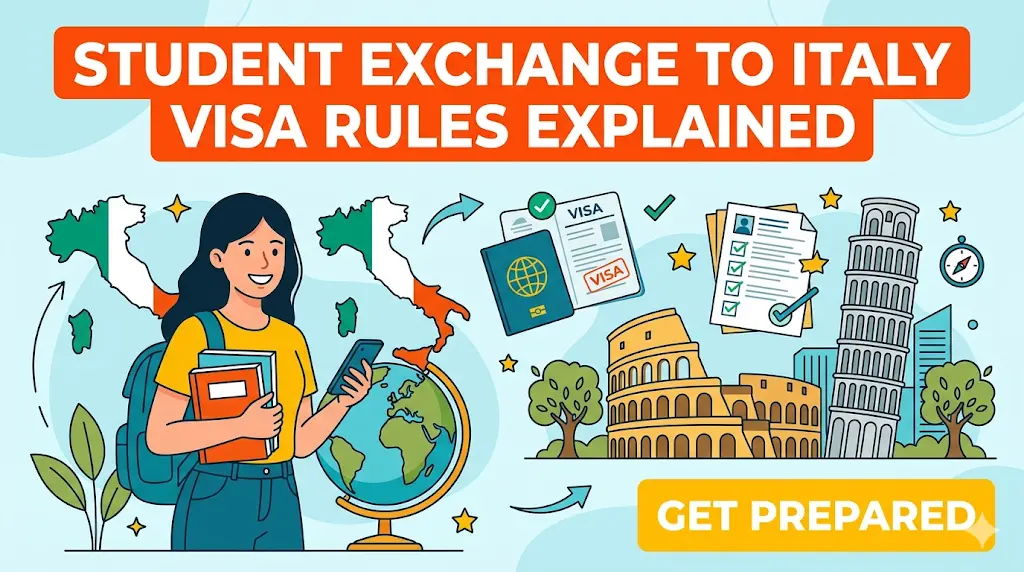
Financial Proof and Translated Documents
Demonstrating Sufficient Funds
The Italian government wants absolute assurance that you can financially support yourself during your exchange program without becoming a burden on the state. To obtain your study visa, you must demonstrate access to a minimum amount of monthly funding. As of recent updates, this threshold is generally calculated at around €467.65 per month for every month of the academic year, though consulates frequently prefer to see a healthier buffer.
Proving you have this money requires an immense amount of paperwork. You cannot simply show a screenshot of your checking account. The consulate requires three to six months of formal bank statements. If your parents are funding your exchange, you must provide a formalized Affidavit of Support, signed by your parents and often notarized, legally pledging their financial backing. Additionally, you must provide their bank statements and sometimes a copy of their employment contract to prove the funds are legitimate.
If you have been awarded a scholarship, grant, or financial aid from your home university, you must provide the official award letter detailing the exact monetary amount disbursed for the semester. All these funds must be clearly accessible to you while you are living in Italy. Misunderstanding these strict financial thresholds frequently leads to visa denials, a reality that parallels the financial scrutiny discussed in Signing an Italian Rental Contract.
Overcoming the Translation Bottleneck
One of the most stressful discoveries for foreign students is that the Italian consulate will not simply accept your English financial affidavits, parental support letters, or birth certificates at face value. The Italian bureaucratic machine operates strictly in Italian, and foreign legal documents must be flawlessly translated to be recognized.
Getting your complex financial documents and legal affidavits translated is a massive bottleneck. I strongly advise using RushTranslate to handle this exact problem. By sending your documents to RushTranslate, you ensure that the consular officer receives certified, legally accurate translations formatted to the Italian government’s strict standards. Do not attempt to translate these sensitive financial documents yourself or use an amateur service to save a few dollars.
A consular officer will instantly reject your visa application if a financial affidavit is poorly translated, causing you to miss your flight and your semester orientation. Relying on RushTranslate guarantees compliance with the Ministry of Foreign Affairs, protecting your non-refundable visa fee from being wasted on a clerical error. Having your pristine RushTranslate files properly organized is the most effective way to secure an approval on your very first try. Properly translated identity documents will also be vital the moment you arrive and need to begin Checking Your Italian Tax Code Codice Fiscale Status.
| Visa Requirement | Specific Details Needed | Common Pitfalls to Avoid |
| Universitaly Summary | Validated PDF from the Italian host institution. | Booking a visa appointment before the host university validates the portal. |
| Acceptance Letter | Official letterhead, wet stamp, explicit dates of the exchange. | Bringing a forwarded email or an unsigned printout. |
| Financial Proof | Bank statements, notarized parental affidavits, or scholarship letters. | Showing insufficient funds or failing to provide certified translations. |
| Proof of Housing | Registered lease, dorm assignment, or host family declaration. | Booking a temporary hotel for just the first week. |
Health Insurance and Housing Guarantees
Securing Valid Medical Coverage
Alongside your financial documents, the single most heavily scrutinized requirement in your entire visa portfolio is your proof of health insurance. The Italian consulate will not issue a student visa unless you prove you possess comprehensive medical coverage that meets the strict €30,000 Schengen minimum for emergency hospitalization and repatriation back to your home country.
Even if you intend to join the public health system later by Registering with the Italian Public Healthcare System SSN, you legally cannot access the public grid until you physically arrive in Italy and obtain your residence permit. To secure the visa beforehand, you must purchase robust private insurance. If you provide a digital policy document from a small, unknown travel insurer, the consular officer will likely reject it for insufficient long-term coverage.
To bypass this delay completely, it is wise to secure a policy through Cigna Global. Using Cigna Global is a bulletproof way to meet the strict visa health insurance requirements. Because Cigna Global is a globally recognized expat insurance provider, their certificates of coverage are explicitly tailored to meet Italian national visa requirements. Presenting a Cigna Global PDF to the consulate instantly satisfies the health checklist. Securing Cigna Global not only guarantees a smoother visa approval, but it also ensures you are safely covered from the exact moment you step off the plane in Rome or Milan. Relying on this premium safety net protects your physical health and your savings while you navigate your chaotic first month abroad.
Providing Proof of Accommodation
You cannot apply for an Italian student visa with the intention of couch-surfing or finding an apartment after you arrive. The consulate requires concrete proof that you have a secure place to sleep for the entire duration of your exchange program.
If your Italian host university provides on-campus housing, you must include the official dormitory assignment letter in your visa application. However, Italian universities severely lack student housing, forcing the vast majority of exchange students into the private rental market. If you are renting privately, you must provide a legally registered rental contract signed by the landlord. If you book an apartment through an online platform, the booking confirmation must clearly state your name, the address, and cover the dates of your study program.
Post-Arrival: The Permesso di Soggiorno
The Eight-Day Rule and the Questura
Securing the visa sticker in your passport is only half the battle. Your visa simply grants you the right to cross the Italian border. Once you land in Italy, the clock starts ticking immediately. Under Italian law, you have exactly eight days from the date of your arrival to visit a local post office (Poste Italiane) and submit a massive yellow application kit for your physical residence permit (Permesso di Soggiorno per motivi di studio).
This post office visit triggers a subsequent appointment at the central police station (Questura) where you will be fingerprinted and your original translated documents will be reviewed once again. Surviving this multi-step, deeply analog process is exhausting and requires extreme patience. It perfectly mirrors the intense bureaucratic hurdles you will face when establishing your life, a process detailed in Navigating Italian Bureaucracy Comune and Prefettura. You must keep the post office receipt (ricevuta) on you at all times, as it is your only legal proof of status while you wait months for the actual plastic card to be printed.
Conversion and Future Options
Many exchange students fall in love with Italy and decide they want to stay after their semester or year concludes. It is crucial to understand the limitations of your permit. A student residence permit allows you to work a maximum of 20 hours per week, which helps subsidize your living costs.
However, if you want to remain in Italy permanently, you must carefully navigate the transition from a student to a professional. If you graduate from an Italian university, or if your exchange leads to a full-time job offer, you can apply to convert your permit. Managing this transition requires an intimate understanding of the annual quota limits, a stressful reality we deeply explore in Converting a Student Visa to a Work Visa in Italy. For the duration of your studies, however, your primary focus will simply be maintaining your legal status and successfully Renewing Your Italian Permesso di Soggiorno if your program extends into a second academic year.
References
Primary sources (official)
- Ministero dell’Università e della Ricerca – Universitaly Portal – https://www.universitaly.it/
- Ministero degli Affari Esteri – Il Visto per l’Italia (Official Visa Guidelines) – https://vistoperitalia.esteri.it/home/en
Other helpful sources
- Educations.com – Study in Italy: Student Visa Requirements – https://www.educations.com/study-guides/europe/study-in-italy/student-visa-4253
- The Local Italy – What you need to know about getting an Italian student visa – https://www.thelocal.it/
Disclaimer
The information provided in this article is for educational and informational purposes only and does not constitute official legal or immigration advice. Visa requirements, financial thresholds, and the Universitaly pre-enrollment procedures are strictly governed by the Italian Ministero degli Affari Esteri and the Ministero dell’Università e della Ricerca and are subject to frequent updates. The timeline for receiving a Permesso di Soggiorno varies significantly by local police jurisdiction (Questura). Always verify current submission requirements and documentation standards directly with your local Italian Consulate prior to submitting a visa application.