The Italian Health Card (Tessera Sanitaria): Uses and How to Get One
Standing in a pharmacy in Milan, I once watched a fellow expat try to buy medicine using only a passport, only to be met with a firm "No" because they lacked the proper card. I’ve been that person, clutching a paper receipt and feeling totally lost in the system. This guide demystifies the Italian Health Card, ensuring you never face that confusion again.
Disclosure: This post may contain affiliate links. We may earn a commission at no extra cost to you if you make a purchase through these links. Read full disclosure.
What Exactly is the Tessera Sanitaria
The Tessera Sanitaria (TS) is far more than just a piece of plastic; it is your golden ticket to the Servizio Sanitario Nazionale (SSN), Italy’s public healthcare system. If you are planning to stay in Italy for more than three months, this card becomes an essential part of your "bureaucracy toolkit," sitting right alongside your residency permit and your tax code. Without it, you are effectively a ghost in the machine, unable to access subsidized medicine or regular check-ups.
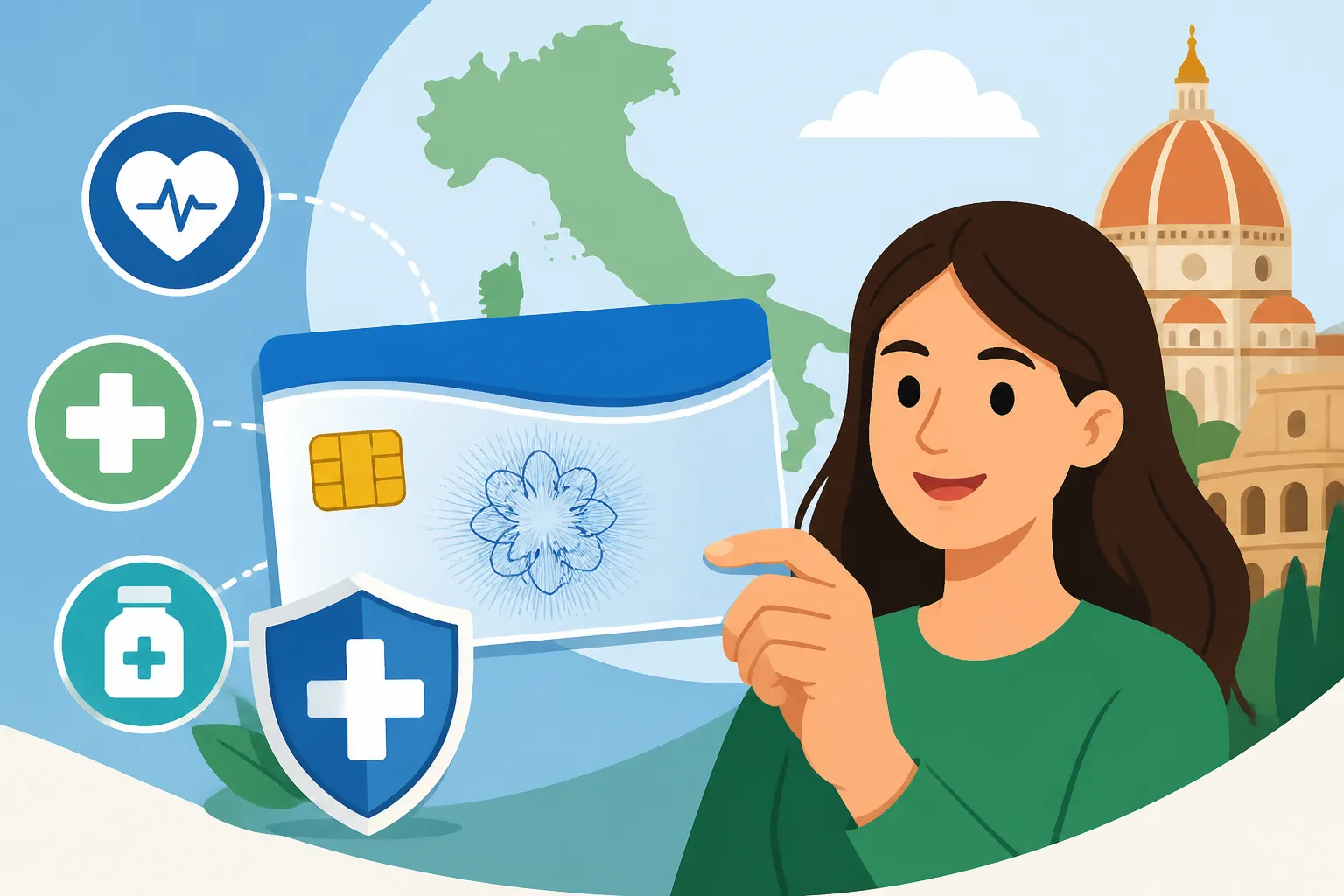
I remember the first time I received mine in the mail. It felt like a rite of passage, a sign that I was no longer just a visitor but a functioning part of Italian society. The card itself is blue, about the size of a credit card, and contains your Codice Fiscale (tax code), your personal data, and an embedded microchip. It serves three main purposes: it’s your health insurance card within Italy, your tax code card for administrative tasks, and, on the reverse side, it acts as your European Health Insurance Card (EHIC) for travel within the EU.
Understanding the nuance between the card and the system is vital. Healthcare in Italy: An Expats' Guide explains that while the system is theoretically open to everyone, the card is the physical manifestation of your right to use it. It tracks your prescriptions, your specialist visits, and even your "ticket" payments (the small co-pay required for certain services). In essence, it is the bridge between you and the Italian state's medical resources.
The Difference Between the Tax Code and the Health Card
One of the most common points of confusion for newcomers is the overlap between the Codice Fiscale and the Tessera Sanitaria. When you first arrive, you’ll likely get a paper slip with your tax code from the Agenzia delle Entrate. This is not your health card. While the Tessera Sanitaria displays your tax code prominently, it is issued by the Ministry of Economy and Finance in collaboration with the Ministry of Health.
The tax code allows you to open a bank account or sign a phone contract, but the health card is what links that code to the medical database. If you have the paper slip but no blue card, you aren't yet registered for healthcare. This is a hurdle I see many expats trip over; they assume that having the code means they are "in" the system. You must take that code and go through the specific process of Enrolling in Italy’s National Health System (SSN) to trigger the production of the plastic card.
The TS-CNS and Digital Identity
In recent years, the card has evolved into the TS-CNS (Tessera Sanitaria—Carta Nazionale dei Servizi). This means the microchip on the card can be used as a digital signature or a way to access government websites. While most expats use it simply for doctor visits, the more tech-savvy among us use it to log into the Fascicolo Sanitario Elettronico (Electronic Health Record), where you can see all your blood test results and vaccination records online.
To use the digital features, you usually need a card reader and a PIN, which you can request at your local ASL (Azienda Sanitaria Locale). However, most people now find it easier to use SPID (the digital identity system) for these tasks. Still, the card remains the physical backup that pharmacists and doctors will ask for every single time you walk through their doors. It’s a multi-tool of Italian administration that you should never leave home without.
Who is Eligible for the Italian Health Card
Eligibility for the Tessera Sanitaria is tied to your legal status in the country. It isn't a "one-size-fits-all" application. Broadly, expats fall into two categories: those who are mandatorily registered (iscrizione obbligatoria) and those who must pay a fee to join voluntarily (iscrizione volontaria). Navigating these categories is where the real stress begins, as the requirements can change depending on your visa type and employment status.
If you are working legally in Italy, whether as an employee or a freelancer with a Partita IVA, you are entitled to mandatory registration. This means your social security contributions are already covering your healthcare costs. For those in this bracket, the process is relatively straightforward, though "straightforward" in Italy still involves at least three different stamps and a bit of waiting. You can find more detail on this in the guide on How to Register for Italian Healthcare (SSN) as a Foreigner.
EU Citizens and the Iscrizione Anagrafica
For my fellow EU citizens, the process is linked to your right to free movement, but it isn't automatic. You generally need to prove that you are working, studying, or have sufficient resources to live in Italy. Once you have completed your Iscrizione Anagrafica (Residency Registration) at the local town hall (Comune), you take your residency certificate to the ASL to get your health card.
If you are an EU citizen but not yet working, you can often use your EHIC from your home country for urgent care, but for a permanent Tessera Sanitaria, you’ll need to prove you are covered. Some retirees from EU countries can use the "S1 Form" from their home country to avoid paying the voluntary fee. This is a lifesaver for many pensioners moving to the sunnier climes of Sicily or Puglia, as it transfers their healthcare rights directly into the Italian system.
Non-EU Citizens and the Permesso di Soggiorno
For non-EU expats, your eligibility is strictly tied to your Permesso di Soggiorno (Residence Permit). If you are here on a work visa, family reunification visa, or for asylum, you are usually entitled to mandatory registration. The validity of your health card will almost always match the expiration date of your residency permit. This can be incredibly frustrating; if your permit is only for one year, you have to renew your health card every single year.
I’ve spent many mornings at the Questura (police station) and the ASL in a circular loop of renewals. If you are here on an Elective Residence Visa (often used by retirees) or a Student Visa, you usually fall into the "voluntary" category. This means you must pay a yearly fee to the SSN. While you wait for these documents to process, services like SafetyWing can provide a crucial safety net for digital nomads or those in the "limbo" phase between arrival and full residency.
Students and Temporary Residents
Students often find themselves in a unique position. While you can pay the voluntary fee (which is significantly discounted for students), many choose to use private insurance instead to satisfy visa requirements. However, if you want the full "Italian experience"—including a local doctor who knows your name—paying the voluntary SSN fee is often worth it.
It’s important to note that for voluntary registration, the fee is calculated based on your global income from the previous year, with a minimum floor (currently around 700-2,000 Euros depending on the region and status). For students, this fee is often fixed at a much lower rate, usually around 150-200 Euros. If you are a high-earner who prefers premium service and English-speaking coordination, Cigna Global offers comprehensive plans that can complement or even replace the public system for those who don't want to deal with the public wait times.
Step by Step Guide to Getting Your Card
The physical process of getting your card happens at the ASL (Azienda Sanitaria Locale). This is the local administrative office for health services. Do not go to the hospital or the pharmacy to apply; they cannot help you. You need to find the ASL office that corresponds to your place of residence. A quick Google search for "ASL [Your City]" should point you to the right district office.
Before you go, prepare yourself mentally. Bring a book, make sure your phone is charged, and arrive early—ideally 15 minutes before the doors open. The "ticket" system in these offices is legendary. You’ll walk in, pull a lettered slip (usually "S" for Scelta/Revoca), and wait. When your number is called, you need to have your "busta" (folder) of documents ready to go. The clerks are often helpful but have no patience for missing paperwork.
| Document Needed | Mandatory Registration (Worker) | Voluntary Registration (Student/Retiree) |
|---|---|---|
| Passport/ID | Original + Photocopy | Original + Photocopy |
| Codice Fiscale | Original + Photocopy | Original + Photocopy |
| Permesso di Soggiorno | Valid permit or receipt of application | Valid permit or receipt of application |
| Proof of Employment | Work contract or recent payslip | N/A |
| Proof of Payment | N/A | F24 receipt of payment to SSN |
| Proof of Residency | Self-declaration or certificate | Self-declaration or certificate |
Gathering the Right Paperwork
The "Self-Declaration" (Autocertificazione) is a wonderful Italian tool that many expats are afraid to use. Instead of waiting weeks for an official residency certificate from the Comune, you can often sign a form stating that you live at a certain address. However, some ASL offices are stricter than others. Always bring your rental contract or a utility bill just in case.
If you are self-employed, you will need your Partita IVA certificate. If you are a dependent worker, your "Busta Paga" (payslip) is the ultimate proof of status. For those paying the voluntary fee, you must first go to a post office or use your online banking to pay the "Bollettino" or "F24" form. You cannot pay at the ASL. You must show up with the paid receipt in hand. This extra step is what catches most people out on their first try.
Visiting the ASL and the Interview
When you finally reach the counter, the clerk will scan your documents and ask you to choose a doctor. This is a critical moment. You should have researched a Medico di Base (Family Doctor) in your neighborhood before arriving. If you don't have a name, they will simply assign you whoever has space on their list, which might be a doctor three neighborhoods away who doesn't speak a word of English.
If you're in a big city, check Websites to Find Doctors Who Speak English in Italy or ask in local expat Facebook groups. Once you provide the name, the clerk will print out a temporary paper version of your Tessera Sanitaria. This paper is valid immediately. You can use it to book appointments and buy prescriptions. The actual plastic card will arrive at your registered home address via mail within 3 to 6 weeks.
Choosing Your Medico di Base
Your family doctor is the gatekeeper to the entire Italian medical system. You cannot see a specialist or get a non-emergency blood test without a "Ricetta" (prescription/referral) from them. When you are Registering with an Italian Family Doctor (Medico di Base), try to find someone whose office hours (orario di studio) fit your schedule.
Some doctors work only in the morning, others only in the afternoon. It’s also worth checking if they use an online booking system or if you have to show up and wait in a crowded hallway. I once had a doctor who required me to call a landline between 8:00 AM and 8:30 AM only. If I missed that window, I couldn't get a referral. Needless to say, I changed doctors quickly. You can change your doctor at any time by simply going back to the ASL or, in some regions, using your online health portal.
Using Your Tessera Sanitaria in Daily Life
Once that blue card arrives, your interaction with Italian healthcare changes. You are no longer paying "full price" for everything. When you go to the pharmacy to pick up medicine, the pharmacist will ask for the card. They scan it, and the system automatically applies any discounts or exemptions you are entitled to. This is where you see the "Ticket" system in action.
For example, a box of antibiotics that might cost 20 Euros at full price might only cost you 2 or 3 Euros with your card. This is because the SSN subsidizes a massive portion of drug costs. However, this only applies to "Class A" drugs (essential medicines). For "Class C" drugs (lifestyle or non-essential meds), you’ll still pay full price, but the purchase will be recorded on your card for tax deduction purposes at the end of the year.
Pharmacies and Prescriptions
Italy has a very high density of pharmacies, and they are the first line of defense for minor ailments. In Italian Pharmacies: Prescription, Over-the-Counter, and Supplies, you’ll learn that pharmacists here are highly trained and can often give better advice than a GP for things like seasonal allergies or minor skin issues. When you have a "Ricetta Rossa" (the old red paper) or the newer "Ricetta Elettronica" (the digital version), the pharmacist needs your Tessera Sanitaria to log the transaction.
If you have a chronic condition, your doctor can issue a long-term prescription. You just bring your card to the pharmacy, and they will see the authorized refills in the system. If you're traveling from abroad and haven't gotten your card yet, SafetyWing is an excellent option for covering emergency prescriptions or medical mishaps while you navigate the ASL bureaucracy.
Booking Specialist Visits through CUP
If your doctor decides you need to see a cardiologist, a dermatologist, or get an MRI, they will issue an "Impegnativa" (a referral). You then use your Tessera Sanitaria to book the appointment through the CUP (Centro Unico di Prenotazione). You can do this at many pharmacies, over the phone, or at a dedicated CUP desk in a hospital.
The clerk will ask for your card and the code on the referral. They will then tell you the "waiting list" times. This is the part of the Italian system that tests everyone's patience. Public wait times can be several months. If you are in a hurry, you might choose to go "Intra Moenia" (paying the public doctor for a private visit within the hospital) or go entirely private. Having Cigna Global coverage allows you to skip these queues entirely and see a specialist of your choice within days, often with English-speaking staff.
Emergency Care and Hospital Admissions
In an emergency, you should head to the "Pronto Soccorso" (ER). If you have your Tessera Sanitaria, the intake process is much faster. They will scan your card, assign you a triage code (White, Green, Yellow, or Red), and your records will be linked to your visit. For serious emergencies, you can call Emergency Medical Services in Italy: 112 and Hospitals.
If you are admitted to the hospital, the card ensures that your stay, your surgery, and your meals are all covered by the state. You might have to pay a small daily fee or a co-pay for specific diagnostic tests, but you will never face a 50,000 Euro bill for an appendectomy. It is one of the most comforting aspects of living in Italy—knowing that if the worst happens, the system will catch you without bankrupting you.
Common Hurdles and How to Jump Them
Even with the best preparation, things go wrong. The most common issue is the "card that never arrives." If it’s been more than two months, go back to the ASL. Sometimes there is an error with the address, or your name isn't on the doorbell (a cardinal sin in Italy—your name must be on the "citofono" and the mailbox for the postman to deliver official mail).
Another hurdle is the expiration date. As mentioned, for non-EU residents, the card expires when your Permesso does. If you are in the process of renewing your permit, the ASL can issue a "temporary" paper extension of your health coverage. You just need to show them the "Cedolino" (the post office receipt) from your renewal application. Don't wait until you get sick to do this; keep your paper coverage up to date.
Lost or Stolen Cards
If you lose your card, don't panic. You can request a duplicate online through the Agenzia delle Entrate website if you have a SPID, or you can go in person to the ASL or an Agenzia delle Entrate office. They will issue a replacement for free. In the meantime, the paper certificate they give you works exactly like the card.
If it was stolen, you should technically file a "Denuncia" (report) with the Carabinieri or Polizia before requesting a new one. This protects you in case someone tries to use your identity for fraudulent medical claims. Always keep a photocopy or a clear photo of your card on your phone; it makes the replacement process ten times easier.
Using the Card as an EHIC for Travel
On the back of your Tessera Sanitaria is the "Tessera Europea di Assicurazione Malattia." This is valid in all EU countries, plus Norway, Iceland, Liechtenstein, and Switzerland. If you break your leg skiing in France or get a fever in Germany, this card gives you access to the local public healthcare system under the same conditions as a local resident.
However, remember that the EHIC is not a replacement for travel insurance. it only covers "necessary" care, not mountain rescue or medical repatriation. For trips outside the EU, or for more comprehensive protection, I always suggest maintaining a policy like those from SafetyWing. They cover the gaps that the public card won't, especially when it comes to travel-related logistics.
Comparison of Health Access Options
| Feature | SSN (with Health Card) | Private Insurance (e.g., Cigna) | Travel/Nomad (e.g., SafetyWing) |
|---|---|---|---|
| Cost | Free (workers) or 700+ Euro (voluntary) | Monthly Premium | Daily/Monthly Rate |
| Wait Times | Can be long (months) | Very short (days) | Short (for emergencies) |
| Language | Mostly Italian | English-speaking options | English support |
| Coverage Area | Italy + EU (emergency) | Global or Regional | Global (excluding home country) |
| Prescriptions | Highly subsidized | Reimbursed per policy | Emergency only |
| Specialists | Needs GP referral | Direct booking | Emergency referral |
Disclaimer
The information provided in this guide is for educational and informational purposes only and does not constitute legal or professional medical advice. Immigration laws and healthcare regulations in Italy are subject to frequent changes. Always verify current requirements with official government sources such as the Ministero della Salute or your local ASL office before making administrative decisions.