Prescriptions in Italy: Ricetta Rossa, Bianca, and Dematerializzata
Standing in line at a local farmacia with a scribbled note from your home-country doctor, only to be met with a sympathetic but firm "non è valida," is a rite of passage for many expats in Italy. I vividly remember my first winter in Milan, clutching a US prescription for basic asthma medication and realizing that the Italian system operates on a completely different frequency of colors and digital codes. This guide solves that confusion by breaking down exactly how to navigate the Ricetta Rossa, Bianca, and the modern Dematerializzata so you never leave a pharmacy empty-handed.
Disclosure: This post may contain affiliate links. We may earn a commission at no extra cost to you if you make a purchase through these links. Read full disclosure.
The Foundations of the Italian Prescription System
Navigating healthcare in a new country is rarely about the medicine itself and almost always about the paperwork that authorizes it. In Italy, the prescription system is deeply integrated with the Servizio Sanitario Nazionale (SSN), the public health service. To even begin this journey, you need to understand that the "farmacia" is your primary point of contact, but they are strictly bound by the type of prescription you present. Unlike some countries where a pharmacist might have more leeway, Italian pharmacists are meticulous about the "ricetta" because it dictates who pays for the medicine—you or the Italian government.
The Essential Role of the Medico di Base
Your journey typically starts with your family doctor, known as the Registering with an Italian Family Doctor (Medico di Base). This individual is the gatekeeper of the public system. If you are a legal resident and have your health card, this doctor is the only person who can issue the subsidized "red" or "electronic" prescriptions for long-term care. I spent months trying to get a specialist to write me a subsidized script, only to learn that the specialist provides the "advice," but the family doctor provides the "official" paper.
The Medico di Base doesn't just treat your symptoms; they manage your medical history within the Italian system. When you visit them, they will decide if your condition requires a medication covered by the state. If it is, they will issue a prescription that looks like a legal document, often with a series of barcodes. This process is the cornerstone of Healthcare in Italy: An Expats' Guide, ensuring that chronic conditions are managed affordably.
The Pharmacist as a Healthcare Consultant
In Italy, a pharmacist is a highly respected professional, often providing more direct advice than you might be used to elsewhere. If you walk in with a minor ailment, they may recommend over-the-counter (OTC) options, but for anything stronger, they will demand a formal ricetta. It’s important to realize that Italian pharmacies are often small, neighborhood-centric hubs where the pharmacist likely knows the local doctors personally.
When you present your prescription, the pharmacist will look for specific elements: the doctor’s stamp, your tax code (Codice Fiscale), and the expiration date of the script. If you are using international coverage like SafetyWing while transitioning between residency statuses, the pharmacist can help you understand which medications are standard and which might require a specific Italian equivalent. They are the final check in a system that prides itself on precision.
The Ricetta Rossa (Red Prescription): The Public Health Standard
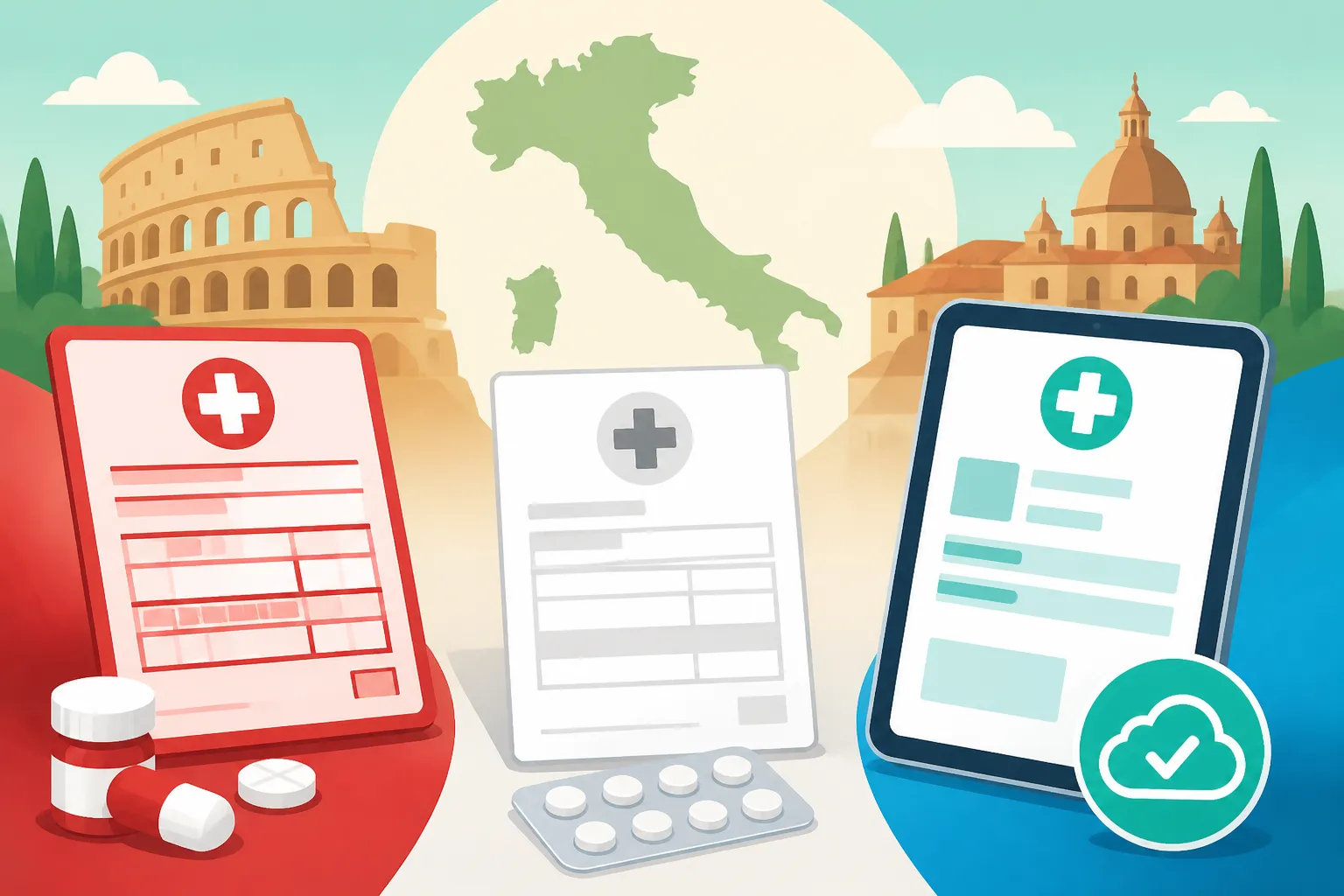
The traditional "Ricetta Rossa" is the iconic pinkish-red paper slip that has defined Italian healthcare for decades. While it is slowly being replaced by digital versions, you will still see it, especially from older doctors or in specific regions where the digital infrastructure lags. This document is essentially a voucher that tells the pharmacist the state is picking up most of the bill. It is only issued by doctors working within the SSN framework.
Who Qualifies and How to Use It
To receive a Ricetta Rossa, you must be enrolled in the national health system. If you are still figuring out the paperwork, you should look into How to Register for Italian Healthcare (SSN) as a Foreigner to ensure you are eligible for these benefits. Once you have your Tessera Sanitaria (health card), your Medico di Base can issue these for medications categorized as "Classe A," which are considered essential or for chronic illnesses.
Using the red prescription is straightforward but time-sensitive. Generally, a Ricetta Rossa for medication is valid for 30 days from the date of issue. If you wait until day 31, the pharmacist cannot process it, and you will have to return to your doctor for a new one. I once made the mistake of "saving" a prescription for a rainy day, only to find it was a useless piece of paper when I actually got sick. Always check the date as soon as the doctor hands it to you.
Understanding the Ticket System and Costs
The primary benefit of the Ricetta Rossa is the "Ticket," which is the small co-payment you pay instead of the full price of the medicine. The amount of the ticket varies significantly by region—a frustration many expats face when moving from Rome to Florence or vice versa. Some regions charge a flat fee per prescription, while others charge per box of medicine.
There are also exemptions (esenzioni) based on income, age, or specific chronic conditions. If you have a documented long-term illness, your doctor can add a code to the Ricetta Rossa that waives the ticket entirely. This is a crucial part of the Cost of Healthcare in Italy: What Expats Need to Know, as it can reduce your monthly medical expenses from hundreds of euros to nearly zero.
The Ricetta Bianca (White Prescription): Navigating Private Care
The "Ricetta Bianca" is the white prescription, and it represents the private side of Italian medicine. You will receive this from private doctors, specialists you see outside the SSN, or even your family doctor for medications that aren't covered by the state (Classe C). Unlike the red version, the white prescription means you are responsible for 100% of the medication cost.
When You Will Receive a White Prescription
You’ll often encounter the Ricetta Bianca when you choose to skip the public waiting lists and visit a specialist privately. For instance, if you visit a private dermatologist for acne treatment, they will issue a white script. Since it doesn't involve state subsidies, the format is less rigid; it can be a simple piece of letterhead with the doctor's signature and stamp.
White prescriptions are also used for "lifestyle" medications or newer drugs that haven't yet been added to the subsidized list. While it feels less "official" than the red one, it is a legally binding document that pharmacists must follow. If you are using a plan from Cigna Global, these private costs are usually what you will be submitting for reimbursement, so keep every receipt (scontrino) the pharmacy gives you.
Managing Costs and Insurance with Private Scripts
Because you pay the full price for Ricetta Bianca medications, the costs can add up quickly. This is where Public vs Private Health Insurance in Italy becomes a vital topic for discussion. While the public system is great for essentials, the private route offers speed, and a good insurance policy will cover the high costs associated with white prescriptions.
One thing to note: the Ricetta Bianca often has a longer validity than the red one. Depending on the medication, it can be valid for up to six months and allow for multiple refills (ripetibile). However, for certain controlled substances, it may only be valid for 30 days and for a single use (non-ripetibile). Always ask the pharmacist "È ripetibile?" so you know if you can reuse the same paper for your next refill.
| Feature | Ricetta Rossa | Ricetta Bianca | Ricetta Dematerializzata |
|---|---|---|---|
| System | Public (SSN) | Private / Non-Essential | Public (Digital) |
| Cost to Expat | Co-payment (Ticket) | Full Market Price | Co-payment (Ticket) |
| Validity | 30 Days | 6 Months (usually) | 30 Days |
| Issuer | SSN Doctor only | Any licensed doctor | SSN Doctor only |
| Format | Red Paper Slip | White Paper / Letterhead | Digital Code / SMS |
The Ricetta Dematerializzata: Navigating the Digital Transition
The "Ricetta Dematerializzata," or electronic prescription, is the modern standard in Italy. It was fast-tracked during the pandemic and has stayed because it makes life significantly easier for both doctors and patients. Instead of a physical slip of paper, the prescription exists as a digital record in a central database, identified by a unique code called the NRE (Numero Ricetta Elettronica).
How the Electronic Prescription Works
When your doctor issues an electronic prescription, they don't necessarily need to see you in person. They can generate the NRE and send it to you via email or even an SMS. When you get to the pharmacy, you simply show the pharmacist the barcode on your phone or give them the NRE code along with your health card.
The pharmacist scans your Tessera Sanitaria, enters the code, and your prescribed medications appear on their screen. This system is incredibly efficient for the Prescription Refill Process for Long-Term Medications, as your doctor can renew your scripts with a five-minute phone call. I’ve found this to be a lifesaver when I’m traveling within Italy and realize I’ve forgotten my daily meds; any pharmacy in the country can access the NRE.
Accessing the Fascicolo Sanitario Elettronico
The backbone of the digital system is the Fascicolo Sanitario Elettronico (FSE), or Electronic Health Record. This is an online portal where every prescription, blood test result, and hospital visit is recorded. For an expat, setting this up is a game-changer. You will need a SPID (Digital Identity) to log in, but once you are in, you can see all your active and past prescriptions.
Using the FSE allows you to manage your health without keeping track of loose papers. If you lose the SMS from your doctor, the NRE code is right there in your portal. For those managing chronic conditions, this digital paper trail is essential. It also helps if you need to show your medical history to a new specialist, as you can download your entire Electronic Health Record in Italy (Fascicolo Sanitario Elettronico) to share with them.
Practical Tips for Expats Navigating Pharmacies
Even with the right prescription, there are cultural and logistical nuances to the Italian pharmacy that can catch you off guard. From knowing when they are open to understanding how they handle foreign prescriptions, a little bit of local knowledge goes a long way in ensuring your health remains a priority while living abroad.
Finding English-Speaking Pharmacists and Night Services
If your Italian is still a work in progress, finding a pharmacist who speaks English can reduce a lot of anxiety. In major cities like Rome, Milan, or Florence, most pharmacies in the city center will have at least one English-speaking staff member. However, if you are in a more rural area, having a translation app ready is a good idea. You can also search for Where to Find English-Speaking Doctors and Clinics who can write scripts that are clearly explained to you in English first.
Emergencies don't happen on a 9-to-5 schedule. Italy uses a "Farmacia di Turno" system, where pharmacies take turns staying open 24/7 or during holidays. Every pharmacy is required to display a sign outside (usually a glowing green cross or a printed list) showing which nearby location is currently "on duty." You can also find this information online to ensure you know How to Find a Farmacia di Turno (Night Pharmacy) in Italy before you go driving around in the middle of the night.
Refilling Medications from Your Home Country
One of the biggest hurdles for new arrivals is realizing that a prescription from the US, UK, or Canada is not directly "fillable" in Italy. An Italian pharmacist cannot legally accept a foreign prescription. You must take your foreign script to an Italian doctor (either a private one or your Medico di Base), who will then "translate" it into an Italian Ricetta Bianca or Rossa.
When you go to this appointment, bring the original box of your medication, as brand names vary wildly. A doctor in Italy might not recognize a brand name from home, but they will recognize the active ingredient. For those here on a shorter stay using SafetyWing, you might still need to visit a private doctor to get that first Italian script. It’s always better to do this before your supply runs out, as it can take a few days to secure an appointment.
Emergency Situations and Over-the-Counter Alternatives
Sometimes you can't wait for a doctor's appointment. In these cases, you need to know how the hospital system handles prescriptions and what you can actually buy over-the-counter without any paperwork at all. The Italian pharmacy is split between "Farmaci da Banco" (OTC) and those requiring a script, and the line is often drawn differently than in other countries.
Hospital-Issued Prescriptions and the ER
If you end up in the Emergency Medical Services in Italy: 112 and Hospitals, the doctors there can issue prescriptions for the immediate treatment you need. Often, if the medication is urgent, the hospital pharmacy itself might provide the first few doses. For the rest, they will give you a "dimissione" (discharge) paper that includes a prescription.
In some cases, this hospital script must still be converted by your Medico di Base into a Ricetta Rossa to get the subsidized price. However, in a pinch, most pharmacists will honor a hospital-issued white script immediately because of the "Pronto Soccorso" stamp. Understanding When to Go to the ER vs Urgent Care in Italy can help you decide if your situation warrants the hospital route or a simple visit to the local "Guardia Medica" (on-call doctor).
Farmaci da Banco vs. Prescription Drugs
You might be surprised to find that some medications that require a prescription in your home country are available over-the-counter in Italy, and vice versa. For example, high-dose Vitamin D or certain topical antibiotics might require a script here, while they are OTC elsewhere. Basic painkillers like Tachipirina (Paracetamol) are widely available, but they are often kept behind the counter—you have to ask the pharmacist for them.
If you have a minor ailment, always ask the pharmacist if there is a "farmaco da banco" or a "SOP" (Senza Obbligo di Prescrizione—without obligation of prescription) alternative. They are legally allowed to suggest these for symptom relief. If you are managing a long-term condition with Cigna Global, it is worth checking if your policy covers these OTC costs if they are recommended by a pharmacist for an acute issue. For more on this, check out Italian Pharmacies: Prescription, Over-the-Counter, and Supplies.
Disclaimer
The information provided in this guide is for educational and informational purposes only and does not constitute professional medical or legal advice. Italian healthcare regulations and pharmacy laws are subject to change, and regional variations in the SSN system are common. Always consult with a qualified medical professional in Italy or contact your local ASL (Azienda Sanitaria Locale) for the most current information regarding your specific health needs and residency status. This guide was written based on expat experiences and publicly available data as of 2026.