Kosher/Halal Options for Patients in Italian Hospitals
Navigating dietary restrictions in a medical setting can be stressful. This guide explores the availability of Kosher and Halal meal options in Italian hospitals, detailing patient rights, administrative procedures, and tips for expatriates to ensure their religious dietary needs are met.
Disclosure: This post may contain affiliate links. We may earn a commission at no extra cost to you if you make a purchase through these links. Read full disclosure.
Introduction to Kosher/Halal Options for Patients in Italian Hospitals
Italy’s public healthcare system, the Servizio Sanitario Nazionale (SSN), is built on the pillars of human dignity and equality. This means that every patient, regardless of their background, has a right to medical treatment that respects their cultural and religious convictions. In the context of hospital catering, this translates into a legal and ethical obligation for medical facilities to provide meals that align with a patient’s dietary restrictions, provided those needs are clearly communicated to the staff.
For an expatriate, the challenge often lies in the “how.” How do you request a Halal meal in a bustling public ward? Can you truly expect a certified Kosher meal in a small provincial hospital? While the major metropolitan hubs like Rome and Milan are well-equipped with sophisticated catering services that handle religious diets daily, smaller facilities may require a more proactive approach from the patient or their family. This comprehensive guide will explore the legal framework of patient rights in Italy, the practical steps for requesting specialized meals, and the differences between public and private hospital catering. We will also provide essential vocabulary to help you advocate for your dietary needs, ensuring that your nutritional intake supports your spiritual values and your physical recovery.
Patient Rights and Religious Freedom in Italy
The foundation of your right to specialized food in an Italian hospital is found in the Italian Constitution and various national health charters. Article 19 of the Italian Constitution guarantees the right to profess one’s religious faith, which includes following specific dietary laws such as Kosher or Halal. Furthermore, the “Charter of Patients’ Rights” (Carta dei Diritti del Malato) explicitly states that healthcare must be personalized and respectful of the individual’s religious and cultural identity.
In recent years, the Italian Ministry of Health has issued specific guidelines regarding “Hospital Catering” (Ristorazione Ospedaliera). These guidelines emphasize that food is not just a commodity but a part of the clinical therapy. For a patient who strictly follows religious laws, being served “forbidden” food can lead to psychological distress and a refusal to eat, both of which hinder recovery. Therefore, hospitals are encouraged to collaborate with religious communities to ensure that meal services are inclusive.
If you are a legal resident, your right to these services is part of your overall coverage.
Availability of Halal Meals in Italian Hospitals
With Islam being the second largest religion in Italy, the demand for Halal options has grown significantly over the last two decades. Most major public hospitals (Ospedali) and University Hospitals (Policlinici) in cities with large Muslim populations—such as Milan, Turin, Rome, and Brescia—have established protocols for providing Halal-certified food.
How Halal is Handled in Public Facilities
In most cases, Italian hospitals do not have a separate “Halal kitchen.” Instead, they utilize specialized catering companies that provide pre-packaged, certified Halal meals. These meals are prepared in external certified kitchens, sealed to prevent cross-contamination, and then heated and served in the hospital.
If a certified Halal meal is not immediately available, the hospital dietician will typically offer a “vegetarian” or “fish-based” menu as a temporary alternative. While this may satisfy the basic requirement of avoiding pork or non-Halal meat, it is important to communicate clearly if you require the meat itself to be slaughtered according to Islamic rites.
Requesting the Service
To secure Halal meals, you must inform the nursing staff or the ward doctor immediately upon admission. In many Italian hospitals, a dietician or a catering representative visits each ward in the morning to take meal orders for the following day. This is the critical moment to specify your needs. It is also helpful to have your family doctor mention these requirements in your admission paperwork if the hospitalization is planned. For more on coordinating with your primary physician, see our post on Registering with an Italian Family Doctor (Medico di Base).
Navigating Kosher Requirements in Italian Hospitals
Providing Kosher meals (pasti Kasher) is often more logistically challenging for Italian hospitals than providing Halal meals. This is due to the smaller size of the Jewish community and the significantly more complex rules surrounding the preparation and serving of Kosher food, particularly the requirement for separate kitchens and supervised preparation.
Kosher Options in Major Hubs
In Rome and Milan, where established Jewish communities and rabbinical authorities exist, the major hospitals (like the Fatebenefratelli on Rome’s Tiber Island) have long-standing agreements to provide Kosher meals. These are usually double-sealed, pre-packaged meals provided by certified Kosher caterers.
In smaller cities, the hospital may not have a pre-existing Kosher catering contract. In these instances, the hospital administration is generally very accommodating toward families who wish to bring in food from the outside. However, there are strict “hygiene and safety” protocols regarding external food in hospitals, so you must always coordinate this with the ward manager (Caposala).
The Role of Jewish Community Support
The Italian Jewish community (UCEI – Unione delle Comunità Ebraiche Italiane) is very proactive. If you or a family member is hospitalized in a city where Kosher food is difficult to obtain, reaching out to the local synagogue or Jewish community office can be a lifesaver. They often have volunteer networks that can arrange for certified Kosher meals to be delivered directly to the hospital ward. If you are staying long-term and need help navigating such services, you might find useful tips in our guide on Connecting with Expat Communities in Italy.
Step-by-Step Guide to Requesting Specialized Meals
Navigating the bureaucracy of a hospital ward while unwell requires a clear strategy. Follow these steps to ensure your dietary needs are recorded correctly:
- At the Emergency Room (Pronto Soccorso): If you are admitted via the ER, inform the triage nurse. While the ER usually only provides basic snacks, they can flag your dietary restriction in the electronic system that transfers with you to the ward.
- During Ward Admission: As soon as you are settled in your room, tell the Infermiere (nurse) or the Medico di Reparto (ward doctor). Use the specific terms: “Dieta Halal” or “Dieta Kasher.”
- The Dietician Consultation: Ask to speak with the hospital dietician (dietista). They are responsible for the nutritional plan and have the direct link to the catering service.
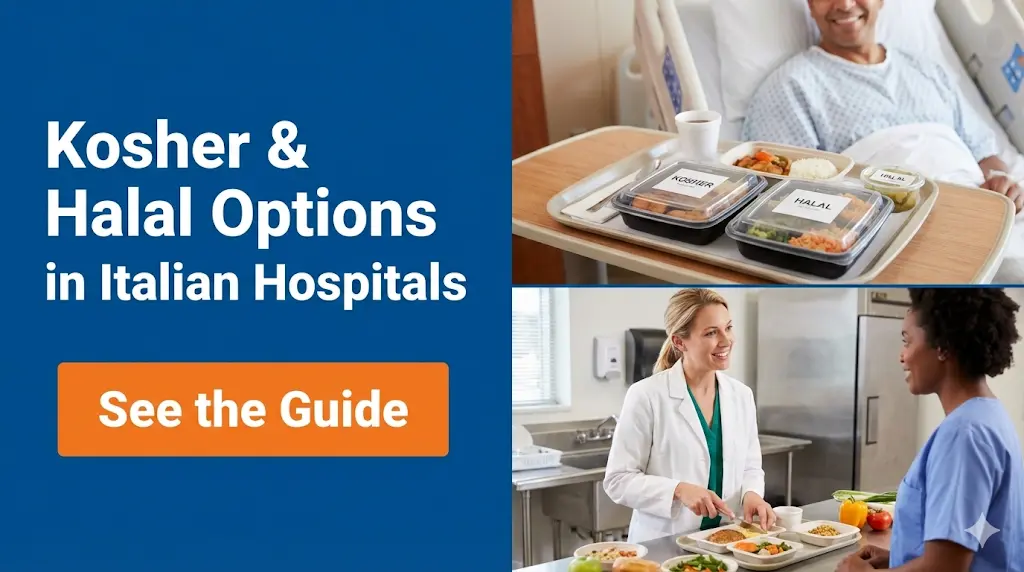
- Verify the Tray: When the food arrives, look for a label on the tray or the meal container. Certified meals should have the name of the catering company and the specific certification (Halal or Kosher) clearly visible.
- Family Support: If the hospital cannot meet your needs to your satisfaction, ask for the rules regarding “external food” (cibo dall’esterno). Most hospitals will allow it if it is kept in a sealed container and meets hygiene standards.
Public vs Private Hospital Catering
The experience of requesting specialized food can differ between the public and private sectors. To understand the broader differences in these facilities, you can read our detailed breakdown on Differences between Public and Private Healthcare in Italy.
Public Hospitals (Ospedali Pubblici)
Public hospitals prioritize medical necessity and have standardized catering contracts. While they are legally required to respect your religion, the variety of the meals may be limited. You might find that the Halal or Kosher option is a repetitive rotation of three or four different dishes.
Private Clinics (Cliniche Private)
Private facilities often market themselves on “premium” service, which includes high-quality catering. If you are paying out-of-pocket or using private insurance, you have much more leverage to request specific brands or types of food. Many private clinics function like high-end hotels and can source specific meals from external restaurants or specialized caterers upon request.
Comparison of Dietary Services by Facility Type
The following table provides a general overview of what to expect regarding religious dietary options in different types of Italian medical facilities.
| Facility Type | Halal Availability | Kosher Availability | Process |
| Large Public Hospital (North) | High | Moderate (Pre-packaged) | Direct request to ward staff |
| Large Public Hospital (South) | Moderate | Low (Requires family aid) | Request to dietician |
| University Policlinico | High | Moderate | Advanced electronic booking |
| Private International Clinic | Very High | High | Concierge/Room service style |
| Small Provincial Hospital | Low (Vegetarian default) | Very Low | Coordination with external family |
Managing Cross-Contamination and Cultural Nuances
For those who are strictly observant, the concern is often not just the ingredients, but the process. In an Italian hospital setting, the staff may not always understand the nuances of cross-contamination—for example, using the same serving spoon for pork-based pasta and a vegetarian option.
Tips for Maintaining Strict Observance:
- Pre-packaged is Best: Always request the pre-sealed, external catering option rather than food served from a common trolley.
- Disposable Utensils: If you are concerned about the cleanliness of hospital cutlery, you can ask for posate monouso (disposable cutlery).
- Vegetarian Default: If you are unsure about the meat source, the “Dieta Vegetariana” is a safe and readily available fallback in every Italian hospital.
- Ramadan Considerations: If you are hospitalized during Ramadan and wish to fast, you must discuss this with your doctor. Italian hospitals can usually arrange to have your meals delivered after sunset and before sunrise (Suhoor), provided it does not interfere with your medication schedule.
Essential Vocabulary for Dietary Requests
Communicating your needs effectively is half the battle. Here are some key Italian phrases and terms to use when speaking with hospital staff:
- I follow a Halal diet: Seguo una dieta Halal.
- I follow a Kosher diet: Seguo una dieta Kasher.
- No pork, please: Senza maiale, per favore.
- I need certified meat: Ho bisogno di carne certificata.
- Is there a vegetarian option?: C’è un’opzione vegetariana?
- Can my family bring me food?: La mia famiglia può portarmi del cibo?
- I have allergies to…: Sono allergico a…
- Disposable cutlery: Posate monouso.
- Sealed meal: Pasto sigillato.
Alternatives and Backup Plans
What happens if you are in a remote part of Italy and the hospital simply cannot provide a certified meal?
The Vegetarian Option
Italian hospitals always have a vegetarian option. Due to the high quality of Italian produce, this usually consists of pasta with tomato sauce (pasta al pomodoro), vegetable soups (minestrone), and fresh cheeses like mozzarella or ricotta. For many Halal-observant patients, this is the most practical and stress-free way to navigate a short hospital stay.
Pharmacy Supplements
If you are struggling to find enough to eat that meets your religious requirements, every Italian hospital has a pharmacy nearby (and often a small shop inside). You can purchase “Medical Food” supplements (Alimenti a fini medici speciali) like nutritional shakes or protein bars that are usually vegetarian-friendly and can help maintain your strength until you are discharged.
Conclusion
Italy’s healthcare system is increasingly sensitive to the needs of its diverse resident population. While the availability of Halal and Kosher meals in hospitals is not yet universal in the way a “low-sodium” diet might be, the legal right to religious dietary accommodation is firmly established. In major cities, you can expect a professional, albeit sometimes basic, level of service with pre-packaged certified meals. In smaller towns, you will find that a combination of clear communication, the vegetarian default, and the support of the local religious community will ensure you are well-fed during your recovery.
The key to a successful experience is proactivity. Do not wait until the meal trolley arrives to express your restrictions. By engaging with the nursing staff and dieticians early, using the correct terminology, and leaning on the vibrant expat and religious networks in Italy, you can ensure that your stay in an Italian hospital respects both your physical health and your spiritual commitments. Recovery is a holistic process, and in Italy, the “right to food” is a vital part of the healing journey.
References
Primary sources (official)
- Ministero della Salute: The official portal for the Italian Ministry of Health, providing national guidelines on hospital catering and patient nutrition. https://www.salute.gov.it/
- Conferenza Stato-Regioni: The body that defines the Essential Levels of Care (LEA), which include the respect for cultural and religious dietary needs in hospitals. https://www.statoregioni.it/
Other helpful sources
- UCEI (Unione delle Comunità Ebraiche Italiane): The official representative body of Italian Jewry, offering resources for Kosher life and hospital support in Italy. https://www.ucei.it/
- COREIS (Comunità Religiosa Islamica Italiana): A leading Islamic organization in Italy that provides guidance on Halal requirements and religious rights for Muslims in public institutions. https://www.coreis.it/
Disclaimer
The information provided in this article is intended for general educational and informational purposes only and does not constitute official medical, legal, or religious advice. Hospital catering protocols and the availability of specialized meals in Italy vary significantly by region and individual facility. Always consult directly with the hospital’s administrative staff, dietician, or ward manager to confirm the availability and certification of specialized dietary options. In the event of a medical emergency, medical treatment should always take precedence over dietary concerns. If you are experiencing a life-threatening crisis, dial the universal European emergency number 112 immediately.