Periodontal Services for Children: Are They Free?
Your child’s gums bleed when they brush, the school dentist visit never happened, and the private dentist quotes a fee that makes you wince. Now you are wondering whether Italy’s public health system actually covers children’s gum care. This guide explains what the SSN covers, where the gaps are, how to get seen, and how to protect your budget.
Disclosure: This post may contain affiliate links. We may earn a commission at no extra cost to you if you make a purchase through these links. Read full disclosure.
How Italy’s Public System Treats Children’s Gum and Dental Care
The first time I took my daughter to a dentist in Italy, I assumed it worked like her pediatrician visits: free, booked through the ASL, done. Then I paid a private clinic bill at the front desk and learned that dental care is the odd one out in Italian healthcare. The full background is in Dental Care in Italy: Why It’s Mostly Private and What It Costs, but children’s gum care has its own rules.
What the SSN Promises for Children
Italy’s national health system, the Servizio Sanitario Nazionale, has a list of essential services every region must provide. These are the Livelli Essenziali di Assistenza, or LEA. For adults, dental care under the LEA is narrow. Children, which the system calls “età evolutiva”, get more protection.
Children up to a nationally defined age are entitled to dental prevention programmes. These usually include check-ups, oral hygiene education, fluoride advice, and sealants on permanent molars. Children who are judged medically or socially vulnerable can also get treatment. Vulnerability can mean a serious health condition, a disability, or a low household income measured through the ISEE declaration. Regions can extend these protections, and many do.
Treatment for gum problems falls inside this framework. Most children’s gum problems are gingivitis, the inflammation that causes red, puffy gums that bleed on brushing. Less often, a child has a more serious periodontal condition, sometimes linked to diabetes, a genetic syndrome, or an immune disorder. The visit to diagnose either one is usually covered in the public system. Whether ongoing treatment is free depends on your child’s age, your region, and whether your family meets the vulnerability criteria.
Free, Co-Paid, or Private: The Honest Answer
So, are periodontal services for children free in Italy? Sometimes, but rarely in the simple way expats hope.
A preventive check at an ASL dental clinic for a young child is often free or close to it. Specialist follow-up may carry a “ticket”, the co-payment charged on many outpatient services. That ticket can be waived if your child qualifies for an exemption based on age, income, or a chronic condition. Treatment beyond prevention is often reserved for vulnerable children. Everyone else is effectively pushed toward private dentistry.
The ticket system is explained step by step in Understanding the Italian Health Ticket (Co-Payment) System. Exemption codes are covered in Health Exemption Codes in Italy (Esenzione): Who Qualifies. If your family income is modest, read How to Apply for a Health Exemption (Esenzione) by Income in Italy before you book anything. An exemption can change the cost of an entire course of treatment.
Is a Dental Check a School Requirement in Italy?
Many expat parents ask whether Italian schools require proof of dental health before enrolment. They do not. No Italian state school, nursery, or scuola dell’infanzia makes a dental check-up or dental certificate a condition of enrolment. The health requirement schools enforce is vaccination status, set out in What Vaccinations Are Required for School in Italy?.
That means nobody will flag a gum problem through the enrolment paperwork. Some regions and ASLs do run oral health screening days in schools, where a dental hygienist or ASL dentist looks at children’s mouths and sends a note home. These programmes are patchy. Your child’s school may run one every year, once in a primary career, or never. If you get a note saying your child has signs of gingivitis or tartar, treat it as a nudge to book a proper visit.
Getting Your Child Seen: The Public Route Step by Step
The public route takes patience, a pediatrician who knows you, and a working grasp of the booking system. Here is how it works in practice.
Start With Your Pediatra di Libera Scelta
Every child registered with the SSN has a family pediatrician chosen by the parents, the pediatra di libera scelta. This is your gateway. If you have not chosen one yet, the process is explained in Choosing a Pediatrician in Italy (Pediatra di Libera Scelta).
When you notice bleeding gums, persistent bad breath, swollen gum tissue, or loose teeth that should not be loose, mention it at the next visit or book a dedicated appointment. The pediatrician will look, ask about brushing habits and diet, and decide whether a dental specialist is needed. If so, they issue an electronic referral called an impegnativa. It carries a priority code that tells the booking system how urgent the case is. For the mechanics, see Specialist Referrals in Italy: How the Impegnativa Works.
A practical tip from my own experience: describe symptoms precisely and mention duration. “Her gums have bled every time she brushes for six weeks” gets a different response than “her gums seem a bit red”. Pediatricians in busy practices respond to specifics.
Booking Through CUP and the ASL Dental Clinic
With the impegnativa, you book through the CUP, the Centro Unico di Prenotazione, which handles public specialist appointments for your area. You can book by phone, in person at a CUP desk, at many pharmacies, or online through your regional portal with SPID. The full process is in Booking Medical Appointments in Italy Through the CUP System.
Pediatric dental appointments are usually at an ASL dental outpatient clinic, the ambulatorio odontoiatrico, or at a hospital dental department. In larger cities, university dental clinics attached to medical schools often treat children. Specialist children’s hospitals such as Bambino Gesù in Rome, Gaslini in Genoa, Meyer in Florence and Regina Margherita in Turin have dental or maxillofacial services. These mostly handle complex cases referred from elsewhere.
Here is the process in order:
- Book a visit with your pediatra and describe the gum symptoms clearly.
- Ask directly whether a dental referral is appropriate and which priority code applies.
- Collect the electronic impegnativa, which usually comes with a printed reminder or a code sent to your phone.
- Contact CUP and ask specifically for a pediatric dental visit, using the term “visita odontoiatrica pediatrica”.
- Ask whether your child’s age or an exemption code removes the ticket, and have your tessera sanitaria ready.
- If the first date is far off, ask about other clinics in the ASL area or a cancellation list.
- Bring the referral, the health card, and any previous dental records to the appointment.
- After the visit, ask in writing what follow-up is covered publicly and what is not.
Waiting Times and Regional Reality
Waiting times are the frustration most expat parents talk about. The priority code is supposed to guarantee a maximum wait, but availability depends on staffing. Some ASLs have one dentist for children covering a wide area. Others have well-run pediatric dental services with reasonable waits.
The north-south divide comes up here too, though it is more complicated than the stereotype. Some southern ASLs run strong school-based prevention, and some northern areas have long dental queues. Regional Healthcare Differences in Italy: North vs South gives a balanced picture. If you live near a regional border, your child may be able to access services in a neighbouring ASL. Ask at CUP.
If the date offered is months away and your child is uncomfortable, you have two options. You can ask the pediatrician whether a higher priority code is justified. Or you can see a private dentist for a first assessment while keeping the public appointment for follow-up. Many families I know do exactly that.
Private Dentists, Costs, and Insurance for Expat Families
Most Italian families use private dentists for their children at some point. Many expats end up doing the same. That does not mean the public route is pointless. Combining the two is often the smartest approach.
What Private Pediatric Gum Care Looks Like
Private dentistry in Italy ranges from a single dentist in a ground-floor studio to large clinic chains with several specialists. For children, look for a dentist who works in pedodonzia, pediatric dentistry. For a real gum problem, look for a dentist who can involve a periodontist, a parodontologo.
A typical private pathway starts with a first visit and a professional cleaning, the “igiene orale” or “detartrasi”, done by a dental hygienist. The dentist then examines the gums, may probe gum pockets, and may take X-rays if bone loss is suspected. For simple gingivitis, the answer is usually better brushing technique, flossing or interdental brushes, a review of sugary snacks, and periodic cleanings. For more serious periodontal disease, treatment can mean deep cleaning under the gumline, antimicrobial rinses, and coordination with your pediatrician if an underlying condition is suspected.
Fees vary widely between cities, neighbourhoods and clinic types, so always ask for a written estimate, the preventivo, before treatment starts. Italian dentists expect this request, and a good one will itemise each procedure. Ask whether the price includes follow-up checks. Ask whether a fattura, a proper invoice, will be issued. You need the fattura for any insurance claim, and medical expenses can be relevant on an Italian tax return.
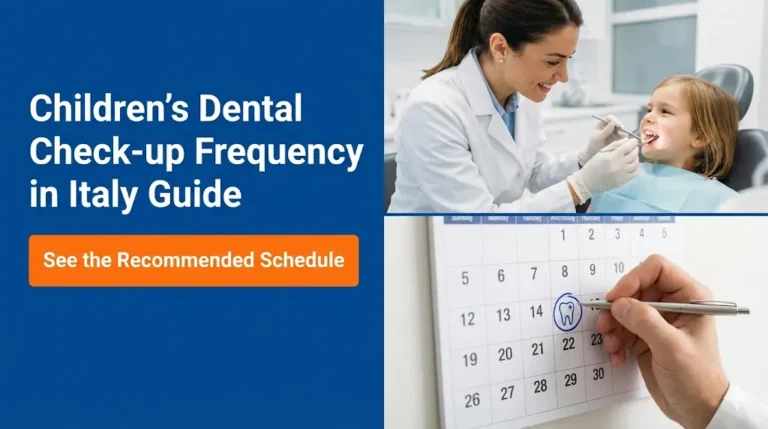
How often should a child go? Frequency of Dental Check-ups in Italy for Children covers the usual rhythm. If your child already has gum problems, the dentist may recommend shorter intervals until things settle.
Comparing Your Options Side by Side
Here is how the main routes compare for a child with a gum problem.
| Route | Best suited to | Shape of the cost | Typical wait | English availability |
|---|---|---|---|---|
| ASL dental clinic through the SSN | Young children, prevention, families with exemptions | Free or ticket-based, often waived by exemption | Varies by ASL, can be long | Limited, depends on the individual dentist |
| University dental clinic | Complex cases, children needing specialist teams | Usually SSN ticket rules, sometimes reduced private rates | Moderate to long | Better in larger university cities |
| Children’s hospital dental service | Children with medical conditions or syndromes | SSN-based with referral | Depends on clinical priority | Often some English-speaking staff |
| Private pediatric dentist | Fast assessment, ongoing hygiene, families without exemptions | Per-visit or per-treatment fee, itemised in a preventivo | Days to a couple of weeks | Common in expat-heavy areas of Rome, Milan, Florence |
| Private dentist plus insurance | Families with dental cover in their health policy | Fee paid then reimbursed, or billed directly where available | Same as private | Same as private |
Where Health Insurance Fits for Children’s Dental Care
This is where many expat parents get caught out. Not all health insurance includes dental, and dental cover for children often works differently from medical cover.
If your family uses an international health plan, check whether dental is included or sold as an optional add-on. With Cigna Global, for example, dental is typically structured as a separate optional module rather than part of the core medical plan. You need to choose it deliberately and check its waiting periods and limits on the provider’s own page. Routine hygiene, gum treatment, and orthodontics are usually treated very differently within these modules.
Nomad-style policies are another story. Families on a digital nomad visa, or in the gap before SSN registration, often use SafetyWing. Policies of this type are usually designed around emergencies. Dental cover, where it exists, is usually aimed at acute pain or accidental injury, not routine gum care or planned periodontal treatment. If your child’s gums need a structured course of treatment, read the SafetyWing policy wording closely before assuming it will pay. Better yet, budget for it privately.
For a deeper look at how policies handle dental claims, see Dental and Optical Care in Italy: What Global Policies Actually Pay. For structuring cover for the whole family, read Insuring Children in Italy: Family Plans vs Individual Policies. Whichever insurer you use, the same rule applies: get the preventivo first, send it to the insurer before treatment if pre-approval is required, and keep every fattura.
Practical Scenarios and Prevention That Actually Works
Abstract rules only go so far. Here are situations I have seen repeatedly among expat families, and what tends to work.
Scenario: The Toddler With Bleeding Gums
A family in Bologna noticed their young son’s gums bled during brushing. They were registered with the SSN and had a pediatra. The pediatrician examined him, suspected plaque buildup from a bottle-at-bedtime habit, and gave brushing advice first. When things had not improved a few weeks later, she issued a dental referral.
The ASL slot was several weeks away, but because of the child’s age the visit carried no ticket. The ASL dentist confirmed early gingivitis, showed the parents how to brush along the gumline, and booked a check. No private spending at all. This is the public system working as designed. The key was a registered pediatrician and a willingness to follow the steps.
Scenario: The Ten-Year-Old Who Needs More Than a Cleaning
A family in Milan, newly arrived and still waiting on their tessera sanitaria, had a daughter with swollen gums and pockets around her molars. A private pediatric dentist did an initial assessment and cleaning. She then recommended a periodontist and blood tests to rule out an underlying condition.
The family paid privately for the first visits and claimed through their international policy’s dental module. Once SSN registration came through, the pediatrician referred the girl to a hospital service for the medical investigation. The lesson: you do not have to choose one system forever. Use private care to move quickly, then bring the public system in once you are registered, especially for anything medical.
If a dental problem turns painful or involves swelling of the face, do not wait for a CUP slot. Read Emergency Dentist Visits in Italy: What to Do so you know where to go at night or on a weekend.
Prevention Habits That Save Money and Gums
Most childhood gum disease is preventable. Prevention is the one part of pediatric dental care the SSN is designed to support. A few habits make a real difference:
- Brush twice a day with a fluoride toothpaste suited to your child’s age, and supervise younger children until they can do it properly.
- Focus on the gumline, angling the brush so the bristles reach where gum meets tooth.
- Introduce flossing or small interdental brushes once teeth are touching, and ask a hygienist which suits your child.
- Limit sugary snacks and drinks between meals, including the merendine and fruit juices that appear at every Italian school break.
- Watch for mouth breathing, crowded teeth, or crooked teeth that trap plaque, and raise them with the pediatra.
- Take school screening notes seriously and follow up promptly.
- Keep a simple folder of dental records, fatture, and referrals, translated where needed.
Italian pharmacies stock excellent children’s dental products. Pharmacists are often happy to recommend age-appropriate toothpaste, soft brushes, and mouth rinses. Asking the farmacista is free.
Talking to Italian Dentists Without Losing the Thread
Language can make any medical visit harder, and dental vocabulary is specific. A few words help: “gengive” for gums, “sanguinamento” for bleeding, “gengivite” for gingivitis, “parodontite” for periodontitis, “tartaro” for tartar, and “pulizia dei denti” for a cleaning. In expat-heavy neighbourhoods of Rome, Milan and Florence, many private dentists speak English. ASL dentists in smaller towns may not.
Bring a written list of symptoms in Italian, with dates. Ask the dentist to write down the diagnosis and treatment plan. Do not leave until you understand what is covered by the SSN, what is private, and when the next appointment is. It feels pushy the first time. It is the norm here, and it saves months of confusion.
Disclaimer
This article is for general informational purposes only and does not constitute professional advice. Laws, prices and regulations vary by location and change over time. Consult a qualified professional for guidance on your specific situation.