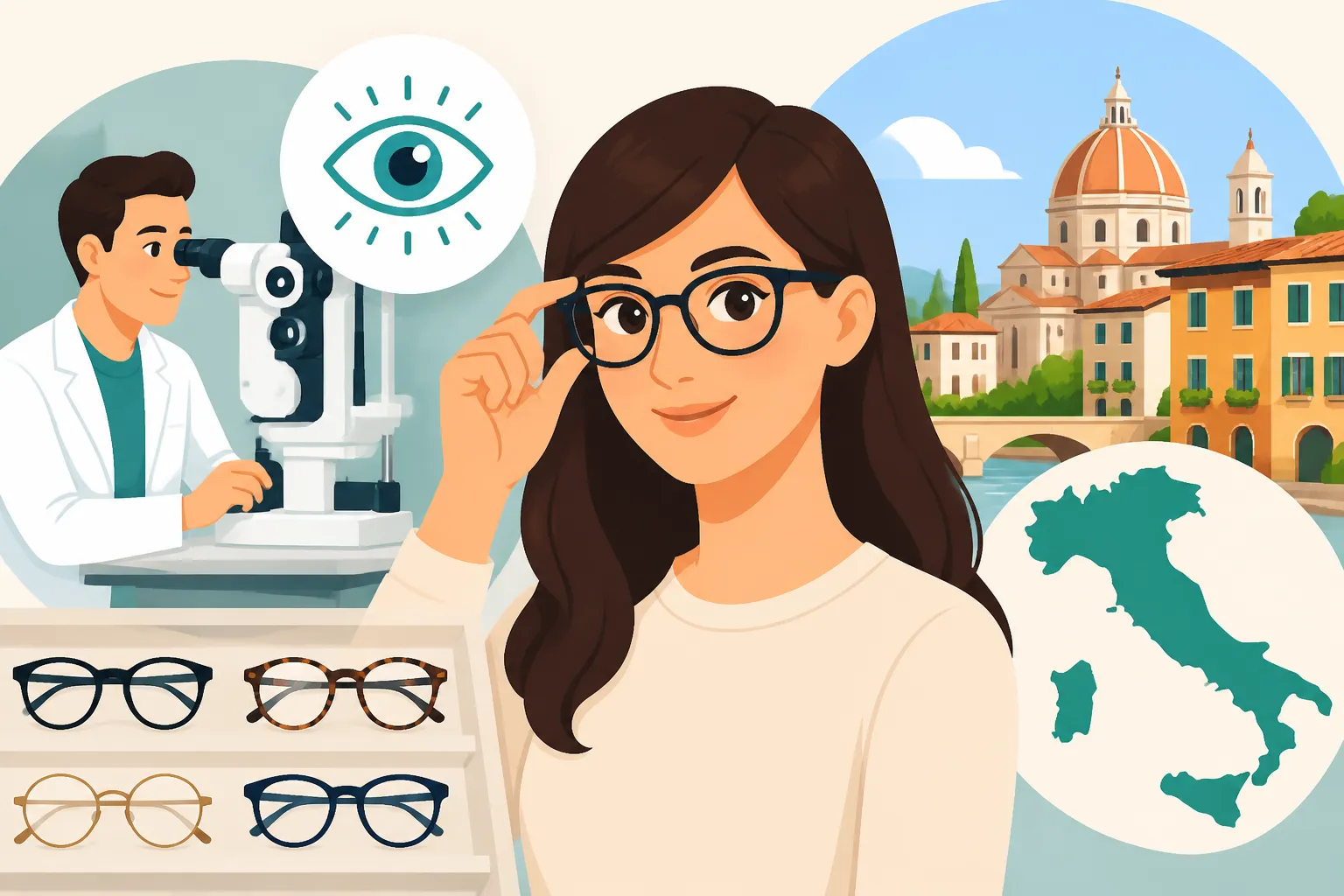
How to Get Eyeglasses and Eye Exams in Italy
Breaking your glasses while squinting at a museum map or losing a contact lens in a cobblestone alleyway is a unique kind of expat nightmare. I remember the literal headache I got trying to find an English-speaking oculista in Milan when my last pair of lenses tore mid-trip. This guide solves every hurdle, from navigating the public vs. private eye exam system to finding the perfect designer frames without overpaying.
Disclosure: This post may contain affiliate links. We may earn a commission at no extra cost to you if you make a purchase through these links. Read full disclosure.
Navigating the Italian Vision Care System: Ottico vs. Oculista
When you first arrive in Italy, the signage can be confusing. You will see "Ottica" shops on every corner, often glowing with neon signs, but these are not medical clinics. In the Italian system, there is a very sharp divide between the person who sells you the frames and the person who checks the health of your retinas. Understanding this distinction is the first step to getting the care you need without wasting time or money.
The Optician (Ottico) Your Go-to for Quick Fixes
The "Ottico" is the professional you will interact with most frequently. These are highly trained technicians who specialize in the measurement of vision and the fitting of corrective lenses. If you already have a prescription from your home country and you just need to replace a broken pair of glasses, the Ottico is your primary contact. Most optical shops in Italy have a small testing room in the back where they can perform a basic refraction test to verify your power.
However, you should be aware that an Ottico is not a medical doctor. They cannot diagnose eye diseases, prescribe medicinal eye drops, or perform surgeries. If you are experiencing flashes of light, sudden blurriness, or pain, the Ottico will immediately refer you to a specialist. For simple vision correction, Getting Prescription Eyeglasses Filled in Italy is relatively straightforward at these shops. They often carry the latest fashion brands, as Italy is the global hub for eyewear manufacturing, but be prepared for "boutique" prices unless you shop during the seasonal sales.
The Ophthalmologist (Oculista) Medical Health and Prescriptions
The "Oculista" is a medical doctor (MD) specializing in ophthalmology. This is the person you must see if you need a formal medical certificate for a driver's license, if you have a chronic condition like glaucoma, or if you want a comprehensive health check. Unlike in some other countries where optometrists sit somewhere in the middle, Italy leans heavily on the Oculista for anything beyond a simple "which lens looks clearer" test.
If you are an expat living here long-term, establishing a relationship with an Oculista is vital. They are the only ones who can issue a "ricetta" (prescription) that is recognized by the national health system for subsidized care. If you have complex needs, having comprehensive coverage from a provider like Cigna Global can be a lifesaver, as it allows you to bypass the public system and head straight to the top specialists in private clinics.
How to Get an Eye Exam in Italy
Getting your eyes checked in Italy can follow two very different paths: the public system (SSN) or the private route. Your choice will depend entirely on your residency status, your budget, and—most importantly—how much of a hurry you are in. Believe me, the wait times can be the stuff of legends if you don't know the shortcuts.
Public Healthcare (SSN) vs. Private Clinics
If you are registered with the Servizio Sanitario Nazionale, you are entitled to eye exams at a subsidized rate. To start this process, you must first visit your Medico di Base (family doctor). They will issue an "impegnativa," which is a formal request for a specialist visit. This is where Specialist Referrals in Italy: How the Impegnativa Works becomes a crucial part of your vocabulary. Once you have this paper, you can book through the CUP system.
The downside to the public route is the timeline. How Long Are Public Waiting Times in Italy's SSN? can range from a few weeks to several months depending on your region. If you are a digital nomad or a traveler who isn't registered with the local health office, you might find this path closed to you. In those cases, a travel-friendly insurance like SafetyWing is essential for covering emergency eye infections or trauma that might require an urgent hospital visit.
Booking Your Appointment through CUP or Directly
CUP stands for Centro Unico di Prenotazione, and it is the centralized booking system for the public health service. You can usually access this at local pharmacies or over the phone. When you call, you’ll need your Codice Fiscale and your impegnativa ready. The operator will give you a date, a time, and a location—often a public hospital or a local "ambulatorio." You don't always get to choose the doctor, which can be a gamble if you are specifically looking for English-speaking staff.
If you choose the private route, the process is much more like what you might be used to in the US or UK. You simply find a doctor—often through Websites to Find Doctors Who Speak English in Italy—and call their office directly. You can usually get an appointment within a few days. The cost will be significantly higher, but the level of personalized service and the modern equipment in private "studi medici" are often superior. For expats who want the best of both worlds, Healthcare in Italy: An Expats' Guide offers a deeper look at balancing these two systems.
Buying Eyeglasses and Contact Lenses
Once you have your prescription in hand, the fun (and expensive) part begins. Italy is the land of Luxottica, Safilo, and Marcolin. Whether you are in a tiny village in Puglia or on a high street in Milan, the selection of frames will be impressive. However, the process of actually getting those frames on your face involves a few cultural nuances.
Choosing Frames and Lenses at an Italian Optical Shop
When you walk into an "Ottica," don't expect to just grab frames off the wall and take them to a self-checkout. The service is very hands-on. An assistant will usually sit you down and bring trays of frames to you based on your face shape and style. This is a great time to practice your Italian, but many shops in tourist areas or major cities will have staff who speak at least basic English.
The cost of lenses in Italy can vary wildly based on the "trattamenti" (coatings). You will be asked if you want anti-riflesso (anti-glare), antigraffio (anti-scratch), or the blue-light filter for computer work. If you have a high prescription, ask for "lenti assottigliate" (thinned lenses). Prices for a complete pair of glasses can range from 150 EUR for a basic house brand to over 600 EUR for high-end designer frames with specialized progressive lenses. For those living here, Getting Health Insurance in Italy: Public and Private Options can sometimes help offset these costs if you choose a policy with a vision rider.
Understanding Italian Eye Prescriptions
If you bring a prescription from home, it might look slightly different than the Italian version. In Italy, the "oculista" will write out the Sfero (Sphere), Cilindro (Cylinder), and Asse (Axis) for each eye. They also specify the "Distanza Interpupillare" (interpupillary distance), which is vital for the optician to center the lenses correctly.
One thing to note: in Italy, you can often buy contact lenses (lenti a contatto) over the counter at any Ottica without showing a physical prescription, provided you know your numbers. This is a lifesaver if you run out while traveling. If you’re a nomad moving frequently, having SafetyWing can provide peace of mind for these minor medical logistics, though they primarily cover emergencies. For long-term vision maintenance, a dedicated expat plan from Cigna Global is usually the better bet for covering routine lens replacements.
Costs, Insurance, and Reimbursements
Money matters can be the most confusing part of Italian healthcare. Between "tickets," private fees, and tax deductions, it’s easy to feel like you’re being overcharged. However, once you understand the system, it’s actually quite logical—even if it is a bit bureaucratic.
Typical Pricing for Exams and Eyewear
The cost of an eye exam depends entirely on how you access it. In the public system, you will pay a "ticket," which is a co-payment. Understanding the Italian Health Ticket (Co-Payment) System will help you realize that this is usually a flat fee, often around 30 to 40 EUR for a specialist visit. In the private sector, a visit to a reputable Oculista will cost anywhere from 100 EUR to 200 EUR.
Eyewear is rarely covered by the public system unless you have a specific disability or are under a certain age and income bracket. For the vast majority of expats, eyeglasses are an out-of-pocket expense. However, keep your receipts! If you are a tax resident in Italy, medical expenses (including glasses and eye exams) are often tax-deductible at a rate of 19% after a small franchise amount.
How Private Insurance and the SSN Handle Costs
If you have private insurance, the reimbursement process usually follows one of two paths: "convenzionato" or "a rimborso." In a convenzionato arrangement, the insurance company pays the clinic directly, and you only pay a small deductible. In a rimborso arrangement, you pay the doctor upfront and then submit the invoice to your provider, like Cigna Global, for reimbursement later.
The SSN primarily focuses on the medical side. If you need surgery for cataracts or treatment for a detached retina, the SSN is world-class and virtually free once you are in the system. But for the "lifestyle" side of vision—like needing a stylish pair of Prada frames—you are on your own. Make sure you are Registering With Your Local ASL in Italy: A Practical Guide as soon as you arrive to ensure you have access to the public medical support when you need it.
| Service Type | Public (SSN) Cost | Private Cost | Waiting Time |
|---|---|---|---|
| Comprehensive Eye Exam | 30 – 45 EUR (Ticket) | 100 – 200 EUR | 2 – 8 Months |
| Emergency Eye Care | Free / Low Ticket | 150+ EUR | Immediate (ER) |
| Designer Frames | Not Covered | 150 – 500+ EUR | 1 – 2 Weeks |
| Contact Lenses (Monthly) | Not Covered | 20 – 40 EUR | Instant (In Stock) |
| Prescription Lenses | Limited Coverage | 100 – 400 EUR | 3 – 7 Days |
Final Tips for the Italian Ottica Experience
Don't be afraid to shop around. While the big chains like Salmoiraghi & Viganò offer convenience, sometimes the smaller, family-owned "Ottiche" will give you a better deal on the lenses themselves or offer free frame adjustments for life. Also, always ask for the "scontrino parlante" (speaking receipt) at the pharmacy or optician, which includes your Codice Fiscale, if you plan on claiming the expense on your Italian taxes.
If you are just starting your journey here, remember that bureaucracy is a marathon, not a sprint. Whether you are dealing with Cost of Private Doctor Visits in Italy or trying to figure out why your "ricetta" expired, stay patient. Italy’s vision care is excellent; you just need to know which door to knock on.
Disclaimer
The information provided in this guide is for informational purposes only and does not constitute medical or legal advice. Healthcare regulations and prices in Italy can change frequently. Always consult with a qualified medical professional or a licensed insurance broker before making decisions regarding your health or insurance coverage.