Free Medications for Seniors under Italy’s SSN
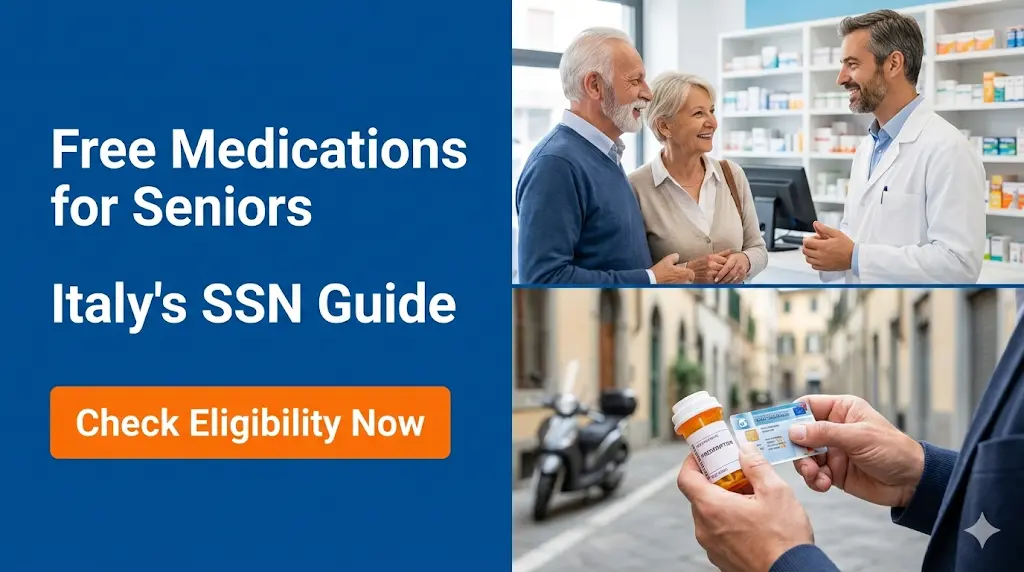
Retiring in Italy offers access to excellent healthcare. This guide explains how seniors over 65 can qualify for free medications under the SSN, detailing the E01 income exemption, chronic illness coverage, and the steps to eliminate pharmacy co-pays.
Disclosure: This post may contain affiliate links. We may earn a commission at no extra cost to you if you make a purchase through these links. Read full disclosure.
Introduction
The Italian healthcare model is built on the principle of universal coverage and solidarity. It ensures that no one is denied essential medical care due to financial constraints. However, the system does utilize a co-payment mechanism known as the “ticket.” When a doctor prescribes a medication, patients are typically required to pay a small ticket at the pharmacy counter to share the cost with the state.
For seniors, these small fees can quickly add up, especially if you are managing multiple long-term health conditions like hypertension, arthritis, or diabetes. To protect the elderly and those on fixed incomes, the Italian government has established a comprehensive system of exemptions (esenzioni). By qualifying for specific exemption codes based on your age and household income, you can completely eliminate these pharmacy co-pays.
This comprehensive guide will break down exactly how the Italian pharmaceutical system categorizes medications, detail the specific E-codes that grant seniors free access to drugs, and provide a step-by-step roadmap for applying for your age and income-based exemptions at your local health authority.
Understanding Italy’s Pharmaceutical Categories
Before exploring the exemptions, you must understand how the Italian Ministry of Health classifies prescription drugs. Not all medications are treated equally under the SSN. When you visit a pharmacy, the price you pay depends entirely on the drug’s designated “Fascia” (Band).
- Fascia A (Class A): These are considered essential medications and life-saving drugs. This category includes treatments for chronic conditions, cardiovascular diseases, and severe infections. For standard SSN enrollees, Fascia A drugs are heavily subsidized, requiring only a small ticket co-pay (usually between 1 and 3 euros per box). For seniors with the correct exemption code, Fascia A drugs are completely free.
- Fascia C (Class C): These are non-essential medications, symptomatic relief drugs, and over-the-counter products (such as mild painkillers, cough syrups, and vitamins). The SSN does not cover Fascia C drugs. Regardless of your age or income, you must pay the full retail price out of pocket for these medications.
- Fascia H (Class H): These are highly specialized drugs typically administered only within a hospital setting, such as advanced chemotherapies. These are entirely free but cannot be purchased at a standard street pharmacy.
The E01 Exemption Free Medications for Seniors Over 65
The most common and impactful exemption for retirees living in Italy is the E01 exemption code. This specific code is designed to protect vulnerable populations from healthcare costs based on a combination of their age and their household income.
To qualify for the E01 exemption, you must meet two strict criteria:
- Age: You must be over 65 years old (the code also applies to children under 6).
- Income: You must belong to a household (nucleo familiare) with a total combined gross annual income of less than €36,151.98.
If you meet these requirements and successfully register this code with your local health authority, the SSN waives the ticket for all specialist medical visits, diagnostic exams (like blood tests and X-rays), and the co-pay for all Fascia A prescription medications. When you hand your prescription to the pharmacist, you will walk out without paying a single cent for your essential drugs.
Defining the Household Income
For expatriates, the definition of the nucleo familiare (household) and the calculation of the €36,151.98 threshold can be confusing. For tax and healthcare purposes, your household income is the combined gross income of you and your spouse (if legally married and living together), as well as any dependent family members living at the same registered address.
If you are a retired expat living on a foreign pension, that global pension income counts toward this threshold. When you apply for the E01 exemption, you must self-certify that your global gross income falls below this precise limit. The Italian Revenue Agency (Agenzia delle Entrate) performs automated checks, so it is crucial that your declaration matches the foreign income you report on your annual Italian tax return.
Other Relevant Income Exemptions for Seniors
While E01 is the primary code for retirees, the Italian system offers other E-codes that may apply to your specific financial situation:
- E03 Code: This exemption is granted to individuals who hold a social pension (assegno sociale) and their dependent family members. The social pension is a specific Italian welfare benefit. If you hold this, you are completely exempt from the ticket for Fascia A drugs.
- E04 Code: This code applies to individuals over 60 years of age who hold a minimum pension (pensione al minimo) and whose household income falls below a specific threshold (typically €8,263.31 for a single person, or €11,362.05 if married).
Exemption for Chronic Illnesses Esenzione per Patologia
What happens if your retirement income exceeds the €36,151.98 limit, but you require expensive daily medications to stay healthy? Fortunately, the Italian healthcare system does not abandon you.
Italy provides a parallel system of exemptions based purely on medical diagnosis, completely independent of your financial income. This is known as the Esenzione per Patologia.
If you suffer from a recognized chronic illness—such as diabetes, severe hypertension, asthma, Alzheimer’s disease, or rheumatoid arthritis—you are entitled to a specific disease exemption code. To secure this, your specialist will issue a medical certificate confirming your diagnosis. You submit this to the ASL, and they link the pathology code to your health profile.
Once active, any Fascia A medication, specialist visit, or diagnostic test directly related to managing that specific chronic illness is provided entirely free of charge. For a deeper understanding of how to protect yourself if you live with a long-term medical condition, you should explore our comprehensive guide on Coverage for Chronic Illnesses in Italy’s SSN.
Step by Step How to Apply for Your Medication Exemption
Securing your E01 or chronic illness exemption requires interacting with the Italian health bureaucracy. You must complete this process before you go to the pharmacy; the pharmacist cannot grant you an exemption at the register.
Step 1 Ensure SSN Enrollment
You cannot apply for any exemptions if you are not officially registered in the public healthcare system. If you are a newly arrived non-EU retiree holding an Elective Residence Visa, you must first secure your legal residency and voluntarily buy into the public system. Make sure you have completed the necessary steps for Obtaining the Italian Health Card (Tessera Sanitaria), as this card is the physical key to your benefits.
Step 2 Submit the Autocertificazione Self Certification
For the E01 age and income exemption, you must provide an autocertificazione (self-certification) declaring your gross household income. You can do this in two ways:
- In-Person at the ASL: Visit your local Azienda Sanitaria Locale (ASL) office. Bring your passport, your Tessera Sanitaria, and your Italian tax code (Codice Fiscale). Ask the clerk at the counter for the “Esenzione E01” form. You will fill it out, sign it, and hand it back. The clerk will immediately update your digital health profile.
- Online via SPID: Italy has vastly modernized its digital infrastructure. If you have an Italian digital identity (SPID or CIE), you can log into your regional health portal (such as Salute Lazio or Fascicolo Sanitario Elettronico Lombardia) and submit your income self-certification digitally from the comfort of your home.
Step 3 Annual Renewal
It is critical to note that income-based exemptions like the E01 are not permanent. Because financial situations can change, these exemptions strictly expire on March 31st of every year. You must remember to renew your self-certification annually—either online or in person—to ensure your free medications are not interrupted on April 1st.
The Role of the Medico di Base
Your exemption code is useless without a valid medical prescription. In Italy, your primary care physician is the gatekeeper for all public healthcare services.
To receive your free medications, you must establish a relationship with a local doctor. If you haven’t done so yet, prioritizing Registering with an Italian Family Doctor (Medico di Base) is essential.
When you need a medication, your Medico di Base will generate a digital electronic prescription (Ricetta Elettronica Dematerializzata). Because your E01 exemption is linked to your tax code in the national database, the doctor’s software automatically recognizes your exempt status. The doctor will print a white paper reminder (promemoria) with a barcode, or simply text you the Electronic Prescription Number (NRE).
You take this NRE code and your Tessera Sanitaria to the pharmacy. The pharmacist scans the barcode, the system registers your E01 exemption, and they hand you your Fascia A medication free of charge. To understand the exact logistics of keeping your medicine cabinet stocked, review our guide on Refilling Chronic Prescription Drugs in Italy.
Summary Table Exemption Codes for Seniors
To help clarify the various pathways to free medication under the SSN, review the comparative table below.
| Exemption Code | Eligibility Criteria | What is Covered (Waived Ticket) |
| E01 | Seniors 65+ (or children under 6) with a household income under €36,151.98. | Fascia A medications, specialist visits, and diagnostic tests. |
| E03 | Holders of an Italian social pension (assegno sociale) and dependents. | Fascia A medications, specialist visits, and diagnostic tests. |
| E04 | Seniors 60+ holding a minimum pension with income below ~€8,263.31. | Fascia A medications, specialist visits, and diagnostic tests. |
| Patologia | Official diagnosis of a recognized chronic or rare illness (no income limit). | Fascia A medications and tests strictly related to the specific illness. |
Managing Non Exempt Medications Fascia C
While the E01 exemption is incredibly generous, expats must remain aware that it does not cover everything. If your doctor prescribes a medication categorized as Fascia C (non-essential), you will have to pay the full retail price, even with your E01 code active.
Fortunately, pharmaceutical prices in Italy are heavily regulated by the state, meaning that out-of-pocket costs for Fascia C drugs are often significantly lower than in countries like the US or the UK. Additionally, your Italian pharmacist is your best advocate. If a prescribed brand-name drug is expensive, always ask the pharmacist if there is an equivalente (generic version) available. Generic drugs in Italy must meet the exact same rigorous safety and efficacy standards as brand-name drugs, but they are sold at a fraction of the price.
Conclusion
Retiring in Italy should be a time of relaxation, cultural exploration, and joy, not a time spent worrying about the rising cost of essential healthcare. The Italian Servizio Sanitario Nazionale reflects the country’s profound respect for its senior citizens, ensuring that age and fixed incomes do not become barriers to health and longevity.
By taking the time to understand the distinction between Fascia A and Fascia C medications, accurately calculating your global household income, and proactively applying for your E01 exemption at your local ASL, you can completely eliminate the financial burden of your essential prescription refills. Navigate the bureaucracy once a year to submit your self-certification, build a trusting relationship with your Medico di Base, and you will find that the Italian healthcare system is not only world-class in its medical expertise but also exceptionally compassionate in its financial care for the elderly.
References
Primary sources official
- Ministero della Salute: The central governmental portal detailing the national pharmaceutical classification system (Fascia A, C, H), the regulations surrounding the Ricetta Elettronica, and the legal frameworks for income-based exemptions (Esenzioni per reddito). https://www.salute.gov.it/
- Agenzia delle Entrate: The official Italian Revenue Agency guidelines outlining the calculation of the nucleo familiare (household) and the requirements for income declaration for medical exemptions. https://www.agenziaentrate.gov.it/
Other helpful sources
- Federfarma: The National Federation of Pharmacy Owners in Italy, offering insights into the role of the Italian pharmacist, generic drug availability, and how ticket co-pays are applied at the pharmacy counter. https://www.federfarma.it/
Disclaimer
The information provided in this article is intended for general educational and informational purposes only and does not constitute official medical, legal, or financial advice. Healthcare regulations, pharmaceutical classifications (Fascia A and C), and the specific income thresholds for SSN exemptions (such as the €36,151.98 limit for E01) are subject to frequent legislative updates by national and regional health authorities. Always consult directly with a licensed Italian medical professional (Medico di Base) for personalized medical advice, and verify your specific financial eligibility for healthcare exemptions with your regional Azienda Sanitaria Locale (ASL) or a certified Italian accountant (Commercialista).