How to Find a Farmacia di Turno (Night Pharmacy) in Italy
It’s 11:40 on a Sunday night, your child’s fever is climbing, and every pharmacy shutter on your street is down. Many newcomers to Italy only find out at that moment that pharmacies take turns staying open overnight. This guide covers how the farmacia di turno system works, how to find tonight’s duty pharmacy anywhere in Italy, what the visit is like, and what it costs.
Disclosure: This post may contain affiliate links. We may earn a commission at no extra cost to you if you make a purchase through these links. Read full disclosure.
What a Farmacia di Turno Actually Is and Why It Confuses Newcomers
Most expats arrive with a picture of pharmacies from home: a big chain store, open late, with a pharmacy counter at the back. Italy works differently. Almost every pharmacy is an independent, licensed business with a green cross outside, and they all close at roughly the same times. They close at lunch in many towns, in the evening, on Sundays, and on public holidays. To keep the population covered, pharmacies in each area rotate the duty of staying open. The one on duty is the farmacia di turno.
How the Rotation System Works
The rota is not decided by each pharmacy. It is set at a local level, usually by the provincial health authority working with the pharmacists’ associations, and published in advance for weeks or months. In a large city like Rome, Milan or Turin, several pharmacies cover each night, spread across districts, so you rarely need to cross the whole city. In a smaller town, one pharmacy may cover a whole cluster of neighbouring comuni, and the duty can change every day or every week.
You will hear a few related terms, and they mean different things:
- Turno diurno: daytime duty, covering lunch closures, Saturday afternoons, Sundays and holidays.
- Turno notturno or servizio notturno: overnight duty.
- A battenti aperti: the pharmacy has its doors open and you walk in as normal.
- A battenti chiusi: the doors are locked and you ring a bell. The pharmacist serves you through a small hatch or window.
- A chiamata: on call. The pharmacist is not on the premises and comes in when you phone or ring, which is common in rural areas.
The last two matter because they decide whether you pay a small surcharge, covered further down.
Why This Trips People Up
The main frustration is that the duty pharmacy changes. The one that was open last Tuesday at midnight may be fully shut tonight. My first winter in Italy I walked twenty minutes to “the night pharmacy” a neighbour had pointed out, only to find a dark shopfront and a printed sheet taped to the glass sending me to a pharmacy on the other side of the river. That sheet, it turns out, is the most reliable tool you have. If your neighbourhood also seems to close down completely on Sundays and in August, see Pharmacies Open on Public Holidays (e.g., Ferragosto) for how holiday coverage is organised.
A second problem is that permanently 24-hour pharmacies do exist, mostly in big cities and sometimes near major railway stations or hospitals, but they are the exception. Newcomers often assume their city has one, or that Google Maps will show it correctly. For how true round-the-clock pharmacies differ from rotating duty ones, read 24-Hour Pharmacies and How They Work in Italy.
Step-by-Step: How to Find Tonight’s Duty Pharmacy
There are several reliable ways to find the farmacia di turno. Use two of them together if you can, especially late at night in an unfamiliar town.
The Methods That Work, Ranked by Reliability
- Read the notice on any pharmacy door. By law and by custom, every pharmacy displays the current duty rota or the name and address of the nearest open pharmacy. Go to the closest green cross, even if it is shut, and look at the glass door or the board next to it. It usually lists the duty pharmacies for the day or week with addresses and sometimes phone numbers. This works in every corner of Italy, from central Florence to a hill village in Basilicata.
- Check the provincial pharmacists’ association website. Federfarma, the national association of pharmacy owners, has provincial branches, and many of them publish a searchable list of farmacie di turno. Searching “farmacie di turno” plus your city or province in Italian usually brings up the right page first.
- Use the comune or regional health website. Many municipalities and regional health portals list duty pharmacies, often on the same page as the Guardia Medica details.
- Look in the local newspaper. Regional papers and their websites often print a daily “farmacie di turno” box. Older Italians rely on this, and it is surprisingly reliable.
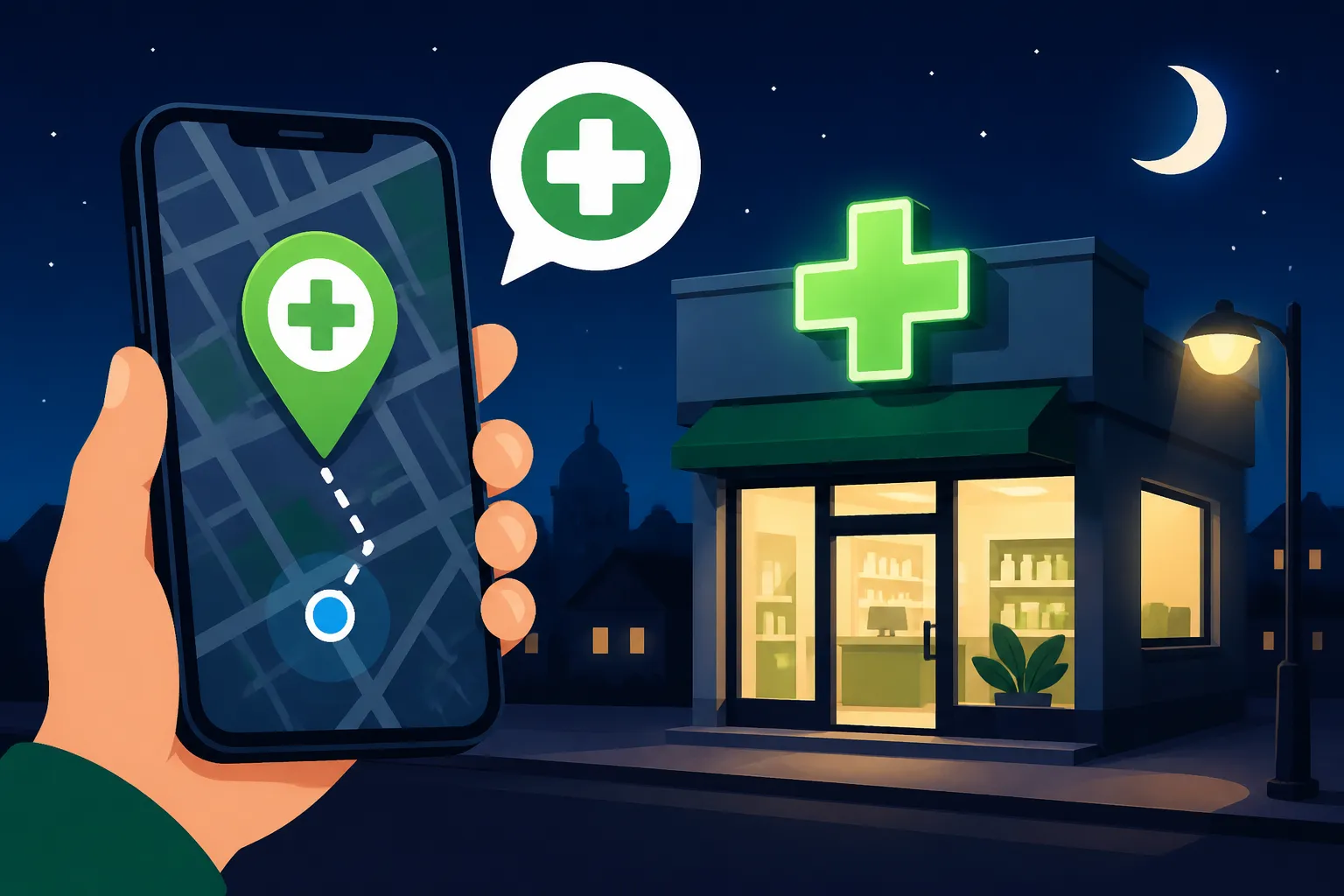
- Use a pharmacy-finder app. Several Italian apps show duty pharmacies by GPS. They are handy, but some depend on data that pharmacies update themselves, so treat the result as a lead to confirm, not as the final word.
- Phone ahead. If a number is listed, call before you leave the house. Ask simply: “Siete di turno stanotte?” (Are you on duty tonight?)
Comparing Your Options at a Glance
| Method | Reliability | Works Offline | Best For | Watch Out For |
|---|---|---|---|---|
| Notice on pharmacy door | Very high | Yes | Anyone, anywhere | You have to physically get to a pharmacy first |
| Provincial Federfarma website | High | No | Planning before you leave home | Site layout varies by province, mostly in Italian |
| Comune or regional health portal | High | No | Residents who know their local site | Can be hard to navigate on a phone |
| Local newspaper listing | Good | Print edition, yes | Small towns, older neighbours | Covers only that paper’s area |
| Pharmacy-finder apps | Variable | No | Quick searches in cities | Data can be outdated |
| Google Maps opening hours | Low for night duty | No | Normal daytime hours only | Rarely reflects the rotating rota |
| Phoning the pharmacy | Very high once you have a number | Phone signal needed | Confirming before a long drive | Rural on-call numbers may divert to a mobile |
A Realistic Scenario in a Small Town
Say you live outside Spoleto in Umbria and your partner’s asthma inhaler runs out on a Saturday night. Your village pharmacy is shut. You drive to it anyway, because the door notice is the fastest source, and it says the duty pharmacy is in a neighbouring village and serves “a chiamata”. There is a mobile number on the sheet. You call, explain slowly, and the pharmacist agrees to meet you at the shop in fifteen minutes. That is how rural night service often works: personal, a little informal, and completely dependent on a sheet of paper on a door.
Keep a photo of the rota for your area on your phone. When the monthly sheet goes up at your local pharmacy, take a picture. It costs nothing and saves a frantic search at midnight.
What to Expect When You Get There
Finding the pharmacy is half the job. The other half is the visit itself, which can feel odd the first time.
Ringing the Bell and Being Served Through a Hatch
At many night pharmacies, especially in cities, you will find the shutters half down and a lit sign by a bell, often labelled “campanello” or “servizio notturno”. Ring it and wait. The pharmacist may take a minute or two. You will then be served through a small window or a security drawer. This is standard practice for staff safety and does not mean anything is wrong.
Be ready to explain briefly what you need. Night pharmacists are there for urgent needs: fever reducers, rehydration salts, an antibiotic someone was prescribed that afternoon, a replacement inhaler, emergency contraception, or advice on whether a symptom needs a doctor. Don’t use it to restock vitamins or skincare. If your Italian is basic, write down the name of the active ingredient, not the brand from home, because brand names often differ in Italy. Practising a few phrases helps, and Medical Italian Practice: Rehearsing Symptoms Before You Need To has phrases you can rehearse in advance.
Useful phrases:
- “Ho bisogno di qualcosa per la febbre.” (I need something for a fever.)
- “È per un bambino di tre anni.” (It’s for a three-year-old child.)
- “Ho una ricetta elettronica.” (I have an electronic prescription.)
- “È allergico a…” (He or she is allergic to…)
Prescriptions, Over-the-Counter Medicines, and Your Health Card
Italian pharmacies split medicines into prescription-only products, pharmacy-only products sold over the counter after a chat with the pharmacist, and freely available items. Many common products that sit on supermarket shelves in the UK or US are only sold over the pharmacy counter in Italy. To understand what you can get without a doctor, see What Over-the-Counter Medicines Can You Buy in Italy?
If you have a prescription, the night pharmacy can usually fill it like any other. Italian prescriptions now mostly come electronically, as a code sent by text or email and linked to your codice fiscale. For the difference between the red, white and electronic forms, read Prescriptions in Italy: Ricetta Rossa, Bianca, and Dematerializzata. Bring your Tessera Sanitaria if you have one, because it lets the pharmacist pull up the electronic prescription and print a receipt that counts towards your tax deductions. If you are still waiting for your card, Obtaining the Italian Health Card (Tessera Sanitaria) covers the process.
A foreign prescription is a different matter. An Italian pharmacist cannot always honour it, and at night your options are even narrower. If you take a regular medication, sort out an Italian prescription early. See Bringing Prescription Medications into Italy before you run low.
When the Pharmacy Is Not the Right Place
Pharmacists in Italy are well trained and often the most approachable health professionals you will meet. But a pharmacist cannot examine a child with a stiff neck, judge a deep cut, or treat chest pain. At night, the route depends on how serious the problem is:
- Life-threatening symptoms, such as chest pain, breathing difficulty, signs of stroke, heavy bleeding or loss of consciousness: call 112 immediately. How to Call 112 in Italy: What to Say and What Happens explains the call step by step.
- Urgent but not life-threatening problems, such as high fever, an ear infection, or a minor injury you are unsure about: contact the Guardia Medica, the after-hours medical service run by the local health authority. A doctor can advise by phone, see you at the clinic, or sometimes write a prescription that you then take to the duty pharmacy. See After-Hours Care in Italy: Guardia Medica Explained.
- Simple needs you already understand, such as a known allergy, a headache, or a refill of something you have been prescribed: go straight to the farmacia di turno.
For the wider picture of nights and weekends, Emergency Medical Care at Night or Weekends in Italy ties all these services together.
What a Night Pharmacy Visit Costs and How to Handle Insurance
Money is where expats tend to feel cheated. They pay a few euros extra at 2 a.m., don’t understand why, and leave convinced the pharmacist made up a “tourist tax”. There is a nationally fixed surcharge, but it only applies in specific circumstances.
The Night Call Surcharge Explained
Italian pharmacies can charge a fixed service fee, the diritto di chiamata or diritto addizionale, for dispensing outside normal hours. The amounts were set by a Ministry of Health decree of 22 September 2017 and are the same across the country.
The fee only applies when the pharmacy serves you a battenti chiusi (doors closed, through the hatch) or a chiamata (on call, with the pharmacist coming in for you). If the duty pharmacy has its doors open and you walk in normally, the surcharge should not appear.
| Situation | Type of Pharmacy | Surcharge |
|---|---|---|
| Night dispensing, closed doors or on call | Urban pharmacy | €7.50 |
| Night dispensing, closed doors or on call | Non-subsidised rural pharmacy | €7.50 |
| Night dispensing, closed doors or on call | Subsidised rural pharmacy | €10.00 |
| Daytime closing hours, closed doors or on call | Subsidised rural pharmacy | €4.00 |
| Any time, doors open for normal service | Any pharmacy | No surcharge |
A subsidised rural pharmacy, or farmacia rurale sussidiata, is one in a small, sparsely populated area that gets public support to stay open. The slightly higher night fee there reflects the reality that the pharmacist may be driving in from home to serve one patient. Back to the Umbrian example: if that village pharmacy is a subsidised rural one and the pharmacist comes in at night, €10.00 is the correct surcharge. If it had been a Saturday afternoon during daytime closing, it would have been €4.00.
The surcharge is separate from the cost of the medicine itself. Prescription co-payments vary by region and by whether the medicine is covered by the national health service, so check your regional health service’s own pages for those amounts. For how pharmacists can charge for services more broadly, see Consulting a Pharmacist in Italy: Fees and Regulations.
Keeping Receipts for Tax and Insurance Claims
Ask for a “scontrino parlante”, a receipt that shows your codice fiscale and describes the medicine. Residents filing an Italian tax return can generally claim medical expenses, and this receipt is what supports the claim. If your pharmacist scans your Tessera Sanitaria, the receipt is usually set up correctly without you asking.
If you rely on private or international cover, the receipt matters even more. Expats on an international health plan such as Cigna Global, and digital nomads on a policy like SafetyWing, often pay at the counter and claim afterwards. Insurers usually want an itemised receipt, the prescription that led to the purchase, and sometimes a note from the doctor. Whether over-the-counter items or the night surcharge are reimbursed depends entirely on your policy wording, so read the outpatient and prescription sections of your own plan rather than assuming. For the step-by-step claims process, see Prescription Costs in Italy Without SSN Cover: Reimbursement Walkthrough.
Pros and Cons of the Italian Duty System
It helps to see the system fairly, frustrations included.
Pros
- Coverage reaches small villages, not just big cities, because every area has to be covered by the rota.
- Pharmacists are highly trained and give real clinical advice, often in a calm, personal way.
- The night surcharge is low, fixed nationally, and limited to closed-door or on-call service.
- The paper notice on every pharmacy door works without data, apps or Italian-language websites.
Cons
- The duty pharmacy changes, so last week’s knowledge is useless tonight.
- Online maps and some apps are unreliable for rotating night duty.
- In rural areas the nearest duty pharmacy may be a drive away, which is hard without a car.
- Language can be a real barrier through a small hatch at midnight, especially when you are stressed.
A Quick Preparation Checklist for New Arrivals
Do these in your first weeks in Italy, before you need them:
- Photograph the duty rota on your nearest pharmacy’s door and update the photo each time a new one goes up.
- Save the provincial Federfarma duty pharmacy page and your comune’s health page as bookmarks.
- Save the Guardia Medica contact for your area in your phone, along with 112.
- Keep a small home kit: a fever reducer suitable for every family member, rehydration salts, plasters, and any regular medication with at least a week’s buffer.
- Write the active ingredients of your regular medicines on a card in Italian.
- Keep your Tessera Sanitaria or codice fiscale details in your wallet so the pharmacist can issue a proper receipt.
- If you use private or international cover, save your insurer’s claims contact and note what documents they ask for.
The first night you have to find a farmacia di turno is stressful. After that, the photo of the rota on your phone and a couple of rehearsed phrases make it routine.
Disclaimer
This article is for general informational purposes only and does not constitute professional advice. Laws, prices and regulations vary by location and change over time. Consult a qualified professional for guidance on your specific situation.