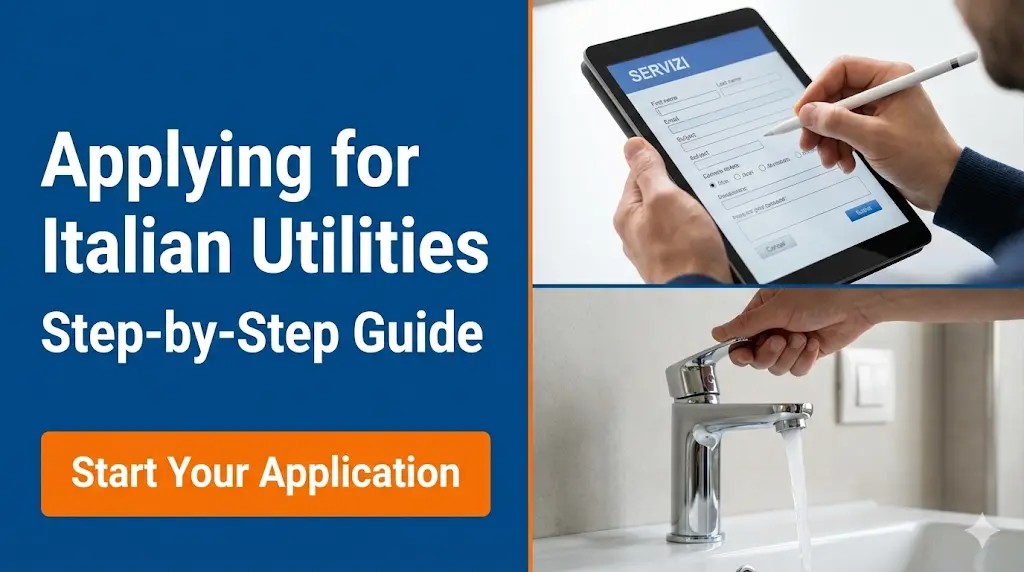
Applying for Utility Services in Italy: Step-by-Step
Moving to Italy? This comprehensive step-by-step guide explains how to apply for essential utility services, including electricity, gas, water, and internet. Learn the critical differences between voltura and subentro, understand the Italian energy market, and discover how to automate your monthly bill payments.
Disclosure: This post may contain affiliate links. We may earn a commission at no extra cost to you if you make a purchase through these links. Read full disclosure.
Introduction to Applying for Utility Services in Italy
In Italy, utility services—collectively known as utenze—are rarely left active between tenants. When a previous occupant moves out, they typically close their accounts to avoid paying standing charges on an empty property. As a new resident, the responsibility of setting up the domestic infrastructure falls entirely on your shoulders.
For foreigners, applying for utility services in Italy can initially feel like navigating a dense administrative maze. The process involves interacting with multiple different regional and national companies, deciphering highly technical Italian vocabulary, and providing a very specific set of legal documents before a single watt of electricity is permitted to flow into your home. Furthermore, the Italian energy market operates differently than those in North America or the UK, featuring unique concepts like legally binding “committed power” limits that can easily trigger blackouts if misunderstood.
However, there is no need to panic. The system, while highly structured, follows a very logical set of rules. Once you understand the baseline terminology and prepare your documentation in advance, the activation process becomes a simple, step-by-step administrative task.
This exhaustive guide is designed to completely demystify the process of setting up your household utilities in Italy. We will walk you through the essential prerequisites, decode the crucial differences between connection types, and provide detailed instructions for activating your electricity, gas, water, and internet. Finally, we will explain the various methods available for paying your monthly bills so you can maintain a comfortable, fully functioning Italian home without unnecessary stress.
Phase 1: The Essential Paperwork
In Italy, you cannot simply pick up the phone, call an energy provider, and ask them to switch the power on under your name. The Italian government strictly regulates utility contracts to prevent fraud, tax evasion, and illegal squatting. Before you even attempt to contact a utility supplier, you must assemble a “dossier” of specific personal and legal documents.
If you are missing even one of these items, the utility company will halt your application. Ensure you have physical and digital copies of the following:
1. The Codice Fiscale
This is the absolute cornerstone of your life in Italy. The Codice Fiscale is a unique, alphanumeric tax identification number assigned by the Agenzia delle Entrate (Italian Revenue Agency). It is the Italian equivalent of a National Insurance Number or a Social Security Number. You cannot sign a utility contract, rent an apartment, or even buy a local SIM card without it. If you have not yet secured this vital document, you must prioritize it immediately. Read our comprehensive guide on Why Codice Fiscale Is Essential for Foreigners in Italy to understand how to apply for one at your local consulate or tax office.
2. Valid Identification
You must provide a valid form of government-issued identification. For non-EU citizens, a current passport is mandatory. For EU citizens, a national identity card (Carta d’Identità) is perfectly acceptable.
3. Proof of Property Occupancy
Utility providers are legally obligated to verify that you have the right to occupy the property. If you are renting, you must provide a copy of your officially registered rental contract (contratto di locazione). If you are purchasing the home, you must provide the property deed (rogito) or a preliminary sales agreement. To better understand the legal frameworks of housing agreements, review Italian Rental Contracts Explained: 3+2, 4+4, Transitorio.
4. A European Bank Account (IBAN)
While you can technically pay your bills manually at the post office, the vast majority of utility providers will strongly encourage (or outright require) you to provide an IBAN for direct debit payments (domiciliazione bancaria). Establishing an automated payment system is the safest way to ensure your services are never disconnected due to a missed international mail delivery. If you are struggling to navigate the local banking sector, explore our detailed breakdown on How to Open a Bank Account in Italy: Requirements and Tips.
Phase 2: Decoding the Terminology (Voltura vs. Subentro)
When you contact an Italian utility company, the very first question the representative will ask you is whether you need a voltura, a subentro, or an allacciamento. Knowing the correct answer is the single most important part of the application process.
Using the wrong term will immediately derail your application. These three terms dictate the physical state of the meters in your new home.
1. Voltura (Account Transfer)
A voltura is the absolute best-case scenario for a new arrival. This term applies when the utility meters in the home are physically present, active, and energy is currently flowing, but the contract is still registered in the name of the previous tenant or the previous owner.
To execute a voltura, you are simply requesting an administrative name change on the existing contract. The beauty of the voltura is that there is absolutely no interruption to the energy supply. You move in, the lights work, and the billing seamlessly transitions from the old occupant to you.
To complete this process, you must obtain a copy of the previous occupant’s most recent utility bill. This bill contains their account number and the specific meter identification codes needed to link the physical hardware to your new name.
2. Subentro (Reactivation)
A subentro is necessary when the physical meters are present in the home, but the previous occupant officially canceled their contract and the utility company deactivated the supply. In this scenario, your new apartment will not have functioning electricity or gas.
You must contact a supplier and request a subentro to reactivate the meters. Because the service is currently “off,” this process takes time. By law, energy providers have a specific number of working days to turn the power back on. For electricity, it typically takes up to 7 working days. For gas, the process can take up to 12 working days because it often requires a technician to physically visit the property to remove a safety seal from the gas valve. You must plan your move-in date accordingly.
3. Allacciamento (New Connection)
An allacciamento (or simply allaccio) is required if you are moving into a brand-new construction or a heavily renovated historic property that has never been connected to the national energy grid.
In this scenario, there are no meters present. You must request that the local distributor physically lay new cables or pipes and install the meter boxes. This is a complex, expensive, and time-consuming infrastructural process. Depending on the complexity of the excavation work required, an allacciamento can take anywhere from 10 to 60 working days to complete.
Quick Reference Guide: Connection Types
| Italian Term | Current Status of the Meter | Action Required | Timeframe |
| Voltura | Present and Active | Administrative name change only. | Immediate (No supply interruption). |
| Subentro | Present but Deactivated | Remote or physical reactivation. | 5 to 12 working days. |
| Allacciamento | Not Present (No connection) | Physical installation of cables/pipes. | 10 to 60 working days. |
Phase 3: Activating Electricity (Luce)
Electricity (luce or energia elettrica) is the primary utility you must secure. Italy boasts a fully liberalized energy market, meaning you have the freedom to choose your retail electricity supplier.
Choosing a Provider
While the physical power lines in your neighborhood are maintained by a single local distributor (often E-Distribuzione), the company that actually sends you the monthly bill is a retail supplier. There are dozens of private and public-hybrid companies competing for your business. The largest and most historic national provider is Enel, but other major competitors include A2A, Edison, Eni (Plenitude), and E.ON. You can easily register with these companies online, over the phone, or by visiting a local storefront.
The Essential POD Code
To set up your electricity account, the provider will demand your POD (Punto di Prelievo). The POD is a unique, 14-character alphanumeric code that permanently identifies the specific physical location of your electricity meter on the national grid. It always begins with the letters “IT”.
If you are performing a voltura, the POD is printed clearly on the previous tenant’s bill. If you are performing a subentro and do not have an old bill, you must physically locate the digital meter box (often found in the basement, the ground floor stairwell, or a specific closet in your apartment building) and press the button on the display until the 14-character POD code scrolls across the screen.
Understanding Committed Power (Potenza Impegnata)
This is the most crucial cultural difference for expats coming from countries with robust electrical grids. In Italy, your electricity contract dictates a strict maximum limit on the amount of power you can draw at any single moment, known as the potenza impegnata (committed power).
For a standard Italian residential home, the default committed power is usually just 3 kilowatts (kW). (Some very small apartments even default to 2 kW).
If you attempt to run a washing machine, a dishwasher, and a hair dryer at the exact same time, you will immediately exceed the 3 kW limit. When this happens, the master switch on your meter will physically trip, plunging your apartment into darkness until you unplug an appliance and manually reset the breaker.
If you are living in a large villa, rely on electric heating/air conditioning, or use power-hungry appliances, a 3 kW limit will be incredibly frustrating. Fortunately, you can request a power upgrade from your supplier to 4.5 kW or 6 kW. Be aware that requesting a higher power threshold permanently increases the fixed distribution charges on your monthly bill.
Phase 4: Activating Gas (Gas Metano)
While modern Italian homes are slowly shifting toward electric induction stoves and heat pumps, traditional mains gas (gas metano) remains heavily utilized across the country for central heating, hot water boilers, and stovetop cooking.
Choosing a Gas Provider
The retail market for gas operates exactly like the electricity market. In fact, the major suppliers (such as Enel, Eni, and Iren) sell both commodities. It is highly recommended to sign a “dual fuel” contract, purchasing both your electricity and gas from the same provider. This simplifies your administrative life, allowing you to manage both utilities through a single app and a single direct debit mandate.
The Essential PDR Code
Just as electricity requires a POD, the gas network requires a PDR (Punto di Riconsegna). The PDR is a unique 14-digit numerical code that permanently identifies your specific gas connection point. Like the POD, it does not change even if you switch retail suppliers. You can find the PDR on an old gas bill.
Safety Certifications for New Activations
Gas connections in Italy are subject to extremely rigorous safety regulations to prevent catastrophic leaks. If you are requesting a new allacciamento (new connection) or reactivating a meter that has been heavily modified, the gas company will not simply turn on the supply.
You must hire a certified, registered installation company to inspect your internal pipes, your stove, and your boiler. This technician must complete and sign strict technical certification documents, specifically known as Annex H/40 and Annex I/40. These documents prove to the distributor (such as Italgas) that your home’s internal system complies with all national safety standards. Only after these forms are submitted and approved will a technician arrive to remove the physical safety seal from your meter.
Furthermore, Italian law dictates that residential gas boilers (caldaie) must undergo mandatory maintenance and exhaust inspections every one to two years. As a tenant, paying for this regular boiler inspection is your legal responsibility.
Phase 5: Managing Water (Acqua) and Waste (TARI)
Unlike electricity and gas, you cannot shop around for your water or waste disposal providers. These services are geographically monopolized and managed by regional public or public-private hybrid companies (such as ACEA in Rome, Publiacqua in Florence, HERA in Emilia-Romagna, or Acquedotto Pugliese in Puglia).
Water Services in Condominiums
Before you attempt to set up a water account, you must ascertain the specific plumbing infrastructure of your building. In a vast number of Italian multi-unit apartment buildings (condomini), the water supply is centralized.
If your building has centralized water, there is only one massive master water meter for the entire structure. In this highly common scenario, you do not need to contact the water company or set up an individual account. The building administrator pays the master bill and simply divides the cost among the residents, billing you directly through your monthly condominium fees (spese condominiali). To access water, you simply locate the master valve inside your apartment and turn it on.
If you rent an independent house, a villa, or a modernized apartment with an independent meter, you must contact the local regional water authority to perform a voltura or subentro, providing your Codice Fiscale and ID just as you did for electricity.
The Municipal Waste Tax (TARI)
Garbage collection and recycling are managed by the local municipality (Comune). Waste disposal is not billed as a standard monthly utility; instead, it is levied as an annual or biannual local tax known as the TARI (Tassa sui Rifiuti).
You are legally required to register your occupancy with the local municipal tax office shortly after moving in. The TARI bill is calculated based on two distinct factors: the total square meterage of your property and the number of people living in the household. The local government will physically mail you the TARI payment slips. To ensure you understand all the localized fiscal duties associated with occupying a home, refer to our comprehensive breakdown on Understanding Local Property Taxes: IMU, TASI, etc..
Phase 6: Setting Up Internet and Wi-Fi
Italy has aggressively modernized its telecommunications infrastructure over the last decade, with high-speed fiber optic networks rapidly replacing older copper ADSL lines in major urban centers.
The primary national internet service providers include TIM (formerly Telecom Italia), Vodafone, Fastweb, and WindTre.
The Application Process
Setting up a home broadband connection is generally straightforward. You can compare packages online and apply directly through the provider’s website, or visit one of their retail stores in person. You will need to provide your ID, Codice Fiscale, billing address, and your bank IBAN for direct debit.
If the previous tenant had an active internet line and you wish to take it over (a voltura), you must obtain their Codice di Migrazione (Migration Code). This is an 18-digit alphanumeric code found on their internet bill that unequivocally identifies the specific physical phone line tied to the apartment. Providing this code to your new chosen provider expedites the transfer process significantly.
Managing Installation Timelines
If your apartment requires a new physical fiber line to be pulled from the street cabinet into your living room, you must schedule an appointment for a technician to visit. Depending on the provider’s backlog, this installation can take anywhere from one to three weeks.
To bridge this gap and ensure you have connectivity on your very first day in the apartment, many expats rely on alternative solutions. Purchasing a local Italian SIM card with a massive 100GB to 300GB data allowance allows you to use your smartphone as a temporary hotspot. Alternatively, you can utilize modern digital eSIM providers or rent a pocket Wi-Fi device to maintain a strong connection while you wait for your permanent home router to be installed.
Phase 7: How to Pay Your Utility Bills (Bollette)
Once your services are successfully activated, the final step is establishing a reliable system to pay your ongoing invoices (bollette). Utility bills in Italy are typically issued bimonthly (every two months), though some providers have shifted to monthly billing.
The Italian billing system offers several payment methods, catering to both traditional preferences and modern digital banking.
1. Domiciliazione Bancaria (Direct Debit)
This is unequivocally the most efficient, secure, and highly recommended payment method for expatriates. By providing your bank IBAN to the utility company, you authorize them to automatically withdraw the exact amount of the bill from your account on the due date via the SEPA Direct Debit (SDD) system.
Automating your payments ensures you never miss a deadline due to lost mail, extended travel, or forgetting to log into a portal. Furthermore, many utility providers offer financial incentives for choosing direct debit, such as waiving the mandatory security deposit required during the initial contract signing.
2. The Traditional Bollettino
If you prefer to manually control your outgoing cash flow, you can choose to receive paper bills in the mail. Attached to the bottom of the bill, you will find a bollettino postale (a standardized payment slip).
You can take this physical slip and pay it in person using cash or a credit card at any Poste Italiane (post office) branch. Alternatively, for ultimate convenience, you can pay the bollettino at almost any authorized local Tabaccheria (tobacco shop displaying a large “T” sign). The clerk will scan the barcode on the slip, process your payment, and hand you a stamped receipt. Be aware that paying via this method incurs a small convenience fee, usually ranging from €1.50 to €2.50 per bill.
3. PagoPA and Online Portals
Italy has rapidly integrated its public and private billing into a unified digital platform known as PagoPA. Most modern utility bills include a PagoPA QR code or notice code. You can scan this code directly within your Italian banking app, through the national “IO” app, or via dedicated payment apps like Satispay, allowing you to settle the invoice instantly from your smartphone. Additionally, all major utility providers maintain robust online customer portals and mobile apps where you can view your consumption history and pay bills instantly using a standard credit card.
Conclusion
Securing your utility services in Italy is an undeniable rite of passage. It tests your patience, introduces you to the precise, bureaucratic vocabulary of the Codice Fiscale and the voltura, and requires a proactive approach to document management. While the initial setup phase—navigating POD codes, power limits, and gas safety certifications—may feel overwhelming to a newcomer, it is a highly structured system that works reliably once the rules are understood.
By demanding previous bills from your landlord to facilitate a seamless voltura, prioritizing a “dual fuel” contract to minimize administrative clutter, and automating your payments through a direct debit mandate, you can entirely bypass the stress of managing Italian bollette. With your electricity flowing, your radiators warming the rooms, and your internet router blinking green, your empty Italian apartment will finally transform into a comfortable, welcoming home.
References
Primary sources (official)
- Italgas – Official guidelines on gas network connection, mandatory safety certifications (Annex H/40 and I/40), and meter activation: https://www.italgas.it/en/clients/connection-activation/
- Banca d’Italia – Official explanation of the SEPA Direct Debit (SDD) system and automating regular payments: https://economiapertutti.bancaditalia.it/aree-tematiche/pagamenti/addebito-diretto/index.html?com.dotmarketing.htmlpage.language=3
Other helpful sources
- Expatica – Setting up utilities in Italy: water, gas, and electricity (Providers, tariffs, and required documentation): https://www.expatica.com/it/living/household/utilities-in-italy-81481/
- Luce-gas.it – Are you moving to Italy? Here is what you need to do for electricity (Detailed breakdown of Voltura vs Subentro and POD codes): https://luce-gas.it/english/moving-italy-electricity-gas-connection-new-home
Disclaimer
The information provided in this article is intended for educational and informational purposes only and does not constitute official legal, financial, or administrative advice. Italian utility regulations, safety certification requirements (such as Annex H/40), national energy market tariffs, and localized municipal waste tax (TARI) calculations are subject to frequent legislative and procedural changes. Always verify current application requirements directly with your chosen retail energy provider, your local water authority, or your building administrator before signing contracts or authorizing direct debit mandates.