Moving to Italy Checklist: Essential Tasks
Relocating to Italy is an incredible adventure, but the bureaucratic hurdles can be overwhelming. This comprehensive moving to Italy checklist covers essential tasks like securing visas, finding housing, obtaining a tax code, and setting up healthcare for a smooth transition.
Disclosure: This post may contain affiliate links. We may earn a commission at no extra cost to you if you make a purchase through these links. Read full disclosure.
Introduction to Moving to Italy Checklist
Behind the romantic facade of the Italian lifestyle lies a famously complex and highly structured bureaucratic system. Relocating to Italy is not simply a matter of booking a flight and finding a charming apartment. The immigration process, housing market, and local administrative requirements demand a proactive and organized approach. Many expatriates arrive entirely unprepared for the sheer volume of paperwork, the specific timelines required for legal residency, and the nuances of Italian civic duties.
A successful relocation hinges on knowing exactly what to do and, crucially, when to do it. Missing a single deadline for your residence permit or failing to legalize a vital document before leaving your home country can result in costly delays, legal headaches, and immense frustration. To prevent these pitfalls, you need a robust, timeline-driven strategy.
This guide serves as your ultimate moving to Italy checklist. We have organized these essential tasks chronologically, starting from a year before your planned departure all the way through your first six months in your new Italian home. We will cover the complexities of securing your visa, the realities of the Italian housing market, the logistics of international shipping, and the critical administrative steps you must take upon arrival, such as obtaining your tax code and registering for healthcare. By following this comprehensive roadmap, you can transform the daunting prospect of international relocation into a manageable, step-by-step journey, allowing you to focus on the joy of your new Italian life.
Phase One: Six to Twelve Months Before Moving
The foundation of a successful move to Italy is laid months before you ever set foot on a plane. This phase is dedicated to extensive research, securing your legal right to enter the country, and establishing a realistic budget.
Research and Determine Your Visa Pathway
Unless you hold an Italian passport or citizenship from another European Union member state, you cannot simply move to Italy. You must secure a long-stay visa (Visa D) before you leave your home country. This is the most critical and time-consuming step of your entire relocation. Italy offers several visa categories, each with its own strict requirements:
- Work Visa: If you have secured employment with an Italian company, your employer must apply for authorization (Nulla Osta) through the local immigration office. Once approved, you can apply for the visa. For a deep dive into this process, review our guide on How to Obtain an Italian Work Visa.
- Elective Residence Visa: Often called the retirement visa, this is for individuals who have substantial, documented passive income (such as pensions or real estate investments) and do not need to work in Italy.
- Digital Nomad Visa: Recently introduced, this visa targets highly skilled remote workers and freelancers who earn their income from sources outside of Italy.
- Student Visa: For those enrolled in an accredited Italian educational institution.
You must identify which consulate serves your current jurisdiction and carefully review their specific checklist, as requirements can vary slightly between consulates.
Check Passport Validity and Gather Official Documents
Your passport must be valid for at least three months beyond the intended expiration date of your visa, though having at least a year or two of validity is highly recommended.
This is also the time to start gathering vital records. You will likely need your birth certificate, marriage certificate, and criminal background checks. For Italian authorities to accept these foreign documents, they usually must carry an Apostille (an international certification) and be translated into Italian by a certified translator. Obtaining Apostilles from various government agencies can take several weeks or even months, so initiate this process early.
Create a Comprehensive Relocation Budget
Moving internationally is expensive. Beyond flights and shipping costs, the Italian system requires significant upfront capital. When securing a long-term rental, landlords typically require a security deposit equal to two or three months of rent. Additionally, if you use a real estate agency to find your home, the standard agency fee is usually equal to one month’s rent plus VAT. You must also budget for initial hotel or Airbnb stays upon arrival, visa application fees, and the cost of buying furniture, as many Italian apartments are rented completely bare.
Phase Two: Three to Six Months Before Departure
With your visa application in motion, you must turn your attention to the logistics of moving your life across the globe.
Begin Your Housing Search
The Italian housing market moves quickly, and finding a long-term rental from abroad is notoriously difficult. Many landlords prefer to meet prospective tenants in person and may hesitate to sign a contract with someone who does not yet have an Italian bank account or a tax code.
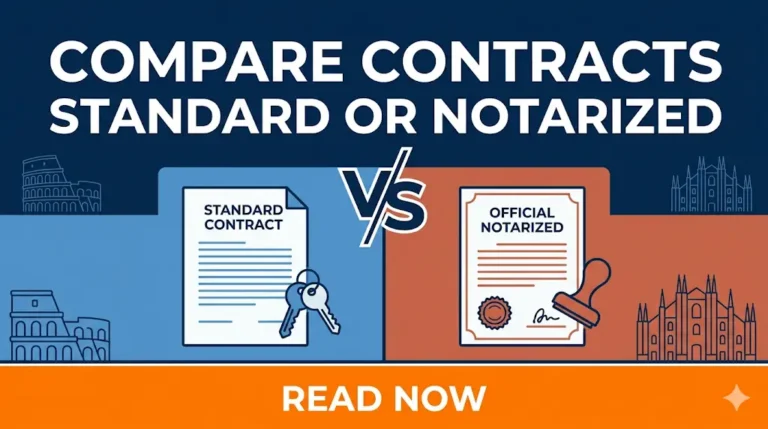
During this phase, you should familiarize yourself with different neighborhoods in your target city, understand the current market rates, and learn the difference between various Italian rental contracts (such as the standard 4+4 contract or the transitory contract). Consider booking a short-term rental or an Airbnb for your first month in Italy. This gives you a home base to conduct in-person viewings and secure a permanent residence without rushing into a bad contract. For a thorough understanding of the property market, read The Ultimate Guide to Renting and Buying a Home in Italy.
Plan Your International Shipping
Decide what you are taking with you and what you are leaving behind. If you are shipping furniture and household goods, begin securing quotes from international moving companies. Sea freight is more economical but can take anywhere from six to twelve weeks to arrive. Air freight is faster but significantly more expensive.
Be aware of Italian customs regulations. If you are moving your primary residence to Italy, you can usually import your used personal belongings and household goods tax-free, provided you have owned them for at least six months and you import them within a specific timeframe of establishing your residency. You will need to prepare a detailed, itemized inventory of everything you are shipping.
Prepare Your Pets for Relocation
If you are bringing furry family members, the preparation must start now. Italy requires all pets entering the country from outside the EU to be microchipped and vaccinated against rabies. The rabies vaccination must be administered at least 21 days before travel.
Depending on your country of origin, you may also need a rabies titer test, which must be performed months in advance. You will also require a specific EU health certificate issued by an accredited veterinarian and endorsed by your home country’s agricultural or animal health department just days before you fly. Research airline pet policies thoroughly, as some carriers have breed restrictions or temperature embargoes.
Phase Three: One to Two Months Before You Leave
The countdown has begun. This phase is about tying up loose ends in your home country and preparing your essential arrival documents.
Attend Your Visa Appointment
If you have not already done so, attend your in-person visa appointment at the Italian consulate. Ensure your dossier of documents is flawlessly organized exactly as the consulate requested. Once your visa is approved, the consulate will affix the visa vignette into your passport. Guard this carefully.
Manage Your Finances and Healthcare
Notify your current banks and credit card companies that you will be moving to Italy to prevent your cards from being blocked for suspicious international activity. Look into opening a multi-currency account or using international money transfer services with low exchange rates to move your initial funds to Italy.
Furthermore, ensure you have travel health insurance that covers you for your first few months in Italy. While you will eventually register for the Italian national healthcare system, you need private coverage to bridge the gap and satisfy the immigration requirements upon entry.
Cancel Subscriptions and Redirect Mail
Begin the tedious process of canceling your domestic utilities, gym memberships, mobile phone plans, and streaming services that are geo-restricted. Set up mail forwarding with your local postal service to ensure any final tax documents or important correspondence reaches you or a trusted family member.
Pack an Essentials Arrival Bag
When you pack your suitcases, create a dedicated folder for all your important physical documents: passport with visa, birth and marriage certificates, employment contracts, medical records, and pet health certificates. Pack a bag with enough clothes, medications, and essential electronics to survive for a few weeks in case your shipped boxes are delayed at customs.
Phase Four: The First Eight Days in Italy
Welcome to Italy! The moment you pass through customs, a legal countdown begins. The first week is an administrative sprint.
Obtain Your Codice Fiscale
The Codice Fiscale is an alphanumeric Italian tax identification number. It is arguably the most important piece of paper you will acquire in Italy. Without it, you cannot sign a lease, open a bank account, set up utilities, buy a car, or register for healthcare.
You can sometimes obtain this through your consulate before leaving, but if not, you must visit the local Agenzia delle Entrate (Revenue Agency) upon arrival. You will need to bring your passport, a photocopy of your passport and visa, and the specific application form. To fully understand the scope and necessity of this document, refer to Why Codice Fiscale Is Essential for Foreigners in Italy.
Apply for Your Permesso di Soggiorno
Your visa allowed you to enter the country, but your Permesso di Soggiorno (Residence Permit) allows you to stay. By law, non-EU citizens must apply for their residence permit within exactly eight days of arriving in Italy.
The application process is unique. You must go to a designated Poste Italiane (Post Office) that features a “Sportello Amico” counter and ask for the “Kit Giallo” (Yellow Kit). This kit contains the application forms you must fill out. You will return the completed kit to the post office along with photocopies of your entire passport, your visa, supporting documents for your visa type, and a specific revenue stamp (Marca da Bollo) which you must purchase at a local tobacco shop.
When you submit the kit, you will pay administrative fees and receive an incredibly important receipt (Ricevuta). This receipt is your temporary proof of legal status. You will also be given an appointment date to visit the local Questura (Police Headquarters) for fingerprinting and final processing.
Phase Five: The First Thirty Days
With your immediate immigration tasks out of the way, you can focus on establishing the foundation of your daily life.
Open an Italian Bank Account
To pay your rent, receive a salary, or set up automated utility payments, you need an Italian bank account (Conto Corrente). Opening an account as a foreigner can be challenging, as many banks require you to have your official residency established first. However, some banks will open a “non-resident” account for you if you provide your Codice Fiscale, passport, and proof of income. Be prepared for a lengthy, in-person appointment involving dozens of signatures.
Secure Long-Term Housing and Set Up Utilities
If you arrived in a temporary Airbnb, it is time to finalize your long-term lease. Once you sign the contract, it must be officially registered with the Agenzia delle Entrate.
If you are moving into an unfurnished apartment, be aware that in Italy, “unfurnished” often means completely bare—no light fixtures, no appliances, and no kitchen cabinets. You will need to order these items immediately. Setting up utilities (electricity, gas, water, and internet) also requires your Codice Fiscale and a registered lease. The process involves either transferring the existing accounts into your name (Voltura) or reactivating disconnected meters (Subentro).
Register Your Residency (Iscrizione Anagrafica)
Once you have a permanent address, you must register as a resident at the local town hall (Comune) in the Anagrafe department. This process is called Iscrizione Anagrafica. You will need your passport, Codice Fiscale, registered rental contract, and your Permesso di Soggiorno (or the postal receipt proving you applied for it).
After you submit your application, the Comune will send a local police officer (Vigile) to your home unannounced within 45 days. The officer’s job is to verify that you actually live at the stated address. Make sure your name is clearly visible on the doorbell and the mailbox. Only after this verification is your residency officially confirmed.
Phase Six: Long-Term Integration Tasks
With your housing secured and your legal presence documented, you can tackle the final administrative hurdles that fully integrate you into the Italian system.
Enroll in the National Healthcare System (SSN)
Italy boasts a high-quality, universally accessible public healthcare system known as the Servizio Sanitario Nazionale (SSN). Once you have your official residency and your Permesso di Soggiorno, you can register with the local health authority (ASL).
Registration is mandatory and free for individuals with work visas or family visas. For those on elective residence or student visas, you can voluntarily opt into the system by paying an annual fee calculated based on your income. Upon registration, you will choose a primary care physician (Medico di Base) and receive your Tessera Sanitaria (Health Card) in the mail. For a complete breakdown of how to navigate this system alongside private alternatives, consult Getting Health Insurance in Italy: Public and Private Options.
Convert or Obtain an Italian Driver’s License
If you plan to drive, be aware of the strict rules for foreigners. Non-EU citizens can drive in Italy using their home country’s driver’s license, accompanied by an International Driving Permit, for up to one year after establishing residency.
After that first year, your foreign license is no longer valid. If your home country has a reciprocal agreement with Italy, you can simply convert your license. Unfortunately, many countries, including the United States, Canada, and Australia, do not have these agreements. Citizens of these countries must enroll in an Italian driving school (Autoscuola), pass a challenging theoretical exam in Italian, complete mandatory driving hours, and pass a practical driving test to earn an Italian license.
Register for Taxes and Learn the Culture
Finally, consult with an Italian commercialista (accountant) to understand your tax obligations. Italy taxes its residents on their worldwide income, but there are numerous beneficial tax regimes available for new residents, highly skilled workers, and retirees that can drastically reduce your tax burden.
Beyond the paperwork, dedicate this time to learning the language, exploring your neighborhood, and adapting to the cultural rhythms of your new home. Accept that bureaucracy will occasionally be frustrating, but patience and a polite demeanor will open many doors.
Moving to Italy Task Timeline
To help you visualize this complex process, refer to the following timeline summary.
| Relocation Phase | Essential Tasks to Complete |
| 6-12 Months Before | Determine visa type, renew passports, budget for moving costs, gather vital records. |
| 3-6 Months Before | Begin housing research, arrange pet vaccinations/passports, secure international moving quotes. |
| 1-2 Months Before | Attend consulate visa appointment, buy travel health insurance, cancel domestic subscriptions, book flights. |
| First 8 Days in Italy | Obtain Codice Fiscale, apply for Permesso di Soggiorno at the post office (Kit Giallo). |
| First 30 Days in Italy | Sign long-term lease, open an Italian bank account, set up utilities, apply for residency at the Comune. |
| Months 2 to 6 in Italy | Register for SSN healthcare, attend fingerprinting at Questura, begin driver’s license conversion process. |
Conclusion
Moving to Italy is an endeavor that requires immense patience, meticulous organization, and a healthy dose of resilience. The bureaucratic maze can seem impenetrable at times, but thousands of expatriates successfully navigate it every year. By utilizing a structured checklist, breaking the monumental task of relocation into manageable phases, and respecting the strict legal timelines for visas, permits, and residency registrations, you can minimize your stress and safeguard your legal status. Once the paperwork is filed, the utilities are connected, and the initial chaos subsides, you will finally have the freedom to embrace the incredible lifestyle, culture, and beauty that drew you to Italy in the first place.
References
Primary sources (official)
- Ministero degli Affari Esteri e della Cooperazione Internazionale (Ministry of Foreign Affairs) – Official visa portal detailing entry requirements for Italy: https://vistoperitalia.esteri.it/home/en
- Polizia di Stato – Official guidelines and procedures for the Permesso di Soggiorno (Residence Permit): https://www.poliziadistato.it/articolo/10617
Other helpful sources
- Expatica – A comprehensive guide to moving to Italy, covering housing, finance, and culture: https://www.expatica.com/it/moving/
- The Local Italy – News and practical advice for foreign residents navigating Italian bureaucracy: https://www.thelocal.it/
Disclaimer
The information provided in this article is for educational and informational purposes only and does not constitute official legal, immigration, or financial advice. Italian immigration laws, visa requirements, consular procedures, and local municipal regulations are subject to frequent changes. Always consult directly with the official Italian consulate in your jurisdiction, a certified immigration lawyer, or an authorized commercialista for personalized guidance regarding your specific relocation circumstances.