eSIM vs Italian Contract SIM for Long-Stay Visa Holders
Arriving in Italy on a long-stay visa is an exciting, often overwhelming, experience. You've navigated the labyrinthine visa process, perhaps even secured your Codice Fiscale, and now you’re finally here. But the moment you land, reality hits: you need to connect. You need data for maps, to call your landlord, to arrange appointments, and to let loved ones know you’ve arrived safely. This guide cuts through the confusion, helping you decide whether an eSIM, like the revolutionary Airalo, or a traditional Italian contract SIM is the best way to stay connected as you embark on your Italian adventure.
Disclosure: This post may contain affiliate links. We may earn a commission at no extra cost to you if you make a purchase through these links. Read full disclosure.
The Connectivity Conundrum for Long-Stayers
When you first land in Italy with your shiny new long-stay visa, the sheer volume of things to organize can feel like a tidal wave. Finding housing, registering your residency, starting the Permesso di Soggiorno application – it’s a lot. And amidst all this, the need for reliable phone service becomes immediately apparent. You can’t afford to be offline.
Why Just Any SIM Won't Do
You might think, "Oh, I'll just grab a cheap tourist SIM at the airport!" And for a short vacation, that’s perfectly fine. But as a long-stay visa holder, you're not a tourist. You're trying to build a life here. Tourist SIMs often have limited data, expire quickly, and don't always offer the kind of robust, long-term options you'll need for essential services, let alone the ability to set up direct debits for utilities or confirm appointments with a local phone number. Plus, they usually lack a proper Italian phone number that service providers here recognize as "local." You'll quickly find that many Italian services, from your Medico di Base to your internet provider, prefer or even require an Italian number.
The Initial Scramble: Tourist SIMs and Short-Term Fixes
I remember the initial panic myself. Landing at Fiumicino, exhausted, only to realize my international roaming was costing a fortune and I couldn't properly navigate the train schedule to my new, temporary apartment. Many expats initially rely on roaming, or purchase a pre-paid "tourist" SIM card from one of the major Italian providers like TIM, Vodafone, or WindTre right at the airport or a tabaccheria. These can work for a week or two, offering some data and limited calls. However, they are often more expensive per gigabyte than proper plans, and critically, they don't solve the long-term problem of needing a stable, locally-recognized number linked to your growing administrative life in Italy. You’re essentially kicking the can down the road, and believe me, you’ll have enough cans to kick already. This is where a truly innovative solution, like an eSIM from Airalo, can make those first few weeks immeasurably smoother.
Unpacking the Italian Contract SIM: The Traditional Route
For many years, the Italian contract SIM was the undisputed champion for anyone settling long-term. It offers stability, often better per-gigabyte rates, and all the "local" legitimacy you could ask for. But, oh, the journey to get one.
The Bureaucratic Gauntlet: What You'll Face
Getting a traditional Italian contract SIM is not a simple walk into a phone store, especially if you're a new arrival. You’ll be asked for a litany of documents. First and foremost, you absolutely need your Codice Fiscale (Italian tax code). This is non-negotiable for almost any official transaction in Italy, and that includes signing a phone contract. Then, you'll need a valid ID, usually your passport. Beyond that, many providers will require proof of Italian residency, which means presenting your Permesso di Soggiorno (or the receipt proving you've applied for it) or a certificato di residenza.
But wait, there's more! To set up a proper contract with a monthly direct debit, you’ll often need an Italian bank account. This, of course, means you’ve already been through the process of How to Open a Bank Account in Italy: Requirements and Tips. The whole process can feel like a classic Italian administrative dance: a lot of waiting, a lot of paperwork, and a fair bit of "computer says no" until you have every single document perfectly in order. It’s enough to make you pull your hair out, particularly if your Italian language skills aren’t quite up to snuff for dissecting complicated contract terms with a persistent sales assistant.
Understanding Contract Types and Providers
Once you've mustered all the required documents and braved the queues, you'll find a range of options from Italy's major mobile network operators: TIM, Vodafone, and WindTre (which now incorporates many former 3 Italia services). These are the big players, each offering various contract types tailored to different needs.
- TIM: Often seen as having the widest coverage, especially in rural areas, TIM offers a variety of plans with competitive data packages. They have strong customer service, though primarily in Italian. Their stores are ubiquitous, and they often have promotions for new customers.
- Vodafone: Known for its reliable network and often strong international call packages, Vodafone is another popular choice. They frequently have English-speaking support lines, which can be a godsend for new expats. Their plans can sometimes be a bit pricier but often come with good value for heavy data users.
- WindTre: This merged entity offers aggressive pricing, often providing a lot of data for a lower monthly fee. While their network coverage has improved significantly since the merger, it can still be a bit patchier than TIM or Vodafone in very remote regions. They are a good option if budget is a primary concern.
Beyond these giants, there are also smaller virtual network operators (MVNOs) like Iliad, Kena Mobile (TIM's MVNO), and Ho. (Vodafone's MVNO) that offer extremely competitive prices, often with simpler, no-frills plans. However, these typically operate exclusively online or through limited physical points, and their customer service might be entirely in Italian. Most offer both "ricaricabile" (pre-paid) options and proper monthly contracts. While pre-paid might seem easier, to get truly beneficial long-term rates and features like direct debit payments for things like Setting Up Utilities (Electricity, Gas, Water) in Italy, a contract is usually preferred.
The Long-Term Perks and Pitfalls
Once you're locked into an Italian contract SIM, there are definite advantages. You usually get a much better cost-per-gigabyte rate for data compared to tourist or short-term eSIM plans. You'll have a fully legitimate Italian phone number, which smooths out countless administrative interactions – from ordering online to registering with your local ASL for How to Register for Italian Healthcare (SSN) as a Foreigner. You also get predictable monthly billing, often with unlimited calls and texts within Italy. This consistency is invaluable when you're budgeting for Cost of Living in Italy 2026: Budgeting for Expats.
However, the pitfalls are also real. That "contract" means commitment, often 12 or 24 months. Early termination fees can be hefty if your plans change unexpectedly. The bureaucracy I mentioned earlier? It doesn't disappear if you need to change your plan, question a bill, or cancel service. And then there are the "extra" charges that can pop up: automatic renewal of services you didn't know you signed up for, or confusing premium SMS services. Customer service, even with English options, can be a test of patience, and trying to decipher an Italian phone bill can feel like a complex puzzle. You’re truly in the deep end, dealing with Italian Navigating Italian Bureaucracy: Comune and Prefettura.
Embracing the eSIM Revolution: A Game Changer
Now, let's talk about the modern solution that’s truly making life easier for expats: the eSIM. This technology has been a godsend, especially for new arrivals trying to get their footing without immediately diving into Italian paperwork.
What Exactly is an eSIM and How Does it Work?
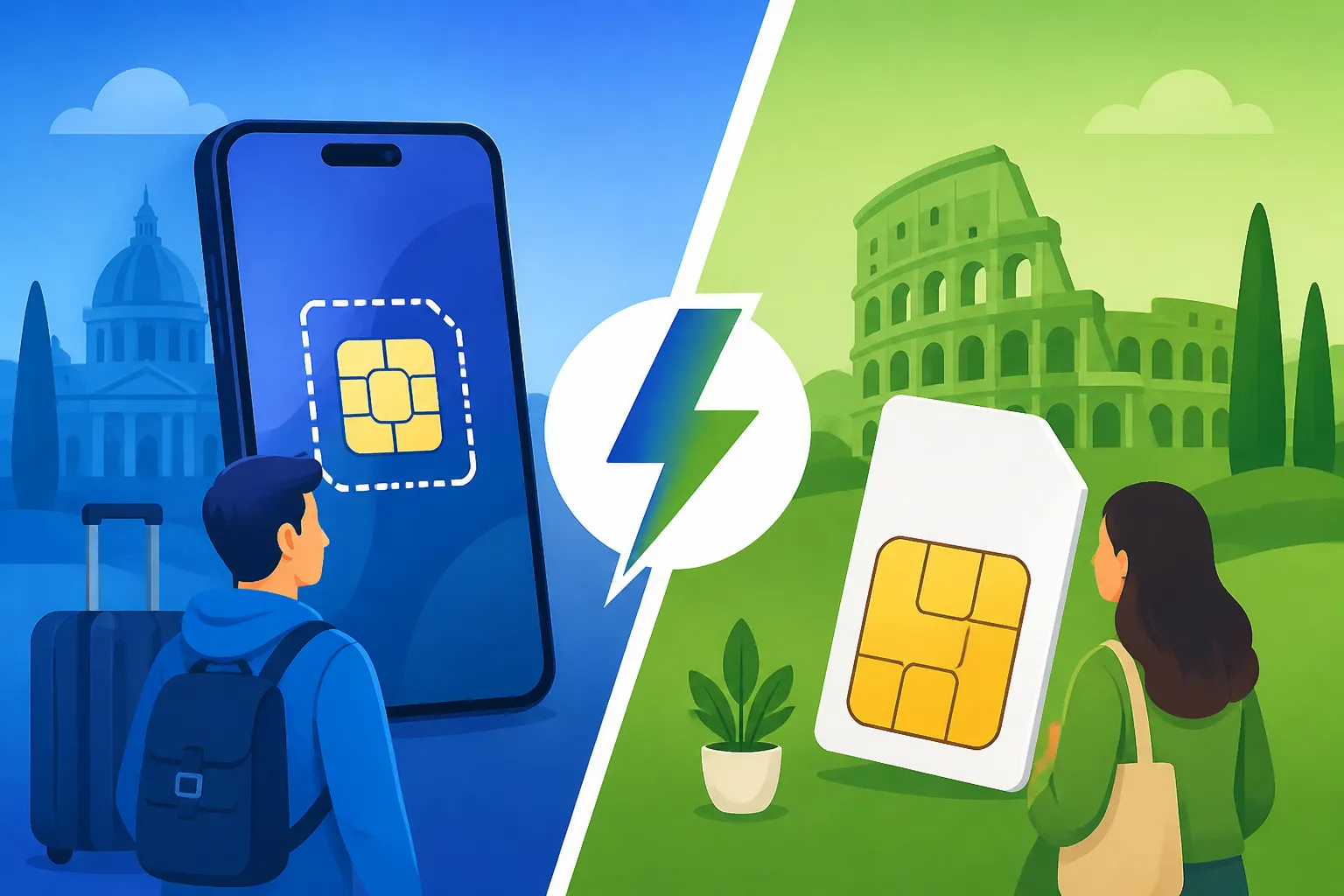
Imagine a SIM card, but instead of a tiny physical chip you have to insert and worry about losing, it's embedded directly into your phone. That's an eSIM (embedded SIM). It allows you to download cellular plans digitally, without needing a physical card. This means you can switch carriers or plans with a few taps on your phone, often without ever stepping foot in a physical store.
For expats, the beauty of an eSIM is that you can activate a local data plan for Italy before you even leave home, or the moment your plane touches down. No more fumbling with tiny trays, no hunting for a local SIM store with your luggage in tow, and absolutely no immediate bureaucratic hurdles. You just scan a QR code or enter some details, and boom – you're connected. Providers like Airalo specialize in making this process incredibly simple and user-friendly, offering data packages for Italy and countless other countries.
The Immediate Benefits for New Arrivals
The advantages of using an eSIM, particularly through a service like Airalo, for long-stay visa holders upon arrival in Italy are monumental.
- Instant Connectivity: The biggest stress-reducer. You land, turn off airplane mode, and you have data. Immediately. You can call your taxi, message your Airbnb host, check maps, or even book a table for that celebratory first Italian meal without missing a beat. This is priceless in those disorienting first few hours.
- No Bureaucracy: This is huge. Forget about needing your Codice Fiscale or Permesso di Soggiorno just to get online. eSIM providers don't ask for these documents. You purchase a plan, often paying by credit card in your home currency, and you're good to go.
- Flexibility: Airalo offers various data packages, from small bundles for a few days to larger ones covering a month or more. This means you can get exactly what you need for your initial settling-in period without committing to a long-term contract in Italian. You can top up easily if you run out, or switch to a different plan when needed.
- Keep Your Home Number: With an eSIM, you can often keep your physical SIM card from your home country active simultaneously (if your phone supports dual SIMs, which most modern smartphones with eSIM capability do). This allows you to receive calls or texts on your original number, crucial for two-factor authentication or keeping in touch with home, while using the eSIM for local Italian data.
Imagine landing and seamlessly updating your family, finding your way to your accommodation, or even accessing Websites to Find Doctors Who Speak English in Italy – all within minutes of arrival. Airalo makes this level of immediate integration a reality, significantly reducing the initial expat stress.
Potential Drawbacks and Compatibility Checks
While eSIMs are fantastic, they're not entirely without their considerations. The primary drawback is that not all phones are eSIM compatible. Most newer smartphones (iPhone XS and later, many Samsung Galaxy models, Google Pixel 3 and later, etc.) support eSIM, but it's essential to check your specific device before you rely on it. A quick online search for "[Your Phone Model] eSIM compatibility" should give you the answer.
Another point to consider is that while eSIMs from providers like Airalo offer data and sometimes international calls (via VoIP apps), they don't always provide a dedicated local Italian phone number that can receive traditional SMS or calls from Italian landlines without extra steps. This means for official services or setting up direct debits, you might still eventually need a traditional Italian number, even if it's a basic pre-paid SIM. However, for the crucial data connectivity and VoIP calls that get you through the initial weeks, the eSIM from Airalo is unparalleled. The cost per gigabyte can sometimes be higher than a long-term Italian contract, but the convenience and freedom from bureaucracy often outweigh this for the short to medium term.
Direct Comparison: eSIM vs. Italian Contract SIM
Let’s lay out the key differences side-by-side to help you visualize which option suits your initial needs and long-term plans in Italy.
| Feature / Category | eSIM (e.g., Airalo) | Italian Contract SIM (e.g., TIM, Vodafone) |
|---|---|---|
| Acquisition & Activation | Instant digital download, QR code scan; no documents required | Requires Codice Fiscale, ID, sometimes Permesso/Residency, bank account |
| Connectivity Upon Arrival | Immediate, works as soon as plane lands | Requires finding store, paperwork, activation time; can take hours/days |
| Documentation Needed | None (just payment method) | Extensive: Codice Fiscale, passport, Permesso di Soggiorno, bank details |
| Flexibility | Short-term data packages (7, 15, 30 days); easy top-up/switch | Long-term commitment (12-24 months); early termination fees apply |
| Local Italian Number | Primarily data-focused; not always a local number for calls/SMS | Full Italian phone number; essential for local services and contacts |
| Cost (per GB) | Often higher for short-term plans, but no hidden fees | Generally lower for long-term contracts, but with fixed monthly cost |
| Bureaucracy Involved | Minimal to none | High, requires navigating complex Italian administrative processes |
| Device Compatibility | Only modern, eSIM-compatible smartphones | Works with any unlocked phone (physical SIM) |
| Keeping Home Number | Possible to run alongside physical home SIM (dual SIM) | Replaces physical home SIM, or requires dual SIM phone for both |
Ease of Acquisition and Activation
When it comes to speed and simplicity, the eSIM, especially from a user-friendly provider like Airalo, wins hands down. You can literally be connected to the internet moments after landing, sometimes even before. You purchase a data package online, download it to your phone, and you're good to go. There’s no waiting in lines, no language barrier, and no need to have a bank account or proof of residency established. It’s the ultimate "plug-and-play" solution for digital connectivity for the new arrival.
On the other hand, securing an Italian contract SIM is a process. You need to locate a phone store, often wait in a queue, present your Codice Fiscale, your passport, and very likely proof of your Italian Residence Permit (Permesso di Soggiorno) Explained or the receipt for its application. If you want a monthly contract with direct debits, you'll also need an Italian bank account. This can take days or even weeks if you're battling bureaucracy or language issues, adding significant stress to an already hectic moving period.
Cost, Data, and Flexibility
From a pure per-gigabyte cost perspective, especially over the long term, an Italian contract SIM will generally offer better value. Plans often come with generous data allowances, unlimited national calls, and sometimes even international call packages, all for a fixed monthly fee that can be relatively low (e.g., €10-€20). However, this comes with a commitment. You're typically signing up for 12 or 24 months, and breaking that contract can incur penalties.
eSIMs, like those from Airalo, typically offer data packages for shorter durations – a week, 15 days, or a month – and while the per-gigabyte cost might be slightly higher than a long-term contract, the flexibility is unparalleled. There's no contract, no monthly commitment, and no hidden fees beyond the upfront cost of the data package. You pay for what you need, when you need it. This financial agility is incredibly valuable when you’re still getting a handle on your Money Matters in Italy: Banking and Finance for Expats. You can easily top up if you run low, or switch to a different regional eSIM if you travel outside of Italy temporarily.
Reliability and Network Coverage
The major Italian network providers (TIM, Vodafone, WindTre) generally offer excellent coverage throughout the country, with varying strengths in different regions. TIM and Vodafone often boast wider and more consistent coverage, particularly in less populated or mountainous areas. Contract SIMs will leverage these networks directly, giving you reliable service for calls and data.
eSIMs from reputable providers like Airalo also utilize these established local networks. When you purchase an Airalo eSIM for Italy, it connects to one of the major Italian networks (e.g., Vodafone or WindTre, depending on the specific plan), so you're getting the same underlying network reliability. The difference isn't in the network quality itself, but in the service wrapper and the administrative ease. Essentially, you get the robust Italian network without the associated red tape. However, as noted before, pure data eSIMs may not give you a direct Italian phone number for inbound calls from traditional landlines unless you specifically seek out an eSIM plan that offers this, which can be less common or more expensive. This is important for many local Italian services that rely on traditional phone calls or SMS.
Making Your Choice: When to Opt for Which
The decision between an eSIM and an Italian contract SIM really boils down to your immediate needs upon arrival versus your long-term integration strategy in Italy. It's not necessarily an either/or situation; many expats start with one and transition to the other.
When Airalo (or another eSIM) Shines Brightest
For new arrivals on a long-stay visa, especially in those crucial first weeks and months, an eSIM from Airalo is an absolute game-changer. It’s your immediate lifeline, providing essential data connectivity without any administrative fuss.
- Upon Arrival: As soon as you land, you'll have data for navigation, contacting your host, urgent communication, and accessing critical information. This immediate connectivity alleviates immense stress.
- During Bureaucracy: While you're busy collecting your Codice Fiscale, applying for your Permesso di Soggiorno, and opening an Italian bank account, you won't have to worry about your phone service. You can use Airalo for these tasks, ensuring you're always connected.
- Short-Term Needs: If you’re not sure how long you’ll be in Italy or want maximum flexibility, Airalo’s pay-as-you-go data packages are perfect. No contracts, no commitment, just simple data when you need it. This is especially useful if your initial visa is temporary or you're considering Converting a Study Permit to a Work Permit in Italy and your situation might change.
- Digital Nomads and Remote Workers: For those pursuing the Italy Digital Nomad Visa: Eligibility and Application, immediate and flexible connectivity is paramount. Airalo ensures you're online and productive from day one, wherever you are in Italy. You can handle client calls, check emails, and stay connected to your work without any local phone hurdles.
Honestly, think of Airalo as your indispensable travel buddy for those initial, chaotic weeks. It takes one significant stressor off your plate, allowing you to focus on all the other, more complex tasks of settling into Italy.
When an Italian Contract SIM Becomes Essential
While an eSIM is brilliant for initial integration, a traditional Italian contract SIM will likely become necessary if you plan to stay in Italy for the long haul (12 months or more) and want to fully integrate into Italian daily life.
- Long-Term Value: If you're staying for years, the lower per-gigabyte cost and unlimited calls/texts that come with a contract SIM make it more economical in the long run.
- Official Communications: Many Italian institutions, from utility companies to healthcare providers, expect and sometimes require a local Italian phone number for communication. This is especially true for setting up direct debits for bills. Your How to Get a Codice Fiscale in Italy (and Why You Need One) is crucial here, as it's linked to everything.
- Local Legitimacy: Having a recognized Italian phone number builds legitimacy and makes interactions smoother. It’s what everyone expects. For example, if you're trying to Registering With Your Local ASL in Italy: A Practical Guide, they'll want an Italian number.
- Customer Service: While challenging at times, the major Italian providers do offer in-person customer service at their stores, which can be invaluable for complex issues that online support might not handle as well. For example, when dealing with issues related to Internet and Mobile Providers in Italy: TIM, Vodafone, and More, being able to talk to someone face-to-face can sometimes cut through the red tape.
My advice as a seasoned expat? Start with the effortless convenience of an Airalo eSIM to navigate your initial arrival and settle into Italy. Once your Codice Fiscale is sorted, your Permesso di Soggiorno application is underway, and you've opened your Italian bank account, then you can consider delving into the world of Italian contract SIMs. This phased approach will save you countless headaches and let you tackle bureaucracy on your own terms, not on the terms of a desperately needed internet connection.
In the meantime, enjoy being connected from the moment you land, thanks to the simplicity and efficiency of Airalo. It’s one less thing to worry about in your exciting, but often challenging, new life in Italy.
Disclaimer
The information provided in this guide is for general informational purposes only and does not constitute legal, financial, or professional advice. While we strive to keep the content up-to-date and accurate, regulations and services in Italy can change rapidly. Always consult official sources, relevant professionals, or service providers for the most current and specific information pertaining to your individual situation.