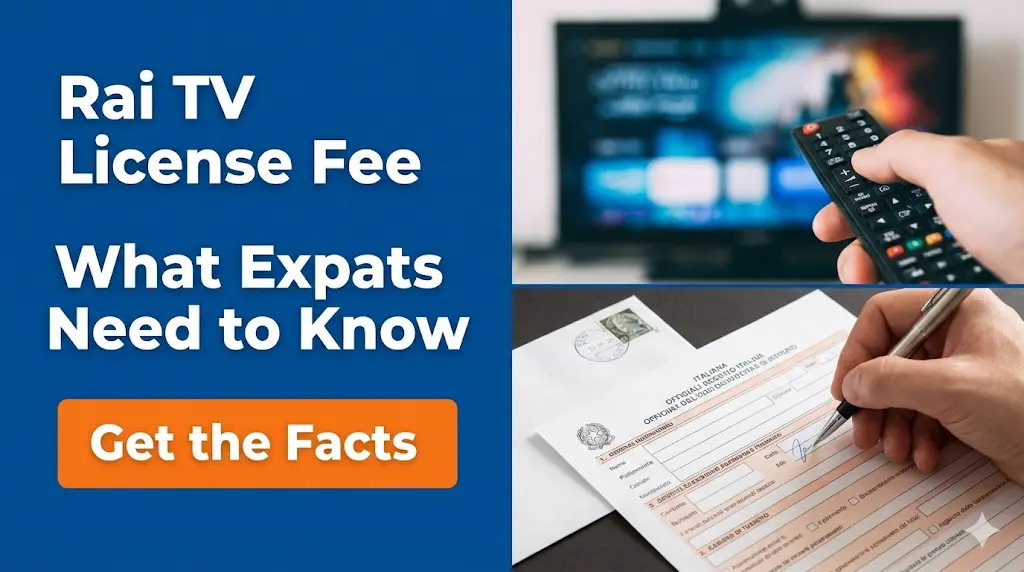
Rai TV License Fee: What Expats Need to Know
Navigating the Italian television tax, known as Canone RAI, is essential for every new resident. This guide explains how the fee is collected through electricity bills, who is eligible for exemptions, and how to file the necessary paperwork.
Disclosure: This post may contain affiliate links. We may earn a commission at no extra cost to you if you make a purchase through these links. Read full disclosure.
Introduction to Rai TV License Fee
In Italy, the public broadcasting service, RAI (Radiotelevisione Italiana), is funded primarily through a mandatory annual license fee. For decades, this fee was a separate bill that many residents simply ignored. However, in 2016, the Italian government fundamentally changed how the fee is collected to combat widespread tax evasion. Today, the fee is automatically added to your residential electricity bill in installments.
For expats, the “Canone RAI” can be confusing. You might wonder why you are paying for Italian television when you only use streaming services like Netflix, or why the charge appeared on your bill before you even bought a television set. Because the law assumes that anyone with a residential electricity meter also owns a device capable of receiving television signals, the burden of proof is on the resident to show otherwise.
Understanding the nuances of this tax is vital for managing your Cost of Living in Italy 2026: Budgeting for Expats. Failing to understand the rules can lead to double payments if you own multiple properties, or missing out on legal exemptions that could save you money. This guide provides a comprehensive breakdown of how the RAI TV license fee works in 2026, how to apply for exemptions, and what happens if you genuinely do not own a television.
What is the Canone RAI?
The Canone RAI is an annual tax on the “possession of an apparatus capable of receiving television signals.” It is important to note that this is not a subscription to a service; it is a tax on the ownership of the hardware. Even if you never tune into RAI 1 or RAI 2, the mere presence of a TV in your home triggers the requirement to pay.
The Presumption of Ownership
The most critical aspect of the law is the presumption of possession. Under current Italian legislation, if there is an active residential electricity contract (utenza elettrica per uso domestico residenziale) at a property, the state presumes that a television set is present. This presumption allows the tax authorities to automatically charge the fee via the electricity provider.
The Cost in 2026
While the amount has fluctuated over the years, the current annual fee is approximately €70 to €90. This total is divided into ten monthly installments of roughly €7 to €9 each, which appear on your electricity bills from January through October. If your electricity provider bills you every two months, you will see a double installment on each bill during those months.
Managing these recurring costs is a standard part of Setting Up Utilities (Electricity, Gas, Water) in Italy. Because it is integrated into the bill, you cannot simply choose to pay the electricity portion and skip the TV fee; the payment is considered indivisible by the provider.
Who is Required to Pay?
The fee is owed by anyone who possesses at least one device capable of receiving television signals. This includes traditional television sets equipped with a tuner and a digital terrestrial or satellite decoder.
The Household Rule
One of the few “expat-friendly” aspects of the Canone RAI is that it is paid once per household (nucleo familiare), regardless of how many televisions you own or how many properties you have.
- Family Units: If a husband and wife are registered at the same residence, only one pay the fee.
- Roommates: If you are How to Find Roommates as an Expat in Italy, the rules can be slightly more complex. Generally, if you are not part of the same “family unit” but share a single electricity bill, only the person whose name is on the bill is charged.
Second Homes
If you own a holiday home in Italy in addition to your primary residence, you do not have to pay the Canone RAI twice. The law specifies that the fee is only added to “resident” electricity contracts. If your second home is correctly registered as a non-resident property (uso domestico non residente), the electricity bill will not include the TV tax. If you find yourself being charged twice, it usually means your residency status hasn’t been properly updated with the energy provider.
Devices That Trigger (and Don’t Trigger) the Fee
The definition of what constitutes a “television apparatus” has been a subject of much debate in Italy, especially with the rise of digital streaming and mobile devices.
Devices Subject to the Fee
- Traditional televisions (Smart or otherwise) with a built-in tuner.
- Old televisions connected to a digital terrestrial decoder (DVB-T2).
- Televisions connected to satellite systems (Tivùsat).
Devices Exempt from the Fee
Crucially, the Italian Revenue Agency (Agenzia delle Entrate) has clarified that devices that do not have a radio-television tuner are not subject to the fee. This means you do not have to pay the Canone RAI if you only own:
- Computers and Laptops: Even if you watch RAI Play or YouTube on your browser.
- Tablets and Smartphones: Mobile devices are exempt.
- Monitors: As long as they do not have a built-in TV tuner.
- Digital Projectors: Unless they have a built-in tuner.
How to Apply for an Exemption
If you do not own a television, the state’s presumption of ownership still applies until you officially tell them otherwise. This is done through a “Declaration of Non-Possession” (Dichiarazione di non detenzione).
The “No TV” Declaration
To stop the automatic charges on your electricity bill, you must file a formal declaration with the Agenzia delle Entrate. This form states that no television sets are present in any of the properties associated with your electricity contract.
Key Deadlines for Filing:
To avoid the fee for the entire year, you must file the declaration between January 1st and January 31st.
- If you file between February 1st and June 30th, you will be exempt for the second half of the year (July to December).
- Declarations filed after July 1st will apply to the following calendar year.
Renewal Requirement
The most frustrating part for many expats is that this declaration is only valid for one year. You must refile the “No TV” declaration every single year during the January window. If you forget to refile, the charges will automatically resume on your electricity bill.
Exemption for Seniors
Residents aged 75 and over are entitled to a full exemption from the Canone RAI if their total annual household income does not exceed €8,000. Unlike the “No TV” declaration, once this age-based exemption is granted, it does not need to be renewed annually unless the household income changes.
Methods for Submitting the Declaration
The Italian government offers several ways to submit your exemption form. For most expats, the digital route is the most efficient, provided you have your digital identity sorted.
1. Online via the Revenue Agency Portal
There is a dedicated section for “Canone TV” where you can fill out and submit the declaration electronically. This provides an immediate receipt and is the most reliable method.
2. Certified Email (PEC)
If you have a PEC (Posta Elettronica Certificata), you can send the signed form to the official address of the Revenue Agency. The email must be digitally signed or sent with a scan of your valid ID.
3. Registered Mail (Raccomandata)
If you prefer a paper-based approach, you can send the form via registered mail (Raccomandata senza busta) with a copy of your ID to the Ufficio Canone TV in Turin. This is often the preferred method for those who do not yet have a SPID.
Common Issues and How to Solve Them
Expats often run into specific hurdles regarding the Canone RAI that native Italians may not experience.
Double Charges
If you and your partner both have electricity contracts in your names (perhaps for different properties), you might both be charged the fee. To solve this, one partner must file a “Declaration of Relationship” stating that the fee is already being paid by another member of the same family unit, providing that person’s Tax Code (Codice Fiscale).
New Residents
When you first move to Italy and set up a utility contract, the energy provider may not charge the fee immediately. You might receive a lump-sum bill later in the year. If you move into an apartment mid-year, the fee is generally pro-rated based on the months you hold the contract.
Buying a TV Mid-Year
If you filed a non-possession declaration in January but decided to buy a television in June, you are legally required to file a new declaration within 30 days to resume payment. Failure to do so can result in fines that far exceed the cost of the license itself.
Canone RAI and Rental Properties
Who pays the fee in a rental situation depends entirely on the name associated with the electricity bill.
Utilities in the Landlord’s Name
If you are Finding Rental Apartments in Italy: Websites and Tips where the utilities remain in the landlord’s name (common in short-term or “transitory” leases), the landlord is technically responsible for the fee. Usually, they will bake this cost into your monthly “all-inclusive” rent.
Utilities in the Tenant’s Name
In a standard long-term lease (like a 4+4 contract), the tenant usually transfers the utilities into their own name (voltura). Once the bill is in your name and your residency is registered at that address, the Canone RAI installments will appear on your bill automatically.
Important Summary Table for Expats
| Scenario | Do You Pay? | Action Required |
| Own a TV + Resident Power Bill | Yes | No action (paid automatically in bills). |
| No TV + Resident Power Bill | No | File “Declaration of Non-Possession” in January. |
| Second Home (Non-Resident) | No | Ensure bill is marked “Non-Residente.” |
| Aged 75+ and Income < €8,000 | No | File for “Seniors Exemption.” |
| Own a PC/Tablet only | No | File “Declaration of Non-Possession.” |
The Consequences of Non-Payment
Because the fee is now collected through the electricity bill, “non-payment” usually only happens if you file a false declaration of non-possession while actually owning a television.
If the authorities conduct an inspection and find a television in a home where a non-possession declaration was filed, the penalties are severe:
- Back Taxes: You will be required to pay all unpaid license fees for previous years.
- Fines: Administrative fines range from €200 to €600 per year of evasion.
- Criminal Charges: In extreme cases, filing a false declaration to a public official can lead to criminal charges under the Italian Penal Code.
Most expats find that the €70-€90 annual cost is small compared to the peace of mind of being fully compliant with local tax laws.
Conclusion
The RAI TV license fee is a quintessential example of how Italian administration can be both surprisingly automated and frustratingly manual. While the automatic collection via electricity bills has made life easier for those who own a TV, it has created an annual bureaucratic hurdle for those who do not.
As an expat, the best strategy is to be proactive. Check your electricity bills during the first quarter of the year. If you see “Canone TV” and you don’t own a television, make sure to hit the January deadline for your declaration. If you do own a TV, simply ensure your residency status is correct to avoid double charges. Navigating these small financial details is a key step in truly feeling at home in Italy.
References
Primary sources (official)
- Agenzia delle Entrate: Official portal for Canone TV declarations and regulations. https://www.agenziaentrate.gov.it
- RAI – Canone: The official public broadcaster’s dedicated site for license fee information. https://www.canone.rai.it
Other helpful sources
- Poste Italiane: Information on paying the Canone via F24 forms if not included in bills. https://www.poste.it
- ARERA: The regulatory authority for energy, detailing how the fee is displayed on electricity invoices. https://www.arera.it
Disclaimer
The information provided in this article is for informational purposes only and does not constitute official legal or tax advice. While we strive to provide the most accurate information for 2026, Italian tax laws and RAI license fee amounts are subject to annual legislative updates. Always consult the official Agenzia delle Entrate website or a qualified accountant (commercialista) regarding your specific financial situation and residency status.