Buying Electronics in Italy: Adapters and Warranties
Navigating the Italian electronics market requires understanding local power standards and consumer rights. This guide covers everything from choosing the right plug adapters for the unique three-pin sockets to leveraging EU-mandated two-year warranties for your devices.
Disclosure: This post may contain affiliate links. We may earn a commission at no extra cost to you if you make a purchase through these links. Read full disclosure.
Introduction to Buying Electronics in Italy
In Italy, the electronics retail landscape is a mix of massive international chains, specialized tech boutiques, and a rapidly growing e-commerce sector. While the devices themselves—iphones, MacBooks, and high-end cameras—are the same global products you find elsewhere, the context in which you use and protect them is distinctly Italian. One of the first things a newcomer will notice is the wall socket. Italy utilizes a specific three-pin grounded system that often baffles those arriving from North America or even other parts of Europe. Without the right knowledge, you risk damaging expensive equipment or finding yourself unable to charge your essential devices.
Beyond the physical connection, there is the matter of “Garanzia Legale” or the legal warranty. Italy, as a member of the European Union, adheres to strict consumer protection laws that mandate a minimum two-year warranty on all new electronic goods. This is a significant benefit for expats, providing long-term peace of mind that is often unavailable in other markets without paying for “extended” protection plans. However, claiming these rights requires understanding the difference between a manufacturer’s warranty and a seller’s legal obligation.
This comprehensive guide is designed to help you navigate the electronics market with confidence. We will break down the three types of Italian power plugs, explain how to choose the correct adapters and voltage converters, and detail exactly how to exercise your warranty rights if a device fails. We will also provide tips on the best places to shop and how to handle repairs. By the end of this article, you will be equipped to keep your digital life running smoothly in your new Mediterranean home. If you are still in the process of setting up your new residence, you may also find our guide on Electrical Outlets and Appliances: What to Expect a helpful companion to this tech-focused deep dive.
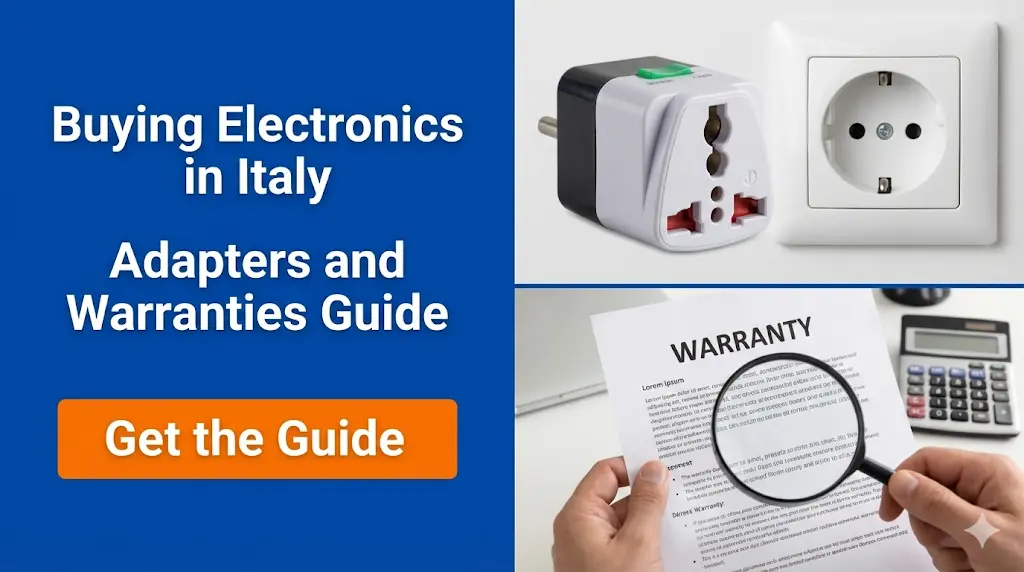
Understanding the Italian Electrical System
Before you swipe your credit card for a new espresso machine or a high-end gaming console, you must understand the “juice” that powers them. Italy operates on a 230V supply voltage and 50Hz frequency. For those arriving from the UK or most of Europe, this is standard. However, for those coming from North America (110-120V), this is a critical distinction.
Voltage Converters vs. Adapters
It is a common mistake to assume that a simple plug adapter—the small plastic piece that changes the shape of the pins—is enough to safely use your foreign electronics. An adapter does not change the voltage. If you plug a 110V American hair dryer into a 230V Italian socket using only an adapter, you will likely see smoke, sparks, and a permanently dead appliance.
Most modern portable electronics, like laptops, tablets, and smartphones, are “dual-voltage” (100-240V). You can check this on the device’s power brick; if it says “Input: 100-240V,” you only need a plug adapter. For high-draw appliances like blenders or older styling tools, you would need a heavy, expensive voltage converter, which is often more costly than simply buying a new version of the appliance in Italy. For a broader look at the costs of setting up your household, check out our Cost of Living in Italy 2026: Budgeting for Expats resource.
The Three Italian Plug Types
Italy uses three primary plug types, and understanding them is essential for choosing the right power strips and adapters:
- Type C (Europlug): The standard two-pin ungrounded plug used across Europe. It fits perfectly into almost every Italian socket.
- Type L (The Italian 3-Pin): This is the classic Italian plug. It features three round pins in a straight line. The middle pin is the “earth” or ground. There are two sizes: 10-amp (thin pins) and 16-amp (thick pins).
- Type F (Schuko): Increasingly common for high-power appliances like washing machines or vacuum cleaners. It is a large, round plug with two pins and side grounding clips.
Where to Buy Electronics in Italy
When shopping for electronics, you have several reliable avenues, ranging from physical “Big Box” stores to specialized online retailers.
Major Retail Chains
The Italian market is dominated by several large chains that offer a wide selection, in-person advice, and easy return policies.
- MediaWorld: The Italian branch of the German MediaMarkt, this is arguably the most popular electronics store in the country. They have massive showrooms in most major cities and shopping malls.
- Unieuro: A strong competitor to MediaWorld with a vast network of stores. They often have aggressive promotional cycles, especially during “Black Friday” and the winter sales.
- Euronics: Often operated as a franchise, these stores are common in smaller cities and towns.
- Apple Stores: Major cities like Milan, Rome, and Florence have official Apple flagship stores for authorized sales and Genius Bar support.
Online Shopping
Online retail is incredibly robust in Italy. Amazon.it is the dominant force, offering fast delivery (often next-day with Prime) and a very consumer-friendly return policy. Other sites like ePRICE and Monclick are also popular for appliances and computer components. When ordering online, ensure your address is correctly registered with the local authorities to avoid delivery issues; see our guide on Registering with Comune: Residency, School, Health Card for more details on administrative setup.
The Two-Year Legal Warranty (Garanzia Legale)
In many countries, a standard warranty lasts for one year. In Italy, thanks to EU Directive 2019/771 (transposed into the Italian Consumer Code), you are entitled to a minimum of two years of protection on all new products purchased from a professional seller.
How it Works
The “Garanzia Legale” is provided by the seller, not the manufacturer. If your laptop motherboard dies 18 months after purchase, you do not necessarily go to the brand (e.g., Dell or HP); you go back to the store where you bought it (e.g., MediaWorld).
- The First 12 Months: During the first year, any defect is presumed to have existed at the time of delivery. The burden of proof is on the seller to prove you caused the damage.
- The Second 12 Months: You still have coverage, but the seller might technically ask you to prove the fault wasn’t due to wear and tear, though most major retailers are quite lenient to maintain customer satisfaction.
- The Remedy: Under the legal warranty, the consumer is entitled to a free repair or a replacement. If neither is possible or reasonable, you can ask for a price reduction or a full refund.
Manufacturer’s Conventional Warranty
This is different from the legal warranty. Brands often offer a “Garanzia Convenzionale” which might include extra perks like home pickup or international coverage. This does not replace your two-year legal right; it sits alongside it. As an expat, always keep your original receipt (scontrino) or digital invoice. Without it, exercising your warranty rights is nearly impossible.
Table: Electronics Compatibility and Warranty Quick-View
| Feature | Standard in Italy | Notes for Expats |
| Voltage | 230V / 50Hz | 110V devices need a transformer. |
| Common Plugs | Type L (3-pin), Type C, Type F | Type L 16A (thick) won’t fit 10A (thin) sockets. |
| Legal Warranty | 2 Years | Mandatory for all new consumer goods. |
| Proof of Purchase | Fiscal Receipt (Scontrino) | Digital copies/photos are usually accepted. |
| Repair Rights | EU “Right to Repair” | Parts must be available for several years. |
Smart Home Connectivity and IoT
If you are setting up a modern home in Italy, you are likely looking into Smart Home and IoT devices. Italy has a very high adoption rate for smart thermostats, security cameras, and connected appliances. When buying these, ensure they are compatible with the European frequency standards.
A significant challenge in many Italian homes—especially those in historic city centers—is the thickness of the walls. Traditional stone or brick construction can be a nightmare for Wi-Fi signals. When buying networking equipment like routers or mesh systems, look for high-output European versions.
Tips for Savvy Electronics Shopping in Italy
- Look for the “Sottocosto” Sales: This translates to “below cost.” Major retailers run these promotions several times a year where they sell a limited quantity of high-end items at significant discounts.
- Tax-Free Shopping for Tourists: If you are a non-EU resident visiting Italy and plan to take the electronics back home, look for stores with the “Global Blue” or “Tax Free” sign. You can claim back the 22% VAT (IVA) at the airport upon departure.
- Refurbished Options: Sites like Back Market or the “Warehouse” section of Amazon.it are excellent for buying certified refurbished electronics with a one-year or two-year warranty at a fraction of the cost.
- Recycling Old Tech: By law, if you buy a new electronic device in Italy, the store is obligated to take back your old, equivalent device for free recycling (the “uno contro uno” rule). For smaller devices (under 25cm), major stores must take them back even if you don’t buy anything (the “uno contro zero” rule).
Handling Repairs and Out-of-Warranty Issues
If your device breaks and it is out of warranty, or if you caused the damage (like a cracked screen), you will need a “Centro Assistenza.”
- Authorized Service Centers: These are specialized shops authorized by brands like Samsung or Sony to perform repairs using original parts. They are generally more expensive but preserve any remaining warranty.
- Independent Repair Shops: Often found in every neighborhood, these are great for quick fixes on older phones or out-of-warranty laptops. Always ask for a “preventivo” (estimate) before leaving your device.
Conclusion
Buying electronics in Italy is a straightforward process once you understand the physical and legal landscape. The unique three-pin sockets and 230V power require a bit of planning, especially if you are bringing devices from overseas, but the reward is a tech-friendly life in one of the most beautiful countries in the world. The two-year legal warranty is a powerful shield for consumers, ensuring that your investments are protected by some of the strongest laws in the world.
Whether you are navigating the aisles of MediaWorld for a new TV or ordering a smart home hub on Amazon, keep your receipts, check your voltages, and don’t be afraid to exercise your consumer rights. With the right adapters and a bit of savvy shopping, your Italian home will be as connected and efficient as any modern residence.
References
Primary sources (official)
- Ministero delle Imprese e del Made in Italy: Official portal for consumer rights and the Italian Consumer Code (Codice del Consumo). https://www.mimit.gov.it/
- European Commission – Consumer Guarantees: Official EU guidelines on the two-year legal guarantee and right to repair. https://commission.europa.eu/
Other helpful sources
- MediaWorld Italy: Official site for product availability, technical specifications, and internal warranty policies. https://www.mediaworld.it/
- Amazon.it Help – Warranty: Detailed breakdown of how Amazon handles the two-year legal guarantee for products sold in Italy. https://www.amazon.it/gp/help/customer/display.html
Disclaimer
The information provided in this article is for informational purposes only and does not constitute legal or technical advice. Electrical standards and consumer laws in Italy are subject to change. Always verify the voltage requirements of your specific devices and consult with a professional electrician or legal advisor if you have concerns about safety or warranty claims. Responsibility for the safe use of electronic devices remains with the consumer.