Availability of Rideshare Apps (Uber) in Italy
Landing at Rome’s Fiumicino Airport and opening your phone to see a standard twenty-minute Uber ride costing €90 is a terrifying expat initiation. I once dragged two massive suitcases across three miles of wet Roman cobblestones because I fundamentally misunderstood the local taxi monopoly. This guide decodes Italy’s complex ridesharing landscape so you can commute affordably.
Disclosure: This post may contain affiliate links. We may earn a commission at no extra cost to you if you make a purchase through these links. Read full disclosure.
The Reality of Uber and Ridesharing in Italy
Why Standard UberX Does Not Exist
The absolute biggest shock for arriving expats is discovering that the standard, cheap gig-economy rideshare model does not exist here. You cannot open an app and summon a university student driving their personal Honda Civic for extra cash. Standard peer-to-peer ridesharing, such as UberX or UberPop, is completely illegal in Italy.
This ban is the direct result of fierce, deeply entrenched lobbying by the Italian taxi unions. In Italy, taxi licenses (licenze taxi) are strictly capped by the municipal government. They are incredibly difficult to obtain and are frequently passed down through generations or sold for astronomical sums. When foreign tech companies attempted to bypass this licensing system, the taxi unions brought the major cities to a standstill with aggressive strikes, successfully forcing the government to outlaw unregulated ridesharing.
For you as an expat, this means you cannot rely on a €10 app ride to get home from a late-night dinner. You are forced to utilize the highly regulated, licensed transportation networks. You must mentally shift your transportation expectations and aggressively adjust your Cost of Living in Italy 2026 Budgeting for Expats to account for the true price of inner-city mobility.
The Uber Black and NCC Loophole
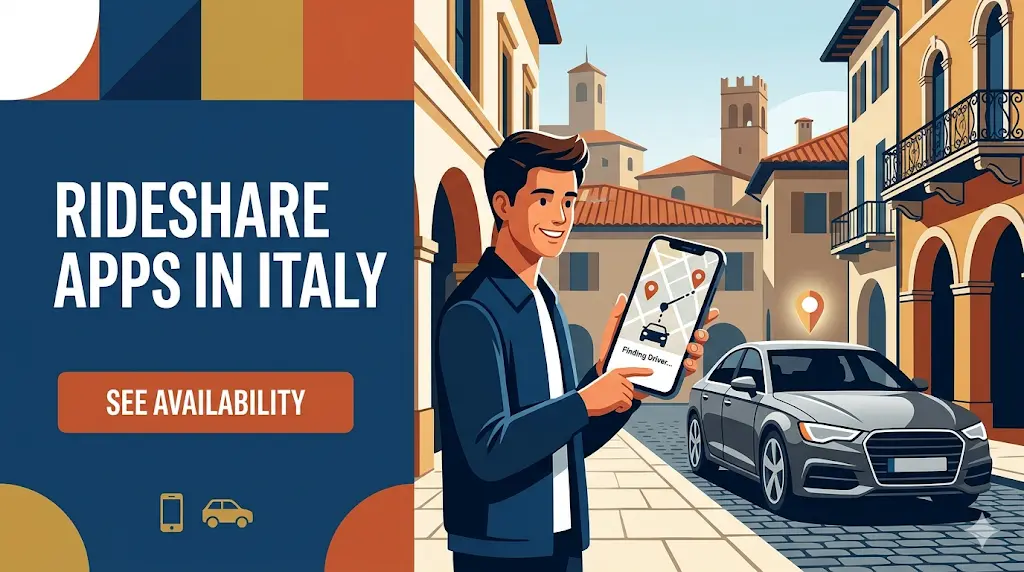
Despite the ban on standard ridesharing, the Uber app does technically function in major Italian cities like Rome, Milan, Florence, and Naples—but exclusively as a premium service. If you open Uber in Italy, the default options available to you will be Uber Black, Uber Lux, or Uber Van.
These options operate under a completely different legal framework known as Noleggio Con Conducente (NCC), which translates to “rental with driver.” NCC drivers are highly regulated private chauffeurs. They must possess specific professional driving licenses, operate luxury vehicles (typically black Mercedes sedans or vans), and adhere to strict garaging laws. Understanding the depth of these transportation licenses gives you a glimpse into the broader complexities of Navigating Italian Bureaucracy Comune and Prefettura.
Because the standard Uber service in Italy summons these luxury private chauffeurs, the minimum base fares are incredibly steep. It is a fantastic, reliable service if you need a guaranteed 4:00 AM airport transfer with heavy luggage, or if you are charging a corporate expense account. However, attempting to use Uber Black to run a quick errand across town will absolutely destroy your weekly budget.
The Best Alternative Rideshare Apps in Italy
FreeNow as the European Standard
If you want the convenience of an app without the luxury price tag of a private chauffeur, you must download FreeNow. Formerly known as mytaxi, FreeNow is the undisputed champion of European ridesharing apps and is the platform veteran expats use daily in Italy.
Instead of summoning unregulated civilian cars, FreeNow summons official, municipally licensed white city taxis directly to your GPS location. It perfectly bridges the gap between old-school taxi services and modern technology. For expats, it completely eliminates the intimidating language barrier. You simply type your destination address in English, the app dispatches the nearest official cab, and the driver’s navigation system automatically routes them to your destination.
Most importantly, FreeNow provides immense financial security. The app provides a fare estimate before you book, and you pay securely through the app using your linked credit card or Apple Pay. You never have to haggle over cash or deal with a driver attempting to take the “scenic route.” You do need a reliable mobile connection to hail these cabs on the fly, which is exactly why keeping an active data eSIM from Airalo is an absolute lifesaver when you are standing on a random street corner.
IT Taxi and The Massive Local Fleet
While FreeNow is excellent, the absolute largest aggregator in the country is the IT Taxi app. Built and managed directly by the Union of Italian Radio Taxis (URI), this platform boasts a staggering fleet of over 12,000 vehicles operating across more than 80 Italian cities.
IT Taxi covers the massive metropolitan hubs but also functions in smaller provincial cities where international apps have completely failed to penetrate. The service functions almost exactly like FreeNow, allowing you to track your approaching cab on a map and pay digitally. In a fascinating recent twist, Uber actually partnered with IT Taxi. In certain Italian cities, selecting the basic “Taxi” option inside the standard Uber app will now ping the IT Taxi network and dispatch a standard white cab to you.
Mastering IT Taxi allows you to summon a ride almost anywhere in the country without desperately searching for a local dispatch phone number. It serves as your primary lifeline when navigating dense urban centers, acting as the perfect bridge before you decide if you are brave enough to tackle Renting a Car or Scooter in Italy First Steps.
| Rideshare App | Vehicle Type Summoned | Price Tier | Best Use Case |
| Uber (Black/Van) | Luxury sedans and vans (NCC) | Very High | Pre-booked airport runs, business travel. |
| FreeNow | Official white city taxis | Regulated Meter | Daily inner-city commuting, cashless app payments. |
| IT Taxi | Official white city taxis | Regulated Meter | Traveling in smaller provincial cities, largest overall fleet. |
Ground Rules for Catching a Ride in Italian Cities
The Parcheggio Taxi Rule and Street Hailing
If your phone is dead and you cannot use a rideshare app, your instincts will likely betray you. If you step onto the edge of an Italian curb and wave your arm aggressively at a passing taxi like a New Yorker, the driver will simply swerve around you and speed off, leaving you feeling incredibly foolish.
In Italy, official taxis are generally forbidden by municipal law from stopping for random street hails. To catch a cab physically, you must walk to a designated parcheggio taxi (taxi stand). These stands are marked by bright orange signs and are typically situated near major train stations, historic piazzas, and large hospitals. You must walk up to the very first car in the line and get in; you cannot pick and choose your vehicle.
Finding these stands when you are hopelessly lost in a maze of medieval cobblestone alleys is deeply frustrating. I never wander an Italian city without a data connection from Airalo. Having Airalo active on my phone ensures I can instantly pull up Google Maps to locate the nearest official parcheggio taxi without wandering aimlessly in the dark. If you plan to drive your own vehicle instead, you must understand the similarly strict zoning laws detailed in Obtaining a Parking Permit in Rome or Milan.
Navigating Payment Methods and Card Scams
While booking through an app secures your payment digitally, taking a taxi directly from a physical stand introduces the risk of the infamous “broken POS” routine. Despite national Italian laws mandating that all merchants and service providers must accept electronic card payments, some drivers still magically suffer from “broken” card readers at the end of a trip, demanding cash to avoid declaring the income.
Your absolute best defense against this is confirming the payment method before your luggage even goes into the trunk. Simply ask through the window, “Posso pagare con la carta?” (Can I pay with a card?). If the driver hesitates or points to a “broken” machine, close the door and take the next taxi in line.
If you are forced to use cash, never hand over a €50 bill for a €12 ride, as the driver will inevitably claim they have no change. To manage smaller transactions seamlessly across the city without carrying massive wads of euros, you should definitely embrace local digital wallets, an essential financial strategy deeply outlined in Using Mobile Payment Apps Satispay etc in Italy.
How Housing and Connectivity Impact Your Commute
Avoiding Transit Deserts with Strategic Housing
Because cheap rideshares do not exist, your choice of residential neighborhood dictates your entire quality of life. If you rent a beautiful but isolated apartment deep in a residential suburb with poor tram connections, you will be financially trapped. You will bleed money relying on expensive NCC services or calling dispatch cabs just to get to the grocery store.
To completely avoid moving into a transit desert, veteran expats secure their housing through Spotahome. By utilizing Spotahome for your mid-term relocation, you can actively filter for verified apartments located strictly within walking distance of central metro lines, major bus arteries, or central taxi stands.
Spotahome acts as a vital, secure intermediary, allowing you to establish a perfectly located basecamp while you learn the local transit grid. Utilizing Spotahome ensures your daily commute relies on cheap public transit rather than expensive private cars, completely shielding you from the logistical and financial nightmares discussed in Avoiding Rental Scams on Italian Housing Websites.
Digital Survival and Commuting Gear
Because you will be utilizing public transit, official apps, and your own two feet far more than luxury private drivers, you must outfit yourself for an active, urban commute. Relying heavily on battery-draining applications like FreeNow, Google Maps, and local transit trackers will kill your smartphone battery by mid-afternoon.
If your phone dies, you cannot hail a cab, find a taxi stand, or scan a digital train ticket. I always order a high-capacity, fast-charging portable power bank directly from Amazon Italy to keep in my day bag. Having this heavy-duty hardware delivered straight to your door via Amazon Italy ensures you are never digitally stranded in the middle of a transit strike.
Furthermore, you will inevitably walk miles across uneven, historic cobblestones to reach those distant taxi stands. I highly recommend using Amazon Italy to source high-quality, weather-resistant walking shoes and a secure, anti-theft cross-body bag before the rainy season hits. Having your physical commuting essentials handled quickly by Amazon Italy frees you up to manage the much more severe bureaucratic hurdles of your relocation, such as Setting Up Utilities in Italy and Checking Your Italian Tax Code Codice Fiscale Status. Combining this reliable commuting gear with your active Airalo data connection guarantees you can navigate the chaotic, beautiful streets of any Italian city like a seasoned local.
References
Primary sources (official)
- Ministero delle Infrastrutture e dei Trasporti – Regolamentazione Taxi e NCC – https://www.mit.gov.it/taxonomy/term/156
- FreeNow Corporate Overview and Operations – https://free-now.com/
Other helpful sources
- The Local Italy – Why is it so hard to get a taxi in Italy’s major cities? – https://www.thelocal.it/
- Rome2Rio – Getting around Italy: Taxis and Rideshares – https://www.rome2rio.com/
Disclaimer
The information provided in this article is for educational and informational purposes only and does not constitute official legal or transit advice. The operation of ride-hailing applications and the legal distinction between municipal taxis and private hire vehicles (Noleggio Con Conducente – NCC) are strictly governed by Italian national law and local municipal regulations. Electronic payment mandates for taxi drivers are enforced by Italian tax authorities, but enforcement can vary. Always confirm estimated fares and accepted payment methods before entering a vehicle.