Dialect vs Italian: What Your Tutor Can and Can’t Prepare You For
You’ve studied Italian, perhaps diligently, poring over grammar books and practicing your ciao and grazie until they sound just right. You feel ready to take on Italy, confident in your linguistic abilities. But then you arrive, and within days, you encounter conversations that leave you scratching your head, words you’ve never heard, and pronunciations that defy everything you learned. Don't worry, it's not you – it's the beautiful, bewildering world of Italian dialects. This guide will help you understand the difference between standard Italian and its regional variations, why it can be a challenge for newcomers, and how platforms like iTalki can empower you to navigate this fascinating linguistic landscape with confidence.
Disclosure: This post may contain affiliate links. We may earn a commission at no extra cost to you if you make a purchase through these links. Read full disclosure.
The Myth vs. Reality of "Speaking Italian" in Italy
Many of us arrive in Italy with a pristine, textbook understanding of the language, only to find that reality is a little less… standard. It's a common and often frustrating experience for expats, leading to moments of genuine bewilderment when locals launch into conversations that sound nothing like the Italian learned from an app or classroom.
Standard Italian: Your Foundation, Not Your Finish Line
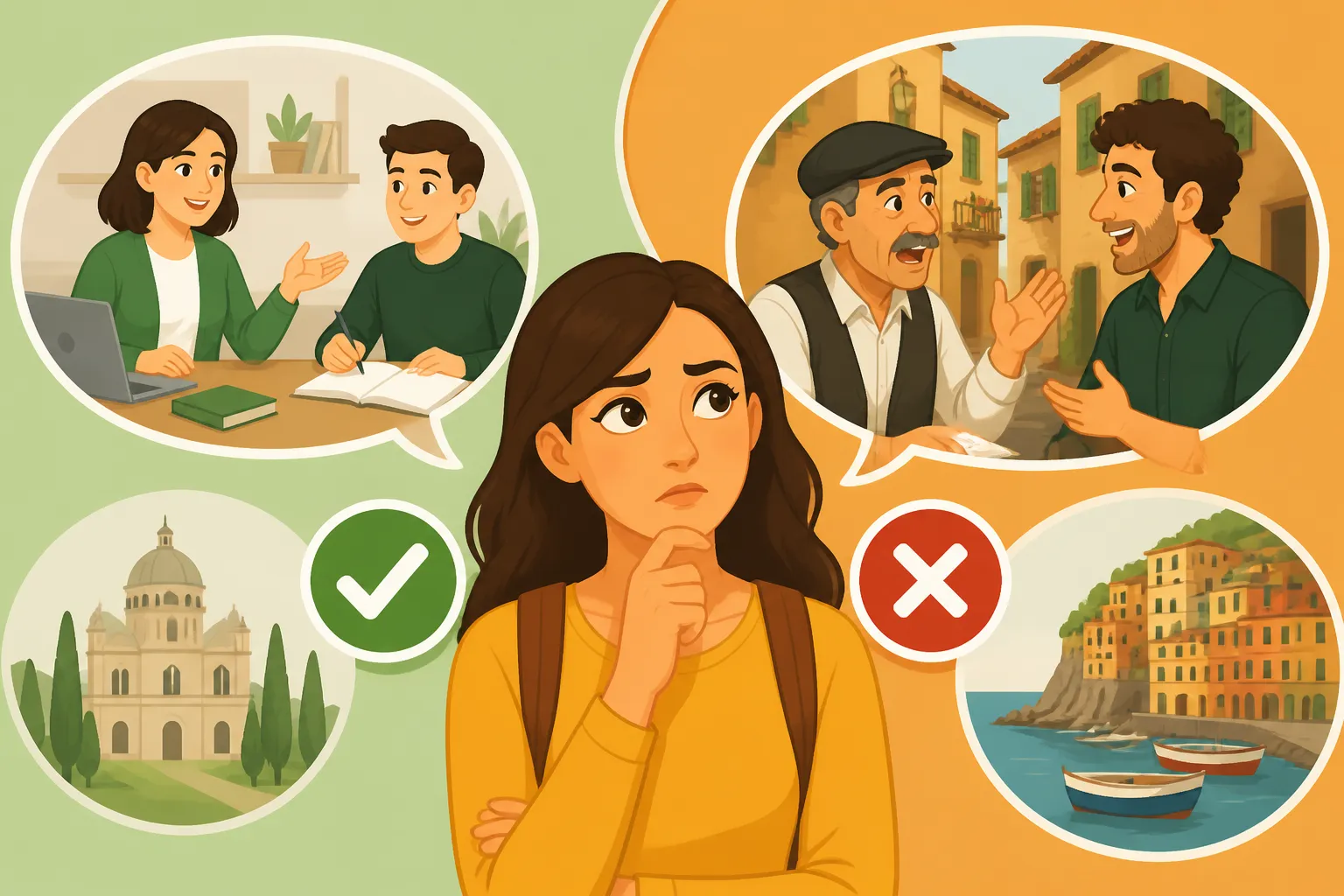
Think of Standard Italian, or Italiano Standard, as the official language taught in schools, used in national media, and understood across the entire peninsula. It's the Italian that evolved from Florentine Tuscan, solidified by literary greats like Dante. Learning it is absolutely essential, and it will serve as your universal key to communication in Italy. You can read newspapers, watch national TV, and engage in formal conversations all based on this foundation. Without it, you’d be truly lost.
However, viewing Standard Italian as the only Italian you'll encounter is a bit like expecting every English speaker in the world to sound like a BBC news anchor. It's a crucial stepping stone, but it’s just the beginning of your linguistic journey in this incredibly diverse country. Your initial frustrations are completely valid because no one really prepares you for the sheer variety of sounds and words you’ll encounter once you step outside the academic bubble. Many language courses, while excellent for grammar and core vocabulary, simply don't have the scope to cover the vast regional differences that are so deeply embedded in daily life here.
The Everyday Presence of Dialects and How They Differ
Italy is a young nation, unified relatively recently, and its regional identities are incredibly strong, especially when it comes to language. What are often referred to as "dialects" (dialetti) are, in many cases, distinct Romance languages with their own grammar, vocabulary, and phonology, often mutually unintelligible with Standard Italian. These aren't just accents; they're entirely different linguistic systems that have coexisted with, and often predated, the spread of national Italian.
You'll hear dialects everywhere: in the local bar where elderly men gather for coffee, among market vendors hawking their wares, within families chatting at the dinner table, or even in casual banter between colleagues. While younger generations generally speak fluent Standard Italian, they often revert to their regional dialect when among family and friends. This can create a bewildering experience for you, as one minute you're following a conversation, and the next, it feels like they’ve switched to an entirely different language – because, in many cases, they have! From the melodic, almost French-sounding Venetian in the North to the guttural, Greek-influenced Salentino in the South, each region, and often each province, boasts its own unique linguistic heritage. Understanding these Italian Dialects and Regional Languages: What to Expect can truly open your eyes to the country's rich cultural tapestry, but it definitely presents a challenge for foreign speakers.
Why Dialects Can Trip You Up (and Why You Shouldn't Panic)
The impact of dialects on your daily life as an expat can be significant, ranging from minor miscommunications to moments of feeling completely left out. It’s okay to feel overwhelmed; it’s a perfectly normal part of the expat experience here. The good news is that most Italians are aware of this and are usually happy to switch to Standard Italian if they realize you're struggling.
Comprehension Hurdles Beyond Pronunciation
When you first encounter a dialect, the most obvious difference is often the pronunciation, or accent. A Roman accent is distinct from a Milanese one, and a Neapolitan accent is a world apart. These phonetic variations can make even familiar words sound alien. For example, the "c" sound in Florentine Italian might be pronounced more like an aspirated "h" (think "house" instead of "cat"), which can throw you off.
But the challenges go much deeper than just how words sound. Dialects often have entirely different vocabulary for common items and concepts. A simple "towel" or "cup" can have a different word in a local dialect than in Standard Italian. Moreover, grammatical structures can vary, with different verb conjugations, noun endings, or even sentence constructions. You might be listening intently, picking out a few familiar words, only to realize the overall sentence structure is completely alien. This isn't a failure on your part; it's the natural complexity of a deeply rooted linguistic phenomenon. It's like trying to understand Scottish Gaelic after only learning Modern English – related, but distinct enough to cause real confusion.
Cultural Nuances and Social Cues Tied to Local Speech
Language is inextricably linked to culture, and dialects are no exception. They carry with them a wealth of local history, humor, and social dynamics. Understanding a dialect, even just a little, can provide incredible insight into the local culture, traditions, and the way people interact. It's a marker of local identity, a shared secret among those who belong.
For an expat, this can sometimes lead to feeling like an outsider. Imagine a group of Italian friends chatting animatedly, then suddenly they switch to their local dialect, and the laughter and rapid-fire exchanges continue, but you're no longer part of it. It’s easy to feel excluded or like you’re missing out on vital social cues. Locals might also use dialect when speaking among themselves to express solidarity or to quickly convey something without a perceived "outsider" understanding. While it’s rarely malicious, it can be isolating. Developing your ear for these nuances, and even learning a few local phrases, can significantly enhance your integration and social experience. Just being able to recognize the shift can make a difference, allowing you to politely ask if they could speak Italiano Standard, or just enjoy the rhythm of the local chatter.
How a Language Tutor Can Bridge the Dialect Gap
This is where a dedicated language tutor becomes your secret weapon. While no single tutor can teach you every Italian dialect, they can equip you with the skills and confidence to navigate this linguistic labyrinth. This is precisely where a platform like iTalki truly shines, connecting you with an array of tutors who can offer specialized, personalized support.
Building a Strong Standard Italian Base with Tailored Support
First and foremost, a strong foundation in Standard Italian is paramount. This is the language everyone generally understands, and it’s your fallback for any situation where dialect becomes too thick. A good tutor, especially through a platform like iTalki, can help you solidify this foundation. They can identify your specific weaknesses, whether it's tricky verb tenses, confusing prepositions, or particular phonetic challenges, and provide targeted exercises and conversational practice.
On iTalki, you can find professional teachers who follow structured curricula, but also community tutors who offer more informal conversational practice. This flexibility allows you to tailor your learning to your needs. If you’re struggling with the rapid pace of real-life Italian conversations, a tutor can slow things down, repeat phrases, and explain nuances that a textbook simply can’t. They offer personalized feedback that a language app can’t, correcting your pronunciation, refining your grammar, and helping you sound more natural. This intensive, one-on-one attention is invaluable for building the core fluency you'll need to understand, and be understood, even when surrounded by different accents and local idioms. How to Choose Between Online and In-Person Italian Classes often comes down to this flexibility and personalized approach.
Preparing for Regional Accents and Common Localisms
While a tutor won't teach you to speak fluent Neapolitan or Sicilian, they can certainly prepare you for the regional variations you're most likely to encounter. When you book a lesson on iTalki, you can often filter tutors by their location or background. If you know you're moving to Florence, you can seek out a tutor from Tuscany. They can then expose you to the typical Florentine accent, point out common local expressions, and even share some insights into the specific social contexts where dialect might be used.
For instance, a tutor from Veneto could introduce you to the typical pronunciation shifts in their region or explain a few key phrases used in the local bacaro (wine bar). This pre-exposure is incredibly helpful. It demystifies the experience, so when you hear those regionalisms in real life, you're less likely to freeze up. They can teach you how to ask politely, "Potrebbe ripetere in italiano standard, per favore?" (Could you please repeat that in standard Italian?) or "Non ho capito bene, è dialetto?" (I didn't quite understand, is that dialect?). This proactive preparation, personalized to your future location, is one of the biggest advantages of working with an online tutor.
Leveraging iTalki's Diverse Tutors for Regional Insights
The beauty of a platform like iTalki is its global reach. You’re not limited to tutors from a single school or city. You can literally browse through hundreds of tutors from all over Italy, each with their own regional background and specialties. This diversity is a game-changer for expats. Imagine you're planning a move to Sicily, but you're currently in London. You can connect with a Sicilian tutor on iTalki who can not only teach you Standard Italian but also give you invaluable cultural insights and a heads-up on the local linguistic quirks of Palermo or Catania.
You can take trial lessons with different tutors to find one whose teaching style and regional background align with your needs. Many tutors are happy to discuss regional differences, explain common slang they hear in their own cities, and even role-play scenarios you might encounter in a specific Italian region. This makes iTalki an indispensable tool for anyone moving to Italy, as it provides a practical bridge between your textbook knowledge and the vibrant, often unpredictable, linguistic reality of daily life here. It allows for a truly customized learning path, something you rarely find in generic language courses. If you want to dive deeper into the nuances of specific regions, finding a tutor who can help you prepare for Italian Regional Cuisine: How Food Changes Across Italy or Italian Wine Regions: A Beginner's Guide can also naturally expose you to localized vocabulary and expressions.
Practical Strategies for Navigating Dialect-Rich Environments
Even with the best preparation, there will still be moments when you feel lost in translation. That's perfectly normal! The key is to develop strategies to cope and to remember that every little bit of exposure is a step forward in your language journey.
Active Listening and Context Clues
When someone starts speaking in a dialect, it’s easy to shut down. Instead, try to engage in active listening. Even if you don't understand every word, listen for the overall tone, emotion, and any familiar words that might pop out. Often, you can grasp the general gist of a conversation from non-verbal cues, facial expressions, and the surrounding context. If they are talking about food and pointing to a menu, chances are you can follow the topic even if the specific dish name is in dialect.
Don't be afraid to piece things together. Italian culture is very expressive, and gestures, known as gesti, are a huge part of communication. A good tutor on iTalki can even introduce you to some common Italian Social Customs: Greetings, Gestures, and Personal Space that accompany the spoken word. The more you expose yourself to the sounds, the more your ear will adapt, and eventually, certain patterns and common dialect words will start to register. It’s a slow process, but persistence pays off.
Embracing the Learning Curve (and Asking for Clarification)
Perhaps the most important strategy is to simply embrace the fact that you’re on a learning curve. Italy is a beautiful, complex country, and its language reflects that. Don’t be embarrassed to admit you didn’t understand. Most Italians are genuinely flattered and happy to help when a foreigner tries to speak their language. Politely ask, "Scusi, potrebbe parlare un po' più lentamente, per favore?" (Excuse me, could you speak a little more slowly, please?) or "Potrebbe ripetere in italiano, per cortesia?" (Could you please repeat that in Italian?).
Locals will often switch back to Standard Italian, or at least try to simplify their speech. A little humility goes a long way. This open approach, combined with the solid linguistic foundation you can build with an iTalki tutor, will ensure that while dialects might initially stump you, they won't stop you from fully engaging with the incredible culture and people of Italy. Remember, every time you push past a moment of confusion, you're not just learning a new word; you're truly integrating into the vibrant tapestry of Italian life.
Here's a quick overview of how different language learning approaches help with Italian and its dialects:
| Learning Method | Focus | Dialect Exposure Level | Key Benefits for Expats | Role of iTalki Tutor |
|---|---|---|---|---|
| Traditional Classroom | Standard Italian Grammar/Vocabulary | Low | Structured learning, foundational grammar, group practice | Fills gaps in conversation, regional accent practice, personalized Q&A on localisms, cultural context |
| Language Apps | Standard Italian Vocabulary/Phrases | Very Low | Convenience, basic conversational starters, vocabulary drills | Provides human interaction, context for phrases, explanation of dialect differences, pronunciation feedback |
| Immersion (No Tutoring) | Uncontrolled Exposure, Contextual | High (unstructured) | Rapid adaptation, natural acquisition, cultural integration | Structured guidance, active correction, confidence building, targeted regional preparation |
| iTalki Tutoring | Personalized Standard Italian | Medium-High (controlled) | Flexible, affordable, tailored to needs, diverse tutor pool | Direct exposure to regional accents, specific local phrases, and explanations of dialect usage in context |
Ultimately, living in Italy means learning to dance with its linguistic quirks. While the initial surprise of encountering strong regional dialects might feel like a setback after all your hard work on Standard Italian, it’s a fascinating part of the journey. A strong foundation in Standard Italian, bolstered by personalized guidance from a platform like iTalki, will give you the tools and confidence to navigate these delightful linguistic diversions. Don't let the dialects intimidate you; let them enrich your Italian experience. Embrace the challenge, keep practicing, and you'll find yourself understanding more and more, connecting with Italy on an even deeper level.
Disclaimer
This article is for general informational purposes only and does not constitute professional advice. Laws, prices and regulations vary by location and change over time. Consult a qualified professional for guidance on your specific situation.