Emergency Medical Services in Italy: 112 and Hospitals
Navigating an emergency in a foreign country can be daunting. This comprehensive guide explains Italy’s emergency medical services, from dialing 112 to understanding the Pronto Soccorso triage color codes, ensuring you and your loved ones are prepared for any situation.
Disclosure: This post may contain affiliate links. We may earn a commission at no extra cost to you if you make a purchase through these links. Read full disclosure.
Introduction to Emergency Medical Services in Italy
The Italian healthcare system provides a high standard of care and maintains a strong commitment to universal access. A significant pillar of this system is its emergency response infrastructure, which provides rapid, life-saving interventions to anyone in need, regardless of their nationality or residency status. However, for those accustomed to systems like the 911 network in North America, the Italian approach to emergency medical services requires a bit of familiarization.
In Italy, the single European emergency number, 112, serves as the primary gateway to police, fire, and medical assistance. This unified system streamlines the process of getting help, but what happens after you make the call—or after you arrive at the hospital doors—is governed by specific national protocols. From the dispatcher assessing your situation to the nurses assigning you a triage color code at the hospital, each step is designed to prioritize critical cases and allocate resources efficiently.
This exhaustive guide is designed to equip you with the knowledge needed to confidently navigate emergency medical situations in Italy. We will explore the mechanics of the 112 dispatch system, break down the triage color codes used in the Pronto Soccorso (Emergency Room), explain the potential costs involved for foreigners, and highlight alternative services like the Guardia Medica for non-life-threatening ailments. By mastering this information, you can ensure that you are fully prepared to protect yourself and your family while living in or visiting the country. For those setting up long-term residency, exploring the broader nuances of Getting Health Insurance in Italy: Public and Private Options will further secure your peace of mind.
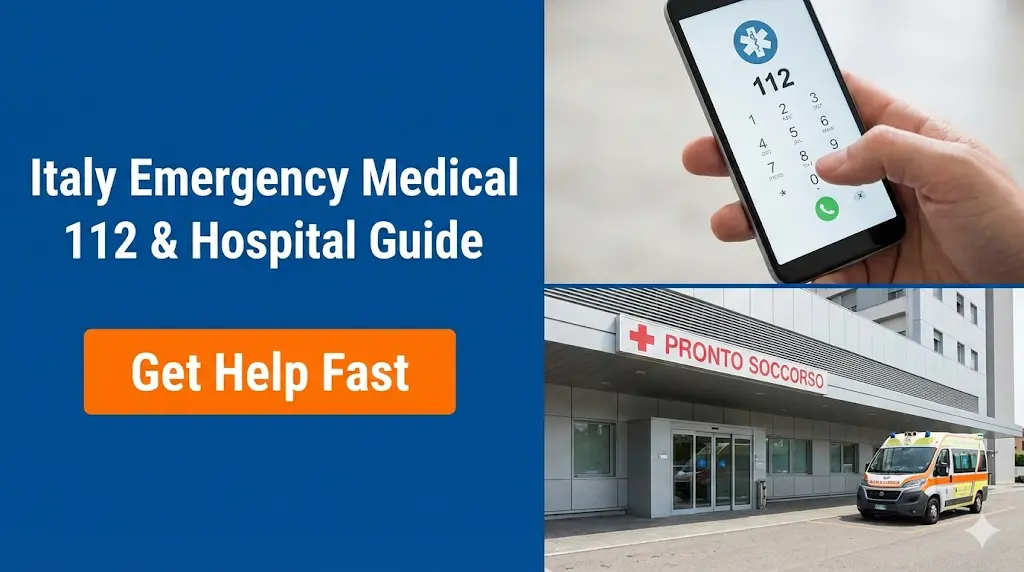
The European Emergency Number 112 Explained
For decades, dialing for help in Europe meant memorizing a different set of numbers for every country you visited. Recognizing the danger this posed to cross-border travelers, the European Union implemented 112 as the single European emergency number. Today, 112 is the universal number you must dial for any emergency—medical, criminal, or fire-related—in Italy.
How 112 Works in Italy
When you dial 112 in Italy, your call is routed to a centralized dispatch center. The operators at these centers are highly trained to rapidly assess the nature of your emergency. One of the greatest advantages of the 112 system for expatriates and tourists is its multilingual capability. Operators can handle calls in multiple languages, including English, to ensure critical information is not lost in translation.
Calling 112 is entirely free of charge from any fixed landline, public payphone, or mobile device. In fact, due to international GSM standards, you can dial 112 from a mobile phone even if it is locked or does not have a SIM card present.
The Absence of 911
A common and potentially dangerous misconception among North American visitors is that dialing 911 will automatically redirect to the local emergency services in Italy. Travelers must be aware that 911 does not work in Italy. You must mentally train yourself to dial 112 instead.
When you connect with the 112 operator, it is vital to remain as calm as possible and speak clearly. The operator will need to know your exact location, so be as specific as possible by providing street names, landmarks, or nearby buildings. The emergency operator will then guide you through the next steps and dispatch the appropriate services.
Legacy Emergency Numbers in Italy
While 112 is the overarching, unified emergency number across Italy, the country historically utilized a fragmented system of direct lines for specific emergency services. These legacy numbers are still active in various regions and will route you to the appropriate dispatchers.
- 118 (Medical Emergency): Historically, 118 was the direct number for emergency medical services and ambulances in Italy. In many areas, dialing 118 will still connect you directly to medical dispatch.
- 113 (National Police): The direct line to the national police force (Polizia di Stato) for reporting crimes, theft, or serious traffic accidents.
- 115 (Fire Brigade): This is the direct line for the fire department (Vigili del Fuoco), which handles active fires, gas leaks, and other related emergencies.
- 1530 (Coast Guard): Given Italy’s extensive coastline, dialing 1530 connects you directly to the Coast Guard for assistance at sea.
- 114 (Child Protection): A specialized emergency line for reporting distress involving children.
While these numbers remain functional, the Italian government and European Union heavily promote 112 to eliminate confusion. Dialing 112 ensures that a central dispatcher coordinates a multi-agency response if needed.
When and How to Call an Ambulance
Calling an ambulance in Italy should be reserved for genuine medical emergencies. The Italian emergency medical service (EMS) is highly sophisticated and operates on a tiered response model.
What to Say to the Operator
When you call 112 or 118, the operator will guide you through a structured interview. You should clearly state:
- Who is calling: State your name.
- What happened: Briefly explain the nature of the emergency and who is involved.
- Where you are: Provide your exact location to help emergency services reach you faster.
- Follow advice: Do not hang up until the operator tells you to do so, and follow their instructions carefully.
Types of Ambulance Units in Italy
Italy largely follows the Franco-German model of emergency medical services, which brings advanced medical care directly to the patient in the field. Depending on the operator’s assessment, one of the following units will be dispatched:
- Basic Life Support (BLS): Typically staffed by volunteer EMTs (soccorritori), consisting of a minimum of two responders. These units handle less critical emergencies and transport.
- Advanced Life Support (ALS): These are intensive care ambulances staffed by paid, hospital-based personnel. They are commonly composed of a physician (usually an emergency physician or anesthetist) and a critical care nurse, allowing them to administer complex treatments on the scene.
- Automedica: A rapid-response physician car carrying an emergency doctor and nurse. They stabilize the patient on-site alongside a BLS crew.
- Air Ambulance (Elisoccorso): For severe emergencies, such as stroke victims or incidents in remote areas, regional authorities deploy helicopters. These are staffed by physicians, critical care nurses, and mountain rescue specialists to transport patients to central hospitals.
Navigating the Pronto Soccorso Emergency Room
If you experience a medical emergency but are stable enough to travel without an ambulance, you should head to the nearest hospital’s emergency department, known in Italy as the Pronto Soccorso.
Upon arriving at the Pronto Soccorso, you will not be seen strictly based on your time of arrival. Instead, Italy utilizes a strict triage system. A specialized triage nurse will evaluate your vital signs and symptoms to assign you a priority color code. This color code directly correlates with your waiting time.
The Triage Color Codes
Historically, the Italian emergency department triage system was defined by a traditional 4-level color-coded model. Recently, hospitals have been transitioning to a more modern 5-level system to better stratify patient acuity and improve patient flow.
| 5-Level Code | Traditional 4-Level Code | Urgency Level | Target Wait Time | Description |
| Red (Rosso) | Red (Rosso) | Life-Threatening Emergency | Immediate | Severe impairment of vital functions. Immediate access to care and treatment. |
| Orange (Arancione) | Yellow (Giallo) | High Urgency | Within 15 minutes | High risk of losing vital functions or experiencing severe pain. |
| Light Blue (Azzurro) | Green (Verde) | Deferrable Urgency | Within 60 minutes | Stable condition without evolutionary risk, but patient requires complex diagnostic tests. |
| Green (Verde) | Green (Verde) | Minor Urgency | Within 120 minutes | Stable condition with minor injuries or illnesses requiring simple therapeutic pathways. |
| White (Bianco) | White (Bianco) | Non-Urgency | Up to 240 minutes | Non-urgent problems of minimal clinical relevance that could typically be managed by a general practitioner. |
If you are assigned a White or Green code, you must be prepared for a long wait, sometimes exceeding 5 or 6 hours in busy urban centers. The official maximum wait time for non-urgent white code cases is targeted at 240 minutes (4 hours). Patience is essential, as the staff is obliged to accept everybody 24/7 but must operate promptly on life-threatening situations first. If you find yourself needing to visit local clinics rather than the ER for non-urgent issues, it is helpful to consult Finding Doctors and Hospitals in Italy for guidance on booking standard appointments.
Costs and Fees for Emergency Care Is it Free
One of the most common questions expatriates and tourists have is whether they will receive a massive bill after an ambulance ride or an emergency room visit. The answer depends heavily on the severity of your condition, your residency status, and your nationality.
Free Care for True Emergencies
Under the Italian public healthcare system (SSN), emergency medical services and hospital admissions for necessary procedures are free of charge. If you have a bad accident or are admitted under a Red or Yellow/Orange code, immediate treatment in the Pronto Soccorso is provided free of charge.
The White Code Co Pay
To prevent public emergency rooms from being overrun by people seeking treatment for minor ailments, Italy enforces a small co-payment for non-urgent visits. If you go to the ER for a condition of minimal clinical relevance (like a cold or a light bruise) and are assigned a White code, you may be subject to a co-payment fee, usually around €25.
Rules for EU Citizens
If you are a citizen of an EU member state, Iceland, Liechtenstein, Norway, or Switzerland, you are entitled to health treatments under the same conditions as Italian residents if you present a valid European Health Insurance Card (EHIC). The EHIC covers necessary medical treatments, though you may still be asked to pay the €25 support fee for non-urgent access.
Rules for Non EU Citizens and Tourists
Healthcare is not entirely free for non-EU tourists. While immediate emergency assistance is provided to everyone, foreign tourists from non-EU countries without international healthcare agreements are legally bound to pay for treatments received, according to regional rates.
However, medical fees in Italy are generally much lower than in countries like the United States. An ER visit in Italy for basic services might cost between €50 and €200, though complex treatments or surgeries will increase the cost. Because of these potential expenses, non-EU tourists are strongly advised to hold comprehensive travel insurance. Understanding these financial dynamics is an important part of calculating the Cost of Healthcare in Italy: What Expats Need to Know.
Guardia Medica The Out of Hours Doctor
If you fall ill late at night, over the weekend, or on a public holiday with a condition that requires medical attention but is not a life-threatening emergency, you should avoid the Pronto Soccorso. Instead, Italy provides an out-of-hours medical service known as the Guardia Medica.
The Guardia Medica guarantees basic medical assistance at home or in designated clinics during situations designated as emergencies that take place outside of normal general practitioner hours. Typically, this service operates from 8:00 PM to 8:00 AM on weekdays, and from 10:00 AM on Saturday continuously until 8:00 AM on Monday, as well as on public holidays.
You can call your regional Guardia Medica phone number, and a doctor will assess your symptoms over the phone. They can offer medical advice, invite you to their clinic for an examination, or perform a house call. The doctors manning these stations can also issue prescriptions for necessary treatments.
Important Medical Vocabulary for Emergencies
In a high-stress situation, the language barrier can induce panic. While 112 operators can access translation services in multiple languages, having a few key Italian phrases committed to memory can save critical time when communicating with bystanders or paramedics.
- Aiuto! (ah-YOO-toh) – Help!
- Chiamate un’ambulanza! (kyah-MAH-teh oon am-boo-LAHN-tsa) – Call an ambulance!
- Ho bisogno di un medico. (oh bee-ZON-yo dee oon MEH-dee-koh) – I need a doctor.
- Pronto Soccorso (PRON-toh sohk-KOR-soh) – Emergency Room.
- Infarto (in-FAR-toh) – Heart attack.
- Sono allergico/a a… (SOH-noh ahl-LEHR-jee-koh/kah ah…) – I am allergic to…
- Dove si trova l’ospedale più vicino? (DOH-veh see TROH-vah loh-speh-DAH-leh pyoo vee-CHEE-noh) – Where is the nearest hospital?
It is highly recommended that expats carry a small card listing their name, blood type, known allergies, current medications, and emergency contact information translated into Italian.
Travel and Medical Evacuation Insurance
While standard public ER costs are affordable, severe medical crises can quickly become expensive if you require private hospital admission, specialized care, or transportation back to your home country.
The U.S. Embassy warns that while local emergency care is provided, payment of hospital expenses ultimately remains the patient’s responsibility. Furthermore, medical evacuation or repatriation flights back to the United States or other non-EU countries can easily cost $60,000 or more, depending on the location and medical condition. Therefore, securing an international health insurance policy that explicitly covers medical evacuation is vital for non-EU expatriates and travelers.
Conclusion
Relocating to Italy is an adventure that enriches the soul, but protecting your physical health must remain a foundational priority. The Italian emergency medical system is robust, deeply egalitarian, and staffed by highly trained professionals who operate under the ethos that life-saving care is a universal right. By memorizing the 112 European emergency number, understanding the strict triage protocols of the Pronto Soccorso, and knowing when to utilize alternative services like the out-of-hours Guardia Medica, you empower yourself to handle medical crises calmly and efficiently.
While the prospect of facing a health emergency in a foreign language is intimidating, preparation is your greatest antidote to fear. Ensure you carry your health documents, understand your insurance coverage requirements, and familiarize yourself with the local hospital infrastructure. The beauty of the Italian lifestyle is best enjoyed with the peace of mind that, should the unexpected happen, you know exactly how to summon the world-class medical assistance that Italy provides.
References
Primary sources (official)
- Your Europe – Official European Union portal detailing the use of 112 as the single European emergency number: https://europa.eu/youreurope/citizens/travel/security-and-emergencies/emergency/index_en.htm
- ASST Garda – Official regional health site outlining Pronto Soccorso guidelines and emergency payment structures for foreigners: https://www.asst-garda.it/ospedali/desenzano/pronto-soccorso/pronto-soccorso-emergency-department/
Other helpful sources
- Firebird Tours – Comprehensive guide on dialing emergency numbers and what to expect in an Italian emergency: https://www.firebirdtours.com/blog/what-do-case-emergency-italy
- TriageIQ – Insights into the Italian Emergency Department Triage System and the evolution from 4-level to 5-level color code models: https://blog.triageiq.com/italian-emergency-department-triage-system-regional-variations-and-the-evolution-from-4-level-to-5-level-models
Disclaimer
The information provided in this article is for educational and informational purposes only and does not constitute official medical, legal, or financial advice. Healthcare protocols, emergency triage systems, and hospital fee structures in Italy are subject to change by regional and national health authorities. In the event of a medical emergency, always dial 112 or seek immediate assistance from trained medical professionals at the nearest hospital or clinic.