SSN Services for Non-EU Expatriates: How to Qualify
Navigating Italian healthcare as a non-EU expat can seem daunting. This comprehensive guide explains how to qualify for Italy’s National Health Service (SSN), detailing mandatory and voluntary registration, essential documents, costs, and the benefits of the Tessera Sanitaria.
Disclosure: This post may contain affiliate links. We may earn a commission at no extra cost to you if you make a purchase through these links. Read full disclosure.
Introduction to SSN Services for Non-EU Expatriates
Italy boasts one of the most highly rated public healthcare systems in the world, known as the Servizio Sanitario Nazionale (SSN). Established to provide universal medical coverage, the SSN is the backbone of Italian public health, offering everything from routine check-ups and preventative screenings to complex surgeries and emergency trauma care. For Italian citizens and residents of the European Union, accessing these services is a relatively seamless process governed by established EU treaties. However, for non-EU expatriates—whether you are arriving from the United States, Canada, Australia, India, or elsewhere—the pathway to accessing the SSN requires navigating a very specific set of immigration and health regulations.
Qualifying for SSN services as a non-EU citizen is not a one-size-fits-all scenario. The Italian government categorizes foreign residents into different groups based on their visa type, their reason for living in Italy, and their employment status. These categories determine whether your enrollment in the public healthcare system is mandatory and free of charge, or voluntary and subject to an annual financial contribution.
This comprehensive guide is designed to completely demystify the Servizio Sanitario Nazionale for non-EU expatriates. We will break down the crucial differences between mandatory and voluntary registration, detail the exact financial costs you can expect if you fall into the voluntary category, and provide a clear, step-by-step roadmap for submitting your application at your local health authority. By understanding these bureaucratic frameworks, you can ensure that you and your family enjoy world-class medical protection throughout your Italian journey.
Understanding the Servizio Sanitario Nazionale
Before diving into the qualification criteria, it is important to understand what the SSN actually is and how it functions on a day-to-day basis. The Servizio Sanitario Nazionale was established in 1978 under the guiding principle that human health is a fundamental right of the individual and a core interest of the community.
The system is highly decentralized. While the central Ministry of Health in Rome sets the overarching national standards and minimum levels of care, the actual administration and delivery of healthcare are managed entirely at the regional level. Each of Italy’s twenty regions is responsible for operating its own network of hospitals, clinics, and local health authorities, known as the Azienda Sanitaria Locale (ASL).
When you qualify for and enroll in the SSN, you are integrated into this regional network. You gain the right to choose a primary care physician, access subsidized prescription medications, and receive free hospitalization in public medical facilities. However, because the system is regionally managed, the exact administrative steps to register, the digital platforms used to book appointments, and even the layout of the local ASL offices can vary significantly depending on whether you live in a bustling northern metropolis like Milan or a quiet southern town in Puglia.
The Foundation of Eligibility Legal Residency
The absolute most important concept to grasp regarding SSN qualification is that Italian public healthcare is entirely tied to legal residency, not just physical presence. You cannot simply arrive in Italy on a three-month tourist visa and sign up for public healthcare.
To even be considered for SSN enrollment, a non-EU expatriate must hold a valid long-stay visa (Type D) and must have applied for or already possess a valid residence permit. You must also be officially registered as a resident in the demographic registry of your local Italian municipality. Without these foundational immigration documents, the doors to the public healthcare system remain firmly closed, and you must rely on private international travel insurance. For an in-depth look at securing your legal status, you should review the guide on Italian Residence Permit (Permesso di Soggiorno) Explained.
Mandatory versus Voluntary SSN Registration
Once your legal residency is established, your pathway into the SSN splits into two distinct categories: Mandatory Registration (Iscrizione Obbligatoria) and Voluntary Registration (Iscrizione Volontaria). Knowing which category you fall into is the most critical step in this process, as it dictates whether your healthcare is free or if you must pay a significant annual fee.
Mandatory Registration Categories
Mandatory registration means that you are legally required to be part of the SSN, and your enrollment is completely free of charge. You do not pay an annual premium because your healthcare is funded through the income taxes you (or your employer) pay to the Italian state. You qualify for mandatory, free registration if you meet any of the following criteria:
- Subordinate Workers: If you are a non-EU citizen holding a valid work permit and are employed by an Italian company with a standard employment contract, you are required to register.
- Self Employed Workers: If you have a self-employment visa, possess an Italian VAT number (Partita IVA), and pay taxes into the Italian social security system (INPS), you qualify for mandatory registration.
- Family Members: If you are a non-EU citizen living in Italy through an official family reunification visa as a dependent of an Italian citizen, an EU citizen, or a non-EU citizen who themselves qualifies for mandatory SSN registration, your enrollment is also mandatory and free.
- Pregnant Women: Under Italian law, all pregnant women, regardless of their immigration status or nationality, have the right to free, mandatory registration covering their pregnancy and up to six months after childbirth.
- Unemployed Residents Seeking Work: If you have lost your Italian job but are legally registered with the local employment center (Centro per l’Impiego) and hold a residence permit for expected employment, you maintain your mandatory free registration.
Voluntary Registration Categories
If you are legally residing in Italy but do not pay income taxes or social security contributions to the Italian state, you do not qualify for free healthcare. Instead, you must apply for voluntary registration. This pathway requires you to pay an annual, lump-sum fee to “buy into” the public system. You fall into the voluntary category if you match these profiles:
- Students: Non-EU students residing in Italy on a student visa must have health insurance. They can choose to purchase private insurance or voluntarily buy into the SSN at a heavily discounted flat rate.
- Elective Residence Visa Holders: This is the category that most non-EU retirees and financially independent expats fall into. Because elective residents are not permitted to work in Italy and often live off foreign pensions or passive income, they must voluntarily pay to join the SSN.
- Religious Workers: Foreign religious personnel residing in Italy on religious visas qualify for voluntary enrollment.
- Au Pairs: Young people working in Italy under officially recognized au pair programs can voluntarily register.
Calculating the Costs for Voluntary Enrollment
For non-EU expatriates who must use the voluntary registration route, understanding the financial commitment is crucial for your relocation budget. The fees for voluntary SSN enrollment underwent significant legislative changes recently, impacting how much expats, particularly elective residents, are required to pay.
Income Based Calculation for Elective Residents
For individuals on an Elective Residence Visa or those living off passive foreign income, the annual SSN fee is not a flat rate. It is calculated as a percentage of your total global income from the previous year.
Historically, the baseline minimum payment was relatively low, but recent legislative updates aimed at balancing the healthcare budget have increased these costs. The general formula requires you to pay a specific percentage (typically around 7.5%) of your total declared income, up to a certain income cap. However, the Italian government has established a strict minimum annual contribution for this category, which currently sits at approximately 2,000 Euros per year. This means that even if 7.5% of your income calculates to less than 2,000 Euros, you must still pay the 2,000 Euro baseline to access the system.
It is vital to declare your income accurately, as the Italian Revenue Agency and the ASL frequently audit these payments. Underpaying your voluntary contribution can result in a suspension of your health coverage and significant financial penalties.
Flat Rates for Students and Au Pairs
To encourage international education and cultural exchange, the Italian government offers heavily discounted, flat-rate voluntary registration fees for specific, non-earning visa categories.
- International Students: Non-EU students holding a valid student visa can register for the SSN by paying a flat annual fee. This fee is historically set at around 700 Euros per year, though this figure can fluctuate slightly based on annual budget laws.
- Au Pairs: Individuals registered under official au pair contracts pay a similarly reduced flat fee, often ranging between 200 and 300 Euros annually.
The Calendar Year Rule
A very important, and often frustrating, quirk of the voluntary registration system is the calendar year rule. Voluntary SSN registration is strictly valid from January 1st to December 31st of the current year, regardless of when you actually pay the fee.
If you arrive in Italy and pay your 2,000 Euro elective resident fee in September, your coverage will still expire on December 31st. You will not receive twelve rolling months of coverage. Therefore, if you are arriving late in the year, it may be more financially prudent to rely on private travel medical insurance for the remaining months and pay for your voluntary SSN registration in early January to maximize the value of your contribution. To understand more about managing your financial resources for medical expenses, you can refer to our guide on the Cost of Healthcare in Italy: What Expats Need to Know.
Comparison of SSN Registration Pathways
To summarize the differences, the table below provides a clear overview of the two registration pathways for non-EU expatriates.
| Feature | Mandatory Registration (Iscrizione Obbligatoria) | Voluntary Registration (Iscrizione Volontaria) |
| Primary Eligibility | Work visa holders, self-employed taxpayers, family reunification members. | Elective residence visa holders (retirees), students, au pairs. |
| Annual Premium Cost | Free (funded by your Italian income taxes). | Paid annually (Income-based for elective residents, flat rate for students). |
| Validity Period | Valid for the duration of your residence permit. | Strictly valid for the calendar year (Jan 1 – Dec 31). |
| Level of Coverage | Full, comprehensive public healthcare access. | Full, comprehensive public healthcare access. |
| Family Coverage | Automatically covers dependent family members. | Fee is generally per person; dependents may require separate calculations. |
Essential Documents for Your Application
Bureaucracy in Italy relies heavily on precise documentation. When you are ready to apply for your SSN coverage, arriving at the local health authority without the correct paperwork will guarantee that you are turned away and told to make another appointment.
Before visiting your local ASL, you must gather the following essential documents:
- Valid Passport: You must bring your original passport and photocopies of the main biographical page and your Italian visa stamp.
- Permesso di Soggiorno (Residence Permit): You need your valid plastic residence permit card. If you are a new arrival and your card is still being processed, you must bring the official postal receipt (ricevuta) proving that you have submitted the application or renewal, along with the expired permit if applicable.
- Codice Fiscale: This is your Italian tax identification number. You must bring the official certificate issued by the Agenzia delle Entrate (Revenue Agency).
- Certificate of Residence: You must provide a Certificato di Residenza or a self-certification form (Autocertificazione) proving that you are officially registered at a physical address within the specific district managed by that ASL.
- Proof of Status: For mandatory registration, bring your employment contract, recent pay slips (buste paga), or proof of your VAT number. For voluntary registration, bring proof of your student enrollment or your elective residence status.
- Payment Receipt (Voluntary Only): If you are enrolling voluntarily, you must go to the post office beforehand, fill out a specific postal payment slip (Bollettino Postale) with the correct ASL bank details and fee amount, pay it, and bring the stamped receipt to your appointment as proof of payment.
Steps to Complete Your ASL Registration
Armed with your meticulously organized folder of documents, you are ready to formally register with the healthcare system. The process involves interacting with the local bureaucracy, which requires patience and a polite demeanor.
Locating Your District ASL
You cannot simply walk into any health office in your city. You must visit the specific ASL office that holds jurisdiction over the postal code where you are officially registered as a resident. You can usually find the correct office by searching the website of your regional health authority. Many ASL offices now require you to book an appointment online in advance, so do not assume you can simply show up and take a physical ticket number.
Submitting the Paperwork
At your appointment, the ASL clerk will review your documents to verify your eligibility. If you are a non-EU citizen presenting a postal receipt rather than a finalized residence permit, the clerk will register you temporarily. This temporary registration typically lasts for six months. Once your physical plastic residence permit is issued by the police headquarters, you must return to the ASL to update your file and extend your health coverage for the full duration of your visa.
Selecting Your Primary Care Physician
The final, and most important, step of your ASL appointment is choosing your primary care physician, known as the Medico di Base or Medico di Medicina Generale. If you have children under the age of fourteen, you must also select a pediatrician (Pediatra di Libera Scelta).
The clerk will provide you with a list or show you a digital screen of doctors operating in your neighborhood who currently have space on their patient rosters. It is highly advisable to do some independent research in expat forums before your appointment to identify doctors in your area who speak English, as the ASL database does not filter physicians by language proficiency. Once you select a doctor, they become your permanent gateway to the public healthcare system. For a deeper dive into this specific relationship, review the guide on Registering with an Italian Family Doctor (Medico di Base).
Securing Your Tessera Sanitaria
Upon successfully processing your registration and selecting your doctor, the ASL clerk will hand you a paper receipt. This document serves as your official, temporary health card. Do not lose it. You can use this paper immediately to book appointments, visit your new doctor, and pick up prescriptions.
The physical, plastic card is called the Tessera Sanitaria. The central government will automatically print this card and mail it to your registered residential address. The card is embedded with a microchip and displays your Codice Fiscale, your name, and the expiration date of your coverage.
It is crucial to monitor the expiration date on your Tessera Sanitaria. For non-EU expatriates, your health coverage expiration is strictly tied to the expiration date of your residence permit. When you begin the process of renewing your visa and residence permit, you must concurrently repeat the ASL registration process to ensure your health coverage does not lapse.
What Services Are Covered Under the SSN
Once you are a fully qualified member of the SSN, holding either mandatory or voluntary status, you enjoy the exact same medical rights as an Italian citizen. The coverage is incredibly broad and designed to ensure comprehensive health security.
Your coverage includes unlimited, free visits to your chosen Medico di Base. If you require specialized care—such as a consultation with a cardiologist, a dermatologist, or an orthopedic surgeon—your primary doctor will write an electronic referral (impegnativa). With this referral, you can book public specialist appointments and diagnostic tests (like blood work, X-rays, or MRI scans).
Hospitalization, including emergency room trauma care, intensive care unit stays, and necessary surgeries, is provided completely free of charge. Furthermore, maternity care, from prenatal ultrasounds to childbirth in public hospitals, is covered extensively.
Understanding the Ticket System
While the SSN is often described as “free” healthcare, this is a slight misnomer. While primary care and emergency hospitalization are free, most outpatient specialist visits and diagnostic tests require a co-payment known as a ticket.
The ticket is a subsidized fee designed to offset the cost of the public service. For example, a specialized blood test or an ultrasound might require a ticket payment of 20 to 40 Euros. Similarly, prescription medications are categorized by the state. Life-saving and chronic disease medications (Class A) are usually free or require a very small ticket (e.g., 2 Euros), while non-essential or over-the-counter medications (Class C) must be paid for in full at the pharmacy. Certain vulnerable populations, such as children, seniors with low incomes, and individuals with recognized chronic illnesses, are legally exempt from paying the ticket.
Private Healthcare as an Alternative or Supplement
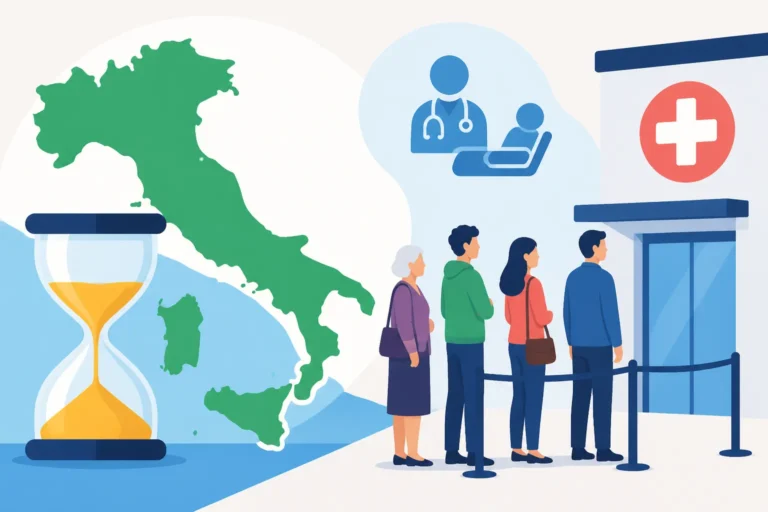
Despite the exceptional quality of medical care provided by the SSN, many non-EU expatriates find the public system challenging to navigate. The two primary complaints regarding the Italian public system are the notoriously long waiting lists for non-urgent specialist appointments and the severe lack of English-speaking administrative staff and doctors in public hospitals.
Because of these friction points, a large segment of the expat community chooses to bypass the SSN entirely or use it only as a backup for major emergencies. Instead, they purchase private international health insurance. Private insurance allows you to bypass public waiting lists, secure immediate appointments at luxury private clinics, and guarantee that your consultations are conducted in English by internationally trained physicians.
If you are an elective resident calculating the cost of the 2,000 Euro voluntary SSN fee, you may find that purchasing a comprehensive private international health insurance policy offers better language support and faster access for a comparable annual price.
Conclusion
Securing access to the Servizio Sanitario Nazionale as a non-EU expatriate requires a clear understanding of Italian immigration law, an organized approach to bureaucracy, and a bit of patience. Whether your employment status grants you the right to free, mandatory registration, or your residency type requires you to calculate and pay for voluntary enrollment, the effort is undeniably worthwhile.
By taking the time to gather your essential documents, visiting your local ASL, and securing your Tessera Sanitaria, you are doing much more than just ticking off an administrative box. You are unlocking access to a public healthcare system that emphasizes preventative care, deep medical expertise, and the fundamental right to well-being. With your medical safety net firmly established, you can leave the stress of healthcare logistics behind and fully immerse yourself in the rich, vibrant, and incredibly beautiful experience of living in Italy.
References
Primary sources (official)
- Ministero della Salute (Ministry of Health): The official Italian government health portal detailing the structural framework of the SSN, the legal rights of foreign citizens to access medical care, and the specific guidelines separating mandatory and voluntary health registration. https://www.salute.gov.it/
- Agenzia delle Entrate (Italian Revenue Agency): The official source for regulations concerning the issuance of the Codice Fiscale, the calculation of the Tessera Sanitaria fees for voluntary enrollment based on income, and tax-related residency requirements. https://www.agenziaentrate.gov.it/
Other helpful sources
- Expatica Italy: A highly detailed and frequently updated resource network for expatriates, offering practical advice on navigating Italian health insurance, finding English-speaking doctors, and understanding the nuances of the ASL registration process. https://www.expatica.com/it/healthcare/
- The Local Italy: A prominent English-language news outlet that provides essential coverage on changes to Italian immigration laws, updates to the cost of voluntary SSN enrollment, and general lifestyle guides for the foreign community living in the peninsula. https://www.thelocal.it/
Disclaimer
The information provided in this article is intended for general educational and informational purposes only and does not constitute official medical, legal, or financial advice. Immigration laws, healthcare regulations, and the specific financial costs associated with voluntary enrollment in the Servizio Sanitario Nazionale are subject to frequent legislative changes by the Italian government. Bureaucratic procedures may also vary significantly depending on your regional Azienda Sanitaria Locale (ASL). Always consult directly with the official Italian authorities, a qualified immigration lawyer, or an accredited accountant (Commercialista) to receive the most accurate and personalized guidance regarding your specific residency and healthcare eligibility status.