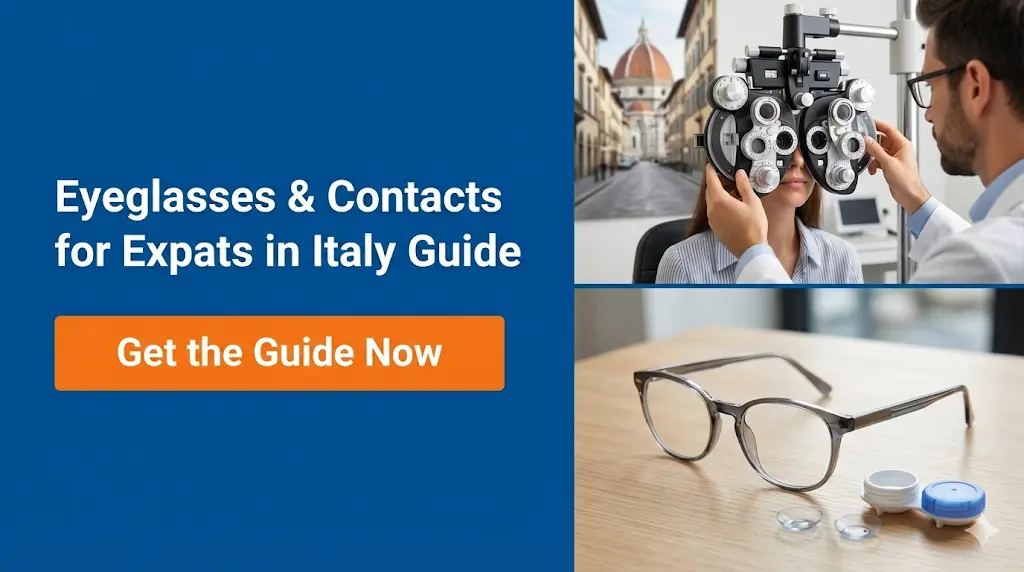
Getting Eyeglasses or Contacts as an Expat in Italy
Navigating vision care abroad can seem daunting, but securing eyeglasses or contact lenses in Italy is incredibly straightforward. This guide covers everything expatriates need to know, from booking an eye exam and buying designer frames to understanding insurance coverage and tax deductions.
Disclosure: This post may contain affiliate links. We may earn a commission at no extra cost to you if you make a purchase through these links. Read full disclosure.
Introduction to the Italian Optical Landscape
Italy is uniquely positioned when it comes to vision care and eyewear. The country is the birthplace of some of the largest and most prestigious eyewear manufacturers in the world. The Veneto region, specifically the province of Belluno, is internationally recognized as the historical district of eyewear manufacturing, home to industry giants that produce frames for nearly every major luxury fashion house globally. Because of this rich heritage, eyeglasses in Italy are viewed as much more than just a medical necessity; they are a fundamental fashion accessory and a statement of personal style.
For an expatriate, this means you will have access to an unparalleled selection of high-quality frames and cutting-edge lens technology. However, the process of getting your eyes checked, securing a valid prescription, and ultimately purchasing your glasses or contact lenses involves navigating a system that might differ significantly from what you are accustomed to in your home country. In many nations, the roles of eye doctors and eyewear retailers are strictly separated by rigorous prescription laws. In Italy, the lines can sometimes blur, offering a surprisingly flexible and convenient experience for the consumer.
Whether you need a comprehensive medical evaluation of your eye health, a simple vision test to update your lenses, or just a fresh box of daily contacts to get you through the month, understanding the roles of different optical professionals and the bureaucratic steps involved is essential. This comprehensive guide will walk you through the entire process, ensuring that your vision remains perfect as you take in the wonders of your new Italian life.
Understanding the Professionals Opticians vs Ophthalmologists
The first step in navigating the Italian eye care system is understanding who does what. When you walk down an Italian street, you will frequently see signs for an Ottica (optical shop), but the professionals inside, and those operating in medical clinics, have very distinct qualifications and legal scopes of practice. To dive deeper into the specific medical roles, you can explore our guide on Eye Care in Italy: Optometrists and Ophthalmologists.
The Oftalmologo or Oculista
An Oculista (ophthalmologist) is a fully qualified medical doctor who specializes in the comprehensive health of the eye. They have completed medical school and a rigorous residency in ophthalmology. You should visit an oculista if you need a thorough medical examination, are experiencing eye pain, suspect you have an infection, or need screening for eye diseases such as glaucoma, cataracts, or macular degeneration. An oculista will dilate your pupils, examine the retina, and can perform eye surgery. They also issue prescriptions for corrective lenses, but their primary focus is medical eye health.
The Optometrista
An Optometrista (optometrist) in Italy is a vision care professional trained to measure eyesight, detect visual defects like myopia (nearsightedness), hyperopia (farsightedness), and astigmatism, and prescribe corrective lenses. They hold a specific degree in optometry. While they are highly skilled at determining your exact visual prescription, they are not medical doctors. If an optometrista detects a potential medical issue during a vision test, they are legally required to refer you to an oculista for a medical diagnosis.
The Ottico
An Ottico (optician) is the professional who actually makes and dispenses your eyeglasses. They interpret the prescription provided by the oculista or optometrista, help you select the appropriate frames, measure your pupillary distance, and cut and fit the lenses into the frames. In Italy, it is incredibly common for an ottica (the retail shop) to employ someone who is both an ottico and an optometrista. This dual qualification makes purchasing glasses incredibly convenient, as you can have your vision tested and your glasses made in the exact same location.
How to Get an Eye Exam in Italy
Depending on your specific needs, your budget, and whether you are integrated into the Italian public healthcare system, you have three primary pathways to get your eyes checked in Italy.
Walk into an Ottica for a Basic Vision Test
If your eyes are generally healthy and you simply feel that your current glasses are no longer strong enough, the fastest and easiest method is to visit a local ottica. Most optical shops offer a misurazione della vista (vision measurement) right in the store. You can often walk in without an appointment, though calling ahead is recommended. The resident optometrist will use standard equipment to determine your new prescription. In many Italian optical shops, this vision test is completely free of charge, provided that you purchase your new frames or lenses from their store. If you just want the prescription written down to take elsewhere, they may charge a small fee, typically between twenty and forty euros.
Use the Public Healthcare System
If you require a comprehensive medical eye exam, you can utilize the Servizio Sanitario Nazionale (SSN), the Italian public healthcare system. To do this, you must first visit your general practitioner to obtain a referral (impegnativa). With this referral, you can book an appointment with a public oculista at a local hospital or regional health clinic. The quality of care is excellent, and the cost is very low—you will only pay a small regional co-pay known as a ticket, which usually ranges from twenty to thirty-five euros. However, the major downside for expats is the waiting time. Public appointments for non-urgent specialist visits can take several months to secure. For more information on navigating this system, you can read our guide on Obtaining the Italian Health Card (Tessera Sanitaria).
Book a Private Ophthalmologist
For expatriates who want a full medical eye exam without the long public waiting lists, booking a private oculista is the best option. You do not need a referral to see a private doctor. You can easily find English-speaking ophthalmologists in major cities like Rome, Milan, Florence, and Naples. A private consultation allows you to be seen within a few days. The doctor will perform a complete medical evaluation, check your eye pressure, examine your retina, and provide a precise prescription for glasses.
Purchasing Eyeglasses in Italy
Once you have your prescription, the fun part begins: choosing your frames. The experience of buying eyeglasses in Italy is highly customer-centric, combining expert craftsmanship with high fashion.
The Retail Experience
Italian cities are dotted with independent optical boutiques as well as large national and international chains like Salmoiraghi & Viganò, Avanzi, and GrandVision. Independent boutiques often carry unique, artisanal brands alongside major designer labels, offering highly personalized service. The staff will spend a significant amount of time helping you find frames that complement your face shape and personal style.
Choosing Your Lenses
When selecting your lenses (lenti), the optician will ask you about your lifestyle to recommend the best treatments and materials. It is helpful to know the Italian terminology for these options:
- Lenti Antiriflesso: Anti-reflective coating. This is highly recommended to reduce glare from screens and headlights when driving at night.
- Lenti Antigraffio: Anti-scratch coating. Essential for prolonging the life of your lenses.
- Lenti Fotocromatiche: Photochromic lenses (like Transitions) that darken automatically when exposed to sunlight.
- Lenti Progressive: Progressive lenses, which feature a seamless transition between distance and reading prescriptions, ideal for those with presbyopia.
- Filtro Luce Blu: Blue light filtering, which is incredibly popular for expats and digital nomads who spend long hours working on computers.
Turnaround Time and Fitting
Once you select your frames and lens options, the optician will measure your pupillary distance to ensure the optical center of the lens aligns perfectly with your eyes. The turnaround time for a standard pair of single-vision glasses is usually quite fast, often between three to five business days. For complex progressive lenses or highly customized high-index lenses (for very strong prescriptions), it may take a week to ten days. When you return to pick up your glasses, the optician will make final adjustments to the arms and nose pads to ensure a comfortable, secure fit behind your ears.
Buying Contact Lenses in Italy
If you prefer contact lenses (lenti a contatto), you will find the purchasing process in Italy to be remarkably relaxed and convenient compared to the strictly regulated systems in countries like the United States.
The Prescription Requirement
One of the biggest surprises for North American expats is that you generally do not need to present a formalized, unexpired medical prescription to purchase standard daily or monthly contact lenses in an Italian ottica or pharmacy. While it is strongly advised to have a professional fitting and regular eye exams to ensure the health of your cornea, the actual retail purchase functions more like buying an over-the-counter product.
If you already know your brand, your base curve (BC), your diameter (DIA), and your power, you can simply walk into any optical shop, provide the numbers, and purchase your boxes. Many optical chains keep popular brands like Acuvue, Dailies, and Biofinity in stock for immediate purchase, especially for common prescriptions ranging from -1.00 to -6.00. If you have astigmatism (requiring toric lenses) or presbyopia (requiring multifocal lenses), the shop will likely need to order them, which takes just a few days.
Types of Contact Lenses Available
Italian optical shops offer the full spectrum of contact lenses:
- Lenti Giornaliere: Daily disposable lenses. These are the most popular option in Italy due to their hygiene and convenience, requiring no cleaning solutions.
- Lenti Mensili: Monthly disposable lenses. These are more cost-effective but require daily cleaning and proper storage.
- Lenti Quindicinali: Bi-weekly lenses, offering a middle ground between dailies and monthlies.
Contact Lens Solutions
If you use reusable lenses, you will need to purchase cleaning and storage liquids. These are readily available at both optical shops and standard pharmacies. Look for soluzione unica (multi-purpose solution) which cleans, rinses, and stores the lenses, or soluzione salina (saline solution) for basic rinsing.
Table Cost Breakdown for Eyewear and Eye Exams
To help you budget for your optical needs in Italy, below is a comparative table of the estimated average costs you can expect to encounter. Please note that prices can vary significantly based on the region, the prestige of the clinic, and whether you choose basic or designer frames. To understand how these out-of-pocket costs fit into your overall budget, you can review our broader breakdown on the Cost of Healthcare in Italy: What Expats Need to Know.
| Service / Item | Public Healthcare (SSN) Cost | Private / Retail Cost |
| Comprehensive Medical Eye Exam | €20 – €35 (Ticket co-pay) | €100 – €200 |
| Basic Vision Test (for a prescription) | N/A | Free (if buying glasses) to €40 |
| Standard Designer Frames | N/A | €100 – €250+ |
| Standard Single-Vision Lenses (Pair) | N/A | €60 – €150 |
| Progressive Lenses (Pair) | N/A | €200 – €500+ |
| Daily Contact Lenses (Box of 30) | N/A | €20 – €35 |
| Monthly Contact Lenses (Box of 6) | N/A | €30 – €50 |
| Multi-Purpose Solution (360ml) | N/A | €8 – €15 |
Does Italian Public Healthcare Cover Vision
A very common question among expats officially residing in Italy is whether the Servizio Sanitario Nazionale (SSN) will pay for their eyeglasses or contact lenses. The general answer is no.
The Italian public healthcare system provides excellent coverage for medical exams, surgeries (such as cataract removal or retinal detachment repair), and emergency eye trauma. However, when it comes to corrective devices like standard eyeglasses and contact lenses, the SSN views these as out-of-pocket personal expenses.
There are very few exceptions to this rule. The SSN may provide partial subsidies or supply corrective devices for minors (children under a certain age) with severe visual impairments, or for adults suffering from recognized severe pathologies (such as legally defined blindness or keratoconus requiring highly specialized hard contact lenses). For the average expatriate dealing with standard myopia, hyperopia, or age-related presbyopia, you must be prepared to pay the retail cost for your frames and lenses.
Navigating Private Health Insurance for Optical Needs
Because the public system does not cover the cost of glasses or contacts, many expatriates choose to rely on private health insurance. If you have relocated for a corporate job, your employer may provide a supplemental Italian health insurance policy, or you may have purchased an international expat insurance plan.
It is vital to review your specific policy documents carefully. Many standard private health insurance policies cover the cost of a private ophthalmologist visit but exclude the physical hardware (the glasses themselves). If you want your frames and lenses covered, you generally need to ensure your policy includes an explicit “Optical Rider” or “Vision and Dental” module. For a comprehensive overview of how to select the right coverage for your lifestyle, read our guide on Choosing Private Health Insurance Plans in Italy.
If your private insurance does include optical coverage, the process in Italy is typically “pay and claim.” You will pay the optician directly for your glasses or contacts, collect a detailed, itemized commercial invoice (fattura), and submit this document to your insurance provider for reimbursement according to your policy limits.
Tax Deductions for Medical Devices
Even if you are paying entirely out of pocket for your eyeglasses or contact lenses, the Italian government offers a significant financial benefit that you must take advantage of. In Italy, corrective eyeglasses and contact lenses are officially classified as Dispositivi Medici (Medical Devices).
If you are an official resident of Italy and file an annual Italian income tax return (Dichiarazione dei Redditi), you are legally entitled to deduct 19% of your medical expenses from your total tax liability, provided your total medical expenses for the year exceed a small baseline threshold (the franchigia of €129.11).
The Crucial Scontrino Parlante
To successfully claim this 19% tax deduction, you cannot just use a standard credit card receipt. You must strictly follow Italian tax rules at the moment of purchase:
- Use a Traceable Payment Method: You cannot pay in cash. You must pay using a debit card (Bancomat), credit card, or bank transfer, and keep the payment receipt.
- Request a Scontrino Parlante: Before the cashier rings up your purchase, you must hand them your Italian Health Card (Tessera Sanitaria) or provide your alphanumeric tax code (Codice Fiscale). You must ask for a scontrino parlante (a “talking receipt”). This specific type of receipt explicitly links your personal tax code to the purchase.
- Verify the CE Mark: The receipt or the accompanying documentation must clearly indicate that the product purchased is a medical device bearing the European “CE” mark of conformity.
When you follow these steps, the ottica or pharmacy automatically transmits the purchase data to the Italian Revenue Agency (Agenzia delle Entrate). Come tax season, your accountant will find that your optical purchases are already pre-filled in your digital tax declaration, saving you a considerable amount of money.
Useful Italian Vocabulary for the Eye Doctor and Optician
Navigating a medical or retail environment in a foreign language can be intimidating. To help you feel confident when you step into an Italian ottica or a doctor’s office, here is a glossary of essential Italian optical vocabulary:
- Eye doctor: Oculista
- Optician: Ottico
- Eye exam: Visita oculistica
- Vision test: Misurazione della vista or Controllo della vista
- Eyeglasses: Occhiali da vista
- Sunglasses: Occhiali da sole
- Frames: Montatura
- Lenses: Lenti
- Contact lenses: Lenti a contatto
- Daily / Monthly lenses: Lenti giornaliere / mensili
- Prescription: Ricetta medica (for an oculista) or Prescrizione visiva
- Nearsighted (Myopia): Miope
- Farsighted (Hyperopia): Ipermetrope
- Astigmatism: Astigmatismo
- I need new glasses: Ho bisogno di occhiali nuovi.
- My vision has worsened: La mia vista è peggiorata.
- Do you have my contact lens brand?: Avete la mia marca di lenti a contatto?
Conclusion
Securing eyeglasses or contact lenses as an expat in Italy is an experience that beautifully highlights the country’s blend of high-quality healthcare and world-class retail fashion. While the nuances of the system—such as distinguishing between an oculista and an ottico, or remembering to ask for your scontrino parlante for tax deductions—require a brief adjustment period, the actual process of obtaining vision care is highly accessible and remarkably efficient.
By understanding your options for eye exams, leveraging the relaxed rules surrounding contact lens purchases, and embracing the immense variety of frames crafted in the heart of the global eyewear industry, you can ensure that your vision remains sharp without unnecessary stress. Whether you are reading a menu at a dimly lit trattoria or admiring the intricate details of a Renaissance masterpiece, taking proactive control of your optical health allows you to focus on the spectacular adventure of your life in Italy.
References
Primary sources (official)
- Ministero della Salute (Italian Ministry of Health): The central governmental portal providing official guidelines on the Servizio Sanitario Nazionale, patient rights, and the classification of medical devices. https://www.salute.gov.it/
- Agenzia delle Entrate (Italian Revenue Agency): The official government tax authority providing detailed regulations on the 19% medical expense deduction, the use of the Codice Fiscale, and the requirements for the scontrino parlante. https://www.agenziaentrate.gov.it/
Other helpful sources
- Federottica: The National Association of Italian Opticians, offering resources on professional standards, optical technology, and consumer guidance for purchasing eyeglasses and contact lenses in Italy. https://www.federottica.org/
- Expatica Italy: A highly comprehensive resource network for foreign residents, offering practical, step-by-step guides on navigating the Italian healthcare system and managing daily life as an expatriate. https://www.expatica.com/it/healthcare/
Disclaimer
The information provided in this article is intended for general educational and informational purposes only and does not constitute official medical, optical, legal, or financial advice. Healthcare regulations, the cost of medical exams and retail eyewear, and the strict administrative rules regarding Italian tax deductions are subject to frequent legislative updates. Always consult directly with a licensed Italian medical professional (Oculista or Optometrista) for an accurate diagnosis and prescription for your vision needs. For inquiries regarding insurance claims or personal income tax deductions, consult directly with your insurance provider or a certified Italian accountant (Commercialista).