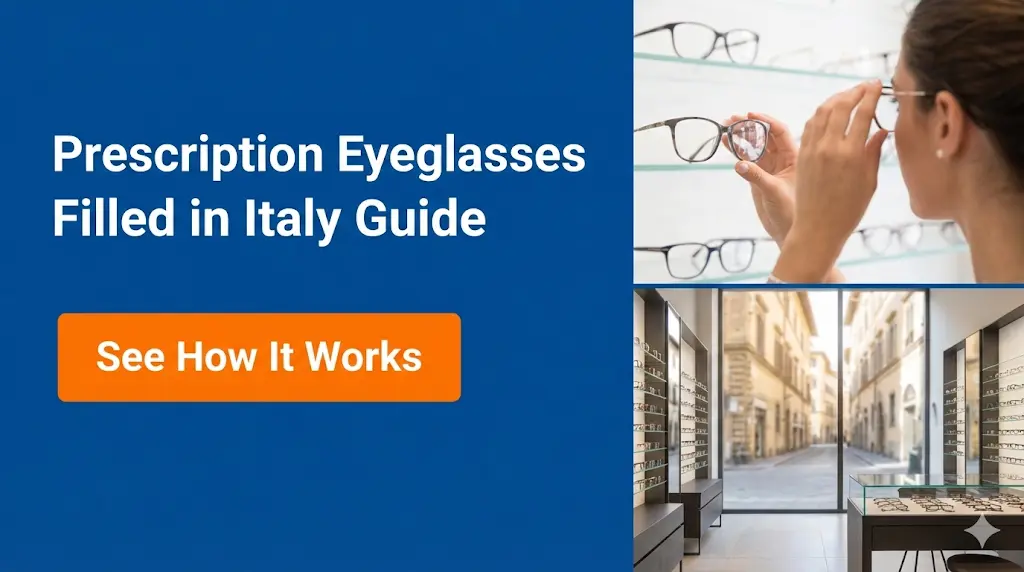
Getting Prescription Eyeglasses Filled in Italy
Navigating vision care abroad can be challenging. This comprehensive guide explains everything you need to know about getting prescription eyeglasses filled in Italy, from translating foreign prescriptions and visiting an Italian optician to understanding costs, lens options, and tax deductions.
Disclosure: This post may contain affiliate links. We may earn a commission at no extra cost to you if you make a purchase through these links. Read full disclosure.
Introduction
Whether you are a tourist who has suffered an unfortunate eyewear emergency or an expatriate settling into a new life in Rome or Milan, knowing how to obtain prescription eyeglasses in Italy is an essential practical skill. The Italian approach to vision care is highly professional and remarkably accessible, but it operates under a system that might differ significantly from what you are used to back home.
In many countries, the lines between an eye doctor and an eyewear retailer are distinctly drawn, and the paperwork required to purchase a simple pair of corrective lenses can be strictly regulated. In Italy, the system is designed to be slightly more fluid, offering multiple pathways to getting your vision corrected. You can bring a prescription from your home country, you can have your vision tested directly at an optical shop, or you can undergo a comprehensive medical eye exam through the public healthcare system. This extensive guide will walk you through every step of getting prescription eyeglasses filled in Italy, detailing the professionals you will encounter, the terminology you need to know, the breakdown of costs, and the financial benefits available to legal residents.
The Professionals: Understanding Who Does What
When you realize you need a new pair of glasses, your first decision is figuring out who to see. In Italy, vision care is divided between two distinct types of professionals, and understanding the difference is crucial for getting the right level of care.
The Oculista (Ophthalmologist)
An oculista is a specialized medical doctor. They have completed a full medical degree followed by a multi-year residency in ophthalmology. You should see an oculista if you need a comprehensive medical evaluation of your eye health. They are the only professionals qualified to diagnose and treat eye diseases such as glaucoma, cataracts, macular degeneration, or severe eye infections. They can dilate your pupils, perform deep retinal exams, and write medical prescriptions for eye drops or other pharmaceuticals. Naturally, they can also test your visual acuity and write a prescription for eyeglasses or contact lenses. If you need complex medical care, exploring the landscape of Eye Care in Italy: Optometrists and Ophthalmologists will help you find the right specialist.
The Ottico and Optometrista (Optician and Optometrist)
An ottico is an optician, a highly trained technician who specializes in the fitting, manufacturing, and dispensing of eyeglasses and contact lenses. Many ottici in Italy have also completed specialized tertiary education to become an optometrista (optometrist).
If your eyes are medically healthy and you simply need a routine vision check to update your prescription for nearsightedness, farsightedness, or astigmatism, you can walk directly into an optical shop (ottica). The resident optometrist is fully qualified to perform a refraction test (measuring your vision using a phoropter and reading charts) and can issue a prescription solely for the purpose of making your glasses. In Italy, this vision test is often provided free of charge or for a very nominal fee if you agree to purchase your new glasses from their shop.
Navigating Foreign Prescriptions in Italy
If you are traveling and break your glasses, or if you are a newly arrived expat who brought a valid prescription from your home country, you might wonder if an Italian optician will accept it. The good news is that optical prescriptions are largely universal, relying on a standardized mathematical format that any trained optician in Italy can easily decipher.
Decoding the Numbers
When you hand your foreign prescription to an Italian ottico, they will look for the same standard abbreviations used globally, though they might translate the headings into Italian:
- OD and OS: In the United States and the UK, you will see OD (Oculus Dexter) for the right eye and OS (Oculus Sinister) for the left eye. In Italy, the optician uses the exact same Latin roots, often written simply as Occhio Destro (OD) and Occhio Sinistro (OS).
- SPH (Sphere / Sfera): This indicates the strength of your lens. A minus sign (-) indicates myopia (nearsightedness or miopia), and a plus sign (+) indicates hyperopia (farsightedness or ipermetropia).
- CYL (Cylinder / Cilindro): This indicates the amount of lens power needed to correct astigmatism (astigmatismo).
- AXIS (Asse): This describes the lens meridian that contains no cylinder power to correct astigmatism, measured in degrees from 1 to 180.
- ADD (Addizione): This is the added magnifying power applied to the bottom part of multifocal or progressive lenses to correct presbyopia (presbiopia), the natural age-related loss of near focusing ability.
Will They Fill It?
Yes, in almost all cases, an Italian optician will gladly fill a foreign prescription without requiring you to undergo a new eye exam. They simply need to read the numbers. If your prescription does not include your Pupillary Distance (PD)—the distance between the centers of your pupils, which is crucial for centering the lenses correctly in the frames—the Italian optician will measure it for you on the spot using a digital pupilometer before ordering your lenses.
Getting a New Eye Exam in Italy: Public vs Private
If you do not have a current prescription, you will need to get your eyes examined. As a legal resident of Italy, you have the choice between navigating the public healthcare system or opting for the speed and convenience of the private sector.
The Public Route (SSN)
To get an eye exam through the SSN, you must first visit your general practitioner (Medico di Base). You will ask them for a referral (impegnativa) for a visita oculistica (eye exam).
Once you have the referral, you must book the appointment through the regional booking center (CUP). The primary advantage of the public route is the cost; you will only pay a small regional co-pay (ticket), usually around 20 to 30 euros. However, the disadvantage is the wait time. Depending on your region, you might wait several weeks or even months for a non-urgent routine eye exam at a public hospital or clinic.
The Private Route
Because routine eye exams are relatively inexpensive, most Italians and expats bypass the public system entirely for standard vision correction. You can book an appointment with a private oculista at a private clinic, which usually costs between 80 and 150 euros and can be scheduled within a few days. Alternatively, as mentioned earlier, you can simply walk into any high-street ottica and ask the in-house optometrist to check your vision. If you simply need new glasses, the optical shop route is by far the fastest and most efficient method. Understanding the general Cost of Private Doctor Visits in Italy can help you budget effectively for these specialized consultations.
The Eyewear Capital of the World: Choosing Your Frames
Once you have your prescription in hand, the enjoyable part begins: choosing your frames (montature). Italy is the global epicenter of eyewear manufacturing. The Veneto region, specifically the province of Belluno, is a historic hub where artisan eyewear crafting meets massive global production. Corporate giants like Luxottica and Safilo—which produce frames for almost every major luxury fashion house in the world, including Ray-Ban, Prada, Gucci, and Armani—are headquartered in Italy.
The High-Street Chains vs Independent Artisans
When shopping for glasses in Italy, you will encounter two main types of stores:
- Optical Chains: Stores like Salmoiraghi & Viganò, Avanzi, and GrandVision are ubiquitous in Italian cities and shopping malls. They offer massive selections of designer brands, frequent promotions (such as “buy one, get one free” or significant discounts on lenses), and highly standardized service.
- Independent Opticians (Ottici Indipendenti): These are locally owned shops that line the cobblestone streets of historic city centers. While they carry designer names, they are also the best places to find bespoke, artisan frames made from premium Italian acetate or lightweight titanium. The service here is highly personalized; the optician takes great pride in helping you select a frame that perfectly complements your face shape and personal style.
When trying on frames, an Italian optician will assist you in checking the fit. They will ensure the bridge rests comfortably on your nose, the temples do not pinch the sides of your head, and the frame is wide enough to accommodate the thickness of your required lenses.
Choosing Your Lenses and Customizations
The frames are only half the equation; the lenses (lenti) are where the actual medical technology resides. Italian optical labs use premium lens manufacturers like Essilor, Zeiss, and Hoya. When you sit down with the optician to finalize your order, you will be presented with a menu of lens options and coatings.
Refractive Index (Lens Thickness)
If you have a strong prescription (anything over +/- 3.00 SPH), standard plastic lenses will be thick and heavy. The optician will recommend lenti ad alto indice (high-index lenses). The refractive index usually ranges from 1.50 (standard) up to 1.74 (ultra-thin). The higher the index, the thinner and lighter the lens will be, but the cost also increases significantly.
Essential Coatings
Modern eyeglasses are rarely sold without protective coatings. You will be offered several options to enhance your visual comfort and protect your investment:
- Antigraffio (Anti-scratch): A hard coating applied to plastic lenses to prevent minor abrasions from daily wear and cleaning.
- Antiriflesso (Anti-reflective): This is highly recommended. It eliminates glare from artificial lights and computer screens, making the lenses look virtually invisible and significantly reducing eye strain during night driving.
- Filtro Luce Blu (Blue Light Filter): If you spend hours working on a computer or scrolling on a smartphone, this coating blocks the high-energy blue light emitted by digital screens, which can disrupt sleep patterns and cause digital eye strain.
Specialized Lenses
- Lenti Progressive (Progressive Lenses): For those over the age of 40 who need both distance and reading correction in the same glasses, progressive lenses provide a seamless transition without the visible line of traditional bifocals.
- Lenti Fotocromatiche (Transition/Photochromic Lenses): These lenses remain clear indoors but automatically darken into sunglasses when exposed to UV light outdoors. The most famous brand is Transitions, which is widely available in Italy.
Useful Italian to English Optical Vocabulary
To help you navigate your conversation with the Italian optician with confidence, we have compiled a table of essential optical terms.
| English Term | Italian Term | Description |
| Eyeglasses | Occhiali da vista | Prescription glasses for daily wear. |
| Sunglasses | Occhiali da sole | Glasses with tinted lenses for UV protection. |
| Frames | Montatura | The physical structure that holds the lenses. |
| Lenses | Lenti | The corrective glass or plastic elements. |
| Eye Exam | Visita Oculistica / Misurazione della vista | The process of testing visual acuity. |
| Nearsightedness | Miopia | Difficulty seeing objects far away. |
| Farsightedness | Ipermetropia | Difficulty seeing objects close up. |
| Reading Glasses | Occhiali da lettura | Simple magnifying glasses for close-up tasks. |
| Anti-reflective | Antiriflesso | Coating to reduce glare. |
| High-Index Lenses | Lenti sottili / Lenti ad alto indice | Thinner, lighter lenses for strong prescriptions. |
| Pupillary Distance | Distanza Interpupillare | The measurement between the centers of your pupils. |
Understanding the Costs of Eyeglasses in Italy
The cost of prescription eyeglasses in Italy can vary wildly depending on your prescription, your aesthetic preferences, and where you shop. Because glasses are fundamentally a private market purchase, it pays to understand how the pricing is structured.
- The Frames: A basic, unbranded frame at a chain store might cost between €50 and €90. High-end designer frames (like Prada or Tom Ford) typically range from €150 to €350. Artisan, handcrafted frames made of exotic materials can easily exceed €500.
- The Lenses: This is where costs can escalate. A standard pair of single-vision lenses with basic anti-reflective coating will cost around €80 to €120 for the pair. If you need ultra-thin, high-index lenses, expect to pay €150 to €250. High-quality progressive lenses are the most expensive, often ranging from €300 to €600 or more for the pair, depending on the width of the visual corridor and the brand of the lens.
Overall, a complete pair of quality prescription glasses in Italy will generally cost between €200 and €500.
Health Insurance and Tax Deductions
A common question among expats is whether the Italian National Health Service (SSN) covers the cost of eyeglasses. Generally, the answer is no. For adults, eyeglasses are considered an out-of-pocket expense. The SSN may provide partial subsidies for highly specialized visual aids for individuals legally classified as visually impaired or blind, or for children under certain regional pediatric programs, but standard glasses for the general population are not covered.
If you have a private international health insurance policy or an Italian corporate health fund (Fondo Sanitario Integrativo), you must check your specific policy details. Many premium policies include a “dental and optical rider” that will reimburse you for a new pair of glasses up to a certain annual limit.
The 19% Tax Deduction (Il Scontrino Parlante)
Even if you do not have private insurance, the Italian government offers a significant financial benefit to legal residents who pay taxes in Italy. Prescription eyeglasses and corrective contact lenses are classified as spese mediche (medical expenses). You are legally entitled to a 19% tax deduction on the cost of your glasses when you file your annual income tax return.
To claim this deduction, you must follow a very specific procedure at the cash register. When you pay for your glasses, you must present your Tessera Sanitaria (Health Card) to the optician and ask for a scontrino parlante (literally, a “talking receipt”). The optician will scan the barcode on your card, ensuring that your Codice Fiscale (Tax Code) is printed directly on the receipt alongside the description of the medical device. You must keep this receipt and give it to your accountant (commercialista) at tax time. Importantly, to qualify for the medical deduction in Italy, the payment must be traceable; you must pay with a credit or debit card, not in cash.
Buying Contact Lenses as an Alternative
If you prefer not to wear glasses, purchasing contact lenses (lenti a contatto) in Italy is incredibly straightforward. Unlike in the United States, where a strict, unexpired medical prescription is legally required to purchase a box of contacts, the Italian system is much more relaxed.
You can walk into any optical shop, and increasingly, into large pharmacies, and simply purchase boxes of contact lenses over the counter. You do not need to show a formal prescription slip. You only need to tell the optician your brand preference (e.g., Acuvue, Dailies, Biofinity), your specific powers, and your base curve/diameter measurements. If you have a box of your old lenses, simply bring it in and ask them to match it.
Contact lenses are available in daily disposables (giornaliere), bi-weekly, or monthly (mensili) formats. Furthermore, contact lenses and the required cleaning solutions (liquido per lenti) are also eligible for the 19% medical tax deduction, so always remember to ask for the scontrino parlante when checking out at the pharmacy or optician. Understanding how retail wellness operates can be useful; read our guide on Finding and Using Pharmacies in Italy for more tips on over-the-counter medical purchases.
Handling Eyewear Emergencies on Vacation
If you are a tourist visiting Italy for a short vacation and you lose your glasses in the Grand Canal or crush them in your luggage, do not panic. The robust Italian eyewear industry is well-equipped to handle emergencies.
If you have your prescription written down or saved as a photo on your smartphone, you can walk into an optical chain in any major city. Many large optical stores in places like Rome, Milan, Florence, or Venice have in-house lens edging laboratories. If your prescription is relatively standard (single vision, moderate power), they can often cut the lenses and assemble your new glasses within an hour or two.
If your prescription is highly complex, requires extreme high-index thinning, or involves custom progressive lenses, the optician will need to order the lenses from a central laboratory. This process typically takes between 3 to 7 working days. If you are moving between cities on a tight itinerary, coordinate with the optician to see if they can ship the finished glasses to your next hotel destination.
Conclusion
Getting your prescription eyeglasses filled in Italy is an experience that perfectly highlights the country’s unique blend of clinical precision, artisanal craftsmanship, and world-renowned fashion. While the administrative steps of securing a scontrino parlante for tax purposes or deciding whether to navigate the public SSN for an eye exam might seem daunting at first, the actual process of acquiring high-quality eyewear is incredibly accessible.
By understanding the distinct roles of the oculista and the ottico, bringing a copy of your current prescription, and familiarizing yourself with basic Italian optical vocabulary, you can easily secure a beautiful, functional pair of glasses. Italy’s unparalleled expertise in eyewear manufacturing ensures that whether you opt for a sleek, independent designer frame in a historic piazza or a fast, reliable replacement from a modern high-street chain, you will leave with a product that significantly enhances both your vision and your personal style.
References
Primary sources (official)
- Ministero della Salute: The official portal for the Italian Ministry of Health, detailing the classifications of medical devices, including corrective eyewear, and the rights of patients within the SSN. https://www.salute.gov.it/
- Agenzia delle Entrate: The Italian Revenue Agency’s official guidelines on the 19% personal income tax deduction for medical expenses, detailing the requirements for the scontrino parlante and traceable payments. https://www.agenziaentrate.gov.it/
Other helpful sources
- Federottica (Associazione Federativa Nazionale Ottici Optometristi): The national association representing opticians and optometrists in Italy, providing professional standards and consumer information regarding vision care. https://www.federottica.org/
Disclaimer
The information provided in this article is intended for general educational and informational purposes only and does not constitute official medical, financial, or legal advice. Healthcare regulations, the cost of private eye exams, and retail pricing for optical goods in Italy are subject to change and vary by region and individual retailer. Tax deduction eligibility and procedures are subject to the current laws enforced by the Italian Revenue Agency (Agenzia delle Entrate). Always consult directly with a licensed Italian ophthalmologist (oculista) or optometrist for specific medical advice regarding your vision health.