Booking for Visiting Parents in Italy: Lifts, Stairs, and Access Checks
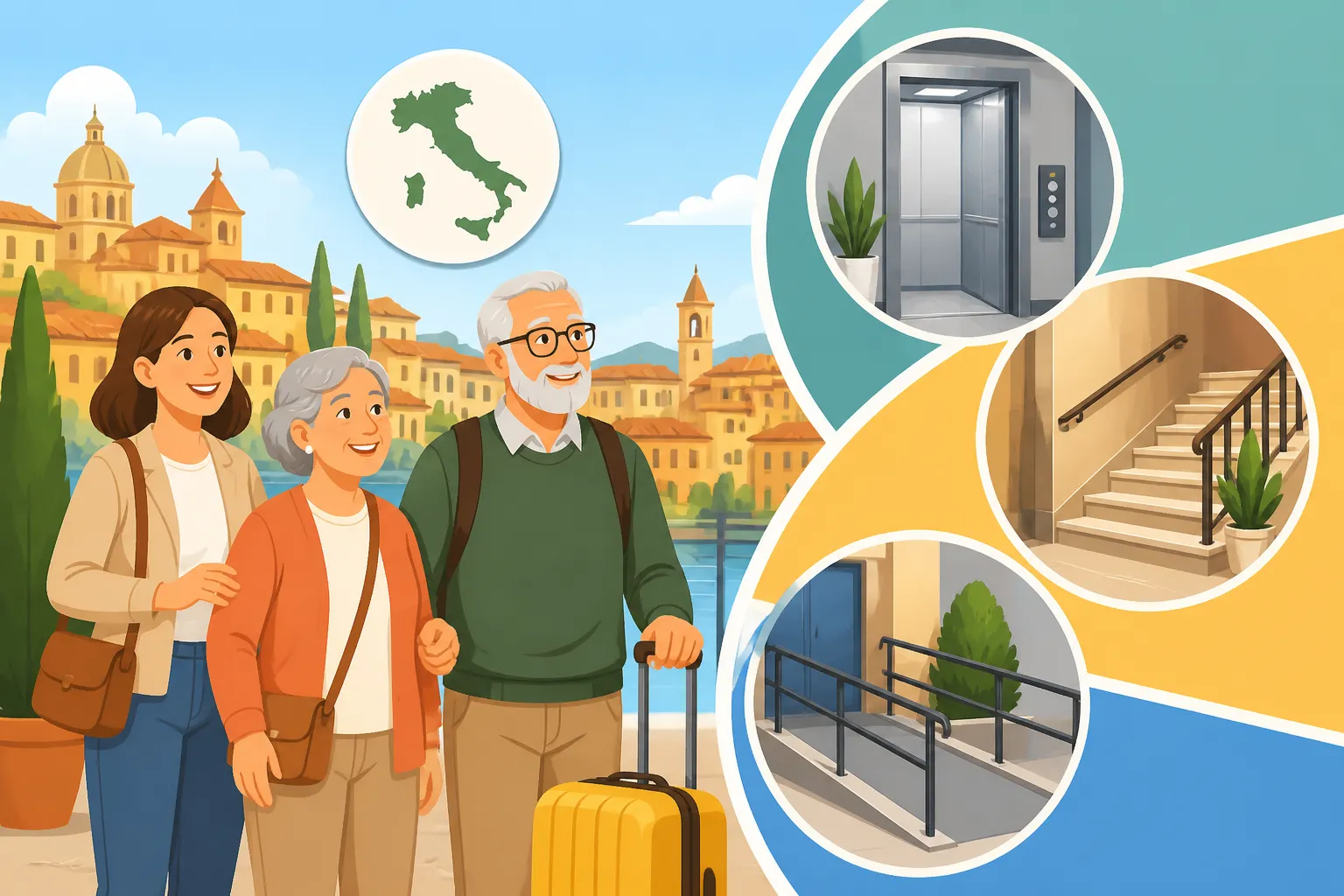
You’ve booked your parents a gorgeous apartment in Florence. Then your father, with his bad knee, arrives at a medieval doorway, finds a lift that fits one suitcase or none at all, and faces four flights of worn stone steps. This guide shows you how to check lifts, stairs and access before you pay, so the trip starts well.
Disclosure: This post may contain affiliate links. We may earn a commission at no extra cost to you if you make a purchase through these links. Read full disclosure.
Why Lifts and Stairs Shape the Whole Trip in Italy
The first time my mother visited me in Italy, I thought I had done everything right. The apartment was central, had glowing reviews, and the listing clearly said “lift.” What it did not say was that the lift started from a landing eleven steps above the entrance hall. It also held two people only if they were close friends, and it stopped running when the building’s condominio board decided to save on electricity during a renovation. She managed, but she was exhausted before we had even unpacked. That week taught me that in Italy the building matters as much as the room.
Most of the housing stock in historic city centres is centuries old. Buildings went up long before anyone imagined lifts, wheelchairs, or rolling suitcases. Lifts were added later, squeezed into stairwells, courtyards or old chimney shafts. Many guesthouses, B&Bs and apartments occupy one floor of a residential palazzo rather than a whole purpose-built hotel. Your parents will share the entrance, the stairs and the lift with Italian families, and the host has little control over any of it.
Italian Floor Numbering and the Piano Rialzato
Floor numbering trips up American visitors in particular. In Italy the street-level floor is the piano terra, sometimes marked “T” or “0” on lift buttons. The primo piano, or first floor, is one full flight above street level. That is what an American calls the second floor. British visitors will find the numbering matches what they use at home.
The real complication is the piano rialzato, a raised ground floor that sits a short flight of steps above the pavement. Some older buildings also have a mezzanino or ammezzato, an intermediate level wedged between the ground floor and the primo piano. In a building like that, a “first floor” apartment can involve noticeably more climbing than the number suggests, because you pass the rialzato or mezzanine on the way up. In grand Roman and Florentine palazzi, ceiling heights are often enormous. A single flight between floors can be long and steep, so a “second floor” walk-up there can feel like the fourth floor of a modern block.
When a listing gives a floor number, treat it as the start of your questions, not the answer. Ask how many steps there are from the street door to the apartment door, counting every step, including the ones before the lift.
The Lift That Exists but Doesn’t Help
An “ascensore” in an Italian listing can mean many things. These are the situations I have seen with friends and family:
- A lift that starts from a half-landing, so there are still several steps from the entrance to reach it.
- A lift so small that one adult and one suitcase must travel separately, which is awkward for anyone who needs to hold an arm.
- A coin-operated or key-operated lift in older condominio buildings, where guests need a key or token from the host.
- A lift that serves the main staircase but not the internal stairs of a duplex apartment, where the bedroom is up a spiral staircase.
- A lift that stops at the floor below the guesthouse, leaving one final flight on foot.
- A lift that is temporarily out of service for building works, which the host may only learn about when the condominio administrator posts a notice.
None of these is unusual, and none makes a place a bad choice for a fit traveller. For a parent with arthritis, heart trouble, a hip replacement or simply low stamina after a long-haul flight, each one can turn a lovely stay into a daily ordeal. Your job is to find out which version of “lift” you are getting.
Cobblestones, Hill Towns, and the Walk From the Taxi
Access does not start at the front door. It starts wherever the taxi can legally stop. Most Italian historic centres sit inside a ZTL, a limited traffic zone. Taxis can often enter, but rental cars usually cannot, and some streets are pedestrian-only. That means the “two-minute walk” in a listing may be measured from the nearest point a car can reach, over uneven cobbles, sometimes uphill. If your parents plan to drive, read Parking at Italian Hotels: ZTL Zones and Why ‘Parking Available’ Costs Extra before you commit to a central address.
Hill towns add another layer. Places like Orvieto, Assisi, Montepulciano and Perugia are built on slopes, and their charm comes partly from steep lanes and stepped alleys. Positano is essentially a vertical village with stairways in place of streets. In Venice, nearly every route between two points crosses bridges with steps, and the waterbus stops involve floating pontoons that move with the tide. Matera’s Sassi districts are carved into a ravine and connected by staircases. A room can be perfectly accessible inside and still leave your mother stranded because every restaurant and sight involves a climb.
Using Booking.com Filters to Shortlist Parent-Friendly Stays
Booking.com is my go-to tool for this kind of search, and not because it is magic. It does three things that matter for older travellers. It lets you filter by accessibility features rather than scrolling hundreds of listings. It gathers a huge volume of guest reviews, which often mention stairs and lifts in plain language. And it gives you a direct messaging channel to the property, so the answers you collect are written down and attached to your reservation. That combination makes Booking.com the most practical way I know to shortlist properties and then verify them one by one.
The Filters Worth Ticking
On the search results page, open the filters panel and look for the accessibility and facility options. Wording varies slightly between the app and the desktop site, and between languages, but you are looking for options along these lines:
- Lift or elevator in the property.
- Upper floors accessible by elevator.
- Entire unit located on the ground floor.
- Wheelchair accessible, if mobility is significantly limited.
- Walk-in shower or roll-in shower.
- Toilet with grab rails or raised toilet.
- 24-hour front desk, which matters if a parent may need help at odd hours.
- Air conditioning, because heat and stairs together are hard on older bodies.
Do not tick everything at once in a small town, or you may filter out every option. Start with the one non-negotiable, usually the lift or ground-floor filter, then add others gradually. For travellers who use a wheelchair or walker full-time, Wheelchair-Accessible Hotels in Italy: The Filters That Matter goes deeper into what each accessibility tag tends to mean in practice.
One honest warning: filters depend on what the property declares. A host might tick “lift” because the building has one, without mentioning the eleven steps before it. Filters narrow the field. They do not replace the checks in the next section.
Reading Photos and Reviews for Access Clues
Once you have a shortlist, slow down and study each listing like a detective. In the photos, look for the entrance, the stairwell and the bathroom. A shot of a beautiful stone spiral staircase is a red flag for a parent with balance problems. A bathroom with a shower inside a high-sided bathtub can be a real hazard, and so can a raised shower tray with a step. Exposed wooden beams and a loft bed suggest a soppalco, a mezzanine sleeping platform reached by a ladder or steep stairs. Those are common in older Italian apartments and completely unsuitable for many older guests.
Then go to the reviews. Search or scan for words like “lift,” “elevator,” “stairs,” “steps,” “climb,” “luggage,” “hill” and “mother” or “parents.” Reviews from older travellers or families with grandparents are gold, because they mention exactly the things younger guests shrug off. A line like “great for us but my 70-year-old dad struggled with the steps to the lift” tells you more than any description. Also check review dates where shown, because a building’s lift may have been installed or renovated recently.
Finally, use the map view. Drop the pin into street view in a separate maps app and look at the street itself. Is it steep? Is it a staircase? Does it look like a car could reach the door? Five minutes of virtual walking can save a week of real limping.
Comparing Accommodation Types for Older Travellers
Different categories of Italian accommodation tend to have different access profiles. These are general patterns from years of booking for visiting family, not rules, and every property still needs checking.
| Accommodation type | Typical access profile | Best for | Watch out for |
|---|---|---|---|
| Large city hotel | Usually a proper lift, staff to help with bags, reception on the ground floor | Parents who want simplicity and help on hand | Rooms can be small; historic hotels may still have steps between wings |
| B&B or affittacamere in a palazzo | Often on an upper floor of a shared residential building | Budget and character | Reception on an upper floor, small or half-landing lifts, no staff at night |
| Holiday apartment or casa vacanza | Varies widely, from modern ground-floor units to fifth-floor walk-ups | Longer stays, families who want a kitchen | Lofts and soppalco beds, internal stairs, self check-in with no one to help |
| Aparthotel or residence | Often purpose-built or renovated, with lifts and a front desk | Longer stays with some service | Locations can be outside the historic centre |
| Agriturismo | Often low-rise farm buildings with ground-floor rooms | Rural Tuscany, Umbria, Puglia | Gravel paths, outdoor steps, and you will need a car or driver |
| Masseria in Puglia | Frequently single-storey with courtyard rooms | Relaxed countryside stays | Distance from towns, uneven terraces |
When guests number more than three, the room types change again. Why Italian Hotels Cap Rooms at Three: Booking for Families of Four Plus explains how to split a multigenerational group without separating grandparents from the people helping them.
The Access Check Message: What to Ask Before You Pay
This is the step that changed everything for me. Before confirming any booking for my parents, I now send the property a short, specific message through Booking.com and wait for the reply. It takes a day at most, and it has saved me from at least three disasters. Because the conversation sits inside the Booking.com platform, it is attached to the reservation. If something turns out to be badly misdescribed, you have a written record to point to when you contact customer service.
The Questions to Send
Keep the message polite, short and numbered. Italian hosts are generally kind and will answer clearly if the questions are clear. Here is the list I use:
- How many steps are there from the street door to the entrance of the room or apartment, including any steps before the lift?
- Does the lift go all the way to the floor of our room, and from which level does it start?
- Roughly how many people and suitcases fit in the lift at once?
- Is the lift currently working, and are you aware of any planned building works during our dates?
- Are there any internal stairs, mezzanine beds or steps inside the room or apartment?
- Is the shower walk-in, or is it inside a bathtub or on a raised tray?
- Can a taxi stop directly outside the building, and if not, how far is the walk and is it uphill or on steps?
- Is someone available to meet guests on arrival and help with luggage?
- If the stairs turn out to be a problem, do you have a ground-floor room or a similar property nearby?
If your parents do not speak Italian and the host does not write English well, add a short Italian line at the top: “Viaggiano i miei genitori anziani, con difficoltà a fare le scale.” That means “My elderly parents are travelling, and they have difficulty with stairs.” It signals the reason for the questions and usually produces a more careful answer.
Decoding the Replies
Replies often contain Italian terms, even when the rest is in English. These are the ones worth knowing:
| Term in the reply | What it means for your parents |
|---|---|
| Piano terra | Street level, usually the easiest option |
| Piano rialzato | Raised ground floor, a short flight of steps up |
| Mezzanino or ammezzato | An intermediate level that adds climbing before the numbered floors |
| Ascensore | Lift; always confirm where it starts and stops |
| Senza ascensore | No lift, so every floor is on foot |
| Scale | Stairs |
| Gradini | Individual steps; a host may give you a count |
| Soppalco | Mezzanine platform, usually for sleeping, reached by steep stairs or a ladder |
| Piatto doccia | Shower tray; ask whether it is flush with the floor |
| Vasca | Bathtub, which may contain the shower |
| Zona pedonale | Pedestrian zone, so the taxi cannot reach the door |
Be wary of vague replies such as “a few steps” or “no problem, everyone manages.” Gently ask for a number. If the host answers specific questions in detail, that is usually a sign of a well-run property. If the host dodges them, move on. There are thousands of other listings, and your parents’ knees are not a negotiating point.
For general help with how listings are worded and what bed and room descriptions really mean, see Reading Italian Hotel Listings: Room Types, Bed Sizes, and Terms Decoded.
Choosing the Right Rate and Protecting the Trip
Older travellers’ plans change more often than anyone likes to admit. A flare-up, a fall at home or a doctor’s advice can cancel a trip at short notice. That is why I almost always book visiting parents on a free-cancellation rate on Booking.com, even if it costs a little more. It also gives you room to switch properties if the access check reveals a problem after you book. To weigh that trade-off properly, read Refundable vs Non-Refundable Rates in Italy: When the Discount Is Worth It.
Sometimes the best answer comes from picking up the phone. Small family-run hotels may hold a ground-floor room back from online inventory, or may happily note a request on your booking. Booking Platforms vs Direct Booking in Italy: When Calling the Hotel Wins covers when that call is worth making. Even then, I like to keep the reservation itself on Booking.com, with the special request typed into the booking notes, so everything is in one place.
Insurance belongs in this conversation too. Cancellation cover, and medical cover that properly reflects age and existing conditions, matters far more for a parent in their seventies than for a backpacker. Insurance for Parents Visiting Italy: Short-Term Cover for Older Relatives walks through what to look for.
City-by-City Access Scenarios for Visiting Parents
Every Italian destination has its own access personality. Here is how I approach the places parents most often want to see.
Rome: Flat-ish Districts Versus Cobbled Charm
Rome is hilly in places but more forgiving than its reputation suggests. Prati, near the Vatican, has wide pavements, a grid of streets and plenty of late nineteenth and early twentieth-century buildings with proper lifts. It is my default recommendation for parents. Trastevere is gorgeous, but its lanes are cobbled, narrow and uneven, and many apartments sit in old buildings without lifts. Monti has sloping streets around the Via dei Serpenti. The area around Termini is flat and well connected, though less atmospheric.
A typical scenario: your parents want to be “right near the Pantheon.” In practice, that may mean a third-floor B&B with a tiny lift and a taxi drop-off around the corner in a pedestrian zone. A hotel in Prati or near Piazza Cavour puts them a short taxi ride away with far less daily climbing. Where to Stay in Rome for Families: Quiet Areas With Space has more on the calmer districts.
Florence and Venice: The Two Trickiest Cities
Florence’s centre is flat, which is good news. The catch is the buildings. Many guesthouses occupy upper floors of Renaissance palazzi, with reception on the second or third floor and towering ceilings between levels. When you search Florence on Booking.com, the “upper floors accessible by elevator” filter does a lot of work, and the access check message does the rest. Oltrarno is charming but rises toward Piazzale Michelangelo. Santa Maria Novella, close to the main station, is flat and convenient for arriving by train.
Venice needs the most planning of anywhere in Italy. Almost every walk involves bridges with steps, and a few have ramps. Luggage has to be carried, wheeled over stones or brought by porter or water taxi. My strongest advice is to choose a hotel very close to a waterbus stop, ideally reachable without crossing a bridge, or one with its own water entrance. Ask the hotel which stop to use and how many bridges lie between it and the door. Some families base parents on the Lido or in Mestre for flatter streets. That trade-off works for some and not others, depending on how much they want to wake up in the historic city.
The Amalfi Coast, Cinque Terre and the Hill Towns
Be frank with yourself and with your parents here. Positano, much of Amalfi and the Cinque Terre villages are built into cliffs, with stairways in place of streets. A hotel can have a lovely lift inside and still sit above a long flight of public steps. For many older travellers, Sorrento is the kinder base. It has flatter central streets and good boat and bus links, so they can visit the coast as day trips rather than sleep on it.
In Tuscan and Umbrian hill towns, look for properties near the main gate or the bus and car drop-off point rather than the top of the town. In Siena, for example, the streets around Piazza del Campo slope steeply. A hotel near the edge of the centre, where taxis can reach, may suit better than one tucked into a lane off the square. Agriturismi in the surrounding countryside are often single-storey and peaceful. Check for gravel paths and outdoor steps, and plan for a driver or rental car.
Getting Between Cities Without Wearing Them Out
The accommodation is only half of the access story. Italian train stations can involve long platforms, stairs to underpasses and high steps up into the carriage. The rail operators offer an assistance service at major stations, and Accessible Travel on Italian Trains: Booking Sala Blu Assistance explains how to arrange it ahead of the journey. Combine that with a hotel close to the station on travel days, and the whole itinerary becomes far gentler.
Comfort matters too. Older travellers often handle heat and stuffy rooms poorly, especially after climbing stairs, so confirm that air conditioning actually works in the bedroom and is not limited to a living area. Air Conditioning and Heating in Italian Accommodation: What to Verify has the details. Once they are settled, How to Find Wheelchair-Accessible Attractions in Italy can help you plan days out that match their energy.
Putting It All Together
Here is the routine I follow every time my parents, or friends’ parents, come to stay:
- Decide on the base district first, choosing flatter, car-reachable areas.
- Search on Booking.com with the lift or ground-floor filter switched on, then add bathroom and air conditioning filters.
- Check photos for spiral stairs, loft beds and bathtub showers, and read reviews for any mention of steps.
- Drop the address into street view to check the slope and the drop-off point.
- Send the numbered access check message and wait for a specific, written reply.
- Book a free-cancellation rate, add the access notes as a special request, and save the conversation.
- Arrange taxi pickup and, if they travel by train, station assistance for each journey.
It sounds like a lot, but once you have done it for one city it takes about an evening. The reward is watching your parents walk into their room relaxed rather than breathless, ready to enjoy the trip you have been looking forward to. Start your shortlist on Booking.com tonight, send those access questions, and let the hosts do the explaining before anyone has to climb a single step.
Disclaimer
This article is for general informational purposes only and does not constitute professional advice. Laws, prices and regulations vary by location and change over time. Consult a qualified professional for guidance on your specific situation.