Can you work on an Italian student visa?
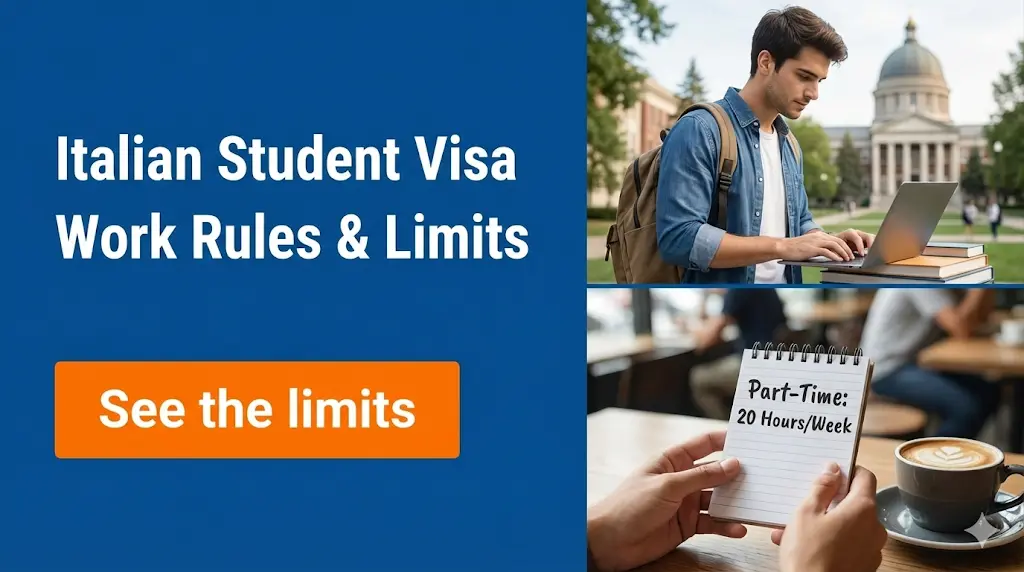
Yes, international students can legally work in Italy on a student visa. However, you are strictly limited to a maximum of 20 hours per week and 1,040 hours per year. You must also hold a valid residence permit and a legal employment contract.
Disclosure: This post may contain affiliate links. We may earn a commission at no extra cost to you if you make a purchase through these links. Read full disclosure.
Introduction to Italian student visa
Moving to a foreign country to pursue a degree is a massive financial and personal investment. For many international students, securing a part-time job is not just a way to earn extra pocket money; it is a fundamental necessity for funding their daily lives and reducing their reliance on family savings or high-interest student loans.
The Italian legal system recognizes this need and has structured its immigration laws to accommodate it, allowing non-EU students to participate in the labor market. However, it is vital to remember the core philosophy behind your visa: you are in Italy primarily to study. The government strictly regulates student employment to ensure that your job does not interfere with your academic performance or your university attendance.
Attempting to navigate the Italian job market without a clear understanding of your legal rights and limitations can lead to severe consequences. Working beyond the permitted hours, accepting “under the table” cash jobs, or failing to secure the proper residency documents can result in heavy fines, the revocation of your visa, and even deportation. By understanding the rules outlined in this guide, you can confidently build a balanced schedule that allows you to succeed academically while earning a steady income to support your Italian adventure.
The Legal Foundation for Student Workers in Italy
Before you can start handing out your resume to local cafes or language schools, you must ensure that your immigration paperwork is flawlessly in order. A visa alone is not a work permit.
The Type D National Visa
If you are enrolled in a standard university degree program in Italy, you will enter the country on a Type D National Visa for study purposes. This long-stay visa is your ticket into the country, but it is only the first step in the bureaucratic process. You cannot legally work if you entered Italy on a standard short-stay tourist visa or a visa-waiver program; working on a tourist visa is a direct violation of European immigration law.
The Permesso di Soggiorno
The most crucial document you need to secure employment is the Permesso di Soggiorno per motivi di studio (Residence Permit for Study Purposes). Under Italian law, you must apply for this permit at a local post office within exactly eight days of arriving in Italy.
When you submit your application kit at the post office, you will receive an official postal receipt (ricevuta). In many cases, employers will allow you to sign a contract and begin working using this official receipt while you wait for the physical plastic residence card to be processed and issued by the local Police Headquarters (Questura). If you are confused about how to obtain this vital document, you should review our comprehensive guide on the Student Visa Italy: Admission, Requirements, and Process.
The Codice Fiscale
In addition to your residence permit, you absolutely must obtain a Codice Fiscale (Italian Tax Identification Number). This unique alphanumeric code is required for everything in Italy, from opening a bank account to signing a residential lease, and it is legally mandatory for your employer to register your employment contract and process your payroll.
The Golden Rule Maximum Hours and Restrictions
The defining characteristic of working on an Italian student visa is the strict cap on allowable working hours. The Italian government uses these limits to ensure that international students remain focused on their university coursework rather than treating the student visa as a backdoor entry into the full-time labor market.
The 20 Hours Per Week Limit
As a general, non-negotiable rule, international students residing in Italy are allowed to work for a maximum of 20 hours per week during the standard academic term.
It is vital to understand that this 20-hour limit is a strict weekly cap. It is not a flexible average. You cannot choose to work 30 hours one week and then “make up for it” by only working 10 hours the following week. If you exceed 20 hours in any single seven-day period, you are technically violating the legal conditions of your residence permit.
If you hold multiple part-time jobs—for example, working 10 hours a week as a barista and 12 hours a week as a private tutor—those hours are combined. In this scenario, your total would be 22 hours, placing you in violation of the law.
The 1040 Hours Per Year Limit
In conjunction with the weekly limit, Italian law dictates that a student cannot exceed a maximum of 1,040 working hours within a 52-week calendar year. This annual cap acts as an absolute ceiling. Even if you manage your weekly hours perfectly, you must ensure that your total accumulated hours by the end of the year do not breach the 1,040 mark.
Can Students Work Full Time During Summer Holidays?
One of the most frequent points of confusion among international students is whether the 20-hour rule applies during official university holidays, such as the long summer break or the winter semester break.
The rules do offer some flexibility during these periods. During official holidays and semester vacations, students are legally permitted to take on full-time shifts, working up to 40 hours per week. This is a fantastic opportunity to save up a significant amount of money to cover tuition or living expenses for the upcoming semester.
However, there is a massive caveat that catches many students off guard: the annual limit of 1,040 hours still applies. Your residence permit does not automatically grant you unlimited extra hours just because it is summer. If you choose to work 40 hours a week for a period of time during the summer, you must mathematically ensure that those heavy weeks do not push your yearly total over 1,040 hours. Furthermore, to work 40 hours a week, your employer must issue you a separate, specific full-time contract for that temporary holiday period.
Can You Freelance or Work Remotely on a Student Visa?
With the rise of the digital economy, many international students arrive in Italy already holding remote jobs, freelance clients, or small online businesses based in their home countries.
If you want to perform standard subordinate work (being an employee) for an Italian company, the rules are clear. However, self-employment and remote work occupy a highly complex legal and tax area in Italy.
To legally operate as a freelancer or independent contractor in Italy, you must open a Partita IVA (an Italian VAT number). Opening a Partita IVA while holding a student residence permit is generally not allowed without undergoing a formal conversion process. Under standard immigration rules, a study permit only authorizes subordinate part-time work, not autonomous self-employment.
Furthermore, if you are living in Italy for more than 183 days a year, you are considered an Italian tax resident. This means you are legally obligated to declare your worldwide income to the Italian tax authorities, including the money you earn from a remote job based in the United States or India. Working remotely without declaring taxes or setting up the proper corporate structures can lead to severe fines. If your primary goal is to work remotely rather than study, you should not use a student visa; instead, you should investigate alternative pathways like the digital nomad program.
Best Part Time Jobs for International Students
Finding a job in a foreign country can be intimidating, especially if you are still mastering the local language. Fortunately, Italy offers a diverse range of part-time opportunities perfectly suited for the schedules and skill sets of international students.
University 150 Hour Collaborations
One of the best-kept secrets for international students is the “150-hour” collaboration program. By law, every public university in Italy reserves a specific number of on-campus jobs exclusively for their enrolled students. These roles include working as an assistant in the university library, helping out in administrative offices, staffing IT help desks, or assisting in research laboratories.
These contracts are strictly capped at 150 paid hours per academic year, ensuring they never interfere with your studies. They are highly flexible, conveniently located on campus, and generally pay around €8 to €9 per hour.
English Teaching and Tutoring
If you are a native English speaker, or possess a highly advanced level of English, tutoring is arguably the most lucrative part-time job available in Italy. Italian parents and professionals are constantly seeking private conversational practice or grammar tutoring.
You can work for private language academies or advertise your services independently on university bulletin boards and local Facebook groups. Private English lessons command excellent rates, with students frequently earning between €16 and €35 per hour depending on the city and the type of specialized instruction offered. Advanced Italian language skills are rarely required for these roles.
Hospitality and Retail Sectors
The backbone of the Italian student job market lies in the hospitality and tourism sectors. Cafes, restaurants, hotels, and popular food-delivery apps maintain large rosters of student workers. Roles such as a barista, waiter, or delivery rider offer flexible evening and weekend shifts that easily fit around a busy lecture schedule.
Similarly, retail stores—particularly high-street clothing chains and supermarkets in major cities like Milan and Rome—frequently hire international students. These jobs generally require at least a basic to intermediate grasp of the Italian language, as you will be interacting with local customers daily. To learn more about navigating the local economy and finding the right fit for your skills, read our guide on Finding Part-Time Jobs for International Students in Italy.
Average Salaries and Taxes for Student Workers
Italy does not currently have a single, universal minimum wage written into national law, though lawmakers actively debate instituting a €9 gross hourly floor. Instead, wages are heavily dictated by National Collective Labor Agreements (CCNL) specific to each industry.
As a student working part-time, you can generally expect to earn between €7 and €15 per hour, depending on the sector, your experience, and the city where you live (wages in northern cities like Milan are typically higher than in the south). If you work your maximum allowed 20 hours per week, your monthly earnings will roughly range between €560 and €1,200. While this is usually not enough to cover a luxury lifestyle, it is more than sufficient to cover groceries, utility bills, transportation, and personal expenses.
Understanding Italian Taxes
You will not be paid “under the table.” Most legitimate part-time jobs will offer you a fixed-term contract (contratto a tempo determinato). Your employer is responsible for deducting your social security contributions (INPS) directly from your gross pay.
Regarding income tax (IRPEF), Italian law is quite favorable to low-income student workers. Income generated from occasional or part-time work is generally tax-free up to a threshold of €5,500 per calendar year. If your earnings exceed this amount, your employer will begin withholding IRPEF income tax on a sliding progressive scale.
Average Part-Time Salaries for Students in Italy
| Job Type | Average Hourly Wage | Required Italian Level |
| University Campus Jobs (150 hours) | €8 – €9 | Varies (often English is fine) |
| English Tutor / Teacher | €16 – €35 | Low / None |
| Hospitality (Café, Waiter, Delivery) | €7 – €10 | Basic to Intermediate |
| Retail / Customer Service | €10 – €15 | Intermediate to Fluent |
The Dangers of Lavoro Nero (Illegal Work)
Because of the 20-hour limitation, some students are tempted to seek out “lavoro nero”—illegal, unregistered cash-in-hand jobs. This is an incredibly risky decision that can jeopardize your entire future in Europe.
Working without a registered contract strips you of all legal labor protections. You will have no recourse if an employer refuses to pay you, forces you to work unsafe hours, or subjects you to workplace harassment. More importantly, the Italian authorities actively crack down on illegal employment. If immigration officers or the labor inspectorate discover that you are working illegally, you will face severe consequences. The authorities can issue massive fines, refuse to renew your Permesso di Soggiorno, and initiate deportation proceedings, which will permanently stain your European immigration record. Always insist on a legal, written contract.
Transitioning to a Work Permit After Graduation
One of the greatest advantages of studying in Italy is the highly accessible pathway to remaining in the country after you complete your degree.
If you successfully graduate from an Italian university with a Bachelor’s degree, a Master’s degree, or a PhD, your relationship with the Italian labor market completely changes. You are no longer restricted to 20 hours a week. You have two primary options for staying in Italy.
The Job Search Permit (Attesa Occupazione)
Upon graduation, if you do not yet have a full-time job offer lined up, you are legally entitled to convert your student permit into a Permesso di Soggiorno per Ricerca Lavoro or Attesa Occupazione (Residence Permit for Job Search). This special permit is valid for up to 12 months. It allows you to legally reside in Italy for a full year while you attend interviews, network, and search for a company willing to hire you full-time.
Converting Directly to a Work Permit
If you are offered a full-time employment contract either during your studies or immediately after graduation, you can convert your student permit directly into a Permesso di Soggiorno per Lavoro Subordinato (Work Permit).
In the past, this conversion was a nightmare because it was subject to the strict numerical quotas of the Decreto Flussi (Flow Decree). Students often had to wait for the annual quotas to open, and if they missed the window, they were forced to leave the country.
However, a recent and massive legislative update known as the Cutro Decree has fundamentally changed this process. Applications to convert a residence permit from study to work have officially left the scope of the quota system. This means that international graduates can now submit applications to convert their student visas into work permits at any time of the year, with absolutely no limit on the number of approvals granted. This makes Italy one of the most attractive European destinations for students looking to build a long-term international career. For a deeper dive into this exact procedure, we highly recommend reading our guide on Transitioning from a Student Visa to a Work Visa.
Conclusion
Working on an Italian student visa is not only legally permissible, but it is also a highly encouraged way to immerse yourself in the local culture, improve your language skills, and alleviate the financial pressures of studying abroad. By strictly adhering to the 20-hour weekly limit, ensuring your total annual hours never exceed 1,040, and securing a formal employment contract, you can safely navigate the Italian labor market.
Whether you choose to pour espressos in a historic Milanese café, help undergraduates in a university library, or teach English to local professionals, part-time work will fundamentally enrich your international experience. Most importantly, respecting these rules ensures that when graduation day finally arrives, your pristine immigration record will allow you to seamlessly convert your student visa into a permanent work permit, opening the door to a lifelong career in Italy.
References
Primary sources (official)
- European Commission – EU Immigration Portal: Student in Italy: https://home-affairs.ec.europa.eu/policies/migration-and-asylum/eu-immigration-portal/student-italy_en
- Italian Ministry of the Interior – Immigration Portal: https://portaleservizi.dlci.interno.it
Other helpful sources
- University Insights – Part-Time Work in Italy for Students | Hours, Rules: https://universityinsights.in/part-time-work-in-italy-for-students/
- Il Centro – Working in Italy on a Student Visa: Hours, Rules & Jobs (2026): https://ilcentro.net/can-i-work-with-a-student-visa-in-italy-rules-hours-and-legal-requirements-2026-guide/
Disclaimer
The information provided in this article is for educational and informational purposes only and does not constitute official legal, tax, or immigration advice. Italian immigration laws, employment regulations, tax thresholds, and visa conversion procedures are complex and subject to frequent changes by the government. Always consult the official websites of the Italian Ministry of Foreign Affairs, your local Italian consulate, or a certified immigration attorney for the most current and personalized guidance regarding your specific student visa and employment situation.