Language Requirements for University Admission in Italy
Scrambling to prove your language fluency to an Italian university is a bureaucratic nightmare of confusing test acronyms and impossible deadlines. I almost lost my admission spot in Milan because I did not realize my high school Italian classes wouldn’t count as official proof. This guide demystifies the exact language requirements for university admission in Italy so you can secure your spot.
Disclosure: This post may contain affiliate links. We may earn a commission at no extra cost to you if you make a purchase through these links. Read full disclosure.
The Reality of Italian Taught Programs
Understanding the B2 Certification Standard
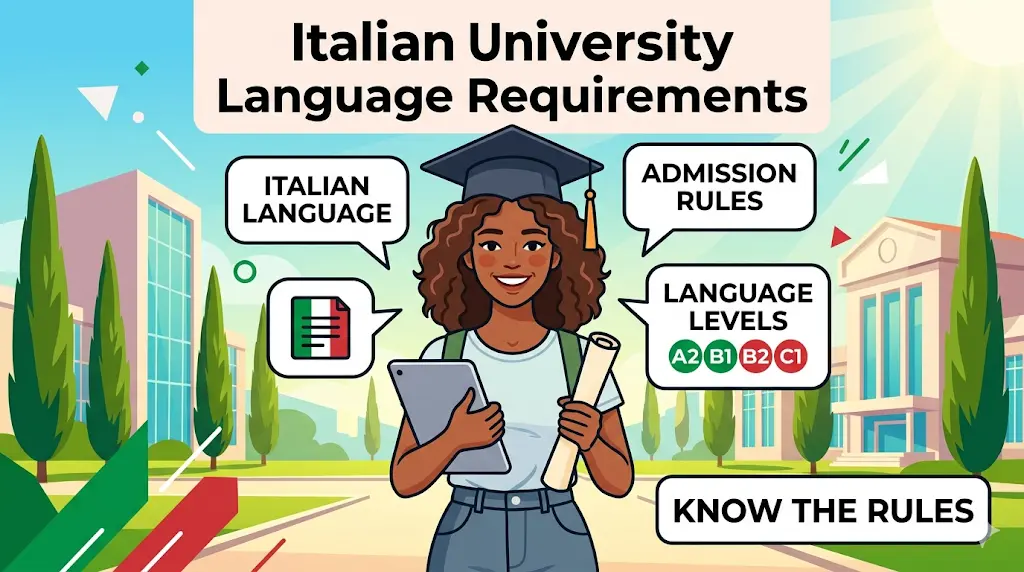
If you are applying for a bachelor’s or master’s degree taught entirely in Italian, the Ministry of University and Research dictates a strict national baseline: you must prove a B2 level of proficiency on the Common European Framework of Reference for Languages. On paper, B2 is considered “upper intermediate.” In reality, navigating an Italian university requires an incredibly robust grasp of the language.
You will be sitting in ancient, echoing lecture halls listening to professors who speak rapidly, use complex academic terminology, and rarely use presentation slides. You are expected to read hundreds of pages of dense academic texts per week. When I first began looking at the requirements, I vastly underestimated the gap between ordering a cappuccino on vacation and debating macroeconomic theory in a seminar. To close this gap before you even apply, utilizing ItalianPod101 to practice high-level listening comprehension is an absolute lifesaver. Their advanced audio modules train your ear to catch the rapid phrasing and complex vocabulary you will encounter in a real academic setting.
Proving this B2 level is intertwined with your entire immigration process. When you submit your pre-enrollment via the Universitaly portal, the Italian consulate in your home country will demand to see your official language certificate alongside your academic records. Gathering this documentation takes months, and reviewing the Student transcript requirements for Italy student visa is vital to ensure your academic and linguistic proofs align perfectly before your consular interview.
The Dreaded University Language Exam
If you do not have an internationally recognized language certificate by the time the summer application window closes, you are not entirely out of luck, but you are in a highly precarious position. The Italian government allows individual universities to administer their own internal language exams, usually held in late August or early September, right before the academic year begins.
These internal exams are notoriously stressful. If you are a non-EU citizen applying for a reserved quota spot, passing this specific exam is mandatory to keep your spot. If you fail, your university admission is immediately revoked, and your student visa application will be permanently denied. The exam typically consists of a reading comprehension section, a grammar test, and a terrifying oral interview with a panel of university professors.
The oral exam is where most expats freeze up due to intimidation. The professors will interrogate you on your motivations for studying in Italy and ask you to summarize a short academic text on the spot. I highly recommend using ItalianPod101 to practice oral exam simulations. Their speaking practice tools and pronunciation guides can give you the confidence needed to sit in front of an intimidating academic panel and speak clearly under immense pressure. If you pass, you can immediately move on to the next phase of your relocation, which you should organize using a comprehensive Checklist: All You Need Before Moving to Italy.
The Certification Alphabet Soup Explained
CELI CILS and PLIDA Breakdown
To avoid the heart-stopping anxiety of the internal university exam, you should obtain a formal, globally recognized certificate well before you apply. The Italian government recognizes certificates issued by the CLIQ consortium. The big three that you will encounter are the CILS (issued by the University for Foreigners of Siena), the CELI (issued by the University for Foreigners of Perugia), and the PLIDA (issued by the Dante Alighieri Society).
While they all test for the B2 level, their formats differ slightly. Some are heavy on multiple-choice reading, while others focus heavily on essay writing. The most brutal section across all these exams is the metalinguistic competence section, which tests your deep understanding of Italian grammar—specifically the dreaded subjunctive mood and complex relative pronouns. I spent weeks using ItalianPod101 to run through specific grammar drills for the CILS exam, as their structured breakdown of complex tenses was much easier to digest than a traditional grammar textbook.
| Certificate | Administered By | Exam Frequency | Best For |
| CILS | University for Foreigners of Siena | June, December (some levels in Spring/Autumn) | Students needing modular exams (you can retake failed sections) |
| CELI | University for Foreigners of Perugia | March, June, November | Those who prefer structured, traditional academic testing |
| PLIDA | Dante Alighieri Society | Varied, often multiple times a year | Expats with local Dante Alighieri society testing centers nearby |
| CERT.IT | Roma Tre University | Varied throughout the year | Students living in or near Rome looking for a fast-track option |
The Grading Timeline Trap
The single biggest trap expats fall into is the grading timeline. Unlike modern computerized English tests that give you a score in five days, Italian language certificates are graded by hand in Italy. It can take up to 90 days to receive your official results, and consulates often require the physical paper certificate, not just an email confirmation, which adds weeks of international shipping time.
If you take a CILS exam in early June, you likely will not have your physical certificate by the time the Universitaly pre-enrollment deadline closes in July. You must plan backwards. Taking your language test in November or March of the year before you intend to enroll is the only safe strategy. Utilizing ItalianPod101 to access mock exam audio and pacing guides during the winter months ensures you are ready for those early testing windows, preventing a massive bureaucratic delay.
Once your certificate is in hand and you arrive in Italy, your timeline stress shifts to immigration. Knowing How long after entry to apply for a residence permit in Italy and tracking the Timelines for picking up your permesso di soggiorno in Italy become your primary concerns the moment your flight lands.
English Taught Degrees and Hidden Traps
IELTS TOEFL and Cambridge Requirements
Because mastering B2 Italian is a massive hurdle, a huge wave of international students opt for English-taught degrees. Italian universities have rapidly expanded their English offerings, particularly in Medicine (the IMAT exam track), Engineering, Economics, and International Relations.
To gain admission to these programs, you are entirely exempt from the B2 Italian requirement. Instead, you must prove your English proficiency. Even if you are a native English speaker from the US or the UK, some overly bureaucratic Italian departments will still demand an IELTS (usually a minimum 5.5 or 6.0), a TOEFL, or a Cambridge B2 First certificate. Always check your specific department’s guidelines, as arguing with an admissions clerk that you are American and don’t need an IELTS is a battle you will usually lose.
The Catch Surviving Outside the Classroom
Here is the harsh reality that universities do not advertise: your lectures and exams will be in English, but absolutely everything else about your university life will be in Italian.
The university administration office (the Segreteria Studenti) is the gatekeeper of your academic career. If you need to register for classes, fix a tuition billing error, or apply for regional scholarships, you must deal with the Segreteria. The clerks there rarely speak English and operate under rigid, paper-heavy rules. Trying to resolve a lost transcript issue using Google Translate is a recipe for disaster. I relied entirely on ItalianPod101 to learn essential bureaucratic vocabulary just to survive my enrollment day at the Segreteria.
Furthermore, you will need to email Italian professors to schedule office hours or dispute grades. Italian academic culture is incredibly formal. You cannot write a casual email to a professor; you must use formal titles, the conditional tense, and polite sign-offs. Learning how to draft formal academic emails with ItalianPod101 will prevent you from accidentally insulting your department head. Navigating the university bureaucracy is just practice for the real world; soon, you will be Navigating Italian Bureaucracy: Comune and Prefettura to register your local residency, which requires the exact same level of formal communication.
Exemptions and Alternative Routes
High School Diplomas and Dual Citizens
There are a few golden tickets that allow you to bypass the language certification process entirely. If you hold an Italian high school diploma (Diploma di Maturità), whether you obtained it in Italy or at an officially recognized Italian school abroad, you are completely exempt from the language requirement.
Similarly, if you hold dual Italian citizenship, you are legally treated as an Italian student, meaning the university assumes your language proficiency. However, be warned: if you are a dual citizen who grew up in Australia and speaks zero Italian, enrolling in an Italian-taught degree just because you legally can will result in immediate academic failure. The professors will not slow down for you.
Foundation Years and Intensive Prep
If your Italian is currently stuck at an A2 level but your dream is to study in Italy, the best alternative route is a Foundation Year. Many major institutions, such as Ca’ Foscari in Venice, Sapienza in Rome, and the University of Pavia, offer these dedicated preparatory years.
You pay to move to Italy for nine to twelve months, during which the university immerses you in intensive Italian language courses and subject-specific academic prep. If you pass the Foundation Year, you are guaranteed admission to their bachelor’s programs the following autumn, completely bypassing the external CILS or CELI requirement.
Moving to Italy with minimal language skills for a Foundation Year is terrifying. The sheer exhaustion of trying to set up a life in a foreign language cannot be overstated. I highly recommend using ItalianPod101 for intensive, real-world conversational practice during your first few weeks. It helps you handle the immediate survival tasks, like setting up a bank account and setting up utilities.
You will also need to handle your immediate health requirements to validate your student visa. You must organize this before you arrive, so reviewing Getting Health Insurance in Italy: Public and Private Options is critical. Once you are somewhat settled and your language improves, you can figure out the Differences between Public and Private Healthcare in Italy and take the necessary steps toward Registering with an Italian Family Doctor (Medico di Base). If you ever find yourself in a crisis, knowing how to communicate with Emergency Medical Services in Italy: 112 and Hospitals is non-negotiable, and building that specific medical vocabulary should be a priority in your language journey. Guard your documentation fiercely; the Consequences of losing your permesso di soggiorno card can derail your entire Foundation Year and force you to return home.
References
Primary sources (official)
- Universitaly (Italian Ministry of University and Research Portal) – https://www.universitaly.it/
- Ministero dell’Università e della Ricerca (MUR) – https://www.mur.gov.it/it
- Università per Stranieri di Siena (CILS Official) – https://cils.unistrasi.it/
Other helpful sources
- Università per Stranieri di Perugia (CELI Official) – https://www.unistrapg.it/
- Società Dante Alighieri (PLIDA Certification) – https://www.dante.global/
Disclaimer
The information provided in this article is for educational and informational purposes only and does not constitute official academic, legal, or immigration advice. Language requirements for Italian universities, including accepted B2 certificates (CILS, CELI, PLIDA), exemption rules, and internal testing dates, are subject to frequent changes by individual university departments and the Ministry of University and Research. Always verify specific language criteria and pre-enrollment deadlines directly through the Universitaly portal and the international admissions office of your chosen institution before applying.