Rent Differences: City Center vs Suburbs in Italy
Falling in love with a listing in the centro storico is easy, but discovering you are paying double for an uninsulated apartment above a loud tourist trap is an expensive expat mistake. I spent my first year bleeding rent money for a picturesque Roman view before escaping to a spacious, affordable suburb. This guide breaks down the true cost differences between Italian city centers and the suburbs.
Disclosure: This post may contain affiliate links. We may earn a commission at no extra cost to you if you make a purchase through these links. Read full disclosure.
The Romantic Illusion of the Centro Storico
Premium Prices and Hidden Costs
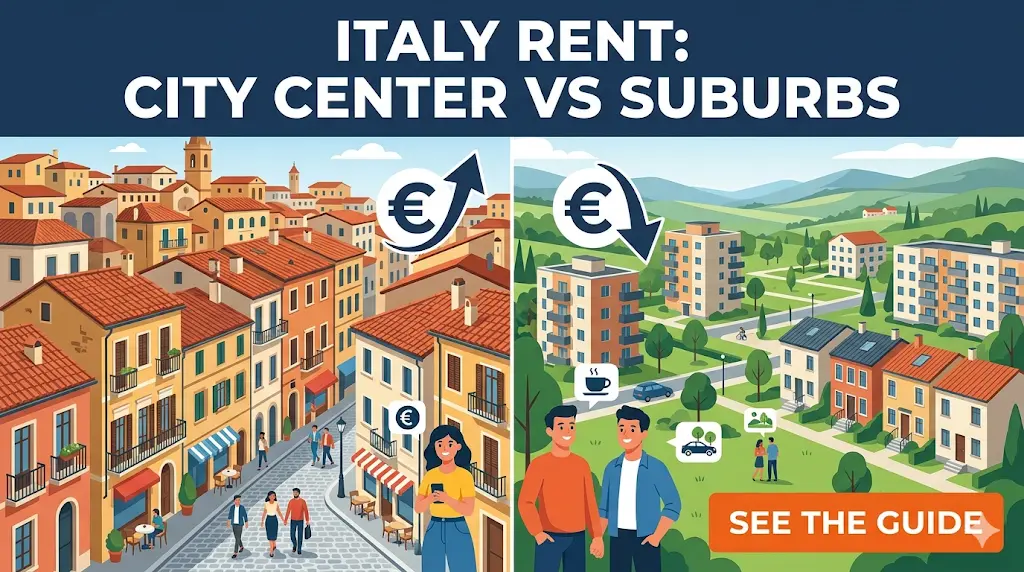
The centro storico (historic center) is where every newly arrived expat desperately wants to live. You imagine sipping a morning espresso on a wrought-iron balcony overlooking a medieval piazza, absorbing the very essence of the Mediterranean lifestyle. However, local landlords are fully aware of this romantic desperation. In major hubs like Milan, Rome, Florence, or Bologna, a tiny, poorly updated one-bedroom apartment in the center can easily cost between €1,200 and €1,800 a month. This extreme financial burden immediately and heavily impacts your overall Cost of Living in Italy 2026 Budgeting for Expats.
But the astronomical rent is just the baseline. Historic buildings were erected centuries before modern plumbing, standard electricity, and weather insulation existed. You will battle drafty, single-pane windows in the winter and suffocating heat in the summer, which inevitably leads to the exhausting challenges outlined in Dealing with Humidity and Mold in Italian Homes.
Furthermore, these central zones are almost universally designated as a Zona a Traffico Limitato (ZTL). If you accidentally drive a rental van to move your furniture through these camera-guarded zones without municipal clearance, you will be hit with massive, compounding fines that arrive months later. Trying to legally bring a vehicle into these ancient streets is a bureaucratic nightmare, forcing you to navigate the intensely frustrating maze of Obtaining a Parking Permit in Rome or Milan. If you do manage to park, you will likely pay an additional €200 to €300 a month just for a dedicated garage spot, as street parking is virtually nonexistent.
The Trade-off of Space and Convenience
When you pay a premium for central living, you are paying purely for the location, not for physical comfort or space. Italian city center apartments are notoriously cramped. An 80-square-meter flat in the center is considered massive and luxurious, whereas that is a standard starter size for a family in the outskirts.
Moreover, the vast majority of historic buildings strictly lack an ascensore (elevator) because the structural footprint simply cannot support modern additions. Carrying heavy grocery bags and bottled water up five flights of steep, uneven marble stairs every single day quickly strips the romance away from your picturesque lifestyle.
However, the convenience factor is undeniable. You are within walking distance to major train terminals, iconic monuments, and international grocery stores. You are completely plugged into the social pulse of the city, which is incredibly valuable during your first year of integration when you are still mastering the local language and struggling to keep your sanity while Navigating Italian Bureaucracy Comune and Prefettura. You must weigh this social access heavily against the high cost of rent and the constant noise of late-night tourist crowds beneath your window.
The Reality of Italian Suburbs and Commuter Towns
Financial Relief and Modern Comforts
If you are willing to look just a few metro stops further out, or even into the neighboring commuter towns (the hinterland or periferia), the financial relief is staggering. Moving to the suburbs can easily slash your monthly rent by 30% to 50%. A modern two-bedroom apartment with a wraparound balcony and a dedicated parking space in a Milanese suburb like Sesto San Giovanni, or a Roman suburb like EUR, might cost the exact same as a cramped, dark studio in the historic center.
Beyond the massive price drop, the infrastructure is significantly better. Suburban residential buildings frequently feature double-paned windows, highly efficient modern central heating, fast fiber-optic internet lines, and functioning, spacious elevators. However, you must be mentally prepared for the fact that these larger, more affordable apartments often come completely empty when rented to long-term tenants. It is vital to understand exactly what you are actually renting—and what you will be forced to buy—by deeply reading up on the Typical Furnishing Level of Italian Homes.
The Commute and Isolation Factor
The primary trade-off for this space and affordability is the daily commute. Italian public transportation (mezzi pubblici) outside of the central metro lines relies heavily on regional surface trains and buses. These networks are notoriously vulnerable to frequent national strikes (scioperi) and unannounced delays. If you move to a deep suburb, you might become entirely dependent on owning your own vehicle to run basic errands. This geographic isolation is compounded by the fact that cheap, late-night gig-economy rideshares do not exist here to save you if you miss the last train home, a harsh reality explained fully in Availability of Rideshare Apps Uber in Italy.
Furthermore, the suburbs are deeply, authentically local. You will not find English-speaking menus, international pubs, or bilingual pharmacy clerks. You will be forced to integrate faster, which is excellent for your long-term language skills but can feel incredibly isolating and overwhelming during your first few months.
| Feature | City Center (Centro Storico) | Suburbs (Periferia / Hinterland) | Expat Impact |
| Average Rent (1-Bed) | €1,200 – €1,800+ | €700 – €1,000 | Massive monthly budget relief in suburbs. |
| Space & Amenities | Cramped, rarely has an elevator or parking. | Spacious, modern buildings with parking. | Suburbs offer far better quality of life for families. |
| Noise & Tourism | High noise, tourist traps, late-night crowds. | Quiet, residential, local businesses. | City centers can be exhausting long-term. |
| Transportation | Highly walkable, strong metro/bus links. | Requires longer commutes, car dependency. | Suburbs demand strategic daily transit planning. |
Navigating the Housing Hunt and Logistics
Overcoming Search Frustrations
Finding a legitimate apartment in either zone is a fierce, highly competitive battle. In the center, landlords routinely inflate prices to prey on naive foreigners seeking the “La Dolce Vita” aesthetic. In the suburbs, traditional real estate agencies are highly conservative; they often refuse to rent to expats who lack an established Italian credit history, an Italian guarantor, or a permanent local work contract. This creates the tense, frustrating standoffs detailed in Signing an Italian Rental Contract.
To completely bypass this intense friction, veteran expats rely heavily on Spotahome. Because Spotahome acts as a secure, verified digital intermediary specializing in mid-term rentals, you can secure a furnished apartment without fighting local landlords over exorbitant guarantees. By booking through Spotahome, you can safely “test drive” a specific suburb for six to twelve months to see if the commute is actually manageable before committing to a rigid four-year lease. Relying on Spotahome provides a massive administrative safety net, allowing you to establish a secure, verified basecamp while you explore the city’s neighborhoods at your own pace.
Connectivity and Outfitting Your Space
When you are riding regional trains out to the distant suburbs to view apartments, or trying to find a hidden local real estate agency on foot, you cannot rely on free cafe Wi-Fi. The sprawling periferia has notoriously spotty public connectivity. Before embarking on your housing hunt, I highly recommend downloading a data eSIM from Airalo.
Keeping Airalo active on your smartphone ensures you have continuous, high-speed mobile internet to route your GPS across complicated suburban bus lines, translate dense lease agreements on the fly, and contact landlords via WhatsApp. Relying on Airalo means you are never digitally stranded when attempting to navigate unfamiliar residential neighborhoods, completely avoiding the severe broadband installation delays highlighted in Average Internet Speed in Italy What to Expect.
Once you find that perfect, spacious suburban apartment, you will have to furnish it. Even if you choose to stay in the tiny city center, you will likely need to buy specific appliances to make the space livable. Because hauling a heavy sofa or a new mattress onto a crowded city tram, or trying to fit it into a tiny historic elevator, is a physical nightmare, I outsource everything to Amazon Italy.
You can easily order massive dehumidifiers, memory foam mattresses, space-saving furniture, and essential kitchen appliances directly from Amazon Italy and have them delivered safely to your new door. Utilizing Amazon Italy to outfit your home completely eliminates the logistical nightmare of renting a moving van and fighting through heavy ZTL traffic. This smart delegation frees up your valuable time and sanity, allowing you to deal with the much more complex bureaucratic hurdles of Setting Up Utilities in Italy and officially settling into your new Mediterranean life.
References
Primary sources (official)
- ISTAT (Istituto Nazionale di Statistica) – Housing costs and demographic data – https://www.istat.it/en/
- Agenzia delle Entrate – OMI (Osservatorio del Mercato Immobiliare) real estate market data – https://www.agenziaentrate.gov.it/portale/web/guest/schede/fabbricatiterreni/omi
Other helpful sources
- Idealista – Rent prices and market analysis for Italian cities and suburbs – https://www.idealista.it/en/
- Numbeo – Cost of living and rent comparisons in Italy – https://www.numbeo.com/cost-of-living/country_result.jsp?country=Italy
Disclaimer
The information provided in this article is for educational and informational purposes only and does not constitute official financial or real estate advice. Rent prices, building conditions, and market dynamics fluctuate heavily based on the specific Italian municipality, the current tourist season, and national economic trends. The division of Zone a Traffico Limitato (ZTL) boundaries and local public transportation infrastructure are strictly governed by individual city councils (Comuni). Always verify current rental caps, local tax implications, and transit schedules with a registered Italian real estate agent (agente immobiliare) before signing a legally binding lease agreement.