Tax Responsibilities for Interns and Students in Italy
Getting your first Italian payslip and seeing your hard-earned euros siphoned off by mysterious acronyms is a terrifying rite of passage. I almost panicked when my very first internship allowance in Milan arrived missing a massive chunk for something called IRPEF. This guide breaks down exactly what tax responsibilities international students and interns face in Italy and how to handle them.
Disclosure: This post may contain affiliate links. We may earn a commission at no extra cost to you if you make a purchase through these links. Read full disclosure.
Navigating the Italian Tax System as a Student
When you move to Italy to study, taxes are probably the last thing on your mind. However, the moment you decide to take on a part-time job or a paid internship, you become entangled in the complex Italian fiscal system. Understanding your baseline obligations is the only way to avoid surprise fines from the government later on.
The Codice Fiscale and Tax Residency
The absolute foundation of the Italian tax system is the Codice Fiscale, your unique alphanumeric tax identification code. You cannot sign an employment contract, open a bank account, sign a registered rental lease, or even receive a legal paycheck without one. If you have been following a thorough Checklist: All You Need Before Moving to Italy, you likely secured this code through your local consulate before you even boarded your flight. If not, you must request one immediately from the local Agenzia delle Entrate (Revenue Agency).
Just because you are in Italy on a temporary student visa does not mean you are automatically exempt from paying local taxes. Italy operates on a worldwide taxation system based on residency. The golden rule here is the 183-day rule. If you are registered as a resident in Italy for more than 183 days in a single calendar year, you are considered an Italian tax resident. This means the Italian government has the right to tax the income you earn within its borders.
Understanding how to communicate your legal residency status to your employer is critical. The HR departments of local Italian businesses, especially smaller family-run shops, are often unfamiliar with the nuances of international student visas. When I first started working part-time during my master’s degree, my employer assumed I was exempt from local taxes, which almost caused a massive compliance issue down the road. I highly recommend using ItalianPod101 to study administrative and bureaucratic vocabulary before you start a job. Being able to confidently explain your visa status and tax residency using precise terminology learned from ItalianPod101 will prevent your employer from making costly payroll errors on your behalf.
How IRPEF Applies to Part-Time Work
The main income tax in Italy is called IRPEF (Imposta sul Reddito delle Persone Fisiche). It is a progressive tax, meaning the more you earn, the higher the percentage you pay. However, as a student working part-time, you will almost certainly fall into the lowest tax bracket, which generally subjects your income to a baseline tax rate.
Under Italian immigration law, international students are allowed to work up to 20 hours a week. You can read more about how to legally balance these hours and protect your immigration status in our guide on Working Part-Time on a Student Visa in Italy. Because your working hours are strictly capped, your total annual income will generally be quite low. Here is the silver lining: Italy has a “No Tax Area” for dependent employees. If your total gross income from employment is below approximately 8,145 euros for the calendar year, you are technically exempt from paying net IRPEF.
However, this exemption does not mean taxes will not be deducted from your monthly paycheck. Employers are required by law to act as withholding agents (sostituto d’imposta). They will automatically deduct an estimated amount of IRPEF from your salary every single month, regardless of whether your final annual income will eventually fall into the No Tax Area. To get that withheld money back, you must file a tax return the following year. If your language skills are holding you back from finding these entry-level part-time roles to begin with, you might want to look into Jobs in Italy That Don’t Require Italian Language Skills to ensure you can support yourself during your studies.
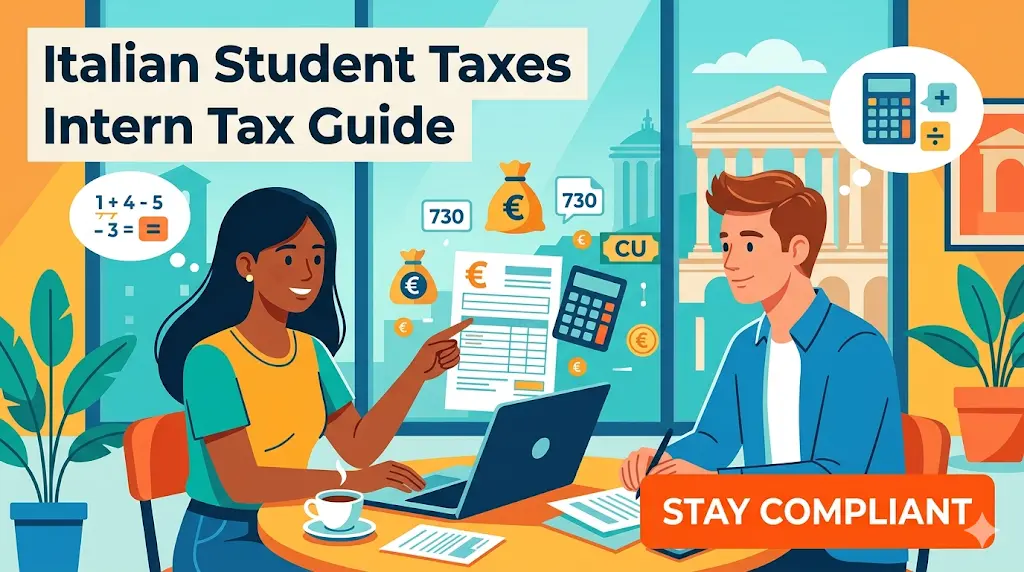
Tax Rules for Internships and Traineeships
The Italian word for internship is tirocinio or stage, and the tax rules governing these positions depend entirely on whether the internship is classified as curricular or extracurricular. This legal distinction dictates whether you will be paid, how you will be paid, and what taxes will be applied to that payment.
Curricular Versus Extracurricular Internships
A curricular internship (tirocinio curriculare) is one that is required by your university program to complete your degree. Because its primary purpose is strictly educational and it occurs while you are actively enrolled, Italian labor law does not mandate that the host company pay you a salary. Many companies offer a small rimborso spese (expense reimbursement) to cover your public transit or lunch costs. A true expense reimbursement, backed by receipts (known as rimborso a piè di lista), is generally not treated as income and is therefore not subject to IRPEF taxation.
An extracurricular internship (tirocinio extracurriculare), on the other hand, takes place after you have graduated. These programs are heavily regulated by regional laws rather than national laws, and the host company is legally required to pay you a minimum monthly allowance, officially known as an indennità di partecipazione. This allowance varies wildly by region; for instance, Lombardy has different minimums than Lazio. You can explore the broader landscape of these post-graduation opportunities by reading about Internships and Trainee Programs in Italy.
Dealing with INPS Contributions
The most confusing aspect of an extracurricular internship allowance is how it is taxed. For IRPEF purposes, the Italian tax agency treats the internship allowance exactly like standard employment income. This means your host company will deduct IRPEF from your monthly allowance before it hits your bank account, lowering your actual take-home pay.
However, because an internship is not legally classified as a formal employment contract, it is treated very differently for social security purposes. In most standard employment contracts, a massive chunk of your paycheck goes to INPS (the National Social Security Institute) to fund your future pension, maternity leave, and public healthcare. Fortunately, internship allowances are generally exempt from INPS contributions. This is a massive financial relief for young expats, as INPS deductions can eat up nearly 10 percent of a standard worker’s gross salary.
Before you sign an internship agreement, you must read the fine print carefully. The official document, usually called a Progetto Formativo, will be drafted in dense, bureaucratic Italian. I used the business communication modules on ItalianPod101 to familiarize myself with standard Italian contract structures. By dedicating an hour a day to reading comprehension exercises on ItalianPod101, I was able to spot a discrepancy in my internship contract regarding my gross versus net monthly allowance before I signed it. To ensure you present yourself as a competent professional who understands local corporate norms, reviewing CV and Interview Tips for Working in Italy is highly recommended before you begin interviewing for these crucial transition roles.
| Feature | Curricular Internship (Tirocinio Curriculare) | Extracurricular Internship (Tirocinio Extracurriculare) | Standard Part-Time Student Job |
| Primary Purpose | Academic credit / Fulfilling university degree requirements | Post-graduation transition into the professional workforce | Earning immediate income |
| Mandatory Pay | No (Expense reimbursement is common but not legally required) | Yes (Subject to a minimum regional allowance) | Yes (Subject to national collective bargaining agreements) |
| Subject to IRPEF (Income Tax) | Generally No (If structured strictly as a receipt-based reimbursement) | Yes (Treated strictly as employment income) | Yes |
| Subject to INPS (Social Security) | No | Generally No | Yes (Heavily deducted) |
Filing Your Taxes and Maximizing Deductions
Knowing how to read your payslip and knowing how to file your annual tax return are two distinct skills. Mastering both is the only way to ensure you are not leaving your hard-earned money on the table in Italy.
Decoding Your Busta Paga
When you receive your first Italian payslip, known as a busta paga, it will likely look like a complex mathematical puzzle. It is traditionally broken down into three main sections. The top section contains your personal details, your employer’s corporate data, and your accumulated vacation days (ferie). The middle section lists your gross pay (lordo) and any specific bonuses or overtime. The bottom section is the most important: it outlines your exact tax deductions (trattenute) and reveals your final net pay (netto in busta).
As an international student, you must pay close attention to this bottom section. You will see deductions for regional and municipal taxes (addizionali regionali e comunali) alongside the standard national IRPEF. If you are working a standard part-time job rather than an internship, you will also see your INPS pension contributions listed here. Additionally, you will see a line item for TFR (Trattamento di Fine Rapporto), which is a mandatory severance pay that your employer sets aside and pays out to you when your contract ends. Understanding these categories is vital because it helps you project your actual take-home pay for rent and groceries. To understand what baseline salaries look like before these heavy taxes hit, you can consult our guide on Salary Expectations in Italy: Jobs and Industries.
If you are confused by your busta paga, do not be afraid to ask your company’s HR department or payroll office for clarification. Asking financial questions in a foreign language can be intimidating, but it is entirely necessary for your financial survival. Practicing workplace dialogues with ItalianPod101 gave me the confidence to walk into the HR office and politely ask for a complete breakdown of my tax deductions. The conversational strategies taught on ItalianPod101 ensure you sound respectful and professional, rather than accusatory, when querying the math on your paycheck.
The Modello 730 versus Modello Redditi
Even if your employer deducts taxes automatically, you may still need—or actively want—to file an annual tax return (Dichiarazione dei Redditi) the following year. If you only had one employer during the calendar year and absolutely no other sources of income, you are generally not legally obligated to file a return. However, it is almost always in your best financial interest to do so voluntarily.
Filing a return allows you to claim deductions (detrazioni) that can trigger a refund of the taxes your employer aggressively withheld. As a student, you can deduct a percentage of your university tuition fees, rent paid for your student accommodation (under very specific conditions regarding the distance from your official residence), and out-of-pocket medical expenses. For example, if you pay for private specialist visits or prescription glasses, you can deduct a portion of those costs; you can read more about navigating these medical receipts in Getting Health Insurance in Italy: Public and Private Options.
In Italy, standard employees and interns typically file the “Modello 730.” The beauty of the Modello 730 is that if you are owed a refund, the government does not send you a slow paper check; instead, they pay it directly into your paycheck via your employer in the summer months (usually July or August). If you have more complex income, such as remote freelance earnings from your home country or foreign investments, you must file the “Modello Redditi PF,” which is vastly more complicated.
To navigate this, you will almost certainly need to visit a CAF (Centro di Assistenza Fiscale). A CAF is a union-run tax assistance center that helps workers file their taxes for a very low fee (often under 50 euros). Be aware that the timing of your tax filings can overlap with immigration renewals, so keeping your paperwork highly organized is essential; staying updated on the Timelines for picking up your permesso di soggiorno in Italy will ensure you are legally present and possess valid identification when it is time to visit your tax accountant. Understanding your tax responsibilities early on empowers you to make informed financial decisions, allowing you to focus your energy on launching your European career rather than stressing over unexpected tax bills.
References
Primary sources (official)
- Agenzia delle Entrate (Italian Revenue Agency): https://www.agenziaentrate.gov.it/
- INPS (National Social Security Institute): https://www.inps.it/
Other helpful sources
- Ministero del Lavoro e delle Politiche Sociali (Ministry of Labor): https://www.lavoro.gov.it/
Disclaimer
The information provided in this article is for general informational purposes only and does not constitute official financial, tax, legal, or immigration advice. Italian tax brackets, “No Tax Area” thresholds, and regional internship regulations are subject to frequent changes by the government. Always verify your specific tax obligations with a qualified Italian commercialista (tax accountant), a registered CAF (Centro di Assistenza Fiscale), or the Agenzia delle Entrate before filing your annual tax return or signing employment contracts.