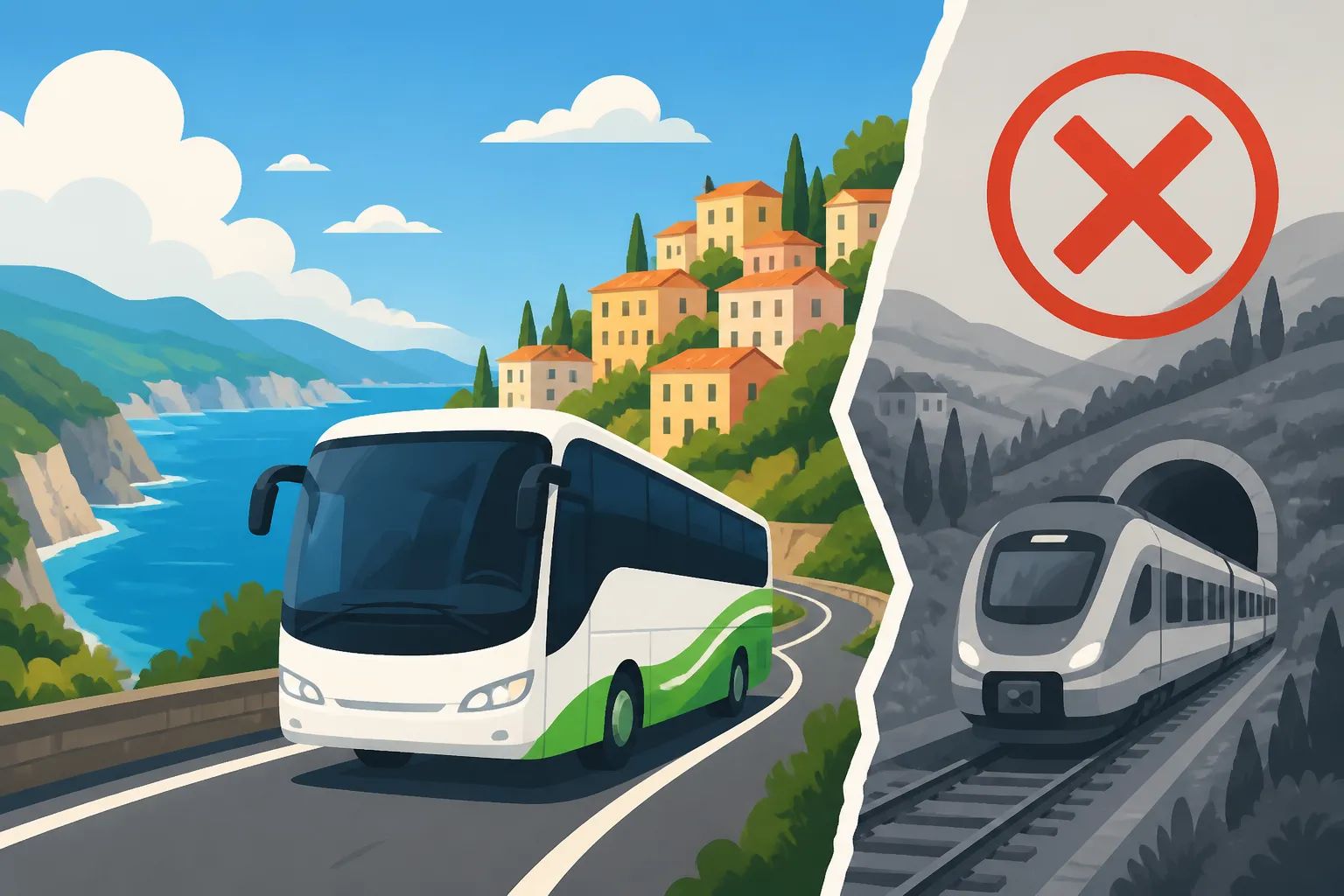
When Buses Beat Trains in Italy: Routes Where Rail Doesn’t Reach
You've arrived in Italy, brimming with dreams of effortlessly zipping between picturesque cities on high-speed trains. And for the major hubs, that dream is largely true! But if you're like most expats or savvy tourists who want to truly explore this incredible country beyond the well-trodden tracks, you'll quickly realize that Italy's charm often lies in its hidden corners. That's where a reliance solely on rail can leave you stranded or facing unnecessarily complex journeys. This guide is here to shed light on those fantastic routes where buses don't just complement trains, they decisively beat them, offering direct access, scenic rides, and often a much more sensible option, especially when you use a reliable platform like Omio to navigate the fragmented bus networks.
Disclosure: This post may contain affiliate links. We may earn a commission at no extra cost to you if you make a purchase through these links. Read full disclosure.
The Myth of Italy's All-Encompassing Rail Network
Let's be honest, Italy's railway system is incredible for connecting its biggest cities. You can hop on a Frecciarossa from Rome and be in Florence in under two hours, or zip from Milan to Venice with relative ease. The thought of train travel here conjures up romantic images of scenic vistas from a window seat. However, this perfectly polished image often doesn't extend to every nook and cranny of the peninsula.
Where Trains Shine and Where They Don't
For primary routes between major metropolitan centers like Milan, Bologna, Florence, Rome, and Naples, trains are absolutely the undisputed champions. They’re fast, comfortable, and often drop you right in the city center. If your itinerary sticks to these well-connected urban areas, you might never even consider a bus. It's a fantastic way to cover significant distances efficiently.
However, venture even slightly off these main arteries, and the rail network can become sparse, slow, or nonexistent. Trying to reach a quaint medieval hill town in Umbria, a specific coastal village along the Adriatic, or a mountain resort in the Dolomites often means the train will only get you so far. You might arrive at a regional station, only to find yourself miles from your actual destination, staring at a bus timetable written entirely in Italian, with infrequent services. This is a common frustration for newcomers, who might have packed lighter for train travel and suddenly face the logistics of an unplanned bus transfer or an expensive taxi ride.
The Hidden Gems Beyond the Tracks
Italy isn't just its major cities; it's a tapestry of thousands of borghi, small historic villages, national parks, and stretches of stunning coastline that have intentionally remained less developed, preserving their authentic character. These are the places that offer a deeper, more immersive Italian experience – where you can truly feel like a local, away from the tourist crowds.
Imagine exploring the ancient Sassi di Matera, wandering through the trulli of Alberobello, or hiking in the dramatic landscapes of Gran Paradiso National Park. While some of these might have a train station in a nearby larger town, the direct link to the heart of the village or the start of a trail often relies solely on local bus services. These destinations embody the slower pace of Italian life and are often deliberately positioned off the high-speed rail lines. The challenge of reaching them is part of their allure, but it doesn't have to be a headache. Knowing how to leverage Italy's extensive bus network is the key to unlocking these treasures. For anyone trying to fully embrace the Italian lifestyle, understanding how to navigate these local transport options is just as crucial as learning how to register for Italian healthcare (SSN).
When Buses Are Your Best Bet: Specific Scenarios
As a veteran expat, I can tell you that assuming trains are always the answer in Italy is a rookie mistake I, and many others, have made. Sometimes, the bus isn't just an option; it's the only sensible option. It's about being practical and choosing the right tool for the job.
Reaching Remote Villages and Hill Towns
Italy is famous for its stunning hilltop villages and charming, often ancient, towns perched in seemingly inaccessible locations. Think of places like Civita di Bagnoregio, often called "The Dying City," which is truly a marvel. A train will get you to Orvieto, but from there, it’s a dedicated bus journey that takes you right to the foot of the pedestrian bridge leading to Civita. Similarly, many of the smaller, incredibly picturesque towns in Tuscany or Umbria – places like Pienza, Montepulciano, or Spello – might have a regional train station nearby, but the station itself could be a significant distance from the historic center. The local bus service, often timed to meet specific train arrivals, will ferry you directly into the piazza.
This direct connection into the heart of a village is invaluable. It saves you from lugging suitcases up steep, winding roads or having to shell out for an expensive taxi. When you’re planning day trips and weekend getaways across Italy, considering bus routes from the outset can drastically simplify your logistics and open up a whole new world of exploration beyond the main tourist circuits. This is where a platform like Omio truly becomes your best friend, because it helps you discover these crucial connecting bus services that are often operated by smaller, local companies whose websites might not be English-friendly or easy to find.
Connecting Across Regions Without Major Hubs
One of the biggest hidden challenges of Italian travel can be moving between two smaller cities or towns that are located in different regions but don't fall on a direct high-speed rail line. For instance, imagine you want to travel from Matera in Basilicata to Lecce in Puglia, two stunning cities in the south. While you could try to piece together a train journey, it would likely involve multiple changes, often routing you through a larger hub like Bari, adding significant time and complexity.
In such cases, a direct inter-regional bus service is often the most efficient and straightforward solution. You can find comfortable coaches that travel directly between these destinations, often in a fraction of the time and for a fraction of the cost of a convoluted train itinerary. This is where services that aggregate travel options, like Omio, truly shine. They allow you to input your origin and destination and instantly see if a direct bus route exists, saving you the headache of poring over multiple regional transport websites. For those mindful of their budget, exploring the various transportation costs in Italy, including bus fares, is a smart move.
Budget Travel and Last-Minute Bookings
Let's face it, Italy can be an expensive place, especially during peak tourist season. High-speed train tickets, particularly if booked last-minute or for popular routes, can be surprisingly costly. This is where buses offer a significant financial advantage. For many routes, bus tickets are considerably cheaper than their train counterparts, making them an excellent choice for students, backpackers, or anyone keeping a close eye on their budget.
Even if you’re not strictly on a shoestring budget, buses provide a fantastic alternative when train tickets are sold out, prohibitively expensive, or when you simply prefer the flexibility of a more spontaneous journey. I've had countless instances where a last-minute decision to visit a friend in a neighboring town meant train prices had skyrocketed, but a comfortable bus ride via FlixBus or Itabus was still readily available at a reasonable price. This flexibility is a godsend when navigating unexpected changes in your travel plans or simply when you're trying to manage your budget for living in Italy. Booking through Omio makes it easy to compare these prices side-by-side, giving you all the options at your fingertips without the fuss.
Navigating Italy's Bus Networks with Omio
Italy's bus system, while extensive, can feel like a labyrinth if you're not familiar with it. Unlike the highly centralized national rail system (Trenitalia and Italo), bus services are run by a myriad of regional and inter-regional companies. This fragmentation is precisely where Omio steps in to transform a potential headache into a smooth journey.
Why Omio is a Game-Changer for Expats and Tourists
When you first try to find bus tickets in Italy, you might encounter dozens of local companies, each with its own website, booking system, and often, only Italian language options. It can be a bewildering experience, and many an expat has thrown their hands up in frustration, defaulting back to less efficient train routes or expensive car hires. This is the exact pain point that Omio was designed to solve.
Omio acts as a brilliant aggregator, pulling together schedules and fares from a vast array of bus operators, including major international players like FlixBus and Itabus, as well as many of the smaller, regional Italian companies. This means you can search for virtually any route in Italy and instantly see all available bus options, alongside train and even flight alternatives, all presented in clear English. The ability to compare prices, travel times, and even specific amenities (like Wi-Fi, if available) across different providers on a single, user-friendly platform is invaluable. It takes the guesswork and language barrier out of finding the best bus connection, making Omio an indispensable tool for anyone getting around Italy: trains, buses, flights, and car hire.
Popular Bus Operators and What to Expect
When you search for bus routes on Omio, you'll likely come across a few key names:
- FlixBus: This is probably the most recognizable international operator, offering a wide network of inter-city and international routes across Italy. FlixBus coaches are generally modern, comfortable, and often equipped with Wi-Fi and power outlets, though reliability of these services can vary. They are known for competitive pricing, especially when booked in advance.
- Itabus: A newer Italian competitor to FlixBus, Itabus also offers extensive inter-city connections. Their buses are typically comfortable, often double-decker, and aim for a high standard of service.
- Regional and Local Operators: These are numerous and vary by region. For example, in Campania, you'll find SITA Sud, which is essential for navigating the Amalfi Coast and other parts of the region. In Sicily, AST or SAIS Autolinee are prominent. For urban routes, cities have their own municipal transport companies (e.g., ATAC in Rome, ATM in Milan). Omio includes many of these, making it easier to find those critical last-mile connections.
What to expect on board really depends on the operator and the route. For longer-distance inter-city buses, you can usually count on air conditioning, comfortable seats, and a luggage compartment under the bus. For shorter, local routes, buses might be more basic, akin to city public transport. A crucial tip for local buses: always remember to validate your ticket once you're on board if you bought it from a tabaccheria or newsstand. Failure to do so can result in a hefty fine.
Practical Tips for Bus Travel in Italy
Once you've found your ideal bus route on Omio, a few practical tips can make your journey even smoother:
- Booking in Advance: For longer journeys, popular routes, or during peak season (like summer or major holidays), booking your bus ticket in advance through Omio is highly recommended. Not only does it secure your spot, but it often locks in a better price. For very local routes, you might buy tickets from a tabaccheria (tobacconist), newsstand, or directly from the driver (though this isn't always possible or advisable on inter-city routes).
- Bus Station Locations: Unlike train stations, which are often grand and centrally located, bus stations can vary wildly. In major cities, they might be near the train station, but sometimes they are slightly out of the center. Always double-check the exact departure point on your Omio ticket or the operator's website. Arrive a little early to find your specific platform, especially in larger hubs like Rome's Tiburtina station.
- Luggage: Most inter-city bus operators are quite generous with luggage allowances, usually permitting one large suitcase and a small carry-on. Always check the specific operator's policy on Omio or their website if you have oversized baggage.
- Patience with Delays: While buses are often more direct, they are also subject to road traffic. Factor in potential delays, especially during rush hour in larger cities or on routes that pass through popular tourist areas. Italy is generally a place where a relaxed approach to timings serves you best.
- Combine and Conquer: Don't limit yourself to just one mode of transport! Omio helps you see how a train-to-bus or bus-to-train combination might be the most efficient. For example, you might take a high-speed train to a regional hub and then connect with a bus for the final leg to a smaller town.
| Feature | Trains (High-Speed) | Buses (Inter-City/Regional) |
|---|---|---|
| Speed | Very fast for inter-city (e.g., Rome-Florence) | Slower than high-speed trains, comparable to regional trains |
| Network Reach | Excellent between major cities; limited for small towns | Extensive, reaches many towns and villages off rail lines |
| Cost | Can be expensive, especially last-minute or peak season | Generally more affordable, good for budget travel |
| Comfort | High (spacious seats, amenities, dining car options) | Good for inter-city; varies for regional/local buses |
| Flexibility | Fixed schedules, less flexible for spontaneous changes | More frequent options on some routes, good last-minute fares |
| Scenic Value | Excellent on some routes (e.g., coastal, mountain) | Often drives through smaller towns and countryside for unique views |
| Luggage | Generous overhead/end-of-car space; check size limits | Generous under-bus storage for large items, small carry-on |
| Booking | Online, station, travel agents | Online (Omio recommended), station, sometimes driver for local |
Real-World Scenarios: Buses in Action
To truly illustrate the power of Italy's bus network, let's dive into some concrete examples where choosing the bus over the train isn't just an alternative, but often a revelation. These are routes where trains struggle to reach, or where buses offer a vastly superior experience in terms of directness and efficiency.
Exploring Southern Italy: Puglia and Basilicata
Southern Italy, with its stunning coastlines, unique historical towns, and vibrant culture, is a region often less serviced by the extensive rail network found in the north. Puglia, the "heel" of Italy, and its neighboring Basilicata, home to the incredible Matera, are prime examples.
Imagine wanting to travel from Bari, Puglia's capital, to Matera in Basilicata. While you can take a regional train from Bari Centrale, it requires a change at a smaller station, and the entire journey can be cumbersome. The far more common and efficient method is a direct bus, such as those offered by FlixBus or local operators, which takes you straight from Bari's central station or airport directly to Matera's bus terminal, often in just over an hour. This is a game-changer for anyone wanting to experience the ancient cave dwellings of Matera without the hassle of multiple transfers.
Similarly, exploring the enchanting towns of Puglia, like the trulli-filled Alberobello, the "White City" of Ostuni, or the beautiful coastal Polignano a Mare, often requires local bus services. While trains might get you near some of these, the bus is usually the direct line into the heart of these picturesque destinations. For expats considering living in Italy, exploring these charming, smaller towns often means getting comfortable with local bus routes. Omio is brilliant for showing you these options, making what could be a frustrating logistical puzzle surprisingly simple.
Mountain Escapes: Dolomites and Apennines
Italy is a country of mountains, from the majestic Dolomites in the north to the rugged Apennine spine running down the center. While trains can get you to the base of these regions, for instance, to cities like Bolzano (Bozen) for the Dolomites, or L'Aquila for the central Apennines, it's the buses that truly take you deep into the valleys, ski resorts, and hiking trails.
For those planning an adventure in the Dolomites, a train journey might take you to Bolzano. From there, a network of efficient public buses operated by Südtirol Alto Adige Mobilità (known as SASA in Bolzano and SAD for regional services) fan out into breathtaking valleys like Val Gardena, Val Badia, or directly to popular hubs like Cortina d'Ampezzo. These bus routes are often incredibly scenic, winding through dramatic mountain passes and quaint alpine villages. Trying to navigate these areas by train alone would be impossible. Similarly, for exploring the lesser-known, but equally beautiful, Apennine regions like Abruzzo or Molise, buses are the lifeblood, connecting isolated mountain villages and natural parks. Using Omio, you can often find direct bus tickets that integrate seamlessly with your train journey, ensuring you reach your ultimate mountain destination without a hitch.
Island Adventures: Sicily and Sardinia
Italy's two largest islands, Sicily and Sardinia, offer distinct cultures, landscapes, and travel experiences. While you can take a unique overnight train-ferry combination to reach Sicily from mainland Italy, once on the islands, buses quickly become your primary mode of inter-city and inter-town transport, especially if you don't plan to rent a car.
In Sicily, for example, if you arrive in Catania and wish to visit the iconic Taormina or the ancient ruins of Syracuse, the bus is often the quickest and most direct option. Similarly, connecting cities like Palermo to Agrigento (home of the Valley of the Temples) or exploring the southeastern baroque towns like Noto and Ragusa are best done by bus. Companies like SAIS Autolinee or Interbus provide extensive networks.
Sardinia, known for its pristine beaches and rugged interior, has an even sparser rail network. To truly explore its diverse landscapes, from the glamorous Costa Smeralda to the wilder inland areas or the ancient Nuragic sites, buses are indispensable. The ARST bus network covers much of the island, connecting major cities like Cagliari, Sassari, and Olbia to smaller towns and coastal resorts. Trying to figure out all these operators and routes on your own could be a monumental task, but Omio simplifies it by allowing you to search and book across these various island bus companies in one go. Whether you're moving to Italy with pets and need to factor in pet-friendly transport, or simply trying to stick to a budget, buses on the islands are a practical, often necessary, choice.
Disclaimer
The information provided in this article is intended for general guidance and informational purposes only. While we strive to offer accurate and up-to-date advice based on personal experience and current knowledge, travel regulations, prices, and service availability in Italy can change rapidly. Always verify the latest information with official sources, transportation providers, and relevant authorities before making any travel decisions. Our recommendations are personal insights and do not constitute professional advice.