Sponsorship by Employer vs Self-Employment Taxes
Deciding whether to accept an Italian employment contract or open a freelance business usually triggers a panic attack once you see the tax rates. I remember staring at my first Milanese payslip, entirely baffled by how much of my gross income disappeared before reaching my bank. This guide breaks down the true tax reality of employer sponsorship versus self-employment in Italy.
Disclosure: This post may contain affiliate links. We may earn a commission at no extra cost to you if you make a purchase through these links. Read full disclosure.
The Comfort and Costs of Employer Sponsorship
When you receive a formal job offer from an Italian company, the immediate sense of relief is intoxicating. Having a corporate entity sponsor your presence in the country provides a massive psychological safety net. However, the financial reality of being a standard employee in Italy can be a harsh awakening for expats accustomed to higher net retention in their home countries.
The Hidden Deductions on Your Busta Paga
The Italian payslip, known as the busta paga, is a notoriously complex document. When you negotiate your salary in Italy, you are always negotiating the lordo (gross) amount. The shock comes when you see the netto (net) amount that actually hits your checking account.
As a sponsored employee, your income is subject to IRPEF (Imposta sul Reddito delle Persone Fisiche), which is a progressive national income tax. Depending on your income bracket, this can range from 23% up to 43%. On top of the national tax, you will also see deductions for regional and municipal taxes, which vary depending on whether you live in Lombardy, Lazio, or Sicily.
Beyond income tax, the heaviest burden is social security, managed by INPS (Istituto Nazionale della Previdenza Sociale). The standard INPS contribution for an employee is roughly 33% of your gross salary. Fortunately, under an employer-sponsored contract, the company covers roughly 24% of this, while the remaining 9% is deducted directly from your paycheck. Understanding this math is essential before you accept any job offer; I highly recommend reviewing Salary Expectations in Italy: Jobs and Industries to understand what a competitive gross offer actually looks like in your sector.
Visa Security Versus Salary Stagnation
The primary advantage of employer sponsorship is administrative. If you are hired from abroad, the company must navigate the Decreto Flussi and apply for your security clearance. You can read exactly how this bureaucratic hurdle works in Understanding Italy’s Nulla Osta Requirement. Once you are in the country, renewing your Permesso di Soggiorno per Motivi di Lavoro Subordinato is relatively straightforward as long as your employment contract remains active.
The downside to this security is salary stagnation. Italian corporate salaries are notoriously low compared to Northern Europe or the US, and raises are infrequent. If you are an expat with financial obligations back home—like student loans or a mortgage—this lower net income can be incredibly restrictive. If you are frequently sending portions of your Italian salary back to your home country to cover these bills, using Wise is the most effective way to protect your shrinking net pay. Traditional Italian banks often charge atrocious currency markup fees on international wire transfers, whereas Wise uses the mid-market exchange rate, ensuring your hard-earned euros stretch as far as possible when converted to dollars or pounds. Setting up your financial infrastructure efficiently should be a priority on your Checklist: All You Need Before Moving to Italy.
The Reality of Self Employment and the Partita IVA
For expats who cannot secure corporate sponsorship, or those who simply demand more earning potential, opening an Italian freelance business is the alternative. This requires opening a Partita IVA (VAT number). While this grants you ultimate freedom, it forces you to become your own tax withholding agent and HR department.
Choosing the Right Tax Regime
Italy heavily incentivizes freelance work through a specialized tax bracket known as the Regime Forfettario. If your freelance business bills less than 85,000 euros per year, you can opt into this regime, which drastically simplifies your fiscal life.
Instead of dealing with the progressive IRPEF brackets that can eat up to 43% of your income, the Regime Forfettario applies a flat tax. For the first five years of a new business, this tax is an unbelievably low 5%. After five years, it caps at a flat 15%. This sounds like an expat dream, but there is a massive catch: you cannot deduct any business expenses. The government applies a “coefficient of profitability” to your income based on your profession. If you are a freelance consultant, the government might assume your expenses are 22%, meaning you are taxed on 78% of your gross revenue, regardless of how many laptops or flights you actually purchased.
If you plan to enter Italy via this route, the initial paperwork is daunting. The consulate will demand proof of your financial viability before granting the visa. You must carefully review Acceptable financial proof for Italy self-employment visa to ensure your bank statements meet their strict criteria. Once you arrive, you will also need to track the Timelines for picking up your permesso di soggiorno in Italy, as you cannot formally invoice local clients until your legal residency is actively secured.
Managing Your Own Social Security
While the 5% flat tax under the Regime Forfettario is brilliant, freelancers face a brutal reality when it comes to INPS. Because you do not have an employer paying the bulk of your social security contributions, you are entirely responsible for them.
If you are a standard freelancer without a specific professional guild (like a registered architect or lawyer), you must enroll in the Gestione Separata INPS. This requires you to pay approximately 26% of your taxable income directly into the state pension fund. You must pay these taxes in advance during the summer, which causes massive cash flow issues for unprepared expats.
If you work with international clients, your banking setup can make or break your tax compliance. Italian banks are notoriously hostile toward incoming non-EU wire transfers, often delaying them or demanding extensive anti-money laundering documentation. Utilizing Wise to invoice your international clients gives you local account details in various countries. Your US clients can pay your Wise account via ACH, and you can instantly convert the funds to euros, keeping your revenue streams clean and easily reportable for your Italian tax accountant. Ensuring your funds are accessible is critical, especially when monitoring the How long after entry to apply for a residence permit in Italy guidelines, as you will need to demonstrate immediate financial stability to the authorities.
Handling Cross-Border Finances and Investments as an Expat
Regardless of whether you are a sponsored employee or a lone freelancer, generating income in Italy is only half the battle. Preserving and growing that wealth in a highly regulated, tax-heavy environment requires specialized tools that local Italian institutions simply do not provide.
Currency Conversion and International Invoices
The global nature of expat life means your financial footprint rarely exists in just one country. You might be earning euros in Milan, paying a mortgage in London, and receiving freelance dividends from a LLC in Delaware.
Traditional Italian retail banks are entirely unequipped for this reality. They charge high monthly account maintenance fees and penalize you for cross-border activity. Using Wise effectively bypasses the Italian retail banking bottleneck. You can receive your salary, manage multiple currency wallets, and pay your Italian rent from a single application without bleeding money on spread markups. This flexibility is particularly useful if you are exploring modern remote-work pathways, such as the programs detailed in Italy’s new digital residency pilot for expats.
Investing Your Income Safely
Investing your leftover income while living in Italy introduces a new layer of bureaucratic misery. If you attempt to open a brokerage account with a local Italian bank, you will likely face high custody fees, expensive per-trade commissions, and limited access to global markets.
For expats, Interactive Brokers is the undisputed gold standard. Because it is a robust international platform, Interactive Brokers allows you to hold a globally diversified portfolio without being suffocated by restrictive local Italian banking fees. You can buy low-cost US or European index funds, trade in multiple currencies, and move your portfolio seamlessly if you eventually relocate from Italy to another country.
Crucially, for US citizens living in Italy, local banks will often outright refuse to open investment accounts due to the restrictive reporting requirements of FATCA (Foreign Account Tax Compliance Act). Interactive Brokers is one of the few global platforms that natively supports American expats living in Europe, ensuring you are not locked out of the financial markets simply because of your passport.
When you use a foreign platform, you operate under the Regime Dichiarativo (declarative tax regime) in Italy. This means the broker does not automatically deduct your 26% capital gains tax; you must declare it yourself. Fortunately, Interactive Brokers provides highly detailed, end-of-year tax reports that your Italian commercialista (tax accountant) can easily translate into the local tax framework, making compliance surprisingly painless.
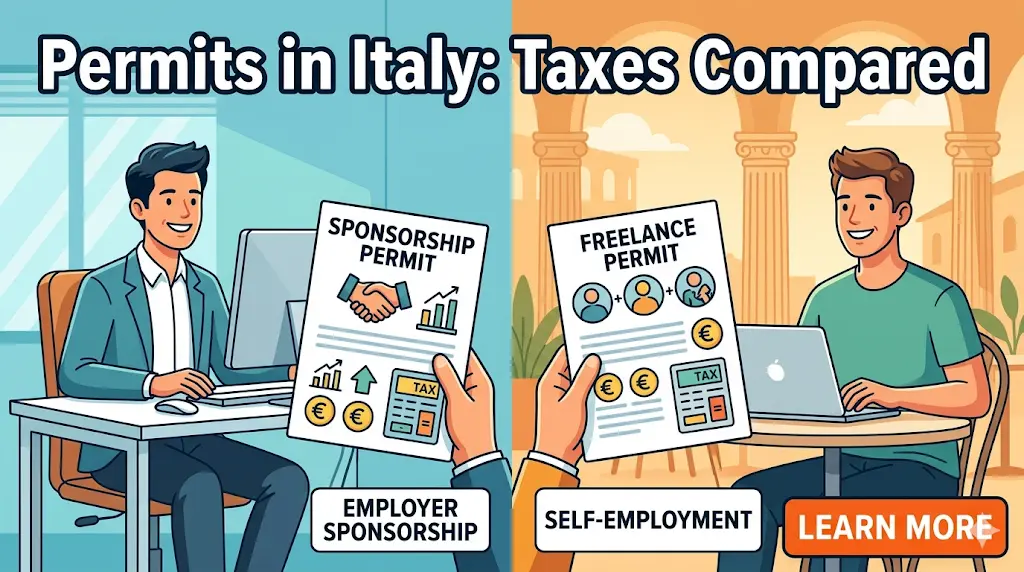
| Feature | Employer Sponsored (Lavoro Subordinato) | Self-Employed (Partita IVA – Forfettario) |
| Income Tax (IRPEF) | Progressive (23% to 43%) | Flat Tax (5% or 15%) |
| Social Security (INPS) | ~9% paid by you, ~24% paid by employer | ~26% paid entirely by you |
| Administrative Burden | Very Low (Employer handles taxes) | High (Requires an accountant and strict invoicing) |
| Visa Difficulty | Moderate (Relies on employer securing quotas) | Very High (Requires robust portfolio and financial proof) |
| Business Expenses | Not applicable | Cannot be deducted (Fixed profitability coefficient) |
Bureaucratic Pitfalls During Visa Transitions
Your tax status and your immigration status are inextricably linked. A change in your employment structure immediately triggers a need to update your relationship with the Ministry of the Interior.
Shifting from Employment to Freelance
Many expats start out sponsored by an employer to get their foot in the door, with the goal of eventually launching their own business once they understand the local market. Converting a Permesso di Soggiorno per Motivi di Lavoro Subordinato (subordinate work permit) into a Permesso di Soggiorno per Lavoro Autonomo (autonomous work permit) is incredibly difficult. It is tightly constrained by the quotas of the Decreto Flussi.
If you lose your sponsored job or resign to start a business, your residence permit does not immediately become invalid, but you cannot legally renew it as a freelancer unless you have secured one of those rare quota spots. Failing to navigate this transition properly can lead to a lapse in legal status. The Consequences of losing your permesso di soggiorno card or letting your status expire are severe, often requiring you to return to your home country to start the visa process entirely from scratch. Alternatively, if you are married to an Italian resident, you might bypass these quotas entirely; reviewing the Conditions for working while on Italy Family Reunification Visa can offer a much safer transition into self-employment.
Maintaining Compliance and Residency
Whether you choose the safety of corporate sponsorship or the independence of a Partita IVA, you must keep your physical residency records pristine. The Italian tax agency (Agenzia delle Entrate) communicates via registered mail or certified email (PEC). If you move to a new apartment and fail to update your official address with the local municipality and the police, you will miss crucial tax assessments or INPS payment demands.
You must meticulously follow the procedures outlined in How to change your address with the Questura in Italy every single time you sign a new lease. Furthermore, if you hold multiple passports, ensure you are utilizing the correct nationality for your tax filings and your business registrations, as the Italian visa policy for dual nationals can sometimes offer hidden administrative shortcuts if one of your passports is from an EU member state. Managing your taxes in Italy is an ongoing administrative marathon, but understanding the stark differences between employment structures allows you to architect a financial life that actually supports your expat goals rather than draining your savings.
References
Primary sources (official)
- Agenzia delle Entrate (Italian Revenue Agency): https://www.agenziaentrate.gov.it/portale/web/english
- INPS (National Social Security Institute): https://www.inps.it/
Other helpful sources
- FiscoOggi (Official Tax Magazine of Agenzia delle Entrate): https://www.fiscooggi.it/
Disclaimer
The information provided in this article is for general informational purposes only and does not constitute official financial, tax, or legal advice. Italian tax laws, INPS contribution rates, and the Regime Forfettario thresholds are subject to frequent legislative changes. Always consult with a registered Italian commercialista (tax accountant) or a qualified financial advisor to evaluate your specific cross-border tax liabilities and ensure strict compliance with local regulations.