Applying for a work visa while already in Italy on a tourist visa
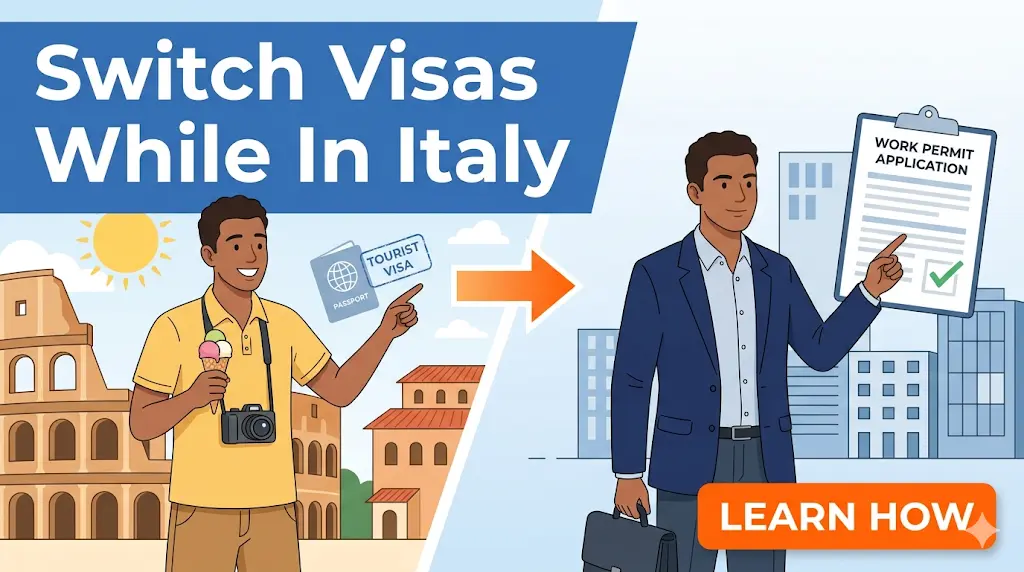
Finding a dream job while vacationing in Italy, only to learn you must leave the country to legally accept it, is devastating. I remember holding a job offer in Milan, completely panicked when human resources casually mentioned I had to fly back to New York to process the paperwork. This guide explains the rigid realities of tourist visa conversions and how to legally secure your work authorization.
Disclosure: This post may contain affiliate links. We may earn a commission at no extra cost to you if you make a purchase through these links. Read full disclosure.
The Brutal Reality of In Country Visa Conversion
The most pervasive myth among expats is that if you can just get your foot in the door and find an Italian employer willing to hire you, you can simply swap your tourist status for a work permit at the local police station. This is a fundamental misunderstanding of European immigration law, and banking on this myth will result in an overstay, hefty fines, and a potential ban from the Schengen zone.
The Schengen Tourist Visa Trap
Whether you entered Italy on a physical Schengen Type C tourist visa or you arrived visa-free on a 90-day passport waiver (like citizens of the US, UK, Canada, or Australia), your status is strictly categorized as a short-stay visitor. Italian immigration law dictates that short-stay tourist statuses cannot be converted into long-stay national residency permits (Permesso di Soggiorno) from within the country.
The Italian state demands that long-term immigrants undergo rigorous background checks, financial vetting, and administrative processing through an Italian consulate abroad. You cannot bypass this consular bottleneck simply because you are already physically sitting in a piazza in Rome. If you are reviewing your Checklist: All You Need Before Moving to Italy, you must accept that the chronological order of operations is rigid: secure the job, get the clearance, apply at the consulate in your home country, and then enter Italy as a resident. If you try to stay and fight the system, you will quickly find out How long after entry to apply for a residence permit in Italy; the answer is eight days, and you cannot apply without a Type D National Visa already stamped in your passport.
Rare Exceptions to the Rule
While the general rule is that you must fly home, there are incredibly narrow, highly specific exceptions. The most notable exception is the EU Blue Card (Carta Blu UE). The EU Blue Card is a specialized work permit designed for highly qualified non-EU nationals.
If you are offered a highly skilled position that meets the strict salary thresholds, and you possess a recognized university degree matching the job description, some local prefectures (Prefetture) will allow your employer to submit the clearance paperwork while you are legally present in Italy on your tourist 90 days. However, even in these rare cases where the clearance is processed while you are in the country, you often still have to leave the Schengen area to pick up the actual visa sticker from a consulate, though a few regional offices sometimes allow direct conversion if your legal entry window has not expired. Similarly, if you are exploring modern remote work options under Italy’s new digital residency pilot for expats, the initial application is deeply tied to your home-country consulate, not the local Italian police station.
Securing Employer Sponsorship from the Inside
Just because you cannot physically convert the visa in Italy does not mean your time as a tourist is wasted. Being on the ground gives you a massive advantage in securing the job and navigating the initial, employer-facing hurdles of the Italian immigration system.
Navigating the Decreto Flussi Quotas
The standard route for an Italian work visa is governed by the Decreto Flussi (Flow Decree). This is an annual quota system set by the Italian government that dictates exactly how many non-EU citizens are allowed to enter the country for work.
The quotas are usually exhausted within minutes on “click day,” when employers desperately submit applications the moment the digital portal opens. Finding an employer willing to navigate this bureaucratic nightmare is incredibly difficult. Because you are physically in Italy, you can interview in person, prove your value, and convince a company that you are worth the administrative headache. If you secure an offer, the employer must apply for your clearance against these quotas.
| Work Authorization Route | Quota Subject | Minimum Salary/Degree Requirement | Can Apply While in Italy? |
| Standard Work Visa (Decreto Flussi) | Yes (Highly restricted) | Standard union wages | No (Must return to home country) |
| EU Blue Card (Carta Blu UE) | No (Outside of quotas) | High minimum salary + University Degree | Sometimes (Depends on Questura) |
| Intra-Company Transfer (ICT) | No (Outside of quotas) | Existing corporate employment | No (Requires consular processing) |
The Nulla Osta Process
Once your employer commits to hiring you, they must apply for a Nulla Osta (Security Clearance/Certificate of No Impediment) through the Sportello Unico per l’Immigrazione (SUI) at the local prefecture.
Your employer must prove that your hiring does not negatively impact the local labor market and that they have the financial stability to support your contract. The Nulla Osta process takes months. During this waiting period, your 90-day tourist window will almost certainly expire. You must leave the Schengen zone before your 90 days are up. Do not wait in Italy for the Nulla Osta to be approved if your tourist time is running out. Overstaying will jeopardize the entire application and could result in an entry ban just as the upcoming Italy’s ETIAS implementation date and what travelers need protocols enforce stricter digital borders.
Gathering Your Documents Before Leaving Italy
While you are waiting for your tourist days to tick down and your employer to wrangle the Nulla Osta, you must use your remaining time in Italy to build your bulletproof consular application packet. Getting ahead of the paperwork now will save you months of agonizing delays when you return home.
Localizing Your Professional Credentials
To process your hiring, the Italian government will demand proof of your qualifications. They will not accept an English-language university diploma or a foreign resume. Every academic and professional document must be perfectly translated into Italian.
Instead of scrambling to find an expensive translator when you return to your home country, you can handle this entirely online while you are still in Italy by using RushTranslate. Having your degrees and professional certifications localized by RushTranslate ensures that your employer has the exact documentation needed to push your Nulla Osta application through the local prefecture. Furthermore, if the consulate eventually demands a Dichiarazione di Valore (Declaration of Value) for your degree, presenting certified translations prepared by RushTranslate makes the consular legalization process infinitely smoother. Because you can submit digital files to RushTranslate from your Italian hotel or cafe, you are actively building your visa dossier without wasting a single day of your trip.
Prepping Your Healthcare and Solvency Proof
When you eventually return to your home-country consulate with your approved Nulla Osta, the consular officer will not just look at your job offer. They will scrutinize your personal liability. To ensure you are not a burden on the state before your Italian payroll begins, they often require proof of robust international health insurance.
You cannot rely on the travel insurance you bought for your tourist trip. You must secure a comprehensive policy, which is why veteran expats turn to Cigna Global. Presenting a Cigna Global policy certificate to the consulate proves that your medical liabilities are entirely covered by private funds. I secured my Cigna Global policy before my consulate appointment, and the underwriter accepted it instantly because Cigna Global is universally recognized for meeting stringent European visa requirements.
Even after you arrive on your new work visa, having Cigna Global active during your first few months is a massive relief. As outlined in the Cost of Healthcare in Italy: What Expats Need to Know, registering for the public Italian healthcare system takes time. Relying on Cigna Global bridges that dangerous coverage gap. Make sure your financial records are equally pristine; reviewing the Acceptable financial proof for Italy self-employment visa gives you a clear baseline of how meticulously the Italian consulate expects your banking history to be presented, even for standard employment visas.
The Return Home and Consular Process
Accepting that you must leave Italy is psychologically difficult, but it is the only legal pathway forward. Once you fly back to your country of legal residence, the final phase of the bureaucratic marathon begins.
Booking the Appointment Abroad
You can only apply for a Type D National Visa at the specific Italian consulate that holds jurisdiction over your permanent home address. You cannot fly to London to apply if you are a resident of California.
Because consular appointments are notoriously difficult to book—often booked out for months in advance—you should attempt to schedule this appointment through the Prenot@Mi system while you are still in Italy, timing it for shortly after your anticipated return home. Once your employer informs you that the Nulla Osta has been approved and electronically transmitted to your home consulate, you attend your appointment. You will hand over your passport, your translated documents from RushTranslate, your insurance certificate from Cigna Global, and the flight itinerary showing your permanent move to Italy.
Re Entering Italy as a Legal Resident
Once the consulate affixes the coveted Type D work visa into your passport, you are finally ready to return to Italy, this time as a legal resident rather than a tourist. However, the visa sticker is not the final step.
By law, you have exactly eight days from the moment you pass through Italian customs to go to the post office and mail the Kit Giallo (Yellow Kit) to apply for your Permesso di Soggiorno. You will then enter a long waiting period for your physical residency card. Tracking the Timelines for picking up your permesso di soggiorno in Italy is vital, as this postal receipt is your only proof of legal status in the interim.
Once you are fully settled and working, you must register your new home address at the local town hall. Following the exact steps for How to change your address with the Questura in Italy ensures your immigration file is tied to your new employment. Protect your new residency card fiercely; dealing with the Consequences of losing your permesso di soggiorno card while trying to prove your right to work to a new employer will paralyze your professional life. If you happen to be navigating this alongside an Italian spouse, ensuring your paperwork aligns with the Conditions for working while on Italy Family Reunification Visa will streamline your household’s entire administrative standing. The journey from tourist to legal worker is long, expensive, and requires a transatlantic flight, but following the letter of the law ensures your new Italian career starts on an unbreakable foundation.
References
Primary sources (official)
- Ministero dell’Interno (Ministry of Interior – Nulla Osta and Immigration): https://www.interno.gov.it/it/temi/immigrazione-e-asilo
- Ministero degli Affari Esteri (Ministry of Foreign Affairs – Visa Portal): https://vistoperitalia.esteri.it/
- Portale Immigrazione (Official Portal for Residence Permits): https://www.portaleimmigrazione.it/
Other helpful sources
- Agenzia Nazionale Politiche Attive del Lavoro (ANPAL – Labor Market Information): https://www.anpal.gov.it/
- INPS (National Social Security Institute): https://www.inps.it/
Disclaimer
The information provided in this article is for general informational purposes only and does not constitute official legal, immigration, or employment advice. Italian immigration laws, the specific quotas of the Decreto Flussi, and consular processing requirements are highly complex and subject to frequent legislative updates. Always consult with a registered Italian immigration lawyer (avvocato immigrazionista) or a licensed labor consultant (consulente del lavoro) to evaluate your specific situation, navigate the Nulla Osta application, and ensure full compliance with Italian and European law before leaving the country or accepting a job offer.