How to convert an EU Blue Card to Italian citizenship
Realizing you have paid Italian taxes as a highly skilled worker for a decade, only to face a mountain of red tape for a passport, is deeply demoralizing. I spent years meticulously maintaining my legal residency, terrified a single missed renewal would reset my naturalization clock. This guide breaks down exactly how to convert your EU Blue Card into permanent Italian citizenship.
Disclosure: This post may contain affiliate links. We may earn a commission at no extra cost to you if you make a purchase through these links. Read full disclosure.
The Administrative Reality of the Ten Year Path
When you are recruited from abroad, companies and relocation agencies love to sell the EU Blue Card as the ultimate golden ticket to Europe. While it is undoubtedly the premier work visa available, its benefits regarding long-term naturalization are frequently exaggerated, leading to immense frustration down the line.
Busting the Fast Track Myth
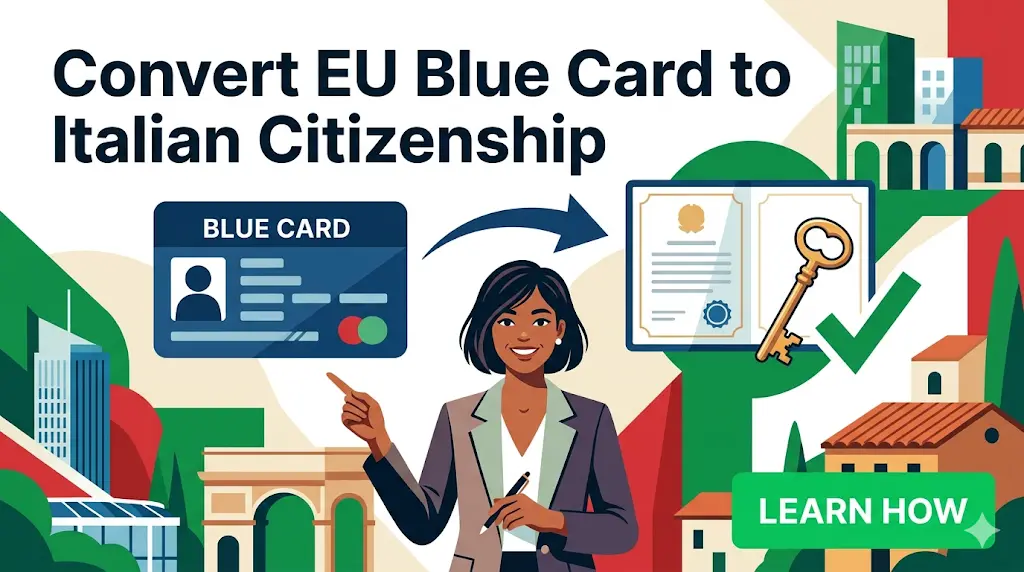
The EU Blue Card was designed by the European Union to attract highly skilled, tertiary-educated talent by completely bypassing the restrictive quotas of the Italian Decreto Flussi (Flow Decree). It allows you to enter the country swiftly, brings your family over easily, and offers a higher baseline of legal rights than a standard subordinate work permit. However, the most pervasive myth is that it provides a fast track to an Italian passport.
Under Italian law, specifically Law 91 of 1992, the timeline for citizenship by naturalization is strictly defined by your original nationality, not your visa type. For non-EU citizens, the requirement is an uncompromising ten years of continuous, legal residency. The EU Blue Card does not magically shorten this to three or five years. You are serving the exact same ten-year administrative sentence as any other non-EU immigrant working in the country.
Understanding this reality from day one prevents severe burnout in year five. You must treat your relocation not as a sprint, but as a decade-long marathon of paperwork. You will endure multiple permit renewals, tax filings, and bureaucratic shifts before you can even look at the citizenship portal. This is why having a meticulously organized Checklist: All You Need Before Moving to Italy is so critical; your administrative hygiene must be flawless from the moment you step off the plane.
The Critical Nature of Continuous Residency
The most devastating mistake an expat can make is confusing their physical presence in Italy with their legal, registered residency. To the Italian government, holding a valid Permesso di Soggiorno (residence permit) only proves you have the right to be in the country. To qualify for citizenship, you must be officially registered in the Anagrafe (population registry) at your local town hall (Comune) for ten unbroken years.
This is the exact point where many highly mobile Blue Card holders accidentally reset their citizenship clocks to zero. If you accept a six-month secondment to your company’s office in Germany, and you formally unregister your Italian address or let your permit lapse, your ten-year streak is broken. Even if you return to Italy and get a new Blue Card, you start over at day one. You must fiercely protect your Iscrizione Anagrafica.
Furthermore, simply registering an address is not enough; you must actually live there. Local police officers (Vigili) conduct random spot checks to ensure you reside at your declared domicile. If they ring your doorbell multiple times and determine the apartment is empty, they will strike you from the registry. If you move apartments within Italy, knowing exactly How to change your address with the Questura in Italy and the Comune ensures your historical timeline remains completely intact and verifiable by the Ministry of the Interior.
Step One Securing Permanent Residency
You cannot simply jump from a temporary EU Blue Card straight to a passport. At the halfway point of your ten-year journey, you must graduate from your temporary status and secure your permanent footing in the Italian state.
Upgrading to EC Long Term Residence
After completing exactly five years of continuous, registered residency on your EU Blue Card, you become eligible for the Permesso di Soggiorno UE per Soggiornanti di Lungo Periodo (EC Long-Term Residence Permit). This is Italy’s version of the American Green Card. It is a monumental milestone because it permanently removes your legal reliance on a specific corporate employer.
To secure this permanent card, you must pass an A2 level Italian language exam, prove you have a clean criminal record in Italy, and demonstrate a stable, ongoing income that exceeds the annual social allowance threshold. The freedom this card provides is immense. Once approved, you can freely change employers, transition into a freelance career, or even start your own business without asking the government for permission to change your visa category.
If you do transition into entrepreneurship, understanding the requirements for Acceptable financial proof for Italy self-employment visa will help you organize your corporate accounting. Permanent residency proves to the Italian state that you are deeply integrated, financially stable, and fully prepared for the final half of your naturalization journey.
Bridging the Bureaucratic Gaps
The transition from a Blue Card to permanent residency is administratively brutal. Submitting the postal kit for your long-term permit triggers a processing timeline that routinely takes eight to twelve months. During this period, your physical Blue Card will expire, leaving you clutching a faded postal receipt as your only proof of legality.
This bureaucratic limbo deeply affects your daily life, specifically your access to the public healthcare system (Tessera Sanitaria). Public health offices frequently refuse to renew your health card while your permanent residency is pending. This is where relying on Cigna Global becomes a vital survival strategy. Having a robust private policy through Cigna Global ensures that you and your family are never left without medical coverage during these terrifying administrative gaps.
If you are expanding your family or managing dependents under the Conditions for working while on Italy Family Reunification Visa, relying entirely on a backlogged public system is incredibly dangerous. Maintaining your Cigna Global coverage guarantees priority access to private, English-speaking specialists without waiting for the police headquarters to finally print your residency card. Navigating the Timelines for picking up your permesso di soggiorno in Italy requires patience, and comprehensive private insurance acts as your ultimate safety net while the government works at a glacial pace.
Step Two The Citizenship Application
The day you cross the ten-year mark of unbroken, registered residency, you unlock the right to submit your application for Italian citizenship by naturalization through the Ministry of the Interior’s online portal (Portale Servizi ALI).
Gathering Your Foreign and Domestic Documents
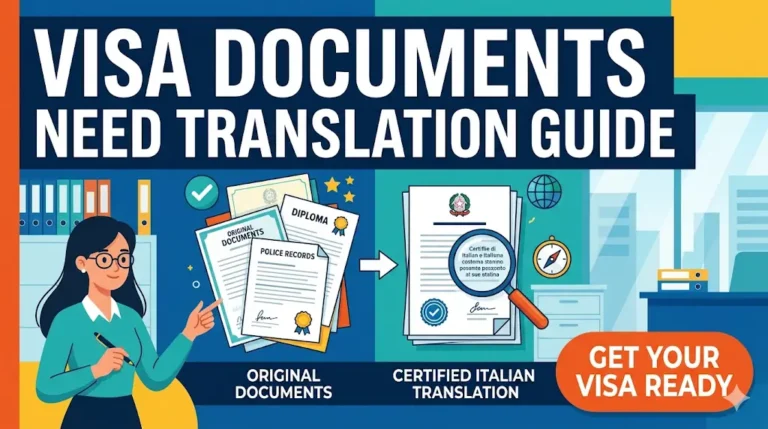
Applying for citizenship requires providing an exhaustive, flawless paper trail of your entire life. You must upload your original birth certificate and criminal background checks from your home country, as well as background checks from any other country where you have lived since turning fourteen.
These foreign documents cannot simply be uploaded in their native language. They must be legally authenticated by your home country (usually via an Apostille) and then perfectly translated into Italian. This is an area with zero margin for error; the Italian authorities will reject an entire citizenship application over a single misspelled name on a translated birth certificate. This is why you must use RushTranslate for your foreign dossier.
By submitting your apostilled background checks and birth records to RushTranslate, you receive certified, sworn Italian translations that are explicitly guaranteed to meet the rigorous legal standards of the Italian Prefettura. Attempting to save money by doing the translations yourself or using an unverified local agency will inevitably result in a rejected application. Relying on RushTranslate ensures your most critical foreign documents pass the government’s intense scrutiny on the very first try.
Proving Financial Solvency and Language Skills
To prove you are integrated, you must pass a B1 level Italian language exam from a recognized CLIQ institution (such as the Dante Alighieri Society, CILS, or CELI). The A2 certificate you used for your permanent residency is no longer sufficient. You must book this exam months in advance, as the grading process alone can take up to ninety days.
Alongside your linguistic skills, you must prove your financial solvency. The state requires your official Italian tax returns (Modello Redditi or 730) for the three years immediately preceding your application. You must demonstrate a minimum yearly income of approximately €8,263 for a single applicant, which increases to over €11,362 if you have a dependent spouse, plus an additional €516 for every dependent child.
If your income dipped below this threshold in year eight or nine because you took a sabbatical or lost your job, your application will be denied, even if you are currently earning a massive salary. If a portion of your income during those three years came from foreign investments or overseas dividends, you must use RushTranslate to provide certified translations of those foreign corporate tax documents. Presenting clear, certified financial translations via RushTranslate guarantees the assessing officer fully understands your global wealth and verifies your financial independence.
| Immigration Phase | Duration Required | Key Requirements | Primary Benefit |
| EU Blue Card | Initial Entry (Years 1-5) | Advanced degree, high-salary job offer | Fast-track entry, bypasses visa quotas |
| Permanent Residency | After 5 Continuous Years | A2 Italian, stable income, clean record | No longer tied to a specific employer |
| Italian Citizenship | After 10 Continuous Years | B1 Italian, 3 years stable tax history | EU Passport, absolute right of abode |
Managing Your Life During the Processing Wait
Hitting submit on the citizenship portal does not end your journey; it merely begins the final, most agonizing waiting period of your expat life.
The Thirty Six Month Black Hole
Under current Italian law, the government has 24 to 36 months to process a citizenship application by naturalization, and they frequently invoke their legal right to extend this to 48 months in complex cases. You will receive a tracking code (known as a K10 or K10C code) and spend the next three years obsessively refreshing a portal that rarely updates.
During this entire three-to-four-year waiting period, you must maintain your continuous Italian residency and your income. You cannot move back to your home country while the application is processing; doing so will result in an immediate denial. You are effectively trapped in a holding pattern.
If you decide to leave your high-stress corporate job to start a consulting business while waiting for your passport, protecting your physical health is paramount. A major medical emergency during a career transition can ruin your financial standing. Keeping your Cigna Global policy active ensures you have unfettered access to elite medical care regardless of your employment status. As outlined in the Cost of Healthcare in Italy: What Expats Need to Know, the public system can be highly unpredictable for freelancers. A robust Cigna Global plan proves to the state that you remain entirely self-sufficient, protecting both your health and your pending citizenship file.
The Citizenship Oath and Ceremony
Eventually, usually when you have completely given up hope, the portal will update. The President of the Republic will sign your decree, and it will be transmitted to your local Comune. You will receive a notification to appear at the town hall to take the Giuramento (Oath of Allegiance).
By law, you must swear the oath within exactly six months of the decree being issued. If you miss this window, your citizenship is revoked, and the entire ten-year process is canceled. On the day you swear the oath, you officially become an Italian citizen. The very next day, you can apply for your Italian passport and return your permanent residency card, completely ending your relationship with the immigration police.
If you have a non-EU spouse or children, their administrative status will also immediately upgrade, but you must register their foreign birth and marriage certificates with the municipality. Utilizing RushTranslate one final time to certify your family’s vital records ensures their transition to the dependents of an Italian citizen is perfectly smooth. Remember that keeping your old documents secure is still vital; reviewing the Consequences of losing your permesso di soggiorno card reminds you how fragile your status was, but holding that burgundy EU passport permanently erases those fears. For expats navigating the Italian visa policy for dual nationals or the remote realities of Italy’s new digital residency pilot for expats, completing the ten-year naturalization journey is the ultimate triumph over the Italian bureaucracy.
References
Primary sources (official)
- Ministero dell’Interno (Ministry of the Interior – Citizenship Portal): https://www.interno.gov.it/it/temi/cittadinanza-e-altri-diritti-civili/cittadinanza
- European Commission (EU Blue Card Italy Guidelines): https://home-affairs.ec.europa.eu/policies/migration-and-asylum/eu-immigration-portal/eu-blue-card/eu-blue-card-italy_en
Other helpful sources
- Consolato Generale d’Italia (Guidelines on Naturalization and Residency): https://conshongkong.esteri.it/en/servizi-consolari-e-visti/servizi-per-il-cittadino-straniero/cittadinanza/la-cittadinanza-italiana-per-residenza-e-naturalizzazione/
- Arletti Partners (Italian Citizenship by Residency Timeline): https://arlettipartners.com/italian-citizenship-by-residency/
Disclaimer
The information provided in this article is for general informational purposes only and does not constitute official legal, immigration, or citizenship advice. Italian nationality laws, processing timelines for naturalization, and the specific income and linguistic requirements mandated by the Ministry of the Interior are highly complex and subject to frequent legislative updates. Always consult with a registered Italian immigration lawyer (avvocato immigrazionista) to evaluate your personal residency history and ensure your application dossier is legally compliant before submitting it to the Italian authorities.