Italy visa requirements for adopting a child
It is utterly heartbreaking to bond with your newly adopted child abroad, only to hit an impenetrable wall of Italian bureaucracy that blocks them from coming home with you. I spent months drowning in paperwork terrors before finally bringing my newly adopted son to Rome. This guide explains how to navigate the Italian adoption visa process, mandatory government authorizations, and the health clearances required to unite your family.
Disclosure: This post may contain affiliate links. We may earn a commission at no extra cost to you if you make a purchase through these links. Read full disclosure.
The Framework of International Adoption in Italy
The Role of the CAI and Authorized Agencies
The most common mistake expats make when adopting internationally is assuming they can simply follow the adoption laws of their home country or the child’s country of origin, and then bring the child to Italy on a standard family visa. If you are a legal resident of Italy, you must strictly follow the Italian international adoption framework.
Italy is a signatory to the Hague Convention on Protection of Children and Co-operation in Respect of Intercountry Adoption. The entire process is strictly governed by a central authority called the Commissione per le Adozioni Internazionali (CAI), which operates directly under the Presidency of the Council of Ministers.
You cannot pursue an independent, private adoption abroad and expect the Italian border police to let the child in. You are legally required to work through an Ente Autorizzato (an Authorized Agency) certified by the CAI. These agencies handle the matchmaking and foreign paperwork. Once the foreign court finalizes the adoption, the CAI must officially review the case and issue a formal authorization (Autorizzazione all’ingresso e alla residenza permanente) allowing the adopted minor to permanently enter and reside in Italy. Without this specific CAI clearance, no Italian consulate in the world will issue an adoption visa.
Understanding the Visto per Adozione
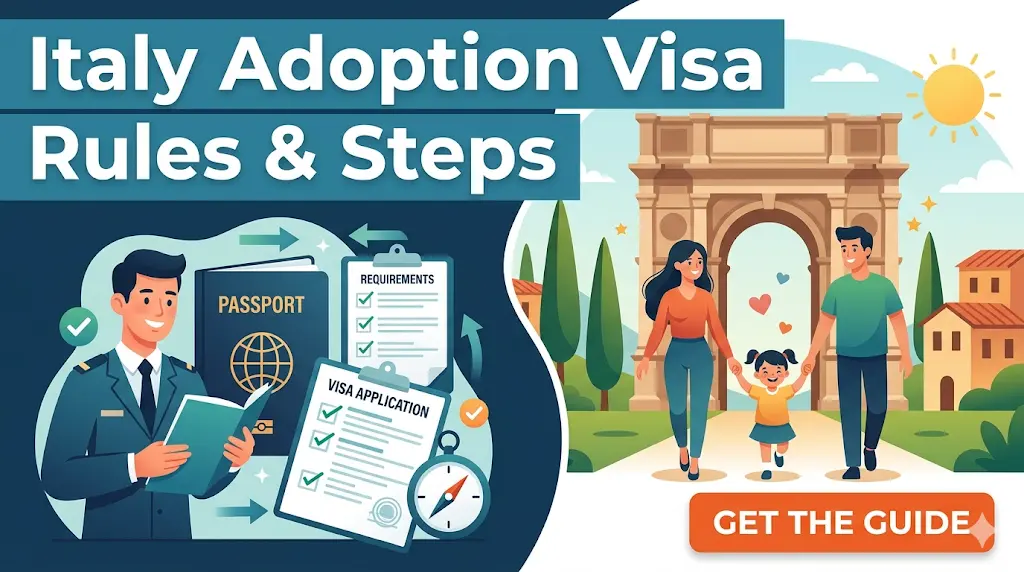
The Visto per Adozione (Adoption Visa) is a highly specialized Type D National Visa. It is designed specifically for foreign minors who have been adopted (or are in the process of pre-adoptive foster care) by Italian citizens or foreign nationals legally residing in Italy.
Unlike standard work or study visas that face strict annual quota limits, the adoption visa is completely exempt from the chaotic quota bottlenecks discussed in Understanding the Decreto Flussi in Italy. The primary obstacle here is not a quota, but rather the flawless alignment of the foreign court decree with Italian family law. The consulate cannot issue the visa until they receive the green light directly from the CAI in Rome. This means the timeline is entirely dependent on how fast the central authorities communicate with the local embassy in the child’s country of origin.
Navigating the Bureaucratic Paperwork
Translating and Legalizing Foreign Decrees
The Italian consulate will demand a massive portfolio of documents before issuing the visa. The absolute core of this portfolio is the foreign adoption decree issued by the judge in the child’s country of origin. Because the Italian government operates strictly in Italian, this dense, legally binding foreign court order is utterly useless if it is not flawlessly translated and legalized (or apostilled).
Getting complex foreign legal judgments translated is a massive bottleneck, which is exactly why you should rely on RushTranslate. By utilizing RushTranslate, you ensure that the consular officer receives certified, legally accurate documents formatted to the Italian government’s exact stringent standards. Do not attempt to translate these sensitive court documents yourself to save a few dollars. A single mistranslated legal term regarding custody can cause the CAI to reject the authorization, leaving your child stranded. Relying on RushTranslate guarantees full compliance with the strict standards of the Italian Ministry of Foreign Affairs. Having your pristine RushTranslate files properly organized is the most effective way to prevent your visa application from being delayed.
Proof of Financial and Housing Suitability
Even with the CAI authorization, the consulate must verify that you are bringing the child into a safe, stable environment. You must prove that your income comfortably supports an expanding family. This involves submitting recent tax returns, translated bank statements, and employment contracts.
Furthermore, you must provide a Certificate of Housing Suitability (Certificato di Idoneità Alloggiativa). This document, issued by your local Italian municipality (Comune) or local health authority (ASL), proves that your apartment meets the minimum square footage and safety standards required for the number of people living there. Securing an apartment that meets these strict parameters is a massive hurdle, and understanding the spatial requirements is a critical factor when Signing an Italian Rental Contract. You must also aggressively calculate the added expenses of child-rearing when formulating your Cost of Living in Italy 2026 Budgeting for Expats.
| Document Required | Purpose | Crucial Detail |
| CAI Authorization | Grants permission for the child to enter Italy. | The consulate cannot proceed without this specific clearance. |
| Foreign Adoption Decree | Proves legal custody. | Must be apostilled/legalized and translated by certified professionals. |
| Idoneità Alloggiativa | Proves safe housing conditions in Italy. | Issued by the Italian Comune; requires physical inspection. |
| Medical Certificate | Clears the child for international travel. | Must be issued by a consulate-approved physician. |
Managing Health and Consular Appointments
Medical Clearance and Interim Insurance
Before the visa can be stamped into the child’s newly issued passport, the child must undergo a thorough medical examination by a physician specifically approved by the Italian consulate. This ensures the child is fit to travel and identifies any pre-existing conditions the Italian health system needs to prepare for.
Here is the terrifying gap most parents do not anticipate: when your child lands in Italy, they are not automatically covered by the state healthcare system. Even if you plan on Registering with the Italian Public Healthcare System SSN immediately, you legally cannot register the child until they physically arrive, establish residency, and obtain their own tax code. During this bureaucratic waiting period, your newly adopted child is completely uninsured.
To protect your child during this vulnerable transition, you must provide private health insurance for their arrival. I highly recommend securing a policy through Cigna Global. Using Cigna Global guarantees that your child is fully covered for sudden illnesses, travel-related emergencies, or routine care while you fight through the slow Italian immigration lines. Furthermore, presenting a robust Cigna Global policy satisfies the strict health requirements of the Italian consular officials when you apply for the visa. With Cigna Global covering your child, you can focus entirely on bonding rather than worrying about catastrophic medical bills, a survival strategy detailed in Healthcare in Italy An Expats Guide.
The Consular Interview and Visa Issuance
Once all documents are translated, the CAI authorization is received, and the medical checks are cleared, you will attend the final consular interview. Depending on the country, the child may need to be present.
The consulate will verify the physical paperwork. As Italy shifts toward a more digitized visa infrastructure, ensuring your uploaded PDFs are perfectly clear and certified is paramount. Understanding how this new digital gateway functions is crucial, a reality discussed in Electronic submission of Italian visa application available. Once approved, the Type D visa is affixed to the child’s passport, finally allowing you to board the flight home.
Post Arrival Bureaucracy in Italy
Registering the Adoption Decree
Securing the visa and landing in Rome or Milan is an incredible victory, but the bureaucracy does not stop at the border. The foreign adoption must be officially recognized and transcribed into the Italian civil registry so the child can be granted their rights (and eventually, Italian citizenship if applicable).
You must present the foreign court decree, the CAI authorization, and the certified translations to the Italian Juvenile Court (Tribunale per i Minorenni). The court validates the adoption and orders the local town hall (Ufficio di Stato Civile) to transcribe the birth and the adoption. This interaction with local municipal clerks is famously exhausting and mirrors the heavy friction found when Navigating Italian Bureaucracy Comune and Prefettura. During this phase, you will also apply for the child’s alphanumeric tax identifier, a foundational step covered in Checking Your Italian Tax Code Codice Fiscale Status.
Upgrading the Permesso di Soggiorno
Under Italian law, any foreigner intending to stay longer than 90 days must apply for a physical residence permit. Within eight days of your child’s arrival in Italy, you must go to the local post office and submit an application for their Permesso di Soggiorno per motivi familiari (Family Motives Residence Permit).
This triggers an appointment at the local police headquarters (Questura). The police will verify the visa and the CAI documentation before printing the physical permit card for the child. Because the child’s legal status is directly tied to yours, you must be meticulous about tracking the expiration dates of all family permits. Managing this ongoing paperwork is a stressful but necessary reality deeply explored in Renewing Your Italian Permesso di Soggiorno. Once this card is in hand, your child is officially a documented resident of Italy, and the grueling bureaucratic nightmare finally ends.
References
Primary sources (official)
- Commissione per le Adozioni Internazionali (CAI) – Official Guidelines – https://www.commissioneadozioni.it/
- Ministero degli Affari Esteri – Visto per Adozione – https://vistoperitalia.esteri.it/home/en
Other helpful sources
- ItaliaAdozioni – Iter dell’Adozione Internazionale – https://www.italiaadozioni.it/
- The Local Italy – How to navigate the adoption process as an expat in Italy – https://www.thelocal.it/
Disclaimer
The information provided in this article is for educational and informational purposes only and does not constitute official legal or immigration advice. International adoptions in Italy are strictly governed by the Hague Convention and the Commissione per le Adozioni Internazionali (CAI). Foreign residents in Italy must utilize a CAI-authorized agency (Ente Autorizzato) to conduct an international adoption; independent adoptions finalized abroad without CAI authorization will not be recognized for a Visto per Adozione. Always consult a registered Italian family law attorney (avvocato familiarista) and your authorized agency before initiating any legal adoption procedures in a foreign country.