Dealing with Strikes in Italy: Transport and Services
Navigating strikes in Italy is an essential skill for expats and visitors alike. This comprehensive guide explains how transport strikes work, details guaranteed minimum service hours, highlights essential tracking tools, and provides actionable strategies to keep your travel plans on track.
Disclosure: This post may contain affiliate links. We may earn a commission at no extra cost to you if you make a purchase through these links. Read full disclosure.
Introduction to Dealing with Strikes in Italy
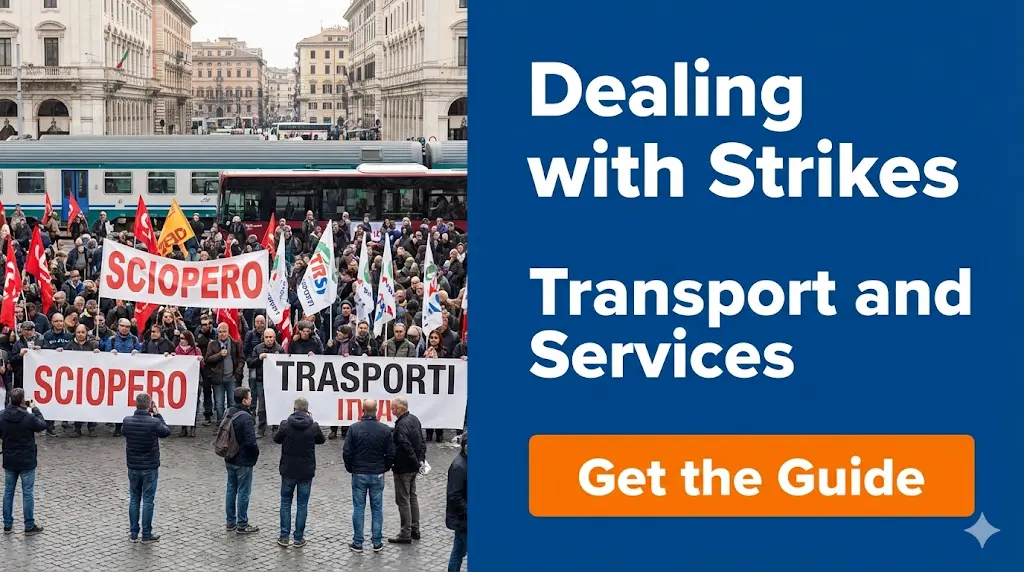
In Italy, a strike—known locally as a sciopero—is not an indicator of societal collapse or a sudden, chaotic emergency. Rather, the right to strike is a fundamental, constitutionally protected pillar of Italian labor rights. Workers across various sectors, particularly within the public transportation networks, utilize coordinated work stoppages to negotiate better wages, improved working conditions, and broader policy changes.
For an expatriate accustomed to continuous, uninterrupted public services, the frequency of Italian strikes can initially be a source of immense frustration and confusion. Transportation strikes can paralyze a city’s metro system, halt high-speed national trains, and ground international flights. However, the saving grace of the Italian strike system is its high degree of regulation and predictability. Strikes are almost never spontaneous; by law, they must be announced well in advance, and essential services must maintain a minimum level of operation to prevent total national shutdown.
Thriving in Italy requires shifting your perspective from one of frustration to one of strategic adaptation. Once you understand the rhythm of the sciopero, learn how to decipher the official government strike calendars, and familiarize yourself with the legally mandated “guaranteed time bands” (fasce di garanzia), these events transform from major crises into minor, manageable inconveniences.
This exhaustive guide is designed to demystify the Italian strike ecosystem. We will thoroughly explore how strikes impact different modes of transportation, from urban buses and regional commuter lines to high-speed rail and aviation. We will provide you with a step-by-step methodology for checking guaranteed train lists, navigating ticket refunds, and utilizing alternative transport methods. By integrating this knowledge into your daily routine, you can confidently navigate the complexities of your new environment. For broader advice on managing your local transit routines, be sure to review our detailed resource on Commuting Options: Trains, Buses, Cars in Italy.
Understanding the ‘Sciopero’: The Culture of Strikes in Italy
To navigate a strike without losing your temper, it helps to understand the cultural and legal framework behind it. In Italy, trade unions (sindacati) hold significant political and social power. When negotiations with employers or the government stall, unions will call a strike.
The primary goal of a transport strike in Italy is not necessarily to inflict suffering on the general public, but rather to cause enough systemic disruption and logistical confusion that the authorities are pressured to return to the negotiating table. The inconvenience experienced by commuters and tourists is, essentially, the leverage the workers use.
Duration and Predictability
Unlike strikes in some other countries that can drag on indefinitely for weeks or months, Italian transport strikes are strictly time-bound. A typical transport sciopero usually lasts for 24 hours, often beginning in the evening (e.g., 9:00 PM on a Thursday) and concluding at the same time the following day. Occasionally, smaller “warning strikes” may only last for four or eight hours.
Crucially, Italian law mandates that strikes affecting essential public services must be announced publicly at least 10 to 15 days in advance. This legal requirement is the expatriate’s greatest advantage. Because the dates and participating unions are published ahead of time, you have the opportunity to proactively alter your travel plans, reschedule important meetings, or secure alternative transportation.
It is also highly common for strikes to be called off or postponed at the very last minute. If the unions reach a tentative agreement with the government the night before the scheduled walkout, the strike will be canceled, and transport services will run perfectly normally. Therefore, monitoring the local news right up until the day of your departure is absolutely essential.
The Golden Rule: Fasce di Garanzia (Guaranteed Minimum Services)
The single most important concept an expat must learn regarding Italian strikes is the fasce di garanzia, or the guaranteed minimum transport services.
Recognizing that a complete and total shutdown of the country’s infrastructure would be catastrophic for public safety and the economy, the Italian Commission responsible for implementing strike laws mandates that certain essential transport services must run, regardless of the strike.
Regional Trains and Local Transit
For regional commuter trains (treni regionali) and local urban public transport (such as city buses, trams, and metro lines), the law protects the peak rush-hour commuting windows.
During a weekday strike, these services are legally guaranteed to operate during two specific time bands:
- Morning Commute: From 6:00 AM to 9:00 AM.
- Evening Commute: From 6:00 PM to 9:00 PM (18:00 to 21:00).
If you are standing on a train platform waiting for a regional train scheduled to depart at 7:30 AM on a strike day, that train will run. However, the moment the clock strikes 9:01 AM, the guarantees vanish. Any train or bus scheduled outside of those protected windows is highly vulnerable to cancellation. It is important to note that these specific time bands apply strictly to weekdays (Monday through Saturday); if a local transport strike falls on a Sunday or a public holiday, the guaranteed commuter bands may not apply.
High-Speed and Long-Distance Trains
High-speed rail operators, specifically the state-owned Trenitalia (operating the Frecce network) and the private operator Italo Treno, handle strikes differently than the regional commuter lines.
Because these trains travel across the entire country, they do not rely on the 6:00 AM to 9:00 AM rush hour rule. Instead, both companies maintain a specific, published list of guaranteed long-distance trains (Treni Garantiti). If the specific train number printed on your ticket (e.g., FR 9642) appears on this official guaranteed list, your train will run, even if the rest of the rail network is completely paralyzed.
How Strikes Impact Specific Transport Sectors
Strikes in Italy are usually sector-specific, though large-scale “General Strikes” (sciopero generale) can occasionally encompass multiple sectors simultaneously. Understanding the nuances of each sector will help you assess your risk.
The National Railway Network (Trenitalia, Italo, Trenord)
Rail strikes are the most common and disruptive form of industrial action for travelers. When railway staff, train conductors, or track maintenance workers strike, it ripples across the entire peninsula.
- If you are already in transit: If a strike officially begins while you are already sitting on a moving train, Italian law provides a buffer. Trains that are already traveling when the strike starts will normally reach their final destination, provided that the destination can be reached within one hour from the beginning of the strike. If the destination is more than an hour away, the train may terminate at the next major station. In this scenario, the rail company staff are required to assist you with alternative connections to your final destination.
- Third-Party Sellers: If you booked your train ticket through a third-party aggregator rather than directly through Trenitalia or Italo, dealing with a strike cancellation is significantly harder. Station staff cannot easily rebook or refund third-party tickets. It is always recommended to book directly with the operators.
Urban Public Transport (Buses, Metro, Trams)
City-specific strikes are organized by the local municipal transport authorities, such as ATAC in Rome or ATM in Milan. These strikes directly affect the metro lines, city buses, and tram networks.
During an urban transit strike outside of the guaranteed commuting hours, the metro stations will physically close, and metal grates will be pulled down over the entrances. City buses will either not leave the depot or will finish their current route and return to base. If you rely on local transit for your daily routine, you should familiarize yourself with your city’s specific transit authority website, where they will post live updates regarding which specific metro lines are operating and which are closed. For a deeper dive into municipal transit networks, review our guide on Public Transportation in Italian Cities: A Guide.
Aviation and Airports
Airport strikes can involve baggage handlers, security personnel, or the air traffic controllers (ENAV). Additionally, specific airlines (like ITA Airways or easyJet) may face strikes from their own flight attendants or pilots.
Similar to the railways, the Italian aviation sector operates with protected time windows. By law, flights scheduled to depart between 7:00 AM and 10:00 AM, and between 6:00 PM and 9:00 PM (18:00 to 21:00), are generally protected from cancellation. Flights scheduled during the massive midday block (10:00 AM to 6:00 PM) face an incredibly high risk of mass cancellation.
If an aviation strike is announced, airlines will proactively cancel flights days in advance and email affected passengers with rebooking options or refund offers.
Non-Transport Services Affected by Strikes
While transport strikes capture the most headlines, expatriates must also be prepared for industrial action in other sectors of Italian civil life. If you are interacting with the government, you should be aware of how these walkouts impact your bureaucracy. For an overview of standard municipal interactions, read Navigating Italian Bureaucracy: Comune and Prefettura.
- Healthcare: Doctors, nurses, and hospital staff occasionally strike to protest working conditions. During a healthcare strike, all elective surgeries, routine check-ups, and non-urgent outpatient appointments will be canceled and rescheduled. However, emergency rooms (Pronto Soccorso) and urgent life-saving medical care are legally mandated to remain fully operational 24/7.
- Education: Teachers and university professors frequently strike. If your children attend an Italian public school, you may receive a notice that the school will be closed or operating with minimal staff on a specific day.
- Public Services and Bureaucracy: Employees at the Comune (Town Hall), the Agenzia delle Entrate (Revenue Agency), and Poste Italiane (the postal service) may strike. If you have an appointment to renew your residency permit or mail a vital document, you will arrive to find the office doors locked.
- Cultural Sites: Personnel at state-run museums, archaeological parks (like the Colosseum or Pompeii), and galleries may participate in strikes, leading to sudden closures and the cancellation of pre-booked tours.
How to Track Upcoming Strikes in Italy
The key to surviving Italian strikes is proactive monitoring. You do not need to be caught off guard if you know where to look.
The Ministry of Transport Strike Portal
The absolute best and most authoritative resource is the official website of the Commissione di Garanzia Sciopero (Strike Guarantee Commission), operated under the Ministry of Transport (scioperi.mit.gov.it).
This government portal publishes a comprehensive, highly detailed calendar of every legally approved strike in the country. You can filter the database by date, transport sector (e.g., Trasporto Aereo for flights, Trasporto Ferroviario for trains), and region. Because the site is exclusively in Italian, you will need to use your web browser’s built-in translation feature.
Transport Authority Websites and Apps
If you have upcoming travel booked, you must monitor the specific operator’s website.
- For Trenitalia, visit their dedicated “In Case of Strike” (In caso di sciopero) page to download the latest PDF list of Treni Garantiti.
- Download the official mobile applications for your local city transit (e.g., the ATAC app in Rome or the ATM app in Milan). These apps provide real-time service updates and will issue push notifications if a metro line shuts down due to a sudden strike escalation.
Actionable Survival Guide: What to Do When a Strike is Announced
If you discover that a strike is scheduled to occur on a day you must travel or commute, do not panic. Follow this step-by-step strategy to minimize the disruption.
Step 1: Verify the Impact
First, determine exactly who is striking and when. Is it a national rail strike, or just a local bus strike in Florence? Does the strike timeline overlap with your scheduled departure? Check your specific train or flight number against the operator’s guaranteed list. If your transport number is on the list, or if your regional train departs precisely at 7:00 AM during the guaranteed window, you can proceed with your plans normally.
Step 2: Rebook Proactively
If your train or flight is not on the guaranteed list, assume it will be canceled. Do not show up at the train station hoping for a miracle; the ticket counters will be overwhelmed with hundreds of confused travelers.
Log into your booking portal immediately. Train companies and airlines allow you to change your ticket free of charge to a different, non-impacted train on the same day, or alter your travel to the day before or the day after the strike. Rebooking early is critical, as seats on the few guaranteed trains will sell out almost instantly once a strike is confirmed.
Step 3: Secure Alternative Transportation
If rebooking is not an option and you absolutely must reach your destination, you must pivot to alternative modes of transport.
- Intercity Coaches: If the trains are striking, book a ticket on a private long-distance bus service like FlixBus or Itabus. These private companies are rarely affected by state railway strikes.
- Taxis and Ride-Shares: If the local metro is down, taxis are your primary lifeline. However, be acutely aware that demand for taxis will surge astronomically during a transit strike. Wait times at taxi ranks will be long, and ride-hailing apps like Uber Black (which operates in major Italian cities) will likely implement severe surge pricing.
- Car Rentals and Car Sharing: Consider renting a car for the day or utilizing short-term urban car-sharing services like Enjoy or Share Now.
Step 4: Claim Your Refund
If your transport is canceled due to a strike and you choose not to travel, you are legally entitled to a full refund of your ticket price. For trains, you can request this cancellation and refund directly at the station counter or, much more conveniently, process it online through the Trenitalia or Italo customer service portals. Be aware that you must usually request the refund before the actual strike event begins or within a specific timeframe afterward. While the processing time can take several weeks, the operators are legally bound to return your money.
Essential Italian Vocabulary for Strike Days
To navigate the train stations and news reports effectively, you should familiarize yourself with these key Italian terms:
- Sciopero (shee-oh-peh-roh): Strike.
- Sciopero Generale: General strike affecting multiple sectors.
- Fasce di Garanzia: Guaranteed time bands (minimum service hours).
- Treni Garantiti: Guaranteed trains.
- Cancellato / Soppresso: Canceled. (Look for soppresso on the digital departure boards).
- Ritardo: Delayed.
- Sindacato: Trade union.
- Rimborso: Refund.
Table: Quick Reference Guide to Italian Transport Strikes
Use this table as a quick-reference checklist when a strike is announced to determine your risk and legal protections.
| Transport Sector | Scope of Impact | Guaranteed Services (By Law) | Recommended Action |
| Regional Trains & Local City Transit | Local commuting, suburbs to city center. | Yes. Usually 6:00 AM to 9:00 AM, and 6:00 PM to 9:00 PM (Weekdays only). | Travel strictly within the morning or evening time bands. |
| High-Speed & Long-Distance Rail | Cross-country travel (Trenitalia Frecce, Italo). | Yes. A specific, published list of train numbers must run. | Verify your exact train number on the operator’s Treni Garantiti PDF. |
| Aviation / Flights | National and International flights. | Yes. Flights between 7:00-10:00 AM and 6:00-9:00 PM are protected. | Rebook flights falling in the midday unprotected window. |
| Taxis & Private Transport | Urban mobility. | No. Taxis may strike independently, or surge in demand during metro strikes. | Keep cash handy and anticipate extreme wait times. |
Conclusion
Encountering a sciopero is an undeniable rite of passage for anyone relocating to or spending significant time in Italy. While the immediate reaction to canceled trains and locked metro stations is understandably one of frustration, it is essential to reframe your perspective. The Italian strike system is highly structured, deeply rooted in the nation’s labor culture, and, most importantly, highly predictable due to mandatory advance notice laws.
By taking a proactive approach—bookmarking the Ministry of Transport’s strike calendar, downloading the necessary mobile transit apps, and memorizing the crucial fasce di garanzia commuting windows—you insulate yourself from the chaos. When the digital departure boards flash red, the seasoned expatriate does not panic. They simply check their guaranteed train list, request their digital refund, and perhaps use the unexpected downtime to enjoy an extra cappuccino at a local cafe. By mastering the mechanics of the Italian strike, you reclaim control of your schedule and seamlessly integrate into the true rhythm of Italian daily life.
References
Primary sources (official)
- Ministero delle Infrastrutture e dei Trasporti (Commissione di Garanzia Sciopero) – The official Italian government portal detailing all legally sanctioned upcoming strikes across all sectors: https://scioperi.mit.gov.it/mit2/public/scioperi
- Trenitalia – Official guidelines on passenger rights in case of a strike, including the list of guaranteed minimum services (Treni Garantiti): https://www.trenitalia.com/it/informazioni/treni-garantiti-incasodisciopero.html
Other helpful sources
- Italy Beyond the Obvious – A Traveler’s Guide to Strikes in Italy (Insights on guaranteed hours and the cultural acceptance of arrangiarsi): https://italybeyondtheobvious.com/travelers-guide-strikes-italy/
- From Home to Rome – How to navigate a strike in Rome and in Italy (Advice on flexible ticketing, taxi demand, and refund procedures): https://www.fromhometorome.com/how-to-navigate-a-strike-in-rome-and-in-italy/
Disclaimer
The information provided in this article is for educational and informational purposes only and does not constitute official legal, travel, or financial advice. Italian labor laws, strike regulations, and guaranteed transport time bands (fasce di garanzia) are subject to change based on government negotiations and union agreements. Always verify current strike schedules, specific transport cancellations, and refund eligibility directly with the official transport operators (e.g., Trenitalia, Italo, local transit authorities) or the Italian Ministry of Transport prior to making travel arrangements.