Excess Baggage vs Air Freight vs Courier: Sending 50-200kg to Italy
Picture yourself at check-in with four bulging suitcases, a bike box and a guitar, while the agent calmly totals up a fee higher than your first month’s rent in Bologna. Sending 50 to 200kg to Italy is an awkward middle weight: too much for normal luggage, too little for a removal van. This guide compares excess baggage, air freight and courier options so you can choose sensibly and avoid that moment at the desk.
Disclosure: This post may contain affiliate links. We may earn a commission at no extra cost to you if you make a purchase through these links. Read full disclosure.
Why the 50 to 200kg Band Is the Most Awkward Weight to Move to Italy
When I moved, the furniture was the easy part. I sold it. The hard part was everything in between: winter coats, work files, kitchen knives I was attached to, a box of books, a decent monitor, and the hiking boots I knew I’d want in the Apennines. Together that came to roughly 140kg. It was too much for my airline allowance and far too little for a removal company to bother sending a truck. Many people moving to Italy end up in exactly this spot, and very few services are designed for it.
The problem is structural. Airlines price luggage for travellers carrying a week’s clothes. Removal companies price by cubic metre and assume a household. Couriers price by the parcel and assume a shoebox or a laptop. Your 50 to 200kg falls into the gaps between these three models. Each one will take your stuff, but each one charges you for the parts of its model that don’t fit your shipment.
What 50, 100 and 200kg Actually Look Like
Before comparing methods, it helps to know what you’re actually sending, because weight and size don’t match the way your intuition suggests. A standard medium moving box packed with books can weigh as much as a fully loaded large suitcase. A box of bedding the same size might weigh a fraction of that.
As a rough mental model:
- Around 50kg is two or three well-packed suitcases plus a carry-on. This is the typical “student semester plus a few extras” load.
- Around 100kg is four or five suitcases, or six to eight medium boxes of mixed belongings. Think of a single professional bringing a full wardrobe across all seasons, some kitchen items, a few books and personal electronics.
- Around 200kg is roughly ten to fifteen boxes, or a small mix of boxes, a bicycle and perhaps a compact piece of furniture such as a bedside table or an office chair. It starts to look like the contents of a small studio.
These weights matter because all three methods use stepped pricing. One extra kilogram can push you into the next bracket, and the jump between brackets is often steep. When I weighed everything on a bathroom scale before calling anyone, I found two boxes of old paperwork I could scan and throw away. That cut my total by a meaningful amount, and the savings applied whichever method I chose.
Actual Weight vs Volumetric Weight
Most people get caught out here. Air freight and courier companies don’t only charge for what your shipment weighs. They also calculate a “volumetric” or “dimensional” weight based on the size of each package, then bill you for whichever figure is higher. An aircraft hold full of light but bulky duvets earns the airline as little as a half-empty hold, so the pricing protects them against bulky, light cargo.
In practice, this means a large box of pillows and winter jackets might be billed as if it were much heavier than the scale says. A dense box of books, on the other hand, is usually billed on its real weight. The calculation divides length times width times height by a fixed number that each carrier sets, and that number varies between companies and services. Always ask which one applies before you pack.
The practical lesson is simple. Pack dense items such as books, tools and kitchenware into smaller, heavier boxes. Use vacuum bags for soft items, or carry them in suitcases as checked baggage, where airlines generally charge by piece and weight rather than volume. If you mix light and dense items carefully, you can lower the billable weight of a courier or air freight shipment without leaving anything behind.
The Customs Question Hiding Behind Every Option
Whichever method you choose, the second big variable is where you’re shipping from. If your belongings start in another EU country, such as Germany, France, Spain or the Netherlands, there’s generally no customs clearance for used personal effects moving within the single market. If you’re shipping from the UK, the US, Canada, Australia, Switzerland or anywhere else outside the EU, your goods cross a customs border. Someone has to declare them, and you may face duties and IVA unless you qualify for an exemption.
The difference is large enough that it often decides the method for you. Our guide EU vs Non-EU Moves to Italy: Why Customs Treats Them Completely Differently explains the split in detail. The short version: for non-EU origins, the cost of shipping matters less than whether your goods are declared correctly as used personal effects.
If you’re establishing residence in Italy, you may be able to bring personal belongings in duty-free under the transfer-of-residence relief. That relief comes with documentation requirements and conditions, including how long you’ve owned and used the items. The whole process is covered in Trasferimento di Residenza: The Italian Duty Exemption for Personal Effects, and it applies to air freight and courier shipments as much as to full containers.
Excess Baggage, Air Freight and Courier Compared
Here’s how each option works in real life, with the parts the sales pages don’t mention.
Excess Baggage: Your Belongings Fly With You
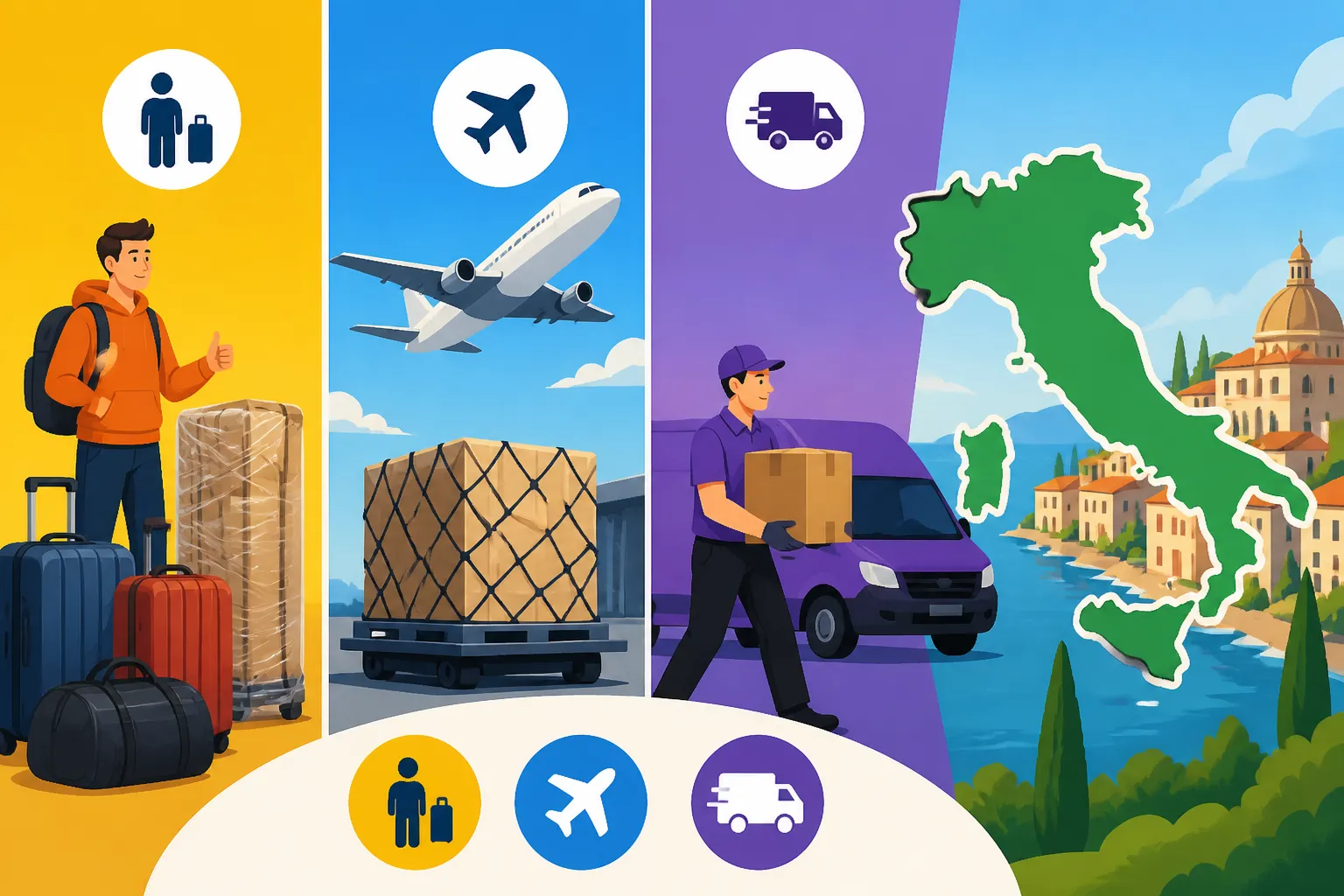
Excess baggage means paying your airline to check extra bags, or heavier bags, on the same flight you take. It’s the simplest option by far. There’s no separate booking, no tracking number and no waiting. Your things come off the carousel at Milano Malpensa, Roma Fiumicino or Napoli Capodichino and leave with you in the taxi.
The cost structure is where you need to pay attention. Airlines usually charge per additional piece, with separate surcharges for overweight bags and oversized items. These are often tiered, so a bag just over the standard limit costs much less than one approaching the maximum the airline will accept. Most carriers have a hard per-piece maximum set for baggage handler safety, and above that they won’t take the bag at any price. Many also cap how many extra pieces you can check. Prices are almost always lower when you prepay online than when you pay at the airport desk, sometimes dramatically so. Check your airline’s own baggage page for the current figures on your route and fare class.
Excess baggage works best at the lower end of our range, roughly 50 to 80kg. It’s ideal for anything you need in your first fortnight: clothes, toiletries, work laptop, documents, medication. It gets harder past that point. Getting six heavy suitcases through Fiumicino, onto the Leonardo Express or into a taxi, and then up four flights of stairs in a Trastevere palazzo with no lift is an experience I’d rather not repeat. There’s also the connection risk: more pieces on a multi-leg itinerary means more chances one of them ends up in Frankfurt for three days.
A note for non-EU arrivals: what’s in your suitcase still counts as goods entering the EU. Used personal clothing and effects for your own use are generally treated very differently from new goods or anything that looks commercial. If you’re carrying several boxes of brand-new items with tags still attached, expect questions at the red and green channels.
Air Freight as Unaccompanied Baggage
Air freight for personal moves is usually sold as “unaccompanied baggage.” Your belongings travel as cargo, booked through a freight forwarder or an international removal company, on a cargo flight or in the hold of a passenger flight, separate from you. It suits people who need their things within a week or two of arrival but have too much to carry.
The pricing model is very different from excess baggage. Forwarders charge per chargeable kilogram, using the higher of actual or volumetric weight, plus a set of fixed charges: airport handling, terminal fees, documentation, security screening and, for non-EU origins, customs clearance at the Italian end. Most also apply a minimum charge. As a result, air freight is often poor value at the bottom of the 50 to 200kg range and becomes much better value as you approach the top. The fixed costs are spread over more kilograms.
You also need to choose between airport-to-airport and door-to-door service. Airport-to-airport sounds cheaper, but someone still has to clear the goods and collect them from a cargo terminal. At Malpensa or Fiumicino, the cargo area is nowhere near the passenger terminals and you’ll need a vehicle large enough for your boxes. You may also be asked to present your passport, proof of residence or a residence application, your codice fiscale and an inventory. Door-to-door service, where the forwarder or mover handles clearance and delivery, costs more on paper but removes a stressful day of Italian bureaucracy in a language you may not yet speak confidently.
Timing matters too. Customs at the Italian end may want you physically in the country before releasing personal effects, so many people book unaccompanied baggage to arrive shortly after they do. If you’re spending your first weeks in temporary accommodation, plan where the shipment will be delivered. Bridge Accommodation: Where to Stay Between Landing and Getting Keys covers that interim period and how to choose an address that can actually accept a delivery.
Courier and Luggage Shipping Services
The courier route means sending your belongings as express parcels through networks such as DHL, UPS, FedEx or the international services that connect with Poste Italiane. There are also luggage-shipping services that collect suitcases and boxes from your door and route them through those same courier networks.
Couriers are excellent for small, dense, well-packed consignments. They pick up from your home and deliver to your Italian address, with tracking the whole way. For a handful of boxes, they’re often quicker than air freight, and you avoid cargo terminals. The catch is the parcel model itself. Each box is priced individually, each one has its own maximum weight and dimensions, and volumetric pricing applies to each piece. Ten boxes means ten consignments’ worth of charges. Past a certain point, the total grows faster than with an air freight shipment billed as a single consolidated load.
For non-EU origins, couriers act as customs brokers. That’s convenient, but it’s also where surprises appear. Unless you’ve paid duties in advance, the courier will often contact the recipient in Italy before delivery to collect any IVA, duties and their own clearance fee. If the shipment’s paperwork describes your goods vaguely, or gives a declared value that looks like a purchase rather than used personal effects, you may be taxed on things you’ve owned for years. Writing “used personal effects, not for resale” with a sensible item-by-item breakdown makes a real difference. If you’re shipping from the US in particular, Sending Packages from the US to Italy: Best Practices has more detail on how the paperwork tends to play out.
Couriers also enforce strict restrictions on lithium batteries, aerosols, perfumes, alcohol, knives and anything liquid. Check before you pack, not at the pickup counter. Prohibited and Restricted Items in a Move to Italy: What Gets Seized goes through what’s banned outright and what needs special handling.
Side-by-Side Comparison
| Factor | Excess Baggage | Air Freight Unaccompanied Baggage | Courier or Luggage Shipping |
|---|---|---|---|
| Best weight range | Lower end, roughly 50 to 80kg | Mid to upper end, roughly 100 to 200kg | Small dense loads, roughly 50 to 120kg |
| How it is priced | Per extra piece plus overweight and oversize surcharges | Per chargeable kilogram plus fixed handling, documentation and clearance charges, usually with a minimum | Per parcel by weight bracket and volumetric size |
| Arrival timing | Same flight as you | Typically days to a couple of weeks after you, depending on route and clearance | Typically days, depending on service level |
| Door collection | No, you take it to the airport | Usually available as an add-on | Yes, standard |
| Door delivery in Italy | No, you carry it home | Available on door-to-door service | Yes, standard |
| Customs for non-EU origins | Handled at arrival channels as passenger baggage | Formal clearance, often needs you present in Italy with documents | Courier acts as broker, recipient may be billed before delivery |
| Volumetric pricing risk | Low, mostly piece and weight based | High for bulky light items | High per box |
| Main risk | Hard per-piece limits and carrying everything yourself | Cargo terminal collection if not door-to-door | Duties and fees billed on arrival, strict restricted-items rules |
Matching the Method to Your Situation
Methods only make sense in context. Here are three situations I see over and over, each with a different answer, and one case where none of the three is the right choice.
Scenario One: The Student With Three Boxes
Mia is starting a master’s degree at the University of Bologna. She’s flying from Dublin with about 60kg: clothes for every season, a laptop, a stack of course books and a few kitchen basics. She has a room lined up in a shared flat near Via Zamboni, she’s on a tight budget and she won’t need everything on day one.
For Mia, the answer is almost always excess baggage for the essentials plus one or two courier boxes for the books. Clothes go in suitcases, where volumetric weight doesn’t apply. The books go in small, dense boxes that are billed on actual weight. Since Ireland is in the EU, the courier boxes don’t need customs clearance, so there are no surprise IVA charges when they reach Bologna. What she should not do is pay a removal company’s minimum fee for a load this small.
If you’re in a similar position, Student Moves to Italy: Shipping on an Erasmus or Language School Budget goes deeper into budget tactics. These include sharing a consolidated shipment with classmates, which can make air freight or groupage viable where it wouldn’t be for one person.
Scenario Two: The Remote Worker Moving to Milan From the US
Daniel works remotely for a company in Chicago and is moving to Milan’s Porta Romana area on a long-stay visa. He has about 120kg: clothes, a professional monitor and a desktop setup, a road bike, a box of kitchen equipment and some framed photographs. He’ll arrive two weeks before his rental starts and stay in a residence hotel near Lodi TIBB in the meantime.
Daniel needs the most care, for three reasons: his load sits in the middle of our range, his goods come from outside the EU, and his things include electronics and a bike. Excess baggage on its own would mean six or seven heavy pieces plus a bike box on a transatlantic itinerary, and many airlines restrict the number of extra pieces anyway. Couriering 120kg from the US means many separate boxes, each billed with volumetric weight, each cleared through customs, and possibly a bill for duties when they reach his door unless the paperwork is right.
The sensible plan is a hybrid. Two suitcases of everyday essentials travel as checked baggage. The remaining roughly 100kg, including the bike and the monitor, goes as door-to-door unaccompanied air freight, timed to arrive after his lease begins. Door-to-door delivery means the forwarder handles clearance under the transfer-of-residence relief if he qualifies, and nobody has to drive to Malpensa’s cargo area in a rented van. His desktop and monitor should be checked for European voltage and plug compatibility before he pays to ship them. That’s a topic in itself, and Shipping Electronics to Italy: Warranty, Voltage, and CE Marks walks through it.
The way Daniel finds that forwarder is the most important step, which I’ll come to below. Getting several quotes is where most of the savings come from.
Scenario Three: The Couple With 200kg Heading to a Village in Sicily
Ruth and Graham are retiring from Manchester to a restored house outside Noto. They’ve sold most of their furniture but are keeping about 200kg: books, artwork, a sewing machine, linens, two bicycles and some tools. They’re in no hurry because the renovation won’t finish for two months.
At 200kg, from a non-EU origin since the UK left the EU, to a rural address in southern Sicily, excess baggage is out of the question and couriers would be very expensive given the number of boxes. Air freight is possible, but it would fly into Catania and still need a road delivery inland. What actually works for them is often none of the three. It’s a part load, also called groupage, with an international mover. Their belongings share space in a truck or container with other customers’ goods and are delivered by road to the door. It’s slower, but they have time. Movers who do this regularly also understand UK-to-Italy export and import paperwork.
The economics of sharing space versus booking your own vehicle are covered in Full Load vs Groupage to Italy: Cost Break-Even by Cubic Metre. For the overall cost picture by origin and volume, International Move to Italy: Full Shipping Price Breakdown by Volume and Origin sets out how these quotes are typically built.
When Road Groupage Beats All Three
Ruth and Graham’s case points to a wider rule. If you’re shipping from elsewhere in Europe, especially somewhere connected to Italy by good road links such as Germany, Austria, France, Switzerland or the Benelux countries, and you’re near the top of our weight range, a small groupage consignment with a removal company is often the quietest and most predictable option. There’s no volumetric surprise per box, no lugging suitcases through Milano Centrale, and for intra-EU moves, no customs at all.
The trade-off is time. Groupage only leaves when the truck is full enough to make the trip worthwhile, so collection and delivery windows can be flexible. If you need your belongings next week, it’s the wrong choice. If you can wait, it’s often the gentlest on your budget and your nerves.
How to Get Accurate Quotes and Ship Without Surprises
Your choice of method matters less than how well you compare providers. A 120kg shipment quoted by three different companies can come back with very different numbers. They might all use the same airline, but they apply different minimums, different volumetric divisors and different handling charges, or one includes delivery to your door and another doesn’t. This is where I’d point you to Sirelo.
Step-by-Step: Using Sirelo to Compare Small-Move Quotes
Sirelo is a comparison platform for removal companies. You describe your move once and receive quotes from several international movers, then compare them with the help of reviews from people who’ve used those companies. For our awkward 50 to 200kg range, its biggest value is this: you don’t need to cold-call a dozen companies to find out which ones actually handle small consignments to Italy. The movers that respond to a small-move request are, almost by definition, the ones interested in your size of job. Many of them offer exactly the services this guide is about, including unaccompanied air baggage, part loads, groupage and small-volume door-to-door moves.
Here’s how I’d use it:
- Weigh and measure everything first. Use a bathroom scale for suitcases and boxes, and note each box’s dimensions. This lets movers quote properly instead of guessing, and lets you check their volumetric calculations.
- Submit your move details on Sirelo, including the origin, your Italian destination city or comune, the approximate weight and volume, and any special items such as a bike, a monitor or artwork. Mention whether your destination is a historic centre or a rural address, because that affects delivery.
- Specify the service level you need. Say clearly whether you want door-to-door or are willing to collect from a port or airport. Also state whether your move is from inside or outside the EU and whether you intend to claim the transfer-of-residence relief.
- Compare the quotes line by line, not just the totals. Check whether customs clearance, Italian delivery, stair carry, packing materials and insurance are included or extra. Our guide Comparing International Removal Quotes for Italy: Line Items That Hide Costs lists what to look for.
- Read the reviews on Sirelo for each shortlisted mover, paying particular attention to reviews from small moves and Italian destinations. A company that’s excellent at full containers may be indifferent to a 100kg part load.
- Ask follow-up questions before booking. Which volumetric divisor do they use? What’s the minimum charge? Who handles Italian customs? What happens if delivery to your street needs a ZTL permit?
- Book, then confirm the timeline against your Italian address. Make sure the delivery date falls after you can legally receive goods at your rental or your temporary accommodation.
What I like about this approach is that it covers all three options in this guide. Before I knew Sirelo existed, I collected one courier quote, one airline excess baggage price and one removal company quote. I had no idea whether any of them were fair. With several mover quotes side by side, I could see that the air freight option was competitive with couriers once door delivery was included, and that a groupage quote beat both for the bulkier items I didn’t need right away. Always check each provider’s own quote for current pricing, since rates depend on route, season and fuel costs.
Packing, Paperwork and Labelling
Whichever method wins, the same discipline pays off:
- Pack dense items in small boxes and light items in suitcases or vacuum bags to keep billable weight close to actual weight.
- Use double-walled boxes and tape every seam. Courier and freight handling is rougher than you’d like.
- Label every box with your name, your Italian address and a phone number with the Italian country code, plus a box number such as “4 of 9.”
- Write an itemised inventory in English and, if you can, Italian, describing contents as used personal effects with a realistic value for each line.
- Keep copies of your passport, visa or residence documents, codice fiscale and lease or accommodation proof in your carry-on. Customs and forwarders may ask for them.
- Carry medication, important documents, jewellery and anything irreplaceable with you rather than in the shipment.
Insurance deserves its own consideration. Standard carrier liability is often limited and based on weight rather than replacement value, which is little comfort if a box of framed prints arrives smashed. Moving Insurance for Shipments to Italy: Coverage, Valuation, and Claims explains how valuation and claims work. When you compare movers on Sirelo, ask each one what cover is included and what top-up options exist.
| Document or Item | Why You Need It | Applies To |
|---|---|---|
| Passport or ID copy | Identifies the owner for customs and collection | All methods, especially non-EU origins |
| Itemised inventory | Supports declaration as used personal effects | Air freight and courier, recommended for baggage too |
| Codice fiscale | Often requested by Italian forwarders and for customs paperwork | Air freight and courier from non-EU origins |
| Proof of Italian address or residence application | Supports transfer-of-residence relief and delivery | Air freight and groupage, sometimes courier |
| Visa or residence permit documentation | Shows the purpose and permanence of your move | Non-EU origins claiming duty relief |
| Booking confirmation and tracking numbers | Proves the shipment exists if anything goes missing | All methods |
Delivery and Collection in Italy
The final kilometre is where Italian moves get colourful. Many historic centres, including Florence, Rome, Bologna and Naples, as well as countless smaller towns, sit inside a ZTL, a limited traffic zone where unauthorised vehicles are fined automatically by camera. Courier vans are usually authorised. A freight delivery truck may need a permit or may only be able to stop at the edge of the zone, leaving the driver to trolley your boxes the rest of the way. Older buildings often have no lift, or a lift that holds two people and a single box. Rural addresses in Sicily, Puglia or the Tuscan hills can involve unpaved roads that a large truck simply won’t attempt.
Tell your provider about these details up front, and confirm whether stair carry is included. Delivery Day in an Italian Building: Narrow Streets, Lifts, and Permits covers the practicalities in more depth, including how to arrange a temporary parking permit where one is needed.
One more tip from experience: put your surname on the citofono, the intercom panel by the street door, and on your mailbox before any delivery is due. Italian couriers and drivers rely on these, and a missing name is the most common reason a delivery attempt fails and turns into a trip to a depot on the outskirts of town. If your building has a portiere, a concierge or doorkeeper, introduce yourself and let them know a delivery is coming. A good portiere is worth more than any tracking app.
Final Recommendation
If you’re carrying 50 to 80kg of things you need right away, prepay excess baggage online and keep it simple. If you have a dense handful of boxes from within the EU, a courier is often the smoothest choice. Once you move past roughly 100kg, especially from outside the EU or with bulky items like bikes and monitors, door-to-door air freight or a small groupage consignment through an international mover usually gives the best mix of cost, convenience and peace of mind.
The surest way to know which applies to your move is to compare real quotes from movers who handle small consignments to Italy. Sirelo lets you do that in one go, so describe your 50 to 200kg load, collect your quotes and choose with the numbers in front of you.
Disclaimer
This article is for general informational purposes only and does not constitute professional advice. Laws, prices and regulations vary by location and change over time. Consult a qualified professional for guidance on your specific situation.