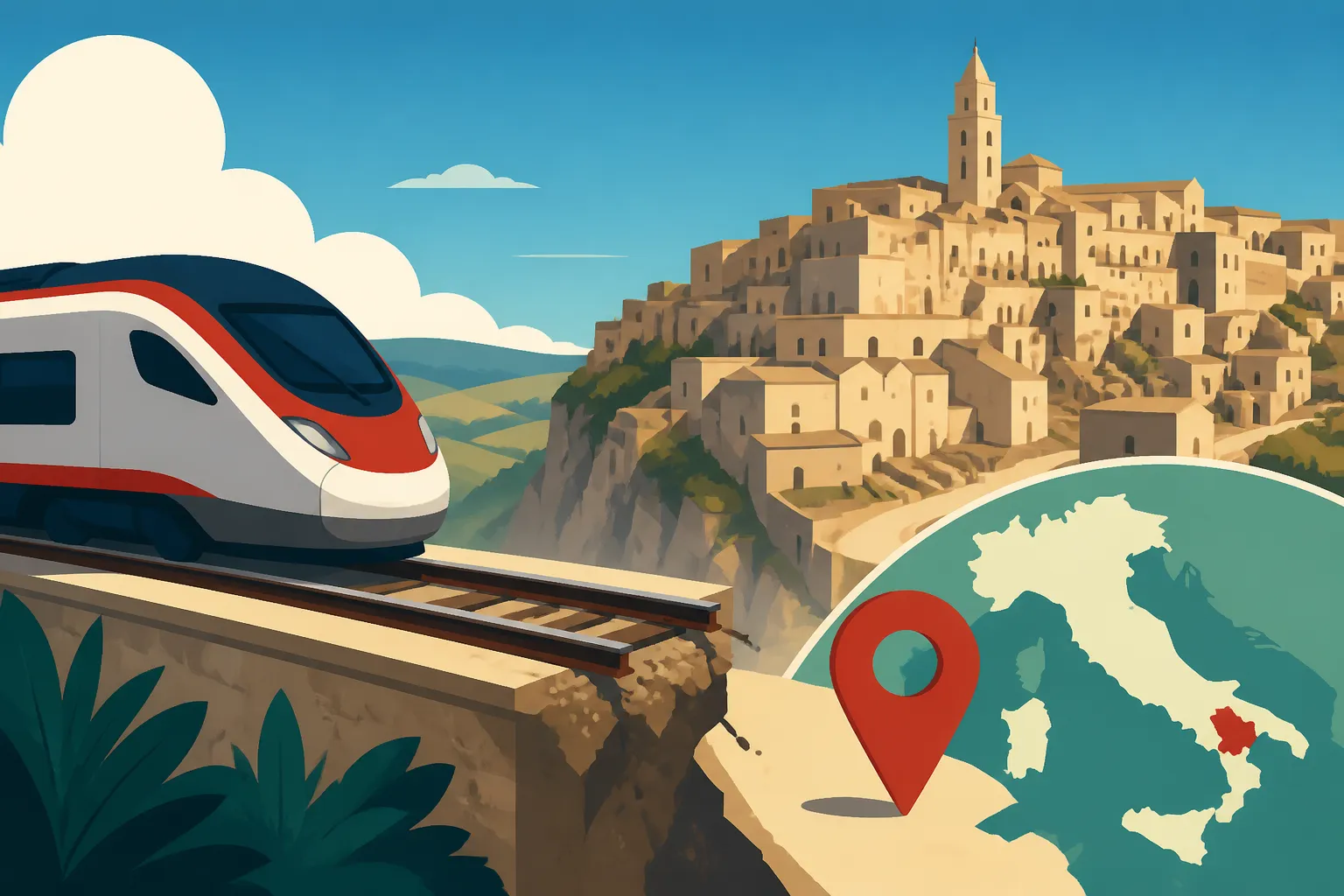
Reaching Matera and Basilicata: Where the Rail Network Runs Out
Oh, the romantic notion of hopping on a train in Italy and zipping off to every corner of this beautiful country! While that’s often true, anyone who has tried to map out a journey to Matera or the wider region of Basilicata quickly realizes that the national rail network, much like a good pasta sauce, sometimes needs a little extra ingredient to get it just right. It's a common expat frustration: you think you've got the hang of the Italian transport system, and then you discover these incredible places that just aren't on the main Trenitalia routes. But don't despair! This guide is here to untangle the journey to Italy's hidden gems, particularly when the main rail lines seemingly "run out," and to show you how a savvy booking tool like Omio can be your secret weapon.
Disclosure: This post may contain affiliate links. We may earn a commission at no extra cost to you if you make a purchase through these links. Read full disclosure.
The Unique Travel Challenge of Matera and Basilicata
Matera's Isolation and Charm
Matera, with its ancient Sassi (cave dwellings), is a city unlike any other. It literally feels like stepping back in time, a place where history is etched into every stone and cavern. As a UNESCO World Heritage site and a former European Capital of Culture, its allure is undeniable, drawing visitors from across the globe. However, this very ancient and captivating quality also means that Matera wasn't exactly designed with 21st-century high-speed rail lines in mind.
I remember my first attempt to reach Matera, meticulously checking Trenitalia schedules, only to find that the train lines stopped frustratingly short. It felt like I was trying to find a hidden path to a mythical kingdom. This isn't a flaw in the system, but rather a characteristic of Matera’s geographical and historical development. The city's unique topography and its long struggle against modernization meant that grand infrastructure projects, like extensive national rail lines, simply weren't a priority or even feasible until more recently. While this initial logistical puzzle can be a bit daunting, the experience of wandering through the Sassi, exploring cave churches, and soaking in millennia of human history is an unparalleled reward.
Basilicata's Rugged Beauty and Limited Infrastructure
Beyond Matera, the region of Basilicata itself is a land of raw, untamed beauty. It boasts diverse landscapes, from the sandy Ionian coast to the dramatic cliffs of Maratea on the Tyrrhenian Sea, and the rugged peaks of the Apennine mountains inland. Often described as the "instep" of Italy's boot, Basilicata is one of the country's least populated regions, a fact that contributes to its pristine natural environment but also to its less-developed infrastructure.
Compared to regions like Lombardy or Tuscany, public transport in Basilicata, especially the rail network, is significantly less comprehensive. While the regional capital, Potenza, has some connections, venturing out to the smaller, picturesque villages, or enjoying the stunning national parks, often requires a bit more effort. Bus routes can be infrequent, particularly on weekends or during holidays like Ferragosto, and local train lines, where they exist, can be slow and limited in their reach. This is a common point of frustration for expats who want to dive deeper into authentic Italy, away from the well-trodden tourist paths. Navigating these gaps in public transport can feel like a complex puzzle, but with the right tools and a flexible mindset, it’s absolutely achievable.
Navigating Your Journey to Matera: Beyond the National Rails
The Bari Connection: Your Gateway to Matera
For the vast majority of travelers heading to Matera from other parts of Italy, the city of Bari in Puglia serves as the crucial connection point. Bari is a vibrant port city, and thankfully, it’s exceptionally well-connected to Italy’s major hubs via Trenitalia’s national and high-speed rail network. So, your primary step will typically involve booking a train to Bari Centrale. This initial segment of your journey is usually straightforward, much like booking any other intercity train in Italy, and can easily be done through a platform like Omio.
However, once you arrive at Bari Centrale, the national network officially bows out. From here, you’ll need to transition to a regional, privately operated railway known as Ferrovie Appulo Lucane (FAL). The FAL station in Bari is located just outside the main Trenitalia station – usually, you’ll exit Bari Centrale, turn right, and look for clear signage for "FAL" or "Appulo Lucane." This local train journey to Matera Centrale typically takes between 1.5 to 2 hours, offering a picturesque ride through the changing landscapes as you cross from Puglia into Basilicata. It's a minor administrative switch, but knowing about it in advance can save you a lot of last-minute scrambling.
Train and Bus Connections with Omio
This is precisely where a platform like Omio becomes an invaluable resource, truly simplifying what could otherwise be a fragmented and confusing booking process. Instead of having to juggle separate websites for national trains (Trenitalia), regional private lines (FAL), and various bus companies, Omio brings all these options together. You simply enter your starting point, say, "Rome," and your destination, "Matera," and Omio will present you with consolidated itineraries.
These itineraries often seamlessly combine the national train journey to Bari with the connecting FAL train or even direct bus services that bypass Bari entirely. This eliminates the headache of deciphering multiple booking systems, especially if your Italian is still a work in progress. I can't tell you how many times I've heard stories of people arriving in Bari, bewildered by the task of finding the FAL station or a suitable bus, when a single booking on Omio could have streamlined their entire trip.
What’s more, Omio isn't limited to just trains. It also aggregates direct bus routes from numerous Italian cities straight to Matera. Sometimes, a direct bus can be a more time-efficient or cost-effective option, depending on your starting location. For example, if you're coming from Naples, a direct bus might be quicker than routing through Bari by train. Always check Omio for these direct bus connections; they can be real game-changers for convenience and sometimes for your wallet, too.
Alternative Routes: Driving and Car Rentals
While public transport gets you to Matera, renting a car offers an unparalleled level of flexibility, especially if your plans include exploring the wider Basilicata region. The roads leading to Matera are generally in good condition, and having your own wheels allows you to stop at panoramic viewpoints, discover charming off-the-beaten-path villages, or simply travel at your own pace.
If you opt for this route, you could take a national train or fly to a major nearby airport like Bari or Brindisi, then pick up a rental car there. This provides independence from train and bus schedules and gives you the freedom to craft your own adventure. However, keep in mind the specific considerations of driving in Italy. You'll need to be aware of the infamous ZTLs (Limited Traffic Zones) in many city centers, which can incur hefty fines if entered without permission. Also, be prepared for sometimes narrow and winding roads, particularly in more rural areas. Parking in Matera itself can be challenging, so it’s always wise to research your accommodation’s parking provisions beforehand. For a deeper dive, check out our guide on Renting a Car in Italy: ZTLs, Insurance, and Driving Tips. Despite these considerations, for those who love the open road and want to fully immerse themselves in Basilicata’s hidden beauty, a rental car is an excellent choice.
Exploring Basilicata: The "Last Mile" Solution
Public Transport Limitations in Rural Basilicata
Once you've had your fill of Matera’s magic, the siren call of Basilicata’s other treasures will undoubtedly beckon. Perhaps you envision basking on the pristine beaches of Maratea, exploring the haunting beauty of the ghost town of Craco, or hiking through the rugged wilderness of Pollino National Park. However, this is where Italy’s public transport system truly shows its limitations outside of major urban corridors.
Venturing into the smaller, more remote villages, reaching an isolated agriturismo, or accessing many of the region’s stunning natural attractions can become a significant logistical challenge without a personal vehicle. Bus schedules, where they exist, are often sparse and infrequent, particularly outside of peak commuting hours or during weekends and public holidays. Making connections between different bus or local train lines can often involve long waits or poorly synchronized timings, leading to precious travel time being consumed by simply waiting around. It’s a classic expat dilemma: the beauty is breathtaking, but getting there tests your patience. For instance, if you're trying to reach a specific trailhead or a tiny village known for its local festival, relying solely on public buses can prove to be a frustrating endeavor. Our piece on Intercity Buses in Italy: FlixBus and Regional Networks can offer more insights into general bus travel, but know that in Basilicata, the regional reality is often more sparse.
Omio's Role in Connecting the Dots
Even when navigating the less dense public transport landscape of Basilicata, Omio continues to be a surprisingly effective tool. While it can't create transport where none exists, it excels at aggregating all available options for a given route, including those obscure regional bus lines and local trains that are often difficult to track down on individual company websites.
For instance, if you're planning a journey from Matera to Potenza, Omio will typically display not only the FAL train options but also any direct bus services, allowing you to quickly compare travel times, prices, and comfort levels. This comprehensive approach means significantly less time spent sifting through multiple Italian-language websites, and more time focusing on what truly matters – like deciding which regional pasta dish you're going to sample next. Omio acts as your central hub for all modes of transport in Italy, helping you uncover those crucial "last mile" connections that the major national services often overlook. It truly simplifies the process of "Getting Around Italy: Trains, Buses, Flights, and Car Hire," especially in regions that demand a more nuanced approach.
Car Rentals for Ultimate Flexibility
For truly unhindered exploration of Basilicata’s most hidden corners, a rental car remains the undisputed champion. Imagine the freedom to spontaneously detour to a hidden trattoria, chase a sunset over the Lucanian Dolomites, or simply pull over for an unexpected photo opportunity. These are the experiences that a car unlocks.
You can pick up a rental car directly in Matera, or at larger regional airports like Bari or Brindisi, giving you the ultimate independence from published schedules and fixed routes. However, remember to factor in fuel costs, which can be higher than in many other countries, and familiarize yourself with local parking regulations. Driving in Basilicata outside of the major towns offers some truly spectacular scenic routes, and the roads are generally less congested than in more popular Italian regions. This is particularly true if your goal is to explore places where regional transport, as covered in topics like Regional Trains in Italy: How to Use Them and Save, simply isn't frequent enough or direct enough for your itinerary. For any multi-day exploration of Basilicata, a car is not just convenient; it's often transformative.
Practical Tips for a Smooth Trip to Southern Italy's Hidden Gem
Booking Smart with Omio
My absolute top piece of advice for anyone planning a trip to Matera and Basilicata is to make Omio your primary travel companion. It’s not merely a booking site for trains; it integrates buses and even some flights, offering you a genuinely holistic view of all your potential travel options.
When you’re searching on Omio, try experimenting with different combinations:
- Direct to Matera: Always check if any intercity bus companies offer direct routes from your initial departure city. This can often be the most straightforward method.
- Via Bari: This remains the most reliable and commonly used combination of national train (to Bari) and regional FAL train (to Matera).
- Major Airport + Car Rental: If driving is on your agenda, search for flights or trains to key regional airports like Bari, Brindisi, or even Naples, then investigate car rental options from there.
Booking everything through a single, intuitive platform like Omio significantly reduces the logistical complexity. It means fewer individual tickets to manage, often clearer information in a language you understand, and a streamlined payment process. This really cuts down on the guesswork and the frantic tab-switching that often accompanies planning multi-modal journeys in Italy. The convenience of having all your tickets digitally accessible on your phone is also a huge advantage, especially when dealing with smaller regional operators. As a veteran expat, I cannot overstate how much stress this alleviates. To secure the best prices and ensure availability, particularly for the high-speed train legs to Bari, it's always a good idea to book your tickets well in advance, especially during peak travel periods or around major Italian Public Holidays: What Services Are Closed.
| Travel Method | Pros | Cons | Best For |
|---|---|---|---|
| Train + FAL Train (via Bari) | Reliable, generally comfortable, scenic | Requires transfer in Bari, separate regional line can be slow | Matera city center access, no driving stress |
| Direct Bus (e.g., from Rome) | Can be direct, potentially cheaper, no train transfers | Longer travel time, fewer schedule options, less scenic | Budget-conscious, avoiding multiple transfers |
| Rental Car (from Bari/Matera) | Ultimate flexibility, explore rural Basilicata | Driving in Italy complexities (ZTLs), parking, higher fuel costs, tolls | Extensive regional exploration, spontaneity |
| Flight to Bari + FAL/Bus/Car | Fastest for long distances | Requires airport transfer, adds complexity and cost | Coming from far away, time-sensitive |
Essential Travel Documents and Considerations
Beyond the intricacies of transport, it’s vital to have all your essential travel documents meticulously organized. Your passport is, of course, your most critical item. If you’re traveling from outside the EU, be sure to confirm your visa requirements well in advance, whether it's a short-stay Schengen visa for tourism or a longer-term visa if you plan on an extended stay. I always recommend having both digital and physical copies of all your tickets and booking confirmations – a dead phone battery or patchy signal can turn a minor inconvenience into a major headache.
For those planning an extended stay or needing to interact with local services, obtaining your Codice Fiscale: Why It’s Essential for Finance in Italy is a crucial step that will make many administrative tasks smoother. If you intend to drive in Italy and your license is from outside the EU, you will almost certainly need an International Driving Permit (IDP) alongside your national driver's license. Always carry a small amount of cash, as card payments might not be accepted in every small shop, market stall, or remote bus kiosk. Finally, even if you’re staying mostly in tourist-heavy Matera, learning a few key Italian phrases will significantly enhance your experience, especially if you venture into the more rural parts of Basilicata. A little "per favore" (please) and "grazie" (thank you) go a long way in making connections and smoothing over any unexpected bumps in your journey. Check out our guide on Italian Language and Everyday Communication for Visitors for some useful phrases.
Disclaimer
The information provided in this guide is intended for general informational purposes only and may not constitute the most up-to-date legal, financial, or travel advice. While we strive to keep information current and accurate, policies and regulations in Italy can change rapidly. We recommend consulting official government websites, accredited legal or financial professionals, and transport providers like Omio for the most current and specific guidance related to your individual situation. Traveling in any foreign country carries inherent risks, and personal discretion and caution are always advised.