Renting a Car in Italy: ZTLs, Insurance, and Driving Tips
Renting a car in Italy opens up enchanting hilltop villages, hidden coastal coves, and vineyard-draped countryside, but navigating local rental desks, cryptic insurance jargon, and notorious traffic zones can stress out even seasoned travelers. This comprehensive guide breaks down everything you need to know about navigating Italian car rentals, avoiding mysterious ZTL fines, choosing the right insurance, and driving confidently on Italian roads.
Disclosure: This post may contain affiliate links. We may earn a commission at no extra cost to you if you make a purchase through these links. Read full disclosure.
Navigating Italian Car Rentals and Booking Essentials
Renting a vehicle in Italy is often the absolute best way to experience the countryside, but the process at the counter can feel overwhelming if you do not know what to expect. From understanding local vehicle sizing to navigating rental desk logistics, preparation is the key to avoiding unnecessary stress before you even turn the key in the ignition.
Choosing the Right Car Size and Transmission for Italian Roads
When selecting a rental vehicle, your instinct might be to choose a spacious SUV or a comfortable mid-sized sedan, especially if you are traveling with family or multiple pieces of luggage. However, Italian infrastructure was largely laid out centuries before automobiles existed. Historic city centers feature streets originally designed for horse-drawn carts, and rural mountain roads often narrow down to single-lane passes with tight hairpin turns.
Choosing a compact or economy-class car is almost always the smarter decision. A smaller vehicle makes maneuvering through medieval villages exponentially easier and simplifies finding street parking. Furthermore, standard transmission (manual) remains the default choice across European rental fleets. If you cannot comfortably drive a stick-shift, particularly when starting on steep uphill inclines in hillside towns, ensure you explicitly reserve an automatic transmission well in advance. Automatic vehicles are in higher demand and lower supply, so booking early is crucial.
Before settling on a car rental for your entire trip, evaluate your travel route realistically. When planning your itinerary, platforms like Omio can help you compare whether a train or car hire makes sense for specific legs of your journey, ensuring you only pay for a rental vehicle when you actually need one.
Navigating Rental Providers and Booking Platforms
Navigating the landscape of car rental providers in Italy requires balancing cost against convenience and reliability. Major international rental chains operate alongside regional Italian providers at primary airports like Rome Fiumicino, Milan Malpensa, and Florence Peretola, as well as at central railway stations. While regional companies sometimes offer tempting baseline rates, international brands often provide smoother customer service and clearer contract terms for non-Italian speakers.
Booking through third-party aggregators can yield competitive pricing, but always read the underlying contract terms carefully. Pay close attention to pick-up locations. Airport desks located directly inside the terminal are far more convenient than off-site locations requiring a shuttle bus, especially after a long international flight. If your flight arrives late at night, verify whether the rental desk stays open and whether late pick-up fees apply.
For comprehensive travel planning, using tools like Booking.com allows you to coordinate both your accommodation and rental pick-up locations smoothly, making sure your hotel choices align with easy parking access.
Key Documentation and Age Requirements at Pick-Up
When arriving at the rental counter, you must present a specific set of documents to collect your vehicle. You will need a valid physical driver’s license from your home country, a credit card issued in the primary driver’s name, and your passport. Digital copies, photos on mobile devices, or debit cards are generally rejected at the desk for the security deposit hold.
For non-EU drivers, an essential requirement that is frequently overlooked is the International Driving Permit (IDP). While some counter agents might forget to ask for it when handing over the keys, Italian law mandates that non-EU license holders carry an official translation of their license. If you are stopped by the Carabinieri or Polizia Stradale without one, you face hefty on-the-spot fines. For full details on obtaining this document, review our dedicated guide on whether Do You Need an International Driving Permit to Drive in Italy? before departing.
Age restrictions also apply across Italian car rentals. While the minimum driving age in Italy is 18, most rental companies require drivers to be at least 21 years old. Drivers under 25 almost universally face a “young driver surcharge,” which adds a daily fee to the rental cost. Conversely, senior drivers over 70 or 75 may encounter maximum age restrictions or additional insurance requirements depending on the provider’s specific policy terms.
| Document / Requirement | Mandatory For | Expat / Tourist Tip |
|---|---|---|
| Physical Driver’s License | All Drivers | Must be valid for duration of stay |
| International Driving Permit (IDP) | Non-EU License Holders | Must carry alongside home license |
| Primary Driver Credit Card | All Rentals | Security deposit hold required |
| Passport / Photo ID | Non-Italian Residents | Used for identity verification |
Decoding Insurance Options and Hidden Fees
Insurance jargon at an Italian rental desk can confuse even seasoned travelers. Understanding what coverage is legally required, what your existing policies cover, and how to protect yourself against unexpected damage claims is vital for a worry-free road trip.
Mandatory Liability vs Collision Damage Coverage
In Italy, third-party liability insurance (Responsabilità Civile Auto) is mandatory by law and is automatically included in the base cost of every vehicle rental. This covers damage or injury caused to other people, vehicles, or property. However, it does not cover damage to your rental car or theft of the vehicle itself.
To address vehicle damage and theft, rental contracts routinely include Collision Damage Waiver (CDW) and Theft Protection (TP). In Italy, CDW and TP are frequently required by law to be integrated into the basic rental package, but these standard waivers almost always come with a substantial deductible (excess). If the car is damaged, scratched, or stolen, you remain responsible for costs up to that excess threshold unless you purchase zero-deductible excess reduction coverage.
Understanding these insurance structures is critical, particularly if you plan on transitioning to long-term residency. Those looking at long-term driving arrangements should examine local vehicle ownership and insurance requirements detailed in our overview on Car Taxes and Costs in Italy: Bollo Auto and Insurance.
Credit Card Insurance Coverage Realities in Italy
Many travelers rely on the primary or secondary auto rental collision coverage offered by premium credit cards. While this works seamlessly in many parts of the world, Italy presents a unique exception. Several credit card issuers explicitly exclude Italy from their standard rental vehicle coverage due to high historical rates of theft and minor body damage on narrow streets.
Before relying on your credit card policy, call your card issuer directly to request a written letter of coverage specifically mentioning Italy. Even if your card does cover Italian rentals, the local rental company will still require you to leave a large security deposit hold on your credit card at pick-up. If damage occurs, the rental company charges your credit card directly, and you must later submit a claim to your credit card company for reimbursement.
If you prefer to avoid high deductibles and credit card holds, purchasing full coverage (Super CDW) directly from the rental provider eliminates your financial liability for bodywork damage, though it usually increases the daily rental price.
Avoiding Post-Rental Charges and Deposit Traps
One of the most common frustrations reported by expats and tourists alike is receiving unexpected charges weeks or months after returning a rental car. These charges usually stem from pre-existing scratches, missing fuel, or administrative processing fees for traffic violations.
To protect yourself, conduct a rigorous inspection of the vehicle before leaving the rental lot. Inspect every panel, wheel rim, windshield, and interior surface. Take clear, well-lit photos and a detailed video walkaround of the entire vehicle, paying special attention to any existing scuffs or dents. Ensure that the agent explicitly marks every single pre-existing mark on the official vehicle condition report before you sign it.
When returning the car, choose a full-to-full fuel policy option whenever possible. Refill the tank at a gas station close to the drop-off location and keep the physical receipt as proof. If returning the car outside of business hours, take a final video showing the fuel gauge odometer reading and the car parked safely in the designated lot.
The Dreaded ZTL System and Urban Driving Rules
Nothing strikes fear into the heart of an expat driving in Italy quite like the Zona a Traffico Limitato (ZTL). These restricted traffic zones are designed to protect historic city centers from congestion and pollution, but they serve as a major trap for uninformed drivers.
| Zone Type / Signage | Who Can Enter? | Penalty for Violation |
|---|---|---|
| ZTL (Zona a Traffico Limitato) | Residents, Logistics, Permitted | Fine per camera entry + Admin fees |
| Area Pedonale (Pedestrian Zone) | Emergency Vehicles Only | Severe fines and immediate towing |
| Corsia Riservata (Bus/Taxi Lane) | Public Transit, Licensed Taxis | Automated camera fines |
What Is a ZTL and How to Spot the Signs
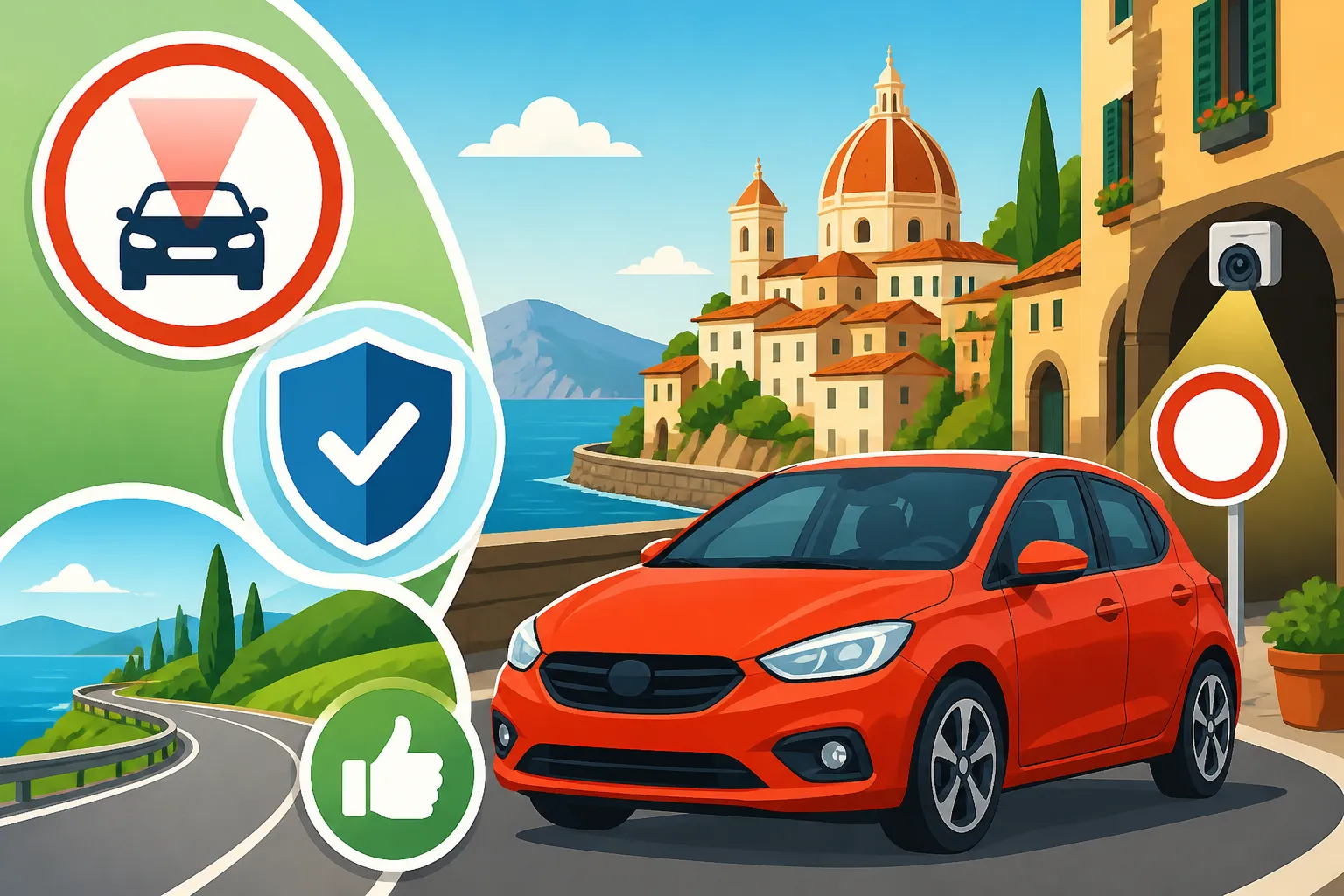
A ZTL is a designated area within a city or town center where vehicular traffic is strictly limited to residents, public transit, emergency services, and authorized delivery vehicles. ZTL boundaries are marked by white circular signs with a red border—the international standard for “no vehicles allowed”—accompanied by text specifying the restricted hours and operational details.
Electronic camera gates monitor these entry points continuously. The moment your rental vehicle passes through a ZTL camera gate without prior registration, the camera captures your license plate image, recording the date and precise time of entry.
It is critical to realize that satellite navigation systems like Google Maps or Apple Maps do not always reliably account for active ZTL boundaries or temporal restrictions. Relying solely on GPS without looking at physical road signage is the leading cause of accidental ZTL violations. To understand the mechanics of these zones in complete depth, consult our guide on What Is a ZTL in Italy and How to Avoid Fines.
Real-World Scenarios and Hotel Pass Rules
A common scenario occurs when travelers reserve a hotel located inside a historic city center. Drivers assume that having a valid hotel reservation automatically grants them permission to drive directly to the front door to unload luggage. Without taking specific preliminary steps, this assumption results in fines.
If your accommodation is situated inside a ZTL, you must contact the hotel management well before arrival. Most hotels located within restricted zones can register your rental car’s license plate with the local traffic police (Polizia Municipale) upon your arrival. This temporary registration white-lists your plate for a specific time window, allowing you to drive directly to the hotel or its affiliated parking garage.
Always confirm that the hotel staff actually submitted your license plate details to the municipal database, and request a printed or digital copy of the registration receipt. Keep this receipt for at least one year as proof in case a ticket is erroneously issued. For day trips to historic towns where parking is tricky, booking an excursion through GetYourGuide can be a stress-free alternative that avoids inner-city driving altogether.
Cameras Fine Enforcement and Appeals
If you drive past a ZTL camera gate without authorization, the violation triggers an automated administrative process. Because you are driving a rental vehicle, the local municipal police send the traffic ticket to the rental company first to identify the driver listed on the contract at that specific hour.
The rental company charges an administrative fee (typically assessed directly to your credit card hold) merely for searching their database and providing your contact address to the police. This administrative fee is not the fine itself. Months later, the official traffic fine will arrive in your mailbox at home.
Drivers sometimes cross multiple camera points within a few minutes while searching frantically for a way out of a historic center, receiving a separate fine for every single camera gate crossed. Contesting these fines from abroad is notoriously difficult, requiring formal appeals submitted in Italian to the local Prefetto or Giudice di Pace. Therefore, absolute prevention is the only practical strategy.
Driving Rules Etiquette and Road Culture
Driving in Italy requires adopting a proactive, attentive, and confident driving style. Understanding local traffic rules, highway systems, and subtle road etiquette will help you blend in safely with local drivers.
Highway Driving on the Autostrada and Telepass Lanes
Italy’s toll highway network, known as the Autostrada, is denoted by green signage (unlike standard regional roads, which use blue signs). The Autostrada network is fast, highly efficient, and well-maintained, but strict lane discipline is enforced.
The left lane on an Autostrada is strictly reserved for overtaking. Cruising in the left lane when the right lane is clear is illegal and heavily frowned upon by local drivers. If a faster car approaches you from behind flashing its left turn signal or high beams, safely signal and move to the right lane as soon as possible. Speed limits on the Autostrada are monitored by automated camera systems known as Tutor, which calculate your average speed between two highway gantries rather than just measuring instantaneous speed at a single point.
When approaching an Autostrada toll plaza (casello), pay careful attention to the overhead lane markers:
* Yellow Lanes (Telepass): Reserved exclusively for vehicles equipped with an electronic transponder. Do not enter these lanes in a standard rental car unless you specifically opted for a Telepass unit at the rental desk, as the barrier will not open and you will incur severe administrative surcharges.
* Blue Lanes (Carte): Designated for automated payments using credit cards, debit cards, or transit payment cards.
* White Lanes (Contanti): Designated for cash payments, either automated or operated by a human attendant.
Roundabouts Tailgating and Italian Road Etiquette
Navigating roundabouts (rotatorie) in Italy can feel chaotic for newcomers. Legally, traffic already inside the roundabout has the right of way over entering vehicles, indicated by yield signs (Dare Precedenza) at the entrance lanes. However, local drivers often enter roundabouts assertively. Maintain vigilance, keep your eyes moving, and enter smoothly when a clear gap appears.
Tailgating is another aspect of local driving culture that causes anxiety for foreign drivers. Italian drivers frequently follow closer behind than drivers in North America or Northern Europe. Try not to feel pressured into speeding or taking unsafe risks; simply maintain a safe speed, drive predictably, and allow faster vehicles to pass at the earliest safe opportunity.
Honking the horn inside urban areas is legally restricted to situations of immediate danger, though it is frequently used in practice to alert pedestrians or express brief frustration. In narrow rural mountain roads with blind corners, a short tap of the horn is customary to alert oncoming drivers of your presence.
Parking Codes White Blue and Yellow Lines
Understanding street parking rules in Italian towns requires recognizing painted street curb markings:
* White Lines (Strisce Bianche): Indicate free parking. Always check nearby street signs to ensure there are no time limits requiring a parking disk (disco orario) displayed on your dashboard, or street cleaning restrictions on specific weekdays.
* Blue Lines (Strisce Blu): Indicate paid parking. Look for a nearby parking meter (parcometro), pay for your anticipated duration, and place the physical ticket clearly on your dashboard. Many meters now accept credit cards or mobile parking apps.
* Yellow Lines (Strisce Gialle): Indicate reserved parking spaces restricted to residents, disabled permit holders, loading zones, or official municipal vehicles. Parking in yellow spaces without a valid local permit results in immediate ticketing or towing.
| Curb Line Color | Meaning | Requirements / Action Needed |
|---|---|---|
| White Lines | Free Parking | Check for time limits / disk rules |
| Blue Lines | Paid Parking | Purchase meter ticket & display |
| Yellow Lines | Reserved Parking | Do not park (Residents/Disabled) |
Fuel Stations Tolls and Practical Roadside Logistics
Handling day-to-day vehicle logistics like refueling and paying tolls requires an understanding of localized procedures to avoid unnecessary expenses.
Self-Service vs Servito Fuel Stations
Fuel stations (distributori di benzina) across Italy offer two distinct service tiers, clearly marked at the pumps:
* Self-Service (Aperto / Fai da Te): You pump the fuel yourself. This option carries a lower price per liter.
* Servito: An attendant pumps the fuel, cleans your windshield, or checks your tire pressure. Choosing a Servito lane carries a significantly higher price per liter, often surprising tourists who do not read the pump signage carefully.
Fuel terminology in Italy is straightforward but critical to get right:
* Benzina (Senza Piombo): Unleaded gasoline (green pump handles).
* Gasolio (or Diesel): Diesel fuel (black or yellow pump handles).
Mistakenly putting gasoline into a diesel engine (or vice versa) is not covered by standard rental insurance policies and results in expensive engine flush repairs. Always verify the required fuel type stamped inside the vehicle’s fuel filler flap or on the rental key fob.
At unstaffed or after-hours stations, fuel terminals accept cash banknotes or credit cards. Insert your payment into the automated payment terminal first, select your designated pump number, and then proceed to dispense the fuel.
Paying Tolls on the Italian Highway Network
The majority of Italian Autostrade utilize a closed-ticket toll system. As you enter the highway, you pull a physical paper ticket from an automated machine at the barrier. Keep this ticket in a safe, accessible spot inside the vehicle.
When exiting the highway, you insert your ticket into the automated toll machine at the exit plaza, which calculates the exact toll based on the distance traveled. Payment can then be made via credit card or cash in the appropriate white or blue lanes.
If you lose your entry ticket during the trip, the exit machine cannot calculate your point of origin and will automatically charge you the maximum possible toll for that entire highway route, alongside administrative processing fees. If a toll barrier fails to raise or your payment is declined, press the red assistance button (Assistenza) to speak with an operator. Do not back up out of a toll lane, as doing so is illegal and highly dangerous.
Handling Breakdown Emergencies and Accidents
In the unfortunate event of a mechanical breakdown or road collision, safety is your top priority. Move the vehicle to the emergency stopping lane (corsia di emergenza) or a designated safety bay (piazzola di sosta) along the highway.
Before exiting the vehicle on an active road or highway, Italian law legally mandates that all occupants wear high-visibility reflective vests (giubbino catarifrangente), which should be stored inside the vehicle cabin rather than in the trunk. Set up your hazard warning triangle (triangolo) behind the vehicle to warn oncoming traffic.
For urgent roadside assistance or medical emergencies:
* Universal Emergency Number: Call 112 for immediate assistance anywhere in Italy.
* ACI Roadside Assistance (Automobile Club d’Italia): Call 803 116 (or 800 116 800 for foreign-registered phones) to request towing and emergency repairs.
* Rental Desk Emergency Line: Contact the 24/7 roadside assistance hotline provided in your rental agreement folder before authorizing third-party repairs.
If an accident involves another party, complete the standard European Accident Statement form (Constatazione Amichevole di Incidente) located in the glove compartment, capture detailed photographs, and file a police report if injuries or major property damage occur.
Regional Driving Comparisons and Vehicle Selection Guide
Driving conditions across Italy vary dramatically depending on geographic region, population density, and local road infrastructure. Choosing where to drive versus where to rely on public transit can make or break your trip.
Major Highways vs Country Roads
Italy’s infrastructure offers stark contrasts between modern highway networks and scenic secondary routes. The Autostrada network allows rapid connection between major metropolitan hubs, but scenic rural routes showcase the authentic beauty of the country.
When exploring rural areas, secondary highways (Strade Statali or SS) and regional roads (Strade Regionali or SR) provide access to unforgettable landscapes. For instance, touring regions like Tuscany for Travelers: Cities, Hills, and Coast or following a curated itinerary for a How to Plan a Road Trip Through Tuscany and Umbria trip offers complete freedom to stop at remote wineries, historical castles, and roadside markets that trains simply cannot reach.
Conversely, navigating urban centers like Rome, Milan, Naples, or Florence by rental car is generally inefficient due to dense traffic, aggressive scooter riders, complex one-way systems, and ZTL restrictions. For urban legs, relying on public transit or high-speed rail systems detailed in our guide to High-Speed Trains in Italy: Trenitalia, Italo, Routes, and Savings is far more convenient.
| Region / Environment | Traffic Complexity | Recommended Mode of Transport |
|---|---|---|
| Major Cities (Rome, Milan, Naples) | High (ZTLs, Congestion, Scooters) | Metro, Taxis, Walking |
| Rural Countryside (Tuscany, Umbria) | Low to Moderate (Winding Roads) | Rental Car |
| Coastal Routes (Amalfi, Liguria) | Very High (Narrow Passes, Buses) | Ferries, Small Car, Driver Excursion |
| Alpine / Mountain Pass Regions | Moderate (Weather Dependent) | Compact All-Wheel Drive Vehicle |
Regional Traffic Patterns North vs South
Driving norms shift noticeably as you travel from the north to the south of the country:
* Northern and Central Italy: Highways and roads are modern and well-maintained. Drivers generally adhere strictly to speed limits, lane etiquette, and signal usage. However, heavy traffic congestion is common around industrial centers like Milan and major tourist corridors during peak holiday seasons.
* Southern Italy and Coastal Passes: Driving styles become significantly more fluid and assertive. In cities like Naples or Palermo, lane markings and turn signals are frequently treated as suggestions rather than strict rules, and scooter riders thread dynamically through traffic gaps. Drivers must remain assertive, vigilant, and composed.
* Coastal Cliff Roads: World-famous routes along the Amalfi Coast or the Ligurian Riviera feature dramatic views paired with tight hairpin turns and wide tour buses navigating narrow passes. During summer months, local traffic authorities often enforce alternate-day license plate rules to limit total vehicular volume on coastal roads.
To compare all ground transportation methods systematically across the peninsula, review our broader overview on Getting Around Italy: Trains, Buses, Flights, and Car Hire. If you are considering staying long-term or moving permanently to Italy, you may also want to review official administrative processes such as Driving in Italy: Obtaining an Italian Driver’s License or Importing Your Car to Italy: Regulations and Costs to understand permanent residency requirements.
Renting a car in Italy does not have to be a source of anxiety. By selecting an appropriately sized vehicle, securing clear insurance coverage, respecting ZTL zones, and maintaining attentive driving habits, you can unlock the full freedom of an unforgettable Italian road trip.
Disclaimer
This article is for general informational purposes only and does not constitute professional advice. Laws, prices and regulations vary by location and change over time. Consult a qualified professional for guidance on your specific situation.