Booking Italian Transport With Kids: Child Fares, Seats, and Prams
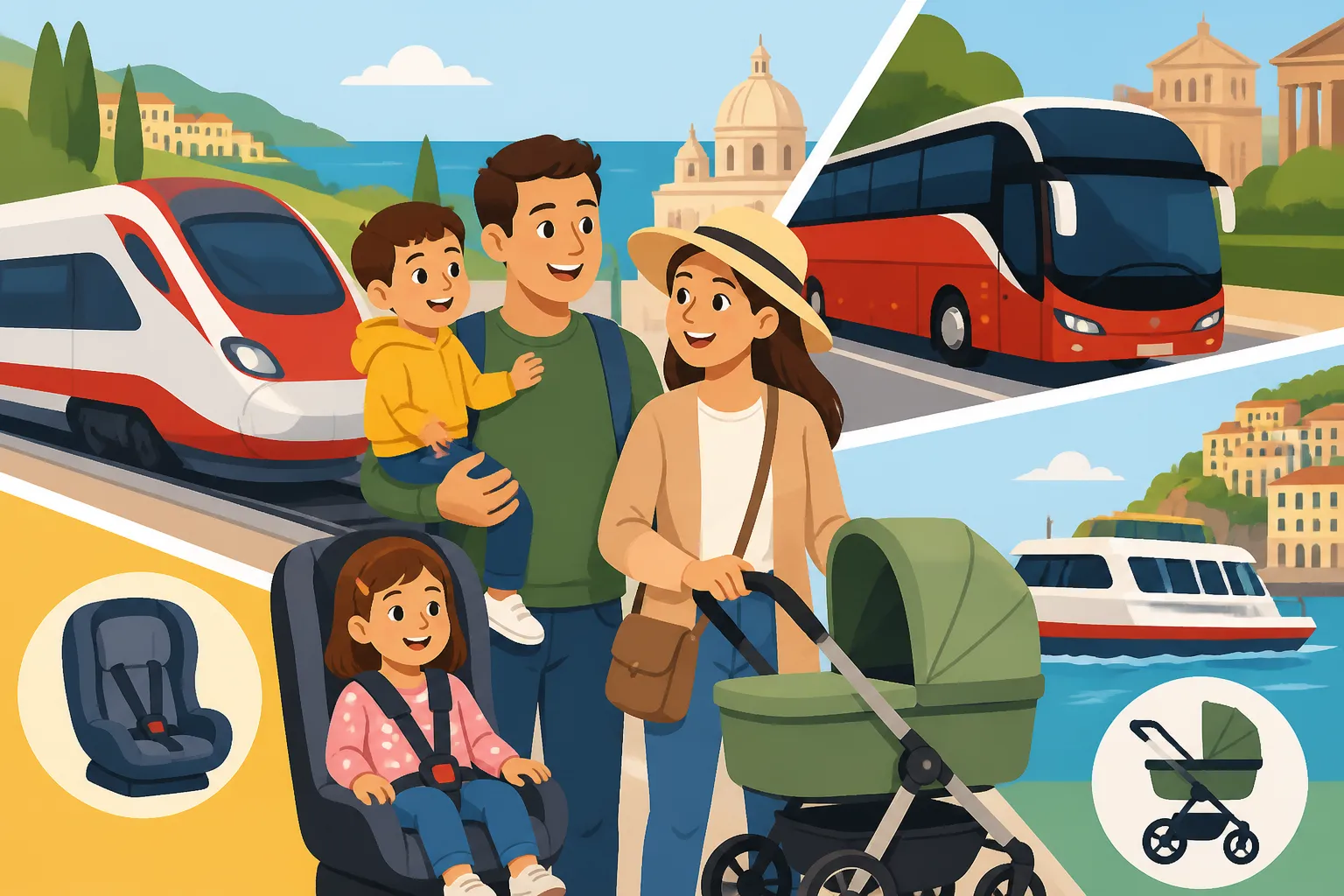
Trying to navigate Italy’s public transport system with children in tow can feel like attempting to herd cats through a crowded piazza during rush hour. Between understanding baffling child fare rules, figuring out where on earth to put the pram, and simply finding comfortable seats for your little adventurers, it’s enough to make even the most seasoned expat break a sweat. This comprehensive guide is here to untangle those knots, giving you the insider tips and practical solutions, with a special shout-out to Omio, to make your family's Italian journeys as smooth and stress-free as possible.
Disclosure: This post may contain affiliate links. We may earn a commission at no extra cost to you if you make a purchase through these links. Read full disclosure.
The Labyrinth of Child Fares on Italian Trains and Buses
One of the first hurdles you’ll face when planning family travel in Italy is deciphering the ever-changing and often opaque rules around child fares. It’s not a one-size-fits-all system, and what applies to a high-speed train across the country might be completely different from a local bus ride within a city. Trust me, I’ve spent countless hours trying to figure this out, often just giving up and buying a full-price ticket for a child who probably could have ridden for free.
Trenitalia and Italo: Train Travel with Minors
When it comes to long-distance train travel, Italy’s two main operators, Trenitalia and Italo, have their own specific policies for children. It can be a godsend when you understand them, and a headache when you don’t.
Trenitalia, the national rail company, offers a couple of options. For children under 4 years old, if they sit on an adult’s lap and don't occupy a seat, they travel for free on most trains, including high-speed Frecciarossa services. This sounds great in theory, but as any parent knows, a restless toddler on your lap for a two-hour journey from Florence to Rome can quickly become less "free" and more "priceless misery." For children aged 4 to 14 (or up to 15, depending on the specific offer), Trenitalia often provides discounted fares, usually around 50% off the base adult fare. Even better, they have something called "Bimbi Gratis" (Kids Free), which allows children under 15 to travel for free in the same carriage as an adult paying the full Base fare (or Economy/Super Economy if available), provided it’s within a family group of 2-5 people. This is brilliant for family budgets, but it usually requires booking well in advance and selecting the specific "Bimbi Gratis" option.
Italo, the private high-speed rail operator, has a similar approach. Generally, children under 36 months (3 years old) can travel for free on an adult’s lap. For older children, Italo offers a "Italo Famiglia" fare, which provides discounted tickets for children up to 14 years old when traveling with at least one adult. The percentage of discount varies depending on the route, class of service, and how far in advance you book. Sometimes, especially with their Smart or Low Cost fares, buying a standard adult promotional ticket might end up being cheaper than a child discount, simply because the adult promotional fares are so aggressive. This is where the confusion truly sets in.
The key takeaway here is that you absolutely need to check the specific policies for each operator and route when booking. It's not always intuitive, and missing a specific family offer can mean paying significantly more. This is precisely why a platform like Omio becomes an invaluable tool. It simplifies this entire process by pulling together options from both Trenitalia and Italo, allowing you to input your children’s ages directly and see the relevant fares pop up, taking the guesswork out of finding those elusive discounts. You won't have to bounce between two different websites, each with its own quirks and language barriers, trying to compare apples and oranges. Omio lays it all out for you, making comparing options incredibly straightforward.
Local and Regional Transport: Buses, Trams, and Metro with Kids
Venturing into the local transport networks of Italian cities and regions introduces yet another layer of complexity. Unlike the national train lines, which have more standardized (though still tricky) child fare rules, local buses, trams, and metro systems operate under the jurisdiction of individual municipalities or regional transport authorities. This means what holds true for the ATAC buses in Rome might not apply to the ATM metro in Milan or the EAV trains around Naples.
In many major Italian cities, young children, often those under the age of six, can travel for free on public transport, provided they are accompanied by a paying adult. However, this is not a universal rule, and the specific age cutoff can differ. For instance, in some cities, children under 4 ride free, while in others it might be under 10. The biggest pain point here is that there often isn't a specific "child ticket" option available for purchase. You either pay the full adult fare, or your child simply rides free based on their age. There's no middle ground for a slightly older child who doesn't quite qualify for free travel but also doesn't need a full adult fare.
To complicate matters, finding clear, concise information in English on these local transport websites can be a challenge. They are primarily designed for residents and often assume a level of familiarity with local bureaucracy and the Italian language. Before you travel to a specific city, it’s always a good idea to search for the official transport operator (e.g., "ATAC Roma," "ATM Milano") and try to find their "Tariffe" or "Biglietti" section, specifically looking for information on "bambini" or "minori." You might need Google Translate handy, but it's better to be informed than to risk a fine or confusion with a ticket inspector. This is where the ease of having a single point of reference like Omio, though primarily for intercity travel, helps mentally by reducing the stress of multi-platform booking for the larger segments of your trip, allowing you to focus on hyper-local details when you arrive.
Securing Seats and Managing Prams: Practicalities on the Go
Beyond the ticket price, the actual act of traveling with kids in Italy brings its own set of logistical challenges. From finding enough space for everyone to wrestling a pram onto a crowded bus, these are the real-world scenarios that can make or break a family trip.
Seat Reservations and Comfort on Trains
High-speed trains in Italy – Trenitalia’s Frecciarossa and Frecciargento, and Italo’s fleet – operate on a mandatory seat reservation system. This means when you purchase your ticket, you are assigned a specific seat. For families, this is largely a good thing, as it guarantees you a spot and prevents the free-for-all of finding seats on busy regional lines. When booking, make sure all family members, including children who might be traveling for free on a lap, have a designated seat if you want them to have one. If a child under 4 is traveling free without a seat, they literally have no assigned spot. If the train is full, they’ll be on your lap the whole way.
Most booking platforms, including Omio, allow you to select your seats or at least choose preferences like "window" or "aisle," or seating together. When booking through Omio, you'll be able to see a seating plan for many routes, allowing you to pick seats that are genuinely next to each other. This is crucial for keeping an eye on your little ones and ensuring they're comfortable. A pro tip: if you can snag a quad seat with a table, it’s a game-changer. These are perfect for spreading out snacks, playing games, or setting up a tablet for some quiet time. They offer a semi-private space that feels like a mini-living room on wheels. Family compartments, while still existing on some older trains, are much rarer now on modern high-speed services, so don't count on them. Just try to get seats facing each other with a table in between; Omio can help identify these configurations when you select your seats.
Prams, Strollers, and Luggage on Italian Transport
Ah, the humble pram. It’s your best friend for navigating cobbled streets and letting tired toddlers rest, but it can quickly become your nemesis when faced with Italian public transport.
On trains, you generally have more space than on buses. High-speed trains have dedicated luggage areas at the end of carriages, as well as overhead racks. A standard, folded stroller can usually fit in the luggage racks or sometimes even in the overhead bins if it’s compact. If you have a larger pram, you’ll likely need to store it in the luggage area. The challenge often comes during boarding and alighting, especially at busy stations where you might only have a minute or two to get on or off. Be prepared to quickly fold your pram and grab your children – a two-person job if possible. This is where traveling light is always best. What to Pack for a Beach Trip in Southern Italy offers some great general packing advice that applies to train travel too.
On buses, trams, and metros, the situation is often far more challenging. Italian city transport can get incredibly crowded, especially during peak hours. Buses frequently have steps, and while some newer models might have ramps or dedicated pram/wheelchair spaces, they are not universal. You might find yourself struggling to lift a pram up steps while simultaneously wrangling children and holding tickets. On very crowded vehicles, drivers or other passengers might expect you to fold your pram, even if it’s inconvenient. This isn't out of malice, but simply due to the limited space. The unspoken rule is often "if it fits, it sits; if it doesn't, fold it."
My advice? If you’re traveling with an infant, a lightweight, easily foldable stroller or baby carrier is a lifesaver. For toddlers, consider a compact travel stroller that can be folded with one hand. Embrace the reality that you might need to carry your child and the folded stroller for short distances. While Italians adore children and will often smile and coo at your little ones, the infrastructure isn't always designed for easy pram access. Be prepared to ask for help – a polite "Scusi, mi aiuta per favore?" (Excuse me, can you help me please?) with a struggling pram and a smiling child can often work wonders. And for those longer journeys between cities, using Omio to book your train tickets allows you to focus less on the booking hassle and more on mentally preparing for the actual journey logistics with your pram.
Navigating Booking with Omio: Your Family Travel Ally
The complexities of Italian transport with kids can feel overwhelming, but tools exist to simplify your life. For intercity travel, Omio truly stands out as a "hero" solution, especially for families. It acts as your single point of truth, cutting through the noise and presenting you with clear, actionable choices.
Simplifying Multi-Provider Search and Booking
Imagine trying to plan a trip from Milan to Naples with two kids: you’d first open Trenitalia’s website, then Italo’s, then maybe FlixBus for a cheaper bus option. You’d input dates, then ages, then compare prices, travel times, and connection points across three or four different tabs, each with its own interface and booking quirks. Now imagine doing that while a toddler is demanding a snack and a preschooler is asking "are we there yet?" every five minutes. It’s a recipe for parental burnout.
This is where Omio shines. It’s an aggregation platform that partners with major European transport providers, including Trenitalia and Italo for trains, and FlixBus for buses in Italy. Instead of juggling multiple websites, you simply enter your departure and arrival points, your travel dates, and crucially, the ages of your children. Omio then pulls up all available options – trains, buses, and sometimes even flights – from various providers, displaying them in one clear, easy-to-compare list. It automatically applies relevant child fares, like Trenitalia’s Bimbi Gratis or Italo’s family discounts, directly to your search results.
This centralized approach saves you precious time and reduces mental load. You can instantly see if taking a Frecciarossa at a certain time is more or less expensive than an Italo train, or if a longer FlixBus journey offers significant savings that might be worth it for your family. The interface is clean, intuitive, and most importantly for many expats and tourists, available in English. This means no more struggling with Italian-only booking flows or second-guessing if you’ve truly selected the right fare for your kids. Omio takes the guesswork out of booking, allowing you to confidently choose the best option for your family.
Real-World Scenarios and Omio's Advantages
Let’s look at a couple of common family travel scenarios where Omio proves its worth.
Scenario 1: Rome to Florence with a 3-year-old and a 7-year-old.
You want to book a high-speed train. Without Omio, you'd go to Trenitalia, find a Frecciarossa, try to apply Bimbi Gratis (remembering it only works if you select a full fare adult ticket in a specific group configuration), then go to Italo, look for Italo Famiglia discounts. It's convoluted.
With Omio, you punch in "Rome" to "Florence," your dates, and then "1 adult, 1 child (age 7), 1 infant (age 3)." Omio will then show you all the Trenitalia and Italo options. For the 3-year-old, it will automatically factor in the free-on-lap option or, if you prefer, offer a seat at a nominal fee or a child discount if available. For the 7-year-old, it will display the applicable child fare, including Bimbi Gratis if it's available for that specific Trenitalia route and class. You can instantly compare prices and travel times side-by-side, then proceed to book directly. It’s incredibly efficient.
Scenario 2: Comparing train vs. bus for a longer journey, like Bologna to Lecce.
This is a substantial journey, and you might be weighing the faster, more expensive train against a potentially cheaper, albeit longer, bus ride. Doing this manually across Trenitalia/Italo and FlixBus sites is a major undertaking.
Omio aggregates these. You’ll see all the high-speed train options with their child fares already applied, and right alongside them, the FlixBus options, also showing the appropriate pricing for your family. This allows you to quickly assess the trade-offs: "Is an extra 5 hours on a bus worth saving €100 for the family?" For some families, especially those on a tighter budget, that answer might be yes. Omio empowers you to make that informed decision quickly and without hassle.
Beyond the initial booking, using Omio means you have all your tickets in one place on your phone, no need to print anything or scramble for different booking confirmations. This digital convenience is a godsend when you're managing multiple children, bags, and boarding passes. For finding ways to get around Italy generally, whether by train, bus, or even considering Renting a Car in Italy: ZTLs, Insurance, and Driving Tips as an alternative, Omio offers a broad overview that can kickstart your planning.
Don't let the complexities of Italian transport rules deter you from exploring this beautiful country with your family. Let Omio be your secret weapon to navigate the system, compare child fares from different providers, and get your family from point A to point B with minimal fuss. It’s truly a game-changer for parents who just want to enjoy their trip without becoming an expert in Italian transport bureaucracy. Book your next family journey through Italy with Omio and experience the difference!
Essential Tips for Stress-Free Family Journeys
Even with the best booking platform and a solid understanding of fares, traveling with kids always throws curveballs. Here are some seasoned expat tips to help you maintain your sanity and enjoy the ride.
Preparation is Key: Snacks, Entertainment, and Timing
Traveling with children is 80% preparation and 20% improvisation. This is especially true on public transport.
First, snacks and water are non-negotiable. Delays happen, shops at stations might be closed or too far, and a hungry child is a grumpy child. Pack a generous supply of their favorite snacks and drinks. Keep them easily accessible. This is fundamental for maintaining peace on any journey, long or short.
Second, entertainment is your best friend. Tablets pre-loaded with movies or games (with headphones!), coloring books, small toys, or even a deck of cards can provide crucial distractions. The goal isn't to over-schedule them, but to have options for when boredom or restlessness sets in. Even the most exciting Italian landscape can lose its charm after a while for little ones.
Third, strategic timing can make a world of difference. Whenever possible, try to book train or bus journeys outside of peak commuter hours (typically 7-9 AM and 5-7 PM on weekdays). These times mean more crowded carriages, less space, and generally more stress. If your children still nap, try to schedule longer journeys during their usual nap times. A sleeping child is a quiet child, and you might even get to enjoy the scenery yourself! For more general tips on Family Travel in Italy: Kid-Friendly Cities and Activities, remember these basics apply to every leg of your journey.
Embrace Flexibility and a 'Go With the Flow' Mentality
Despite all your meticulous planning, things will go wrong. Your train might be delayed, the bus might be unexpectedly crowded, or your child might decide the exact moment you’re trying to board is the perfect time for a meltdown. This is Italy, and while generally efficient, schedules can sometimes be suggestions, and personal space can be a fluid concept, especially on public transport.
The most important advice I can give is to cultivate a "go with the flow" mentality. Leave extra time between connections, don’t over-schedule your travel days, and accept that perfection is an illusion. A missed connection or a half-hour delay isn't the end of the world; it's just another part of the adventure. Italians themselves are often quite pragmatic about delays and unexpected events, and their general love for children often means you’ll be met with smiles and understanding, not judgment, when your little one inevitably has a moment. A simple "Mi scusi" (Excuse me) or "Scusa" (Sorry, informal) for a small inconvenience can go a long way. This aligns with a broader understanding of Italian Customs, Etiquette, and Social Life.
Embrace the chaotic beauty of it all. Your children might get a spontaneous "ciao bello/bella!" from a nonna, or a conductor might make a funny face to cheer them up. These are the moments that truly make traveling in Italy with kids memorable. Stay calm, be patient, and enjoy the journey – even the bumpy bits.
Italian Child Fare Overview for Common Transport
Here's a simplified table to give you a general idea of child fare policies. Always check specific operator websites or use Omio for the most accurate and up-to-date information for your specific journey.
| Transport Type | Operator / Authority | Age for Free Travel (approx.) | Discounted Fares (approx.) | Notes |
|---|---|---|---|---|
| High-Speed Trains | Trenitalia | Under 4 (on lap) | 4-14 years | "Bimbi Gratis" (under 15 free with paying adult in group). Mandatory seat reservations. |
| Italo | Under 3 years (on lap) | 3-14 years | "Italo Famiglia" offers discounts. Mandatory seat reservations. | |
| Regional Trains | Trenitalia (region-specific) | Under 4 (on lap) | 4-11 years (varies) | Policies vary by region. Usually less strict on seat reservations. |
| Intercity Buses | FlixBus (example) | No specific free age | Child discount (varies) | Generally, infants/children still require a ticket, often discounted. Check during booking. |
| Local Buses, Metro, Trams | City/Regional Authority (e.g., ATAC, ATM) | Under 6 or 10 (varies by city) | No specific child ticket; often full fare for older kids | Free for very young children. Check specific city transport websites. |
Disclaimer
The information provided in this guide is for general informational purposes only and is based on typical scenarios and common regulations in Italy. Transport policies, fare structures, and age limits for children can change frequently and may vary significantly between different regions, cities, and specific transport operators. While every effort has been made to ensure accuracy, we recommend always verifying the most current information directly with the respective transport provider or through a reliable booking platform like Omio at the time of your travel. We do not accept liability for any errors or omissions.