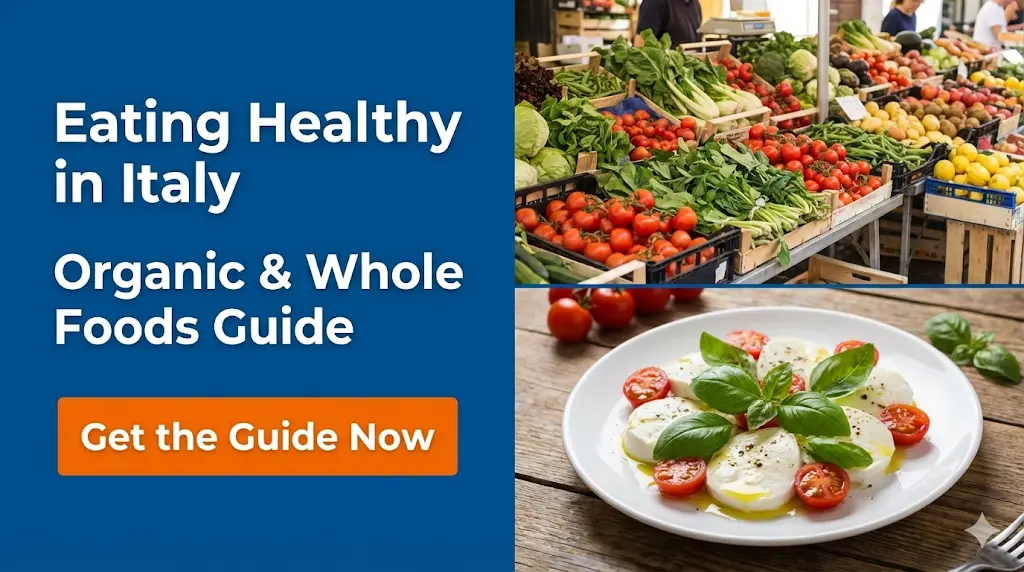
Eating Healthy: Organic and Whole Foods in Italy
Discover how to maintain a healthy lifestyle in Italy by embracing organic and whole foods. This comprehensive guide covers decoding local biologico labels, navigating vibrant farmers markets, finding specialized health food stores, and shopping for seasonal ingredients.
Disclosure: This post may contain affiliate links. We may earn a commission at no extra cost to you if you make a purchase through these links. Read full disclosure.
Introduction
Transitioning your diet in a new country can be an intimidating process. As an expatriate, you might find yourself wandering the aisles of a foreign supermarket, struggling to translate ingredient labels, and searching in vain for the familiar health food brands you relied upon back home. You might wonder where to find organic produce, how to identify whole grains, or how to navigate dietary restrictions in a country famous for its wheat-based staples.
The excellent news is that Italy is one of the easiest and most rewarding countries in the world in which to maintain a healthy, whole-food-based lifestyle. The entire Italian culinary philosophy revolves around the quality of raw ingredients rather than complex, heavy sauces or artificial additives. By learning how the local food supply chain works, you can easily access some of the most nutritious, pesticide-free, and delicious foods available anywhere in Europe.
This extensive guide will serve as your roadmap to healthy eating in Italy. We will decode the labeling systems used for organic products, provide insider tips on shopping at local outdoor markets, highlight the best supermarket chains for health-conscious consumers, and explain how to eat seasonally like a true Italian. Whether you are a dedicated vegan, managing a gluten intolerance, or simply looking to fuel your body with clean, vibrant foods, this guide will help you navigate the Italian culinary landscape with absolute confidence. For a broader look at how this fits into your overall well-being, you can also explore our guide on Mediterranean Diet Benefits and Nutrition in Italy.
The Philosophy of the Italian Diet
To truly understand how to eat healthily in Italy, you must first understand the fundamental philosophy that guides local consumption. The authentic Italian diet is the epitome of the Mediterranean Diet, a nutritional framework recognized globally by cardiologists and dietitians as one of the healthiest in the world.
Emphasis on Whole Foods
In Italy, the concept of a “whole food” is not a modern wellness trend; it is simply how food has always been consumed. A whole food is an ingredient that has been processed or refined as little as possible, free from artificial additives, preservatives, and excess added sugars. The traditional Italian pantry is built entirely on these foundations. It relies heavily on fresh vegetables, robust legumes like chickpeas and lentils, unrefined grains, lean proteins from wild-caught fish, and healthy fats derived almost exclusively from high-quality extra virgin olive oil.
The Slow Food Movement
Italy is the birthplace of the Slow Food movement, an organization founded in the 1980s to combat the rise of fast food and the erosion of local food traditions. This movement champions the concept of “good, clean, and fair” food. It actively promotes sustainable agriculture, the preservation of heirloom seeds, and the ethical treatment of farm workers. Because of this deeply ingrained cultural respect for agriculture, you will find that the quality of standard, non-organic produce in Italy is often vastly superior to the heavily commercialized produce found in North America or Northern Europe.
Understanding Organic Food Labels in Italy
If you are committed to eating strictly organic foods to avoid synthetic pesticides and chemical fertilizers, you need to know what to look for on Italian packaging. The term “organic” translates to “biologico” in Italian, often abbreviated simply as “Bio.”
The European Union Organic Certification
Italy adheres to the strict agricultural standards set by the European Union. When shopping for packaged goods, fresh produce, or dairy, you should look for the official EU organic logo. This logo features a stylized leaf made of white stars against a bright green background.
For a product to legally bear this Euro-leaf logo in Italy, it must fulfill stringent conditions:
- At least ninety-five percent of its agricultural ingredients must be organically farmed.
- It must comply with strict rules on animal welfare.
- The use of chemical pesticides and synthetic fertilizers is heavily restricted.
- Genetically modified organisms (GMOs) are strictly prohibited.
Beneath the Euro-leaf logo, you will often see a code (such as IT-BIO-009) which identifies the specific national control body that certified the product, providing complete traceability from the farm to the supermarket shelf.
DOP IGP and STG Certifications
While not strictly organic certifications, you will frequently encounter acronyms like DOP, IGP, and STG on high-quality Italian foods. These are geographical indications that guarantee the authenticity, origin, and traditional production methods of a product.
- DOP (Denominazione di Origine Protetta): Protected Designation of Origin. This guarantees that every step of the food’s production, processing, and preparation took place in a specific geographic region using traditional methods. Examples include authentic Parmigiano Reggiano cheese or San Marzano tomatoes.
- IGP (Indicazione Geografica Protetta): Protected Geographical Indication. This indicates that at least one of the stages of production occurred in a specific region.
While a DOP product is not automatically certified “Bio,” the strict adherence to traditional, artisanal production methods means these foods are almost always whole, unadulterated, and free from modern industrial additives.
Chilometro Zero The Sustainable Alternative
In Italy, you will often hear the phrase “chilometro zero” (zero kilometer). This refers to food that is produced, sold, and consumed locally, significantly reducing the environmental impact of transportation. Many local Italian farmers employ organic, pesticide-free farming methods but cannot afford the expensive bureaucratic process of obtaining the official EU “Bio” certification. Buying chilometro zero produce directly from these local farmers is often just as healthy, if not healthier, than buying certified organic produce that has been shipped across the continent.
Navigating the Italian Farmers Market
The absolute best place to source fresh, whole, and seasonal foods in Italy is the local outdoor market, known as the mercato. Almost every neighborhood, town, and village in Italy hosts a market at least once a week, while larger cities have permanent daily markets. For a deeper dive into the logistics of your weekly errands, check out our guide on Grocery Shopping in Italy: Supermarkets vs Markets.
The Market Experience
Shopping at a mercato is a vibrant, sensory experience. It is a place of loud voices, colorful displays, and intense community interaction. The produce you find here was likely pulled from the earth just hours before. The vendors, known as fruttivendoli, take immense pride in their offerings.
To successfully navigate an Italian farmers market, you must understand a few crucial unwritten rules of etiquette. The most important rule is that you generally do not touch the produce yourself. In many countries, shoppers squeeze the tomatoes and inspect every apple before placing them in their bags. In Italy, this is considered highly rude and unsanitary. Instead, you wait your turn, greet the vendor with a polite “Buongiorno,” and verbally request what you want. The vendor will select the best pieces for you and weigh them.
Building Relationships with Vendors
If you want the best organic produce, you need to ask questions. You can ask the vendor, “È biologico?” (Is it organic?) or “Da dove viene?” (Where is this from?). Vendors are usually incredibly happy to discuss the origin of their food. Building a rapport with your local fruttivendolo guarantees that they will save the sweetest peaches or the most tender spinach for you week after week.
What to Buy at the Market
The market is your primary source for raw, whole foods.
- Fresh Produce: Seasonal vegetables, leafy greens, root vegetables, and fresh fruits.
- Legumes and Grains: Many stalls sell large sacks of dried, whole legumes like chickpeas (ceci), lentils (lenticchie), and ancient grains like spelt (farro) and barley (orzo).
- Nuts and Seeds: Raw, unsalted walnuts, almonds, and pine nuts are abundant.
- Fresh Herbs: Massive bunches of basil, rosemary, sage, and mint, which are essential for flavoring healthy meals without relying on salt or heavy sauces.
Supermarkets and Specialized Health Food Stores
While the farmers market is ideal for fresh produce, you will inevitably need to visit a supermarket for pantry staples, household items, and specific health foods. The Italian supermarket landscape has evolved dramatically over the last decade, becoming highly accommodating to the health-conscious consumer.
The “Bio” Aisle in Mainstream Supermarkets
Major Italian supermarket chains such as Coop, Esselunga, Conad, and Pam have recognized the massive demand for healthy eating. Almost all mid-to-large-sized supermarkets now feature dedicated “Bio” aisles.
These chains have also developed their own high-quality, in-house organic brands, making organic eating highly affordable. For example, Coop features the “Vivi Verde” line, which encompasses everything from organic extra virgin olive oil to organic whole wheat pasta and eco-friendly cleaning products. Conad offers the “Verso Natura” line, focusing on organic, vegetarian, and environmentally sustainable goods.
Specialized Health Food Stores
If you are looking for highly specific health items—such as adaptogenic powders, rare alternative flours, organic tofu, or specialized dietary supplements—you will want to visit a dedicated health food store.
The most prominent organic supermarket chain in Italy is NaturaSì. With hundreds of locations across the country, NaturaSì is the closest Italian equivalent to stores like Whole Foods Market in the United States. They sell exclusively organic, biodynamic, and natural products. Walking into a NaturaSì, you will find an abundance of organic fresh produce, extensive bulk bins for zero-waste shopping, high-quality vegan alternatives, and a massive selection of natural cosmetics.
Another excellent resource is the traditional Erboristeria. Italy respects its herbalist traditions. While primarily known for natural remedies, the erboristeria is also a fantastic place to buy high-quality, loose-leaf herbal teas, organic essential oils, and specialized whole-food supplements. If you are interested in how these shops bridge the gap between diet and medicine, take a look at Complementary Medicine: Homeopathy and Acupuncture in Italy.
Useful Italian Terms for Healthy Shopping
Navigating food labels requires a specific vocabulary. To help you read packaging and communicate your needs, we have compiled a table of essential Italian terms related to healthy, organic, and whole foods.
| English Term | Italian Translation | Context / Usage Notes |
| Organic | Biologico (or Bio) | Look for this on labels; guarantees EU certification standards. |
| Whole Grain / Whole Wheat | Integrale | Used for pasta, bread, and rice (e.g., Pasta Integrale). |
| Gluten-Free | Senza Glutine | Crucial for celiacs; heavily regulated and clearly marked. |
| Sugar-Free / No Added Sugar | Senza Zucchero Aggiunto | Found on fruit juices, plant milks, and jams. |
| Vegan / Plant-Based | Vegano / 100% Vegetale | Indicates no animal products were used. |
| Lactose-Free | Senza Lattosio | Used for milk alternatives or lactose-free cow’s milk. |
| Zero Kilometer / Local | A Chilometro Zero (Km 0) | Indicates the product was grown very close to where it is sold. |
| Preservative-Free | Senza Conservanti | Shows the food is free from artificial shelf-life extenders. |
| Cold-Pressed (Olive Oil) | Spremuto a Freddo | The healthiest, most nutrient-dense method of extracting olive oil. |
| Spelt / Ancient Wheat | Farro | A highly nutritious, ancient whole grain very popular in Italy. |
The Importance of Seasonal Eating
One of the cornerstones of eating healthy whole foods in Italy is adhering strictly to the seasons. In many Western countries, the globalization of the food supply chain means you can buy a tomato or a strawberry in the dead of winter. While this is convenient, out-of-season produce is often picked prematurely, shipped thousands of miles, and severely lacking in flavor and nutritional density.
In Italy, eating out of season is generally frowned upon. Supermarkets and local markets naturally cycle their offerings based on what the earth is currently producing. Eating seasonally ensures that your food is at its peak nutritional value, packed with vitamins, and naturally more affordable because it is abundant.
A Quick Guide to Italian Seasons
To maximize your nutrient intake, align your shopping list with the Italian harvest calendar:
- Spring (Primavera): This is the season of renewal. Look for tender asparagus, vibrant green peas, fava beans, and the absolute king of the Italian spring: the artichoke (carciofo). Spring is also the time for fresh, bitter greens which are excellent for liver health and digestion.
- Summer (Estate): The Mediterranean summer yields an explosion of color. This is the only time you should be buying tomatoes (pomodori), which are rich in lycopene. Summer also brings zucchini, eggplants (melanzane), bell peppers, fresh basil, and sweet fruits like peaches, melons, and figs.
- Autumn (Autunno): As the weather cools, the diet becomes earthier. Autumn is famous for wild mushrooms, particularly Porcini, which are excellent sources of B vitamins. Look for pumpkins (zucca), chestnuts, fresh apples, pears, and the highly anticipated olive harvest, which yields the freshest, spiciest new olive oil (olio nuovo).
- Winter (Inverno): Winter is the season for robust immunity-building foods. The markets are dominated by citrus fruits from the south—oranges, lemons, and mandarins packed with Vitamin C. You will also find hearty cruciferous vegetables like broccoli, cauliflower, fennel (finocchio), and the Tuscan staple, black kale (cavolo nero), which is an absolute nutritional powerhouse.
Managing Dietary Restrictions in Italy
A common concern for expats with specific dietary needs is that Italy, a country famous for pasta, cheese, and cured meats, will be difficult to navigate. In reality, Italy is incredibly accommodating to dietary restrictions.
Eating Gluten Free (Senza Glutine)
If you suffer from Celiac disease or gluten intolerance, Italy is surprisingly one of the safest and easiest countries in the world to live in. The Italian government takes Celiac disease very seriously, classifying it as a recognized medical condition.
The Italian Celiac Association (AIC) strictly monitors restaurants, pizzerias, and food brands. In supermarkets, the Senza Glutine sections are massive, offering high-quality gluten-free pastas made from corn, rice, and legumes, alongside gluten-free breads and snacks. Furthermore, virtually all pharmacies carry specialized, certified gluten-free dietary foods. In fact, residents diagnosed with Celiac disease receive a monthly monetary voucher from the public healthcare system specifically to subsidize the cost of these gluten-free products.
Vegan and Vegetarian Diets
Maintaining a plant-based diet in Italy is remarkably simple if you focus on whole foods rather than processed meat substitutes. The traditional Mediterranean diet is naturally plant-heavy.
Many classic, historical Italian dishes are “accidentally” vegan. For example, Pasta al Pomodoro (pasta with tomato sauce), Ribollita (a hearty Tuscan vegetable and bean stew), Pasta e Fagioli (pasta with beans), and Caponata are entirely plant-based. When shopping, you will find that legumes are a massive staple of the Italian diet, providing excellent, cheap sources of vegan protein. For milk alternatives, all major supermarkets carry a wide variety of oat, soy, almond, and rice milks (latte vegetale).
Integrating Whole Foods into Your Daily Routine
Embracing the Italian approach to healthy eating means changing how you structure your meals and your relationship with food preparation.
Cooking at Home
The most effective way to ensure you are eating whole, organic foods is to cook at home. Italian cooking relies on simplicity. A healthy dinner does not require complex recipes or hours in the kitchen. A standard, highly nutritious Italian meal might consist of a piece of baked wild-caught fish, a large side of seasonal vegetables sautéed lightly in garlic and extra virgin olive oil, and a small portion of whole-grain bread or farro.
The Importance of Extra Virgin Olive Oil
If you make only one change to your diet when moving to Italy, let it be upgrading your cooking fat. Replace butter, margarine, and highly processed seed oils (like canola or vegetable oil) with high-quality Extra Virgin Olive Oil (Olio Extra Vergine di Oliva or EVO).
Extra virgin olive oil is the absolute lifeblood of the Italian diet. It is loaded with heart-healthy monounsaturated fats and powerful antioxidants. When shopping, spend the extra money to buy oil that is sold in dark glass bottles (to protect it from light degradation) and is marked as “estratto a freddo” (cold-extracted). Use it generously to dress salads, drizzle over cooked vegetables, and even to cook with at moderate temperatures.
Rethinking Portion Sizes and Snacking
Healthy eating in Italy is also about portion control. Pasta is consumed frequently, but a traditional Italian portion of pasta is a small primo piatto (first course), usually around 80 to 100 grams, rather than the massive, overflowing bowls served in foreign restaurants.
Furthermore, the concept of constant, mindless snacking is relatively rare in Italy. Meals are respected as distinct events in the day. By eating nutrient-dense, whole-food meals at breakfast, lunch, and dinner, you stabilize your blood sugar and eliminate the urge to consume processed snack foods.
Cost and Budgeting for Organic Foods
A common misconception is that eating a whole-food, organic diet is prohibitively expensive. While it is true that a basket of certified organic produce at a specialized store like NaturaSì will cost more than conventional produce at a discount supermarket, eating healthily in Italy can be incredibly economical if approached strategically.
The key to budgeting is to prioritize seasonal produce from the farmers market and to rely heavily on affordable whole-food staples like dried legumes and whole grains. Meat and highly processed convenience foods are the most expensive items in the Italian grocery basket. By adopting a more plant-forward Mediterranean diet, you significantly reduce your grocery bills. To understand how these grocery costs factor into your broader monthly expenses, review our detailed guide on the Cost of Living in Italy 2026: Budgeting for Expats.
Conclusion
Eating healthy, organic, and whole foods in Italy is not an arduous chore or an expensive luxury; it is a seamless integration into a culture that has revered the earth’s natural bounty for millennia. The transition simply requires stepping away from the convenience of heavily processed foods and embracing the vibrant, sensory experience of local Italian markets and specialized biologico aisles.
By educating yourself on the EU organic labeling system, learning to communicate with your local market vendors, and committing to eating strictly according to the seasons, you will radically transform your health. You will find that cooking with high-quality extra virgin olive oil, fresh herbs, and ancient whole grains makes healthy eating incredibly delicious. Ultimately, adopting the authentic Italian approach to food—one that values quality, simplicity, and the joy of a shared meal—will not only nourish your physical body but will profoundly enrich your entire expatriate experience in the magnificent Bel Paese.
References
Primary Sources Official
- Ministero della Salute (Italian Ministry of Health): The official government portal outlining nutritional guidelines, the Mediterranean diet framework, and regulations supporting Celiac patients. https://www.salute.gov.it/
- European Commission – Organic Farming: The official European Union website detailing the strict agricultural standards, pesticide limitations, and legal requirements for using the Euro-leaf organic logo. https://agriculture.ec.europa.eu/farming/organic-farming_en
Other Helpful Sources
- Slow Food Italy: The official organization dedicated to preserving local food cultures, promoting biodiversity, and advocating for good, clean, and fair agricultural practices. https://www.slowfood.it/
- Associazione Italiana Celiachia (AIC): The Italian Celiac Association provides an extensive, indispensable directory of certified gluten-free foods, safe restaurants, and medical guidelines for expats with gluten intolerances. https://www.celiachia.it/
Disclaimer
The information provided in this article is for educational and informational purposes only and does not constitute official medical, dietary, or nutritional advice. Dietary needs, food intolerances, and health conditions are highly individualized. Always consult with a licensed medical professional, a registered dietitian, or a certified healthcare provider before making significant changes to your diet, managing food allergies like Celiac disease, or beginning any new nutritional supplement regimen while living in or traveling through Italy.