Pharmacies Open on Public Holidays (e.g., Ferragosto)
Falling ill during an Italian public holiday can be stressful when most businesses close. This comprehensive guide explains how to find duty pharmacies during major holidays like Ferragosto, understanding out-of-hours fees, and navigating the healthcare system for urgent needs.
Disclosure: This post may contain affiliate links. We may earn a commission at no extra cost to you if you make a purchase through these links. Read full disclosure.
Introduction
In Italy, public holidays are deeply respected and universally observed. While a few tourist-centric restaurants and major museum attractions might remain operational in the historic centers of Rome, Florence, or Venice, the vast majority of commercial businesses, offices, and essential services shut their doors completely to allow workers to celebrate with their families. This widespread closure can trigger an immediate sense of panic for expatriates and travelers who suddenly find themselves in need of medical supplies, over-the-counter painkillers, or urgent prescription refills.
However, the Italian healthcare system is meticulously designed to ensure that no citizen or visitor is ever left without access to essential medical care and pharmaceutical supplies, regardless of the date on the calendar. The solution to this holiday shutdown lies in a highly organized, legally mandated rotational system known as the duty pharmacy network.
Understanding how this rotational system works, knowing exactly where to look for information when your local shop is closed, and being aware of the specific surcharges that apply during holidays and late-night hours are essential survival skills for anyone spending a significant amount of time in the Bel Paese. This extensive guide will demystify the process of finding open pharmacies on public holidays, specifically highlighting massive national shutdowns like Ferragosto, and will provide you with the practical tools and knowledge required to navigate these situations with absolute confidence.
The Cultural Impact of Italian Public Holidays
To understand why finding an open pharmacy requires a specific system, one must first understand the profound cultural significance of public holidays in Italy. Unlike in some Western countries where holidays are merely an excuse for major retail sales and extended shopping hours, Italian holidays are characterized by rest, religious observance, and large family gatherings.
When a “Red Letter Day” (a national public holiday marked in red on the calendar) arrives, the standard rhythm of life stops. This is especially true for holidays that fall on a Thursday or Tuesday, often resulting in a “ponte” (a bridge), where Italians take the intervening Friday or Monday off to create an ultra-long weekend. If you are unfamiliar with the specific dates that trigger these massive closures, you should review our guide on Italian Public Holidays: What Services Are Closed to properly prepare your household and schedule.
The most notorious of these holidays is Ferragosto, celebrated on August 15th. Originally instituted by the Emperor Augustus to celebrate the harvest, and later adopted by the Catholic Church as the Assumption of Mary, Ferragosto marks the absolute peak of the Italian summer vacation period. In the weeks surrounding Ferragosto, entire cities empty out as locals flee to the mountains or the coast. Finding regular services open in a non-coastal city during mid-August is incredibly challenging, making the duty pharmacy system an absolute lifeline for those who remain behind.
Understanding the Farmacia di Turno System
The Italian government recognizes that illness and medical emergencies do not take holidays. Therefore, the law mandates a continuous, uninterrupted pharmaceutical service for the population. This is achieved through the Farmacia di Turno (Duty Pharmacy) system.
How the Rotational System Works
In every municipality across Italy, pharmacies operate in a coordinated syndicate managed by the local health authority and the professional order of pharmacists. When standard operating hours end—which includes nights, Sundays, and all national public holidays—a designated number of pharmacies are legally required to remain open to serve the community.
These duty pharmacies rotate. The pharmacy that is open on Christmas Day this year will likely be closed next Christmas, passing the duty to another pharmacy in the district. In large metropolitan areas like Milan or Naples, there are always multiple duty pharmacies open simultaneously, scattered strategically across different neighborhoods to ensure that no resident has to travel an unreasonable distance. In smaller provincial towns or rural villages, multiple neighboring municipalities might share a single duty pharmacy on a rotating basis, meaning you might have to drive to the next town over to get your medication.
The Role of the Pharmacist
It is crucial to remember that Italian pharmacies are highly regulated healthcare facilities, not standard retail convenience stores. The person serving you is a highly educated medical professional. Because you cannot simply browse aisles for medications in Italy, you must consult the professional behind the counter. For a deeper understanding of what these professionals can do for you and the legal boundaries they operate within, consult our article on Consulting a Pharmacist in Italy: Fees and Regulations.
Identifying an Open Pharmacy on a Holiday
When you need medicine on Ferragosto, Easter, or New Year’s Day, you will likely find that your usual neighborhood pharmacy has its metal grates pulled down. Do not panic; the information you need to find an open alternative is directly in front of you.
Reading the Notice Board (La Bacheca)
By strict municipal law, every single pharmacy in Italy must display a clear, easily readable notice board on their exterior wall or door, even when they are closed. This board, usually encased in glass, provides the official schedule of the Farmacie di Turno for that specific day and week.
When you walk up to your closed local pharmacy, look for a printed list. It will state the current date and provide the names, addresses, and often the telephone numbers of the pharmacies in your immediate vicinity that are currently on duty. Some modern pharmacies have upgraded from paper lists to digital scrolling screens, but the function remains exactly the same.
The Flashing Green Cross
The universal symbol of a pharmacy in Italy is a large, illuminated green cross protruding from the building. This cross serves as a visual indicator of the pharmacy’s status.
- If the green cross is switched off, the pharmacy is closed.
- If the green cross is illuminated and flashing or entirely lit up, the pharmacy is open and actively serving the public. During a public holiday or late at night, spotting a glowing green cross from down the street is a deeply reassuring sight.
Digital Tools for Finding Duty Pharmacies
While walking to the nearest closed pharmacy to read the paper notice board is the traditional method, technology has made finding a duty pharmacy much easier, especially if you are too ill to leave your bed without a guaranteed destination.
National and Regional Websites
The National Federation of Italian Pharmacy Owners (Federfarma) and regional health authorities maintain updated digital databases of duty pharmacies. You can search online using terms like “Farmacie di turno” followed by the name of your city or postal code. These websites are highly reliable because the shift schedules are legally mandated and planned months in advance.
Mobile Applications
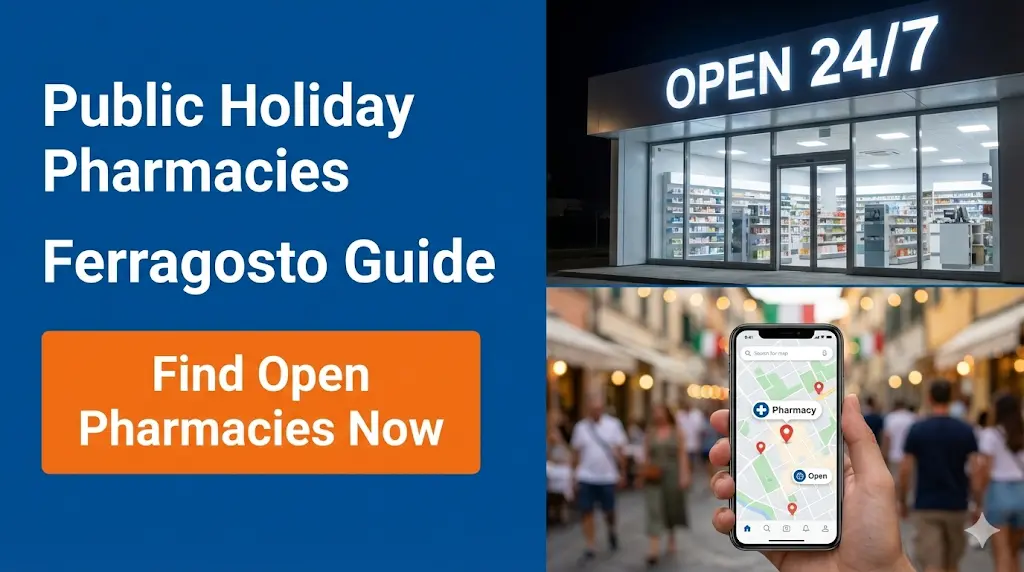
Several free mobile applications have been developed specifically to solve this problem. Apps like “Farmacie di Turno” use your smartphone’s GPS location to pinpoint exactly where you are and provide a map to the nearest open pharmacy, along with its operating hours and contact information. Downloading one of these apps is highly recommended for any expatriate living in Italy.
Calling the Information Line
In some regions, you can dial a specific local toll-free number to hear an automated recording listing the open pharmacies in your postal code. Additionally, local newspapers usually print the duty pharmacy schedule in their daily editions, though this is less useful for those who rely primarily on digital news.
Surcharges and Fees for Holiday and Night Services
Operating a pharmacy during a major national holiday or in the middle of the night incurs additional staffing and operational costs. To compensate the pharmacist for working these unsociable hours and to deter people from utilizing emergency services for non-urgent purchases, the Italian system implements a specific surcharge.
The Diritto di Chiamata (Call Fee)
When you purchase medication from a duty pharmacy outside of standard operating hours (which includes nights and full public holidays like Ferragosto or Christmas), the pharmacist is legally entitled to apply a surcharge to your bill. This is known as the Diritto di Addizionale or Diritto di Chiamata (Call Fee).
As of the current national regulations, this fee is typically €7.50 for night shifts and holiday duties. This fee is added to the total cost of your receipt, regardless of what you purchase. If you go to a duty pharmacy on a public holiday to buy a €5 box of ibuprofen, your total bill will be €12.50.
Exemptions to the Holiday Fee
There is a critical exception to this surcharge designed to protect those experiencing genuine medical emergencies. The €7.50 holiday or night fee is completely waived if you meet all of the following criteria:
- You present a prescription from a doctor.
- The prescription was written by an emergency room doctor, a hospital ward, or the out-of-hours duty doctor (Guardia Medica).
- The prescription explicitly states that the medication is “Urgente” (Urgent).
- You bring the prescription to the pharmacy on the exact same day or night it was issued.
If you meet these conditions, you will only pay the standard cost of the medication or the standard regional co-pay (ticket), and the extra holiday fee is waived.
The Physical Experience of a Holiday Pharmacy Visit
Visiting a duty pharmacy, particularly late at night or during a deserted public holiday afternoon, can be a unique experience. To ensure the safety and security of the pharmacist working alone, the physical layout of the transaction often changes.
The Service Hatch (Lo Sportello)
During standard daytime hours, you walk through the automatic doors and stand at a large counter. However, during night shifts or on extremely quiet holidays, the main doors of the pharmacy will likely be locked.
Instead, you will find a small, reinforced service hatch or window integrated into the front door or the wall next to it. You will usually need to press a buzzer or ring a doorbell next to this hatch to summon the pharmacist. You will communicate with the pharmacist through an intercom, pass your prescription or request through a sliding drawer, and receive your medication and change through the same secure mechanism. Do not be offended by this; it is a standard security protocol across all of Europe for out-of-hours pharmaceutical service.
What You Can and Cannot Buy on a Holiday
When utilizing a duty pharmacy on a public holiday, it is important to manage your expectations regarding what the pharmacist can legally provide. The laws governing the dispensing of medications in Italy remain strictly in place, regardless of the day of the year.
Over the Counter and SOP Medications
You can freely purchase any Over the Counter (OTC) medication or medication Without Prescription Obligation (SOP) on a public holiday. If you have a headache, a mild allergic reaction, a sudden bout of indigestion after a heavy holiday meal, or need basic first aid supplies like bandages and antiseptics, the pharmacist will readily assist you. If you are unsure of the Italian brand names for your usual home remedies, our guide on Finding and Using Pharmacies in Italy provides helpful translations and equivalencies.
The Problem with Prescription Medications
The most stressful scenario for an expat is running out of a critical, chronic prescription medication on a public holiday when your regular family doctor is unavailable.
By law, an Italian pharmacist cannot dispense prescription-only medications (like antibiotics, strong corticosteroids, or cardiovascular drugs) without a valid doctor’s prescription. If you show up on Ferragosto demanding antibiotics for a sinus infection, the pharmacist will legally refuse you, no matter how much pain you are in.
There is a small caveat for extreme emergencies: if you have a chronic condition and can present an empty box with your name on the pharmacy label, or a previous medical report proving your diagnosis, a pharmacist may use their professional discretion to provide a very small, temporary emergency supply to tide you over. However, this is never guaranteed and absolutely does not apply to controlled substances, narcotics, or psychiatric medications.
The Guardia Medica The Solution for Holiday Prescriptions
If you find yourself desperately needing a prescription medication on a public holiday, you cannot simply rely on the pharmacy. You must first see a doctor to obtain the prescription. Because standard General Practitioner clinics are closed on public holidays and weekends, the Italian healthcare system provides a specialized service known as the Guardia Medica or Continuità Assistenziale (Continuity of Care).
How the Guardia Medica Works
The Guardia Medica is a network of public, out-of-hours doctors who are on call specifically when normal clinics are closed. This includes nights (usually from 8:00 PM to 8:00 AM), weekends, and all public holidays (starting from 10:00 AM on the day before the holiday).
If you need antibiotics on Christmas Day or strong painkillers on Ferragosto, you must locate the local Guardia Medica clinic in your district. You can usually find the address and phone number on your regional health authority’s website, or by dialing a specific regional toll-free number.
You visit the Guardia Medica, explain your symptoms to the on-call doctor, and if they deem it medically necessary, they will write you a formal medical prescription. You then take this prescription to the open Farmacia di Turno to collect your medication. This two-step process is the official, legal way to handle non-life-threatening medical issues during an Italian public holiday.
When to Skip the Pharmacy and Go to the ER
It is vital to distinguish between a situation that requires a duty pharmacy and a true medical emergency. Pharmacies and the Guardia Medica are designed for urgent but non-life-threatening situations.
If you or a family member experience symptoms such as severe chest pain, difficulty breathing, sudden numbness or weakness, signs of a stroke, or major physical trauma, do not waste time searching for a duty pharmacy. You must seek immediate emergency medical intervention.
In these critical scenarios, you must dial 112, the universal European emergency number, to dispatch an ambulance, or proceed immediately to the nearest public hospital’s Pronto Soccorso (Emergency Room). The emergency rooms in Italian public hospitals operate 24 hours a day, 365 days a year, and are fully equipped to handle severe crises.
Major Public Holidays Affecting Pharmacy Hours
To help you anticipate when the standard pharmacy schedules will be disrupted, it is essential to familiarize yourself with the Italian public holiday calendar. On the following days, standard shops will close, and only the designated Farmacie di Turno will remain open:
- January 1: Capodanno (New Year’s Day)
- January 6: Epifania (Epiphany)
- Varies (March/April): Pasqua (Easter Sunday)
- Varies (March/April): Pasquetta (Easter Monday)
- April 25: Festa della Liberazione (Liberation Day)
- May 1: Festa dei Lavoratori (Labor Day)
- June 2: Festa della Repubblica (Republic Day)
- August 15: Ferragosto (Assumption of Mary)
- November 1: Tutti i Santi (All Saints’ Day)
- December 8: Immacolata Concezione (Immaculate Conception)
- December 25: Natale (Christmas Day)
- December 26: Santo Stefano (St. Stephen’s Day)
Additionally, every single municipality in Italy celebrates the feast day of its specific Patron Saint (Festa del Santo Patrono). On this localized public holiday, the specific town will shut down as if it were a national holiday, and the duty pharmacy system will be activated just for that municipality. For example, Rome shuts down on June 29th for St. Peter and St. Paul, while Milan observes its local holiday on December 7th for St. Ambrose.
Essential Italian Vocabulary for Holiday Emergencies
When visiting a duty pharmacy on a holiday, the pharmacist may not speak fluent English, especially in rural areas or outside of the main tourist centers. Knowing a few key phrases will help you communicate your needs effectively through the service hatch:
- Where is the duty pharmacy?: Dov’è la farmacia di turno?
- I have an emergency: Ho un’emergenza.
- I need a painkiller: Ho bisogno di un antidolorifico.
- Do you have medicine for a fever?: Ha una medicina per la febbre?
- I have a prescription from the Guardia Medica: Ho una ricetta della Guardia Medica.
- Can you check my blood pressure?: Può misurarmi la pressione?
- My stomach hurts: Mi fa male lo stomaco.
- I am allergic to penicillin: Sono allergico/a alla penicillina.
Preparing Your Medicine Cabinet Before the Holidays
The absolute best way to handle finding an open pharmacy on a public holiday is to avoid needing one in the first place. Expatriates and seasoned travelers in Italy quickly learn to practice proactive healthcare management.
As major holidays like Ferragosto or Christmas approach, take inventory of your home medicine cabinet. Ensure you have an adequate supply of basic necessities: a reliable thermometer, paracetamol or ibuprofen for fevers and pain, antacids for holiday overindulgence, antihistamines for unexpected allergies, and basic first aid supplies.
Most importantly, if you rely on daily prescription medications for chronic conditions like hypertension, diabetes, or asthma, check your supply at least two weeks before a major holiday. Schedule an appointment with your family doctor to secure your prescription refills and visit your local, regular pharmacy before the holiday closures begin. Being proactive guarantees your health and allows you to enjoy the Italian festivities without the stress of navigating the duty pharmacy system.
Conclusion
The initial shock of encountering a completely shuttered Italian city on a public holiday like Ferragosto is a rite of passage for many expatriates. However, beneath the quiet streets lies a deeply organized, legally structured system designed to prioritize public health above all else.
By understanding the mechanics of the Farmacia di Turno, familiarizing yourself with the visual cues of the illuminated green cross and the paper notice boards, and utilizing modern digital apps, you can easily locate vital pharmaceutical services 365 days a year. Furthermore, by acknowledging the integration of the Guardia Medica for urgent prescriptions and understanding the justification for the holiday call fee, you can navigate these stressful moments with the poise and confidence of a local. Italy’s commitment to continuous healthcare ensures that even when the country stops to celebrate, your health and safety are never left unattended.
References
Primary sources official
- Federfarma: The National Federation of Italian Pharmacy Owners. This is the definitive source for national regulations regarding duty pharmacies, legal holiday surcharges, and finding authorized regional pharmacy locators. https://www.federfarma.it/
- Ministero della Salute: The official portal of the Italian Ministry of Health, providing overarching guidelines on the continuity of care, the obligations of the SSN, and out-of-hours medical services. https://www.salute.gov.it/
Other helpful sources
- Farmacie di Turno: A dedicated, nationwide digital directory and mobile app service providing real-time geographical data on open pharmacies across all Italian municipalities. https://www.farmaciediturno.org/
Disclaimer
The information provided in this article is intended for general educational and informational purposes only and does not constitute official medical, diagnostic, or legal advice. The operational hours of duty pharmacies, the availability of specific medications, and the exact cost of the out-of-hours surcharge (diritto di chiamata) are subject to change based on regional legislation and national health authority updates. Always consult directly with a licensed Italian pharmacist or medical professional for personalized advice. In the event of a severe, life-threatening medical emergency, do not delay by searching for a pharmacy; please dial the universal European emergency number 112 immediately to dispatch an ambulance or proceed directly to the nearest hospital emergency room.