Affittacamere and Case Vacanza: Reading Italy’s Accommodation Categories
You find a sunny double near Campo de’ Fiori labelled “affittacamere,” book it, and land at nine in the evening. There is no reception, a keypad on the street door, and a shared corridor with three other guest rooms. Italy’s accommodation labels are legal categories, not marketing words. This guide explains what affittacamere, casa vacanza and their neighbours mean, so you know what you’re booking before you pay.
Disclosure: This post may contain affiliate links. We may earn a commission at no extra cost to you if you make a purchase through these links. Read full disclosure.
Why Italian Accommodation Labels Matter More Than Star Ratings
When I first moved here, I treated every listing like a hotel with a different name. That cost me some odd nights. Once I was handed keys by a neighbour’s teenager because the owner was “at her sister’s in Frosinone.” Another time I discovered that “kitchen” meant a two-ring hob hidden inside a wardrobe.
None of this was a scam. The listings were accurate, and I simply didn’t speak the language of Italian accommodation law. Each category tells you, in legal shorthand, who runs the place, what services exist, and what you’ll handle yourself. Once you can read the labels, Italy gets far easier to book.
Categories Are Set by Regional Law
Hotel stars are the category foreigners understand, but most of Italy’s charm sits in the “extra-hotel” world: the strutture extralberghiere. Each of Italy’s regions writes its own rules for these structures. That means an affittacamere in Tuscany may be regulated slightly differently from one in Puglia or Lombardy.
The differences show up in details. Regions set how many rooms a property can have before it must reclassify. They decide whether breakfast may be served, whether the owner must live on site, and what minimum facilities are required. You don’t need to memorise regional statutes, which even locals don’t know. The useful takeaway is that the category name tells you the broad shape of the stay. The house rules and listing details then tell you the local specifics.
This is also why two places with the same label can feel completely different. A Venetian affittacamere might be three rooms in a crooked palazzo with a host who brings you a pastry. A Milanese one might be a sleek, keyless operation run by a management company that you never meet in person. Both are legal, and both are “affittacamere.” What matters is which one suits you, and you can only tell if you read beyond the headline.
The Words You Will See Most Often
Below is the cheat sheet I wish someone had given me on day one. Keep it open while you browse. For the hotel side of things, our broader overview in Accommodation in Italy: Hotels, B&Bs, and Agriturismi covers star ratings and rural stays in more depth.
| Italian Term | What You Rent | Who Runs It | Typical Services | Kitchen Access | Best For |
|---|---|---|---|---|---|
| Hotel / Albergo | A room in a dedicated building | A licensed hotel business | Reception, daily cleaning, often breakfast | Rarely | Short city stops, late arrivals |
| Affittacamere | A private room within a property that has several guest rooms | An owner or operator, not always on site | Room cleaning, linen; breakfast only where regional rules allow | Sometimes a shared kitchenette, often none | Solo travellers and couples on short stays |
| Bed and Breakfast | A room in the host’s own home, usually with breakfast | A private host who typically lives there | Breakfast, personal hosting | Usually not | Travellers who enjoy local contact |
| Casa Vacanza | An entire independent unit, such as an apartment or house | A private owner or a property manager | Keys, linen, cleaning at check-out | Yes, a private kitchen | Families, groups, stays of a week or more |
| CAV, Case e Appartamenti per Vacanze | Entire independent units, often several in one building | An operator managing them as a business | Basic services, cleaning between guests | Yes, a private kitchen | Longer stays with some professional backup |
| Locazione Turistica | An entire unit under a short tourist lease | A private owner | Minimal or no hotel-style services | Yes, a private kitchen | Self-sufficient travellers |
| Residence / RTA | A serviced apartment within a managed complex | A hospitality business | Reception, cleaning, sometimes a pool | Yes | Long stays with services |
| Agriturismo | A room or apartment on a working farm | A farming business | Meals and farm produce, varies widely | Varies | Rural escapes, food lovers |
| Ostello | A dorm bed or private room | A hostel operator | Shared facilities, common areas | Often a shared kitchen | Budget travel, solo trips |
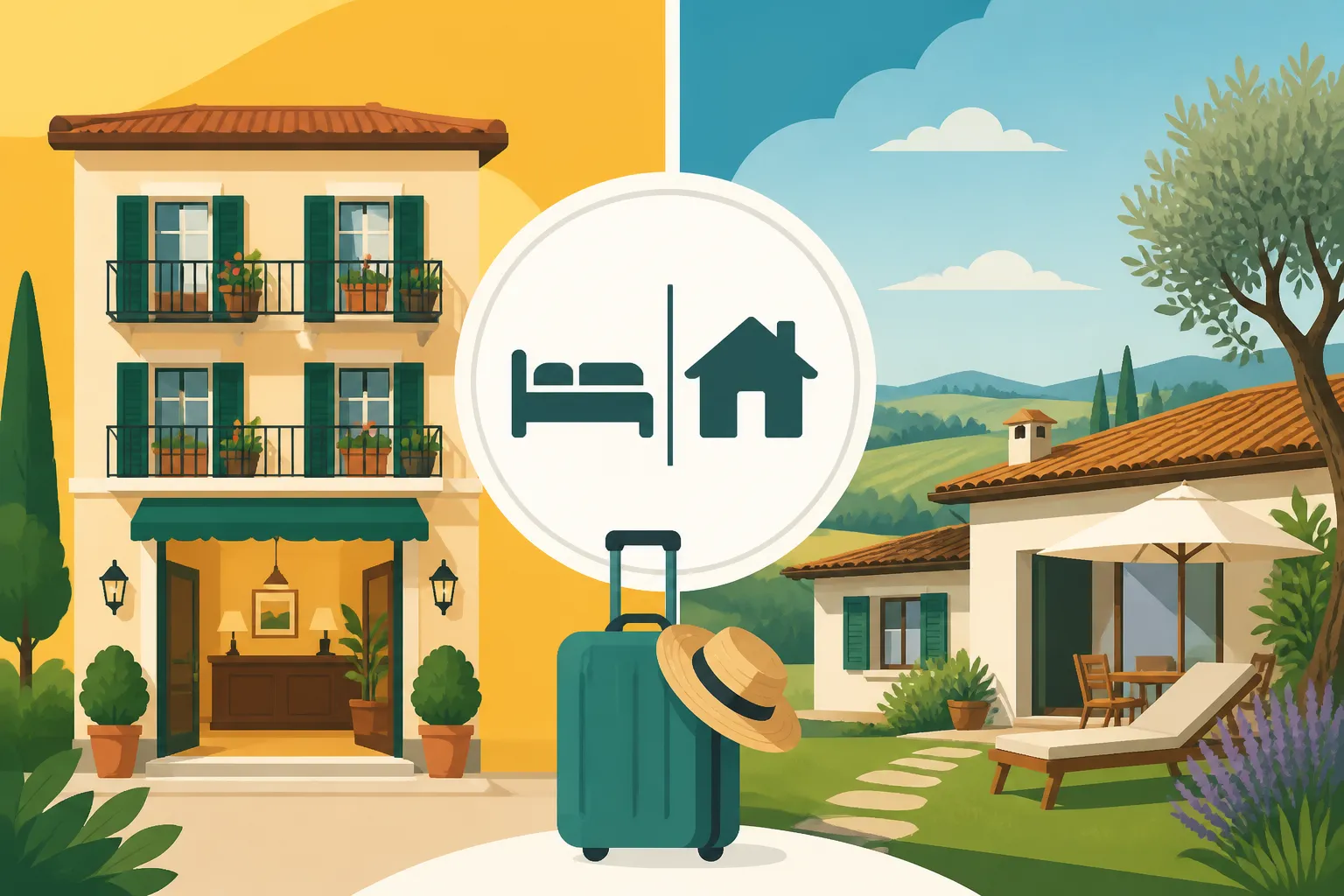
Notice the dividing line in that table. Affittacamere, B&Bs and hotels rent you a room. Casa vacanza, CAV and locazione turistica rent you an entire independent unit. That single distinction predicts most of what your stay will feel like.
Affittacamere Decoded: Rooms in Someone Else’s Building
The word literally means “rents rooms,” and that’s exactly what it is. You get a private bedroom, usually with its own bathroom though not always, inside a property that hosts other guests in other rooms. Think of it as a small guesthouse that is often tucked inside an ordinary residential apartment block.
What You Actually Get
In practice, an affittacamere is often a large old city apartment that has been divided into three to six guest rooms off a central corridor. Each room has a lock, a bed, a wardrobe and, in most modern conversions, an en-suite bathroom. Shared spaces vary: sometimes a hallway, sometimes a small breakfast nook with a kettle and a fridge, sometimes nothing at all.
Here’s a typical scenario. Sarah, a teacher from Manchester, books an affittacamere near Florence’s Santa Maria Novella station for three nights. Her room is spotless, with a rainfall shower and a balcony over the rooftops. There’s also a shared fridge where she keeps her yogurt. What it doesn’t have is anyone present after 8pm, a place to leave her bag after check-out, or a kitchen to cook in. For a city break built around museums and trattorie, that was perfect. For a fortnight with two kids, it would have been miserable.
Breakfast is the most variable feature. Some regions allow affittacamere to serve a simple breakfast, some allow only packaged items, and some have arrangements with the café downstairs. If the listing says “breakfast available,” check whether it’s served on site, provided as a voucher, or a plate of wrapped croissants. Our guide Booking a B&B in Italy: Breakfast, Check-In Windows, and Payment Terms explains how breakfast differs between B&Bs and room-rental properties, which is the comparison most people are really making.
Bathrooms deserve a second look too. “Private bathroom” and “en-suite” aren’t always the same thing. A private bathroom may be across the corridor, reserved for you but outside your room. If you’re travelling with an elderly parent or simply hate padding down a hallway at 3am, look for the word “en-suite” or check the room photos carefully.
The Check-In Reality
This is where foreigners feel the friction most. Many affittacamere have no staffed reception. You might meet the host at a set time, collect keys from a nearby bar or tabaccheria, or receive a door code by message. If your train from Naples is delayed by two hours, as trains are, you need a plan before you leave.
Italian law requires accommodation providers to register guests’ identity documents with the police through the Alloggiati Web system. That’s why every host, from a grand hotel to a three-room affittacamere, will ask for your passport or ID card. Some hosts collect a photo of your document in advance, and others insist on checking it in person. For the full picture, see Why Italian Hotels Ask for Your Passport: Check-In Registration Explained.
Then there’s the tourist tax. Most Italian cities charge a tassa di soggiorno per person per night, and the amount depends on the comune and the category of accommodation. Smaller structures often collect it in cash at the property, separate from the price you paid online. Bring some euros and read Italy’s Tourist Tax by City: Tassa di Soggiorno and What You Pay before you go, so the request doesn’t feel like an ambush.
Who Affittacamere Suit Best
After years of hopping between Italian cities, here’s my honest assessment of the room-rental category.
Pros:
- Often in central, residential locations where hotels are scarce
- Usually more character and more space than a budget hotel room
- Small scale, so quieter than a big hotel when the other guests are considerate
- Hosts frequently give excellent local tips on where to eat and which bus to take
Cons:
- No reception, so late arrivals need coordination
- Luggage storage before check-in or after check-out is not guaranteed
- Shared walls and corridors with strangers
- Limited or no cooking facilities
- Old buildings may lack a lift, which matters with heavy suitcases
Affittacamere shine for solo travellers, couples and friends on short city stays. They are less suited to families who need to cook, guests with mobility needs who require step-free access, and anyone arriving on a midnight flight without a confirmed key handover.
Case Vacanza Decoded: An Entire Unit to Yourself
A casa vacanza, literally a “holiday house,” is the opposite model. You rent an entire independent unit: an apartment, a cottage, a house or a converted farm building. Nobody else is staying behind the next bedroom door. You have your own entrance, your own kitchen and your own bathroom, and the space is yours for the length of the stay.
What Makes a Casa Vacanza
The defining feature is independence. If you’re sharing a kitchen, a corridor or a bathroom with other guests, you aren’t in a casa vacanza, whatever the photos look like. A single private room in someone’s apartment belongs in the room-rental categories, such as affittacamere or B&B. Keep this distinction in mind when you compare listings, because it decides how you’ll live for the week.
A real-world example: the Okafor family of four, from Toronto, wanted ten days near Lucca. They booked a casa vacanza on the ground floor of a restored farmhouse, with two bedrooms, a full kitchen, a washing machine and a terrace looking over olive trees. They shopped at the Esselunga in town, cooked most dinners, and did laundry halfway through the trip. Compared with two hotel rooms and every meal out, the savings were substantial, and the kids had space to run.
The trade-off is service. Cleaning usually happens only at check-out, not daily. Towels and sheets are provided, but mid-stay changes may be extra or simply not offered. There’s no one to call at 11pm about a dripping tap except the owner’s mobile number. For guests who want independence, this is liberating. If you expect hotel comfort, it can feel like being left alone with somebody else’s house.
Families of four or more benefit most. Italian hotel rooms often cap occupancy at three, which pushes larger families into two rooms or entire units. We cover that problem in Why Italian Hotels Cap Rooms at Three: Booking for Families of Four Plus.
Locazione Turistica, CAV and the Legal Fine Print
Within the “entire unit” world, you’ll see a few legal flavours. Here they are in plain language.
Locazione turistica is a short-term tourist lease, typically between a private owner and you, with few or no hotel-style services. Legally it sits closer to renting an apartment than to staying at a guesthouse. You get the keys and the space, and that’s about it.
CAV, case e appartamenti per vacanze, is the managed version. An operator runs several entire units as a business, sometimes in the same building and sometimes scattered around a town. You still get a whole independent apartment, but there’s usually a more professional setup, with structured check-in, cleaning between guests and someone whose job is to answer your messages.
Residence or RTA properties go further, adding reception and services to a complex of apartments. If you’re staying a month or more, compare all three options. Monthly Stays in Italy: Hotel vs Residence vs Short-Term Rental walks through that decision, and Aparthotels and Residences in Italy: Kitchens, Laundry, and Long Stays covers the serviced end of the scale.
Every legitimate tourist accommodation in Italy is expected to display a CIN, the Codice Identificativo Nazionale, a national identification code for the property. It’s one of the easiest ways to confirm you’re dealing with a registered unit rather than an informal sublet. Platform differences around CIN display, fees and cancellation are covered in Booking.com vs Airbnb in Italy: CIN Codes, Fees, and Cancellation.
Hidden Chores: Trash, Utilities and House Rules
Nobody warns you about the bins. Italian comuni run strict waste-sorting systems, and in an entire unit you are the household. Expect a laminated sheet on the fridge explaining which days are for organic waste, paper, plastic and glass, and which coloured bin is which. In some towns, collection happens door to door at set hours. In others, you carry bags to street containers that open with a card the host leaves you. Get it wrong and your host may find a note, or a fine, from the condominio.
Utilities can also surprise you. Some houses charge separately for heating in winter or air conditioning in summer, or set consumption limits. Older stone houses in Umbria can be cold in shoulder season, and top-floor flats in Rome bake in July. Before booking, read Air Conditioning and Heating in Italian Accommodation: What to Verify.
Then there’s the car question. Rural houses in Tuscany or Puglia often need a car, while city-centre apartments sit inside ZTL limited-traffic zones that will fine you for driving in. If the listing mentions parking, find out exactly where it is and whether it’s inside the ZTL. Our guide Parking at Italian Hotels: ZTL Zones and Why ‘Parking Available’ Costs Extra explains the details.
How to Filter and Verify on Booking.com Before You Pay
Once you understand the categories, the hard part is matching a listing to the right one before money leaves your account. This is where Booking.com does most of the heavy lifting for me. Its filters separate whole units from rooms, its policies section spells out check-in and tax details, and its messaging lets you settle the awkward questions before you commit. Here’s the exact process I follow for every Italian booking.
A Step-by-Step Verification Routine
- Decide first whether you need a room or an entire unit. Write it down. If you need a kitchen and privacy for a family, you’re shopping for a casa vacanza or CAV. If you’re two adults out sightseeing all day, an affittacamere or B&B is fine.
- Search your destination on Booking.com and open the filters. Use the property-type filter to narrow results to guesthouses, B&Bs, apartments or homes. If you need a full unit, select the entire homes and apartments option so that single rooms drop out of the results.
- Open each shortlisted listing and read the property description for the Italian category name. Hosts often state it plainly, for example “affittacamere,” “casa vacanze” or “CAV.” Match that word to the table earlier in this guide.
- Check the room or unit details for “en-suite” or “private bathroom,” the number of bedrooms, and whether a kitchen is private or shared. Our guide Reading Italian Hotel Listings: Room Types, Bed Sizes, and Terms Decoded decodes bed and room terminology.
- Scroll to the house rules and the fine print on the Booking.com listing. This is where you’ll find check-in windows, late-arrival fees, key-collection instructions, whether the tourist tax is included, and whether a damage deposit applies.
- Look for the CIN code in the listing details, which signals a registered property.
- Read recent reviews with category-specific questions in mind. For an affittacamere, look for comments about noise, the host’s responsiveness and check-in. For a casa vacanza, look for cleanliness on arrival, kitchen equipment and how easy the bin system was.
- Compare cancellation terms. Free-cancellation and non-refundable rates are both common, and the right choice depends on how firm your plans are. See Refundable vs Non-Refundable Rates in Italy: When the Discount Is Worth It.
- Message the property through the platform before booking, or immediately after, with your arrival time and any special needs. Keep the conversation in the app so there’s a written record.
- Save your confirmation, the host’s phone number and the check-in instructions offline. Signal in old stone stairwells can be patchy.
Five Booking Scenarios Compared
These are composite examples drawn from trips that friends and I have actually taken. They show how the category choice changes the experience.
| Scenario | Smart Category Choice | What to Filter For | Key Question to Ask the Host |
|---|---|---|---|
| Couple, three nights in Bologna, out from morning to midnight | Affittacamere or B&B | Private room, en-suite bathroom, central location | Can we leave luggage after check-out? |
| Family of five, one week on Lake Garda | Casa vacanza or CAV | Entire unit, private kitchen, enough bedrooms for five | Is parking on site and outside any ZTL? |
| Remote worker, one month in Lecce | CAV or residence | Entire unit, private kitchen, workspace, washing machine | How fast is the Wi-Fi, and is heating or cooling charged separately? |
| Solo traveller, two nights in Venice on a tight budget | Affittacamere or ostello | Private room or dorm, close to a vaporetto stop | How do I find the door from the nearest water-bus stop? |
| Older parents, five nights in Rome | Hotel or affittacamere with a lift | Lift, ground-floor or step-free room, en-suite bathroom | How many steps are there between the street and the room? |
For the Venice budget scenario, our comparison Hostels and Ostelli in Italy: Private Rooms vs Dorms on Total Cost helps you weigh a private hostel room against a small room-rental property.
Messages Worth Sending Before You Arrive
Italian hosts are, in my experience, warm and helpful, but they communicate on their own schedule. A short, polite message sent through Booking.com a few days before arrival saves a lot of stress. Here’s what I always cover:
- My estimated arrival time, and a request for the key-collection procedure if I’m late
- Whether the tourist tax is payable in cash on arrival and roughly how it’s calculated
- For an affittacamere, whether luggage drop is possible before check-in
- For a casa vacanza, where the bins are, which collection days apply, and whether there’s a starter kit of dish soap, salt and oil
- For anywhere in an old building, whether there’s a lift
- For rural properties, whether the last stretch of road is drivable in a standard rental car
A quick “Buongiorno, arriviamo verso le 21, va bene?” (Good morning, we’ll arrive around 9pm, is that okay?) goes a long way. Hosts appreciate the effort, even in broken Italian. Keeping everything in the Booking.com chat also means that if anything goes wrong, you have the platform’s customer service and a written record behind you, which matters far more than it sounds when you’re tired, at a locked door, in a city where you don’t speak the language.
My personal rule after many years here: never book an Italian stay on photos alone. Read the category, filter for what you actually need, scan the fine print, and send one clear message. Do those four things on Booking.com and the next time you see “affittacamere” or “casa vacanza,” you’ll know exactly what’s waiting behind the door, whether that’s a host with a pastry or a kitchen you’ll be cooking in.
Disclaimer
This article is for general informational purposes only and does not constitute professional advice. Laws, prices and regulations vary by location and change over time. Consult a qualified professional for guidance on your specific situation.