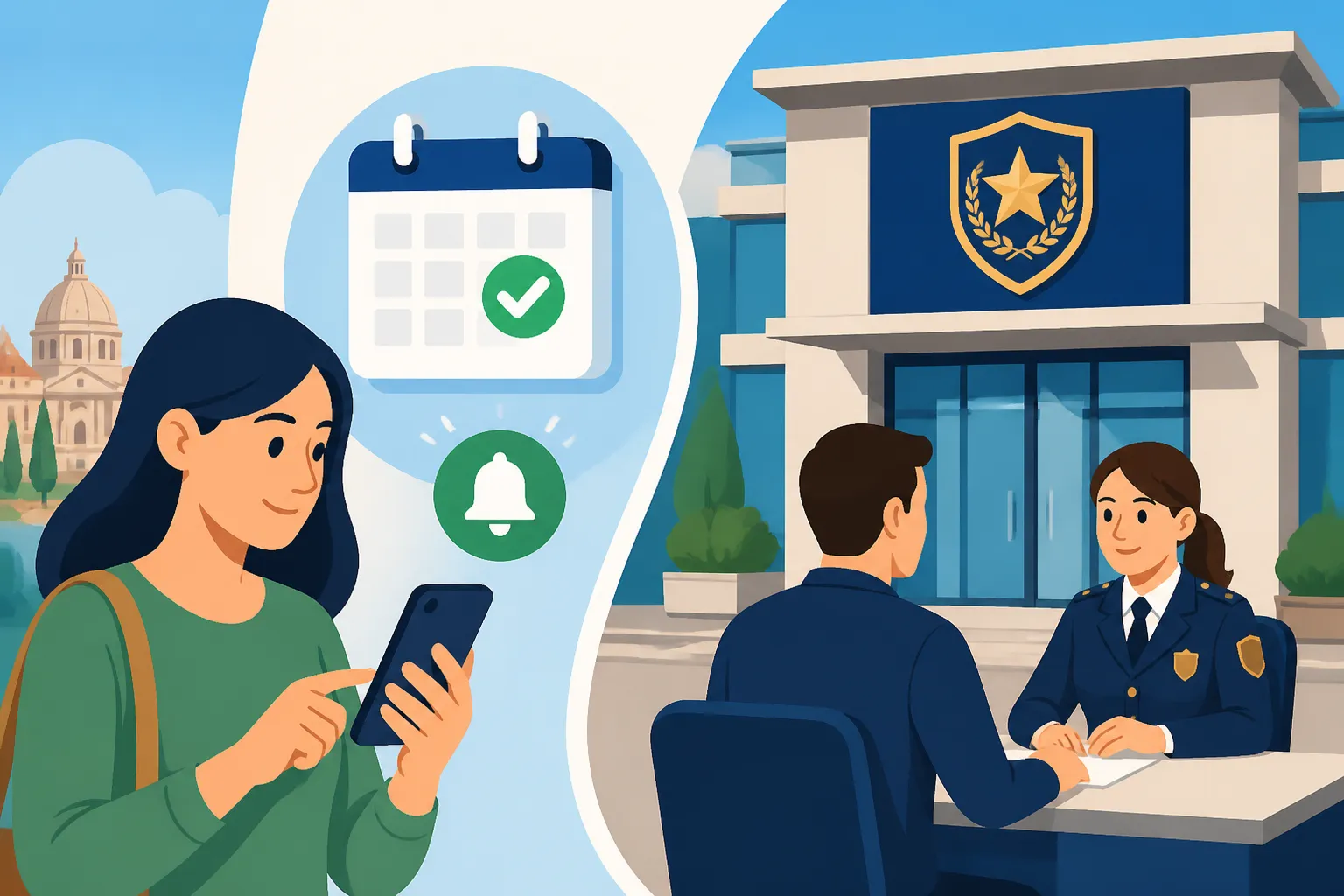
Booking and Attending Questura Appointments in Italy
The sight of a Questura—the Italian provincial police headquarters—often triggers a unique kind of anxiety for even the most seasoned expat. I still remember standing outside in the freezing Milanese rain at 5:30 AM, clutching a soggy folder of documents, wondering if I’d ever actually legalise my stay. This guide provides a roadmap to navigate the booking and attendance of your Questura appointments without the usual heartbreak.
Disclosure: This post may contain affiliate links. We may earn a commission at no extra cost to you if you make a purchase through these links. Read full disclosure.
Understanding the Questura’s Role in Your Expat Life
The Questura is not just a police station; it is the gatekeeper of your legal life in Italy. While the Italian consulate in your home country grants you a visa, the Questura is the entity that issues your actual physical residence permit, known as the Permesso di Soggiorno. Understanding this distinction is the first step in managing your expectations. The officers here are responsible for everything from fingerprinting you to verifying your local address and ensuring your presence doesn't pose a security risk.
Every province in Italy has its own Questura, and usually, several "Commissariati" (smaller branch offices) scattered throughout the territory. Where you go depends entirely on where you have declared your residency. If you are living in a bustling metropolis like Rome or Milan, the experience will be vastly different from someone settling in a quiet village in Tuscany. In the bigger cities, the sheer volume of applicants means the system is often stretched to its limit, resulting in long wait times and a more "assembly-line" atmosphere.
It is also important to distinguish between the Questura and the Prefecture. The Prefecture (Prefettura) generally handles citizenship applications and the initial "Nulla Osta" (work authorization), whereas the Questura is strictly about the mechanics of your Italian Residence Permit (Permesso di Soggiorno) Explained. You will become very familiar with the local police office because, for most non-EU expats, you must interact with them every time you move, change your job status, or renew your permit.
How to Book Your Questura Appointment
Booking an appointment used to involve showing up at dawn and hoping for a paper ticket, but the system has modernized—mostly. Today, there are two primary ways to secure your slot: the online "Prenota Facile" portal and the "Kit Postale" method. The "Prenota Facile" system is increasingly used for specific categories like family reunions, first-time arrivals with certain visas, and political asylum. You create an account using your email or a SPID (Digital Identity), select your province, and look for an available slot.
The more common route for work or study permits, however, is the How to Apply for a Permesso di Soggiorno With the Kit Postale. In this scenario, you go to a "Sportello Amico" at an Italian Post Office and request a large envelope with a yellow stripe. Once you fill out the forms and pay the processing fees, the postal clerk will give you a "ricevuta" (receipt) which contains a user ID and password. Crucially, this receipt will also have a printed date and time for your appointment at the Questura. Do not lose this paper; it is your temporary legal ID until your physical card arrives.
The "No Slots Available" nightmare is a real hurdle. In cities like Florence or Bologna, you might log into the online portal only to find every single day for the next six months is greyed out. If this happens, don't panic. Slots often refresh at midnight or early Monday mornings. Some expats have success by visiting the Questura's immigration office during public hours just to ask for an emergency "appuntamento," though this is increasingly rare. Persistence is the only solution here; you must check the portal daily.
| Booking Method | Primary Use Case | How Appointment is Assigned |
|---|---|---|
| Prenota Facile (Online) | Family Visas, EU Long-term, Asylum | Selected by user on the website portal |
| Kit Postale (Post Office) | Work, Study, Common Renewals | Automatically printed on the post office receipt |
| Direct Convocazione | Missing Data or Special Cases | Sent via SMS or Registered Mail (Raccomandata) |
Preparing Your Paperwork for the Appointment
The Questura runs on paper. Even if you uploaded documents online, you must bring a physical "dossier" to your appointment. At a minimum, you need your original passport and a full photocopy of every single page—yes, even the empty ones and the ones with stamps from your vacation to Greece. You also need four identical passport-sized photos on a white background. Pro tip: use the photo booths (Fototessera) found in most metro stations or near the Questura; they are calibrated to the exact size the Italian government requires.
Financial proof and housing contracts are the two areas where officers are most scrutinizing. If you are here on a work visa, bring your latest "busta paga" (payslip) or your employment contract. If you are an entrepreneur, you'll need your How to Get a Codice Fiscale in Italy (and Why You Need One) and evidence of your VAT registration. For housing, a registered rental contract (the "contratto di locazione") is mandatory. If you are staying with a friend, you must provide a "Dichiarazione di Ospitalità," which is a formal declaration your host signs and submits to the local police.
Language barriers can be a major sticking point during document verification. If your marriage certificate, birth certificate, or degree is in English or another foreign language, the Questura will likely demand a certified translation. Services like RushTranslate or Translayte are excellent for getting these documents into a format that Italian bureaucrats will accept. Without a "traduzione giurata" (sworn translation), the officer may reject the document on the spot, forcing you to return for a second appointment weeks later. It is always better to over-prepare with How to Get a Sworn (Giurata) Translation for Italy before you walk through those doors.
Addressing Health Insurance Requirements
One of the most frequent reasons for an "integrazione" (a request for more documents) is insufficient health insurance. Italy requires all foreign residents to have coverage, but the type depends on your visa. If you have already managed the Registering Residency in Italy (Anagrafe), you might be eligible for the National Health Service (SSN). However, for your very first appointment, you usually need private coverage that meets specific Euro-value minimums and covers emergency medical evacuation.
Many expats opt for international providers like Cigna Global because their policies are widely recognized by Italian immigration officers. When you present your insurance certificate, make sure it is translated into Italian if the original is in English. The officer needs to see that the policy is valid for at least one year and that it has no "limit of liability" for emergency hospitalizations. If you show up with a basic travel insurance policy intended for a two-week holiday, it will be rejected immediately.
The cost of this insurance is a necessary investment in your residency. While you might eventually transition to the public system, having a robust policy from a brand like Cigna Global during your initial months provides peace of mind, especially when navigating Healthcare in Italy: An Expats' Guide. Ensure the policy start date aligns with your arrival in Italy, as gaps in coverage can lead to questions about your legal status during the "waiting period" between your visa entry and your Questura appointment.
What to Expect on the Day of the Appointment
The day of your appointment will likely be long. Even if your receipt says "9:00 AM," that is often just the time you are allowed to join the queue. When you arrive at the Questura, look for the "Ufficio Immigrazione" entrance. There will usually be a crowd of people outside. Find the officer at the gate, show them your appointment paper, and they will tell you when to enter. Once inside, you’ll go through a security screening similar to an airport—belts off, bags scanned.
The process is divided into two main stages: the "sportello" (counter) and the "fotosegnalamento" (fingerprinting). At the counter, a clerk will take your folder and go through your documents one by one. This is the moment where they might ask you questions in Italian. If your Italian is shaky, don't panic, but try to learn the basics like "lavoro" (work), "affitto" (rent), and "scadenza" (expiry). If the officer finds everything in order, they will keep your photocopies and return your originals. They will then give you a numbered ticket for the fingerprinting room.
The "fotosegnalamento" is where they take digital scans of all ten fingers and a digital photo of your face. It is a silent, mechanical process. Once finished, the officer will give you a paper that confirms your fingerprints have been taken. They might also give you a small slip of paper with a "codice assicurata" which you can use for How to Track Your Permesso di Soggiorno Status Online. After this, you are free to go. The total time spent inside can range from two hours in a small town to an entire day in Rome or Milan.
Dealing with the "Integrazione" Request
Sometimes, despite your best efforts, the officer will tell you that a document is missing or insufficient. This is called an "integrazione." They will hand you a printed sheet with a box checked next to the required item—perhaps a more recent bank statement or a specific Public vs Private Health Insurance in Italy certificate. Do not take this personally. It is a standard part of the bureaucratic dance in Italy.
The officer will usually give you a deadline, often 10 to 30 days, to bring the missing document back. In some Questure, you can just show up during specific "integrazione" hours without a new appointment. In others, you might have to send the document via PEC (certified email). If you used a translation service like RushTranslate or Translayte for your initial documents but the officer wants a different one translated, get it done immediately. The faster you respond to the integrazione, the faster your file moves to the "approved" pile.
If you are asked for something that seems impossible—like a document that doesn't exist in your home country—stay calm. You can try to explain the situation, perhaps providing an "autocertificazione" (a self-declaration form) which is a legal tool in Italy where you swear to the truth of a fact. However, use this sparingly; Italian officers much prefer official stamps and signatures over personal declarations. If the language barrier is too high, it might be worth bringing a bilingual friend or hiring a "pratiche" consultant to help you navigate the final stretch.
Tracking Your Status and Collecting the Card
Once your appointment is over, the long wait for the physical card begins. Legally, the Questura is supposed to issue the permit within 60 days, but in reality, it can take anywhere from three to eight months. You should check the "Polizia di Stato" website once a week using your file number. The status will eventually change from "in trattazione" (being processed) to "documento di soggiorno in consegna" (ready for collection).
When the card is ready, you will usually receive an SMS on the Italian phone number you provided. The message will give you a date, time, and specific location for collection. Unlike the first appointment, collection is usually much faster. You will need to bring your passport and the original "ricevuta" from the Post Office. The officer will take your old receipt, have you sign a few papers, and hand over your shiny new plastic "Permesso di Soggiorno" card.
Checking your card for errors is vital before you leave the window. Ensure your name is spelled correctly, your date of birth is right, and the "motivo del soggiorno" (reason for stay) matches your visa. If there is a mistake, tell them immediately. It is much easier to fix an error while you are still at the counter than to start a new How to Renew an Expiring Permesso di Soggiorno in Italy process later. Once you have the card, make several photocopies and keep a digital scan on your phone—it is now your most important document in Italy.
Veteran Tips for a Smooth Experience
After years of dealing with various Questure across the country, I’ve learned that attitude is 50% of the battle. Italian bureaucracy is famous for being rigid, but the individual officers are often just overwhelmed. Being polite, patient, and having your documents organized in a clear, labeled folder goes a long way. If an officer sees that you have made an effort to understand the system, they are much more likely to help you if a minor issue arises.
Always bring a portable power bank for your phone and a bottle of water. Many Questura waiting rooms do not have working vending machines, and you are not allowed to leave and come back once your number is close. Also, be aware of "Scioperi" (strikes). Check the news the day before your appointment to ensure there isn't a national transport strike that will prevent you from reaching the office. If you miss your appointment due to a strike or illness, you must go to the Questura as soon as possible with proof (like a medical certificate) to reschedule.
Lastly, remember that your "ricevuta" is a powerful document. While you wait for your card, you can use it to sign up for the Healthcare in Italy: An Expats' Guide, open certain bank accounts, and even travel back to your home country, provided you take a direct flight and don't transit through other Schengen countries. It’s not a perfect system, but once you have that plastic card in your hand, all the 5 AM wake-up calls and rainy queues will feel like a distant memory. If you ever find yourself in a bind, don't forget to look for How to Handle a Medical Emergency in Italy Without Italian or other local resources that can bridge the gap during your transition.
Disclaimer
The information provided in this guide is for informational purposes only and does not constitute legal advice. Immigration laws and Questura procedures in Italy are subject to frequent changes. Always consult the official website of the Polizia di Stato or a qualified immigration professional for the most current requirements regarding your specific situation.