Choosing a Cell Phone Plan in Italy
Navigating the Italian telecommunications market can be daunting for new arrivals. This comprehensive guide covers everything from identifying the best national providers and budget-friendly networks to understanding essential documentation requirements, helping you choose the perfect mobile plan in Italy.
Disclosure: This post may contain affiliate links. We may earn a commission at no extra cost to you if you make a purchase through these links. Read full disclosure.
Introduction
Fortunately, for expatriates, digital nomads, and tourists alike, Italy boasts one of the most competitive and affordable mobile telecommunications markets in the entire world. If you are arriving from the United States, Canada, or even certain parts of Northern Europe, you will likely be astonished by how much mobile data you can acquire for a fraction of what you are accustomed to paying. It is entirely common to find prepaid plans offering upwards of 150 to 200 gigabytes of high-speed 5G data, alongside unlimited domestic calls and texts, for under fifteen euros a month.
However, this unparalleled affordability comes with its own unique set of bureaucratic hurdles. Purchasing a SIM card in Italy is not as simple as grabbing a generic starter pack off a supermarket shelf and walking out the door. The Italian government enforces strict anti-terrorism and anti-fraud regulations that require every single mobile phone number to be directly linked to a verified identity. This means you must navigate physical storefronts, present official government documentation, and understand the nuances of Italian tax codes before your device can legally connect to the local network.
Furthermore, the sheer number of choices can be overwhelming. The market is saturated with legacy operators, aggressive new disruptors, and a multitude of virtual networks offering seemingly identical packages. Making the right choice requires understanding your specific data habits, your geographical location, and your long-term travel plans within the European Union. This extensive guide is designed to dismantle the confusion surrounding Italian mobile networks. We will walk you through the essential preparations, decode the documentation requirements, compare the top service providers, and provide a step-by-step roadmap to getting connected so you can focus on enjoying your new Mediterranean lifestyle.
Preparing Your Smartphone for the Italian Network
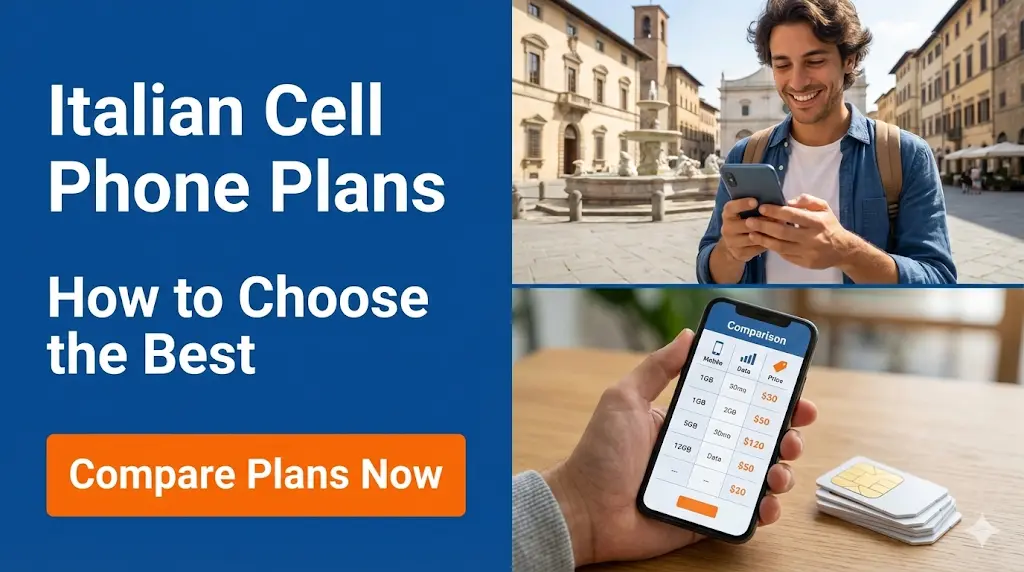
Before you even begin comparing Italian mobile providers, you must ensure that your current smartphone is physically and digitally capable of operating on a European network.
First and foremost, your device must be “unlocked.” In many countries, particularly the United States, cellular carriers often lock smartphones to their specific network if the phone was purchased on an installment plan or subsidized contract. An Italian SIM card will simply trigger an error message if inserted into a locked phone. You must contact your home carrier well in advance of your departure to request a network unlock. This process usually requires the device to be fully paid off.
Secondly, you must consider hardware frequency compatibility. The global cellular network operates on various radio frequency bands. While modern flagship smartphones (such as recent Apple iPhones, Samsung Galaxy S-series, and Google Pixels) are designed as “global phones” equipped with the antennas necessary to connect to almost any network worldwide, older or budget-tier smartphones might lack the specific 4G LTE or 5G bands used in Italy. Italy primarily utilizes bands 3, 7, and 20 for 4G LTE, and bands N78 and N28 for its expanding 5G networks. If your phone does not support these bands, you will suffer from agonizingly slow 3G speeds or no service at all, regardless of which Italian provider you choose.
Essential Documentation for Buying a SIM Card
As mentioned earlier, anonymity does not exist in the Italian telecommunications sector. To purchase and activate a standard mobile plan, you must present a specific set of documents to the sales clerk. Attempting to bypass this requirement is impossible for long-term residential plans.
Valid Identification
If you are a citizen of the European Union, a standard national identity card is sufficient. If you are a non-EU citizen, you must present your physical, original passport. A driver’s license from your home country will generally be rejected. Some stores may also ask to see your Permesso di Soggiorno (Residence Permit) if you are setting up a post-paid contract, but a passport is usually all that is required for standard prepaid plans.
The Codice Fiscale
This is the document that frequently catches expatriates off guard. The Codice Fiscale is your alphanumeric Italian tax identification number. It is an absolute requirement for integrating into the Italian civic system, and mobile providers require it to register your SIM card into the national database. If you have just arrived and have not yet secured this document, you may face roadblocks at smaller retail stores. Some providers offering dedicated “Tourist SIMs” at airport kiosks have specialized systems that can bypass or generate a temporary code for you based on your passport data, but these tourist plans are significantly more expensive than standard local plans. To ensure you can access the cheapest, standard market rates, it is highly advisable to sort out your administrative paperwork immediately upon arrival. For a complete walkthrough of this essential process, review our guide on Local Tax Registration: Codice Fiscale and ISEE.
The Big Four Mobile Network Operators
The Italian mobile landscape is dominated by four primary Mobile Network Operators. These companies own and maintain the physical cell towers, fiber optic cables, and network infrastructure across the country.
TIM
Telecom Italia Mobile (TIM) is the historic, state-legacy incumbent carrier. Boasting the most extensive network infrastructure in the country, TIM is widely considered the most reliable choice if your lifestyle or travels will take you into rural Italy, deep into the Apennine or Alpine mountain ranges, or out to smaller islands. While their plans tend to be slightly more expensive than their competitors, the premium you pay is reflected in widespread 4G reliability, excellent customer service infrastructure, and an aggressively expanding 5G footprint.
Vodafone Italy
Vodafone is synonymous with speed and performance. Independent mobile network testing frequently awards Vodafone Italy the top spot for download and upload speeds, as well as the highest consistency of video streaming quality. If you are a heavy data user, rely on your smartphone for mobile hotspot tethering to work remotely, or plan to stream high-definition video regularly, Vodafone is an exceptional choice. Furthermore, Vodafone often provides the most robust and seamless international roaming partnerships if you plan to travel extensively outside of the European Union.
WindTre
WindTre is the result of a massive corporate merger between two former competitors, Wind and 3 Italia. This merger created a telecommunications giant that currently holds one of the largest market shares of active SIM cards in Italy. WindTre offers an excellent middle ground, providing highly competitive pricing structures alongside a massive, modernized 4G and 5G network. Their coverage is consistently excellent nationwide, making them a highly popular choice for the average expatriate and local resident alike.
Iliad
Iliad is the great disruptor of the Italian telecom market. Entering the scene in 2018, this French-owned company aggressively undercut the legacy operators, forcing prices down across the entire industry. Iliad’s philosophy centers on absolute transparency: no hidden activation fees, no confusing promotional periods that double in price after six months, and no contractual traps. They offer massive data allowances (often up to 300GB) at rock-bottom prices. While their independent network is still growing—meaning they occasionally rely on roaming agreements with WindTre in remote areas—their urban coverage is excellent, making them the absolute favorite for budget-conscious digital nomads living in major cities.
Comparing the Major Network Operators
To help you synthesize these options and choose the provider that best aligns with your lifestyle, review the following comparison matrix.
| Provider | Network Focus | Best Feature | Average Monthly Cost | 5G Availability |
| TIM | Widest national coverage, superior in rural and mountainous areas | Premium customer service, extensive physical retail footprint | €10 – €15 | Widespread in major cities |
| Vodafone | Highest overall data speeds, premium network infrastructure | Unmatched reliability and excellent international roaming options | €12 – €18 | Extensive nationwide |
| WindTre | Excellent overall 4G/5G footprint, large market share | Great balance of speed, coverage, and affordable pricing | €10 – €15 | Growing rapidly |
| Iliad | Budget-friendly, transparent, urban-focused | No hidden fees, massive data limits, lifetime price guarantees | €8 – €12 | Expanding, primarily urban |
The Rise of Mobile Virtual Network Operators
If the prices of the Big Four are still not low enough for you, you should explore the thriving market of Mobile Virtual Network Operators. An MVNO is a company that does not own any physical cell towers; instead, they lease network space in bulk from the major operators and resell it to consumers at deeply discounted rates.
The most popular MVNOs in Italy are actually wholly owned subsidiaries of the major operators, launched specifically to combat the rise of Iliad.
- ho. Mobile: Owned by Vodafone, offering Vodafone’s stellar network reliability at a fraction of the cost, though download speeds are usually capped at 30 Mbps or 60 Mbps.
- Kena Mobile: Owned by TIM, providing access to TIM’s vast rural network at budget prices, also with capped speeds.
- Very Mobile: Owned by WindTre, offering exceptional deals for users who port their numbers from other budget carriers.
- Fastweb Mobile: A major player that historically operated as an MVNO on the TIM and WindTre networks, Fastweb is transitioning toward becoming a fully independent operator. They offer excellent, un-capped 5G speeds and massive data bundles.
Choosing an MVNO is an incredible way to slash your monthly expenses without sacrificing network reliability. If optimizing your financial strategy is a priority during your relocation, taking the time to explore these budget carriers is highly recommended. You can integrate these savings into your broader financial plan by reading Mobile Phone and Internet Costs in Italy.
Understanding Prepaid Plans Versus Contracts
When setting up your mobile service, you will encounter a fundamental cultural difference in how Italians pay for their phones. In many Western countries, users sign a binding one-year or two-year post-paid contract. In Italy, the overwhelming majority of the population relies on prepaid plans, known locally as a Ricaricabile.
A Ricaricabile plan is essentially a rolling 30-day subscription. You pay upfront for a bundle of minutes, texts, and data. If you do not have sufficient funds in your account when the renewal date arrives, the service simply pauses until you add money. There are no late fees, no credit checks, and no collection agencies. Because of the simplicity and lack of financial liability, this is the absolute best route for expatriates.
Conversely, an Abbonamento (contract) requires an Italian bank account (IBAN) for automatic direct debits, a thorough credit check, and a long-term commitment. Breaking these contracts early often results in steep cancellation penalties.
Maintaining a prepaid plan is incredibly easy. You can link your international credit card to the provider’s smartphone app for automatic monthly recharges, or you can utilize a uniquely Italian method: the Tabaccheria. By walking into almost any local tobacco shop (marked with a large “T” sign) or supermarket, you can ask the cashier for a ricarica (top-up). You simply provide your phone number, specify the amount (e.g., ten euros), pay in cash, and the credit is instantly applied to your mobile account.
The Convenience of Tourist SIMs and eSIMs
If you are only visiting Italy for a few weeks, or if you need immediate connectivity the second you step off the airplane before you have time to acquire your Codice Fiscale, you have alternative options.
Major providers like TIM and Vodafone offer specific “Tourist SIMs.” These are valid for exactly thirty days, require only a passport for activation, and usually include generous international calling minutes to destinations outside Europe. However, they are notably more expensive—often costing between twenty and thirty euros for the month—and cannot be easily renewed or converted into standard, cheaper long-term plans.
A more modern alternative is the travel eSIM. Providers like Airalo, Jetpac, and Holafly allow you to purchase and download a digital SIM card to your smartphone via an app while you are still sitting in your home country. When your plane touches down in Rome or Milan, you simply toggle the eSIM on in your phone’s settings, and you instantly have data. While eSIMs are incredibly convenient and bypass all Italian documentation requirements, they route your data through international servers, which can result in slightly slower ping times. They are the perfect bridge solution for your first week in the country while you organize your permanent physical local SIM.
Navigating European Union Roaming Regulations
One of the greatest benefits of securing an Italian mobile plan is the European Union’s “Roam Like At Home” legislation. This policy mandates that you can use your Italian SIM card in any other EU member state (such as France, Spain, Germany, or Greece) without incurring predatory international roaming charges. Your domestic calls and texts operate exactly as they would in Italy.
However, there is a crucial caveat regarding data usage known as the Fair Use Policy. While your Italian plan might provide you with 150GB of data while physically inside Italy’s borders, you cannot use all 150GB while vacationing in Paris. The EU allows mobile providers to enforce a roaming data cap calculated by a complex mathematical formula based on the wholesale cost of data.
In practical terms, a cheap ten-euro Italian plan will generally afford you between 8GB and 12GB of roaming data per month across the EU. Once you exceed this roaming cap, you will be charged a small fee per megabyte. Your provider is legally required to send you a text message upon crossing an international border, clearly outlining your specific EU data allowance, so you will never be caught off guard.
Bundling Home Internet and Mobile Deals
If you are settling in Italy long-term and renting an apartment, you will eventually need to install home Wi-Fi. In the Italian telecom market, immense synergy exists between home broadband (Fibra) and mobile networks.
Almost all major operators incentivize customers to bundle their services. If you use Vodafone for your mobile phone and choose Vodafone to install fiber optic internet in your apartment, they will frequently upgrade your mobile plan to completely unlimited 5G data at no extra cost, or heavily discount your home internet bill. Approaching your telecommunications setup holistically can yield massive savings. When you are ready to tackle your apartment’s infrastructure, be sure to explore the broader landscape of domestic utilities in our guide on Italian Utilities: Electricity, Water, Gas, Internet.
Switching Providers and Number Portability
The Italian mobile market is fiercely competitive, and loyalty is rarely rewarded. Providers constantly release new, hyper-aggressive promotions to steal customers from their rivals. Fortunately, the Italian government mandates a streamlined process for switching providers, known as Mobile Number Portability (MNP) or Passaggio a nuovo operatore.
If you secure a plan with TIM but later see a massive data promotion from Iliad, you do not have to lose your phone number. You simply walk into an Iliad store, present your ID, and provide the ICCID number (the long serial number printed on the back of your current physical SIM card). The new provider handles all the backend administration, and within 48 working hours, your existing phone number will magically transfer over to the new SIM card.
This environment has spawned a phenomenon known as Offerte Operator Attack. Providers will offer secret, extremely cheap plans specifically targeting customers of a rival network. Always ask store clerks if there are any special “passa a noi” (switch to us) promotions based on your current carrier.
Step by Step Guide to Purchasing Your SIM Card
To ensure a seamless experience, follow this strategic sequence when buying your permanent Italian SIM card:
- Verify Your Device: Confirm your smartphone is entirely unlocked from your home carrier.
- Gather Your Documents: Place your physical passport and your official Codice Fiscale certificate into a secure folder.
- Avoid the Airport Kiosks: Unless it is an absolute emergency, do not buy your permanent SIM at the airport arrivals terminal. These kiosks predominantly sell marked-up tourist packages and frequently lack the system access to register standard local plans. Wait until you reach the city center.
- Visit an Official Retail Store: Locate an official storefront (negozio) for TIM, Vodafone, WindTre, or an Iliad “Simbox” kiosk in a local shopping mall.
- Request a Prepaid Plan: Clearly state that you want a ricaricabile (prepaid) plan. Avoid the word abbonamento (contract).
- Download the App: Before leaving the store, download the provider’s official smartphone application and ask the clerk to help you register your account. This app is essential for tracking your data usage, checking your balance, and managing your monthly top-ups.
Conclusion
Securing a cell phone plan in Italy is a vital rite of passage that bridges the gap between feeling like a disconnected tourist and functioning as an integrated resident. While the strict documentation requirements and the dizzying array of MVNOs might initially seem complex, the reward is access to one of the most robust, high-speed, and incredibly affordable mobile networks on the planet.
By ensuring your device is unlocked, arriving at the store armed with your passport and Codice Fiscale, and strategically choosing a flexible prepaid ricaricabile plan, you can sidestep the common pitfalls that ensnare many newcomers. Whether you opt for the premium reliability of Vodafone or the budget-friendly transparency of Iliad, your new Italian mobile plan will serve as your digital compass, guiding you through the countless adventures that await in your new home.
References
Primary sources (official)
- AGCOM (Autorità per le Garanzie nelle Comunicazioni) – The official Italian communications regulatory authority, providing oversight on consumer rights, roaming regulations, and network standards: https://www.agcom.it/
- Agenzia delle Entrate (Italian Revenue Agency) – Official guidelines on acquiring the mandatory Codice Fiscale required for telecommunications contracts: https://www.agenziaentrate.gov.it/
Other helpful sources
- Opensignal – Italy Mobile Network Experience Report (Detailed, independent analysis of 4G/5G speeds, coverage, and reliability among TIM, Vodafone, WindTre, and Iliad): https://insights.opensignal.com/reports/2023/05/italy/mobile-network-experience
- Traveltomtom – Best Prepaid Tourist Sim Card for Italy in 2026 (Comprehensive guide on current market pricing, MVNOs, and EU roaming caps): https://www.traveltomtom.net/destinations/europe/italy/best-prepaid-italy-sim-card
Disclaimer
The information provided in this article is for educational and informational purposes only and does not constitute official financial, legal, or telecommunications advice. Mobile plan prices, network coverage, EU roaming fair-use caps, and documentation requirements are subject to frequent changes by the service providers and Italian regulatory authorities. Always verify current offerings, exact pricing structures, and legal requirements directly with the mobile operators before signing a contract or purchasing a SIM card.