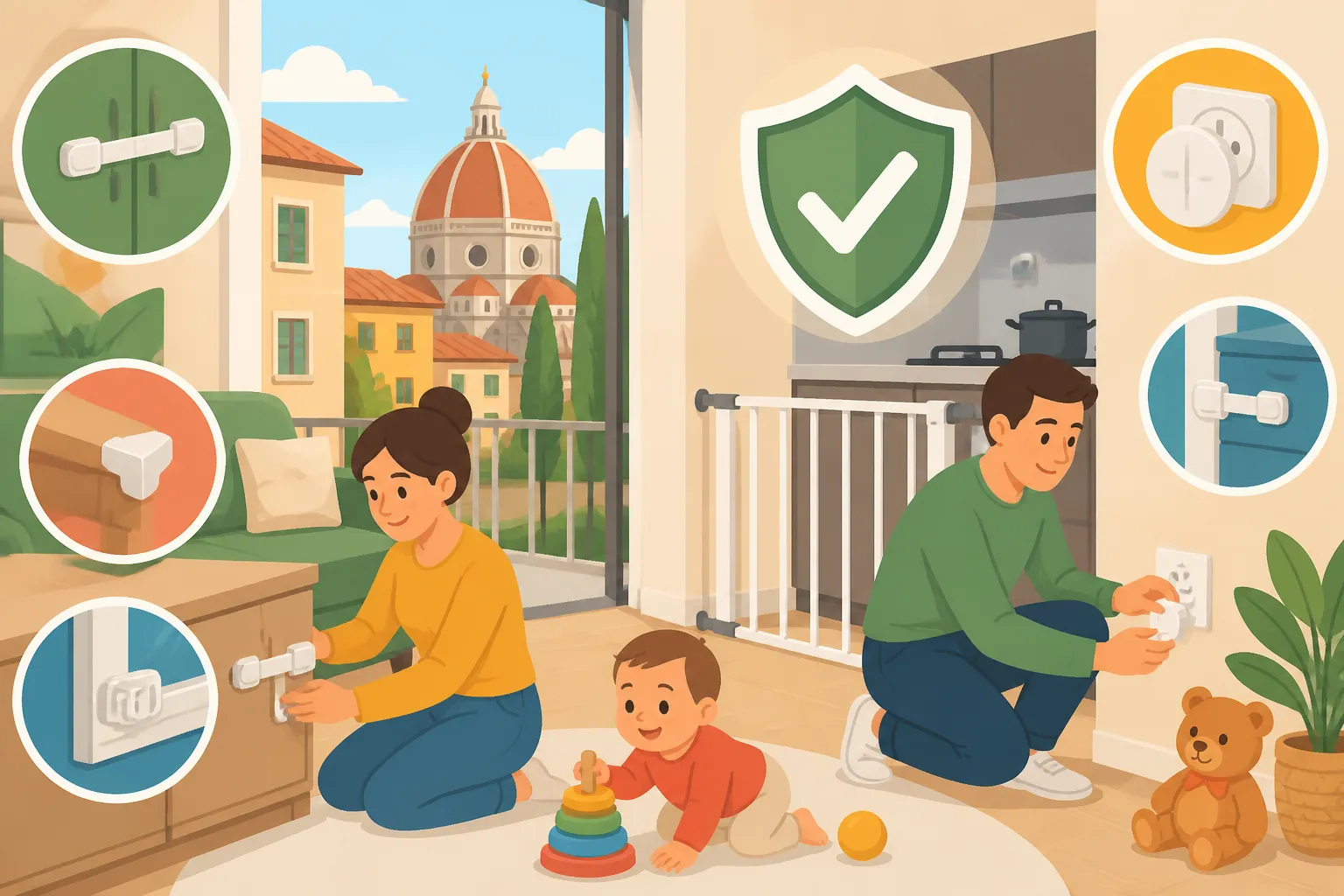
How to Childproof a Rented Apartment in Italy
Most Italian apartments feel like they were designed by an 18th-century architect with a vendetta against toddlers, featuring hard marble floors, low-sills, and sharp stone corners. I remember moving into my first Roman flat with a crawler and realizing the entire home was essentially a beautiful, terracotta-tiled obstacle course. This guide solves the specific challenge of making these "non-negotiable" spaces safe for your children without risking your security deposit.
Disclosure: This post may contain affiliate links. We may earn a commission at no extra cost to you if you make a purchase through these links. Read full disclosure.
Navigating the Unique Hazards of an Italian Home
When you first walk into a classic Italian rental, you are usually struck by the beauty of the high ceilings and the "graniglia" or marble flooring. However, once you have a small human wandering around, those features become significant liabilities. Unlike the carpeted, drywall-heavy homes many of us are used to in North America or Northern Europe, Italian apartments are built to last centuries, meaning the materials are incredibly hard and difficult to modify.
The first thing you have to accept is that the floors are unforgiving. A tumble on "parquet" is one thing, but a slip on Sicilian tile is quite another. You will also notice that many Italian apartments, especially those found on platforms like Spotahome, often come with "arredato" (furnished) labels, including heavy, antique wardrobes that are rarely secured to the walls. In a country where minor tremors are a reality in many regions, an unanchored "armadio" is a major safety concern.
Furthermore, the windows in Italy often open inward (a-battente) and frequently lack the built-in screens or locks we might expect. If you live on a higher floor in a city like Milan or Naples, the "balcone" becomes the focal point of your childproofing anxiety. The railings on older buildings were often designed for aesthetics rather than preventing a curious three-year-old from slipping through. Understanding these structural quirks is the first step in creating a safe environment. Before you even sign the lease, it is worth learning How to Understand an Italian Rental Contract Clause by Clause to see what modifications are permitted.
Non-Permanent Flooring and Corner Solutions
Since you cannot exactly rip out the marble and install wall-to-wall carpeting in a rental, you have to get creative with temporary surfaces. Large, high-quality foam play mats are your best friend here. However, be careful with the cheap interlocking tiles; in the humid Italian summer, moisture can sometimes get trapped underneath, potentially damaging the finish of older wood floors. I always recommend using breathable rug pads underneath any large mats.
Sharp corners are the next priority. Italian furniture tends to favor heavy wood and stone tops with very sharp "spigoli." While you can find basic corner guards at local "ferramenta" (hardware stores), the selection is often limited. I found that ordering specialized, extra-thick silicone bumpers from Amazon Italy was the only way to get enough variety to cover the myriad of edges in a typical "salotto."
When applying adhesives to old Italian furniture or marble, proceed with extreme caution. The "lucido" (polish) on marble can be stripped by strong chemical adhesives. I learned the hard way that "Command" strips are generally safer, but even then, you should test a small, inconspicuous area first. If you are worried about the landlord’s reaction during the final walkthrough, it helps to know How to Handle a Deposit Dispute With an Italian Landlord in case a bit of sticky residue causes a disagreement.
Securing Windows and Balconies Without Drilling
This is perhaps the most stressful part of parenting in Italy. The "finestre" are often large and tempting for children to climb. Since you usually cannot drill into the window frames (especially if they are high-quality PVC or restored wood), you should look for tension-based window locks. These "blocca-finestre" can be tightened onto the frame to prevent the window from opening more than a few centimeters.
For balconies, the "rete di sicurezza" (safety netting) is a common sight in Italian cities. You can buy transparent or green mesh that blends in relatively well. The trick is to secure it using heavy-duty zip ties rather than hooks that require drilling into the "facciata" (facade). Most "condominio" rules are strict about the building's external appearance, so choosing a transparent mesh is usually the safest bet to avoid complaints from neighbors.
If your apartment has the traditional "tapparelle" (rolling shutters), the cords can be a strangulation hazard. You should never leave these dangling. Use adhesive cleats positioned high out of reach to wrap the cords. If you are still in the process of choosing a home, you might want to consider How to Find Family-Friendly Neighborhoods Near Italian Schools to ensure you are in an area where landlords are more accustomed to families and their safety needs.
| Hazard Category | Typical Italian Feature | Recommended Non-Permanent Solution |
|---|---|---|
| Floors | Marble, Tile, Stone | High-density foam mats with non-slip rug pads |
| Windows | Inward-swinging, no locks | Tension-arm window restrictors (no drill) |
| Balconies | Wide-spaced iron railings | Transparent safety netting secured with zip ties |
| Furniture | Heavy, unanchored antiques | Furniture straps attached to heavy-duty adhesive hooks |
| Electricity | Low-set "Bicino" outlets | Italian-specific two-prong socket covers |
| Kitchen | Gas stoves without guards | Removable adhesive knob covers and stove screens |
Electrical Safety and Small Hands
Italian electrical outlets (prese) are different from those in the US or UK. Most modern apartments use the "Bticino" style outlets which often have built-in shutters, but older rentals might still have open holes that are perfectly sized for small fingers or toys. You can find "copripresa" (socket covers) easily at any local "casalinghi" store or via Amazon Italy.
Another quirk of Italian electricity is the power limit. Most homes have a 3kW limit, which means if you run the dishwasher and the oven at the same time, the power will "scattare" (trip). While this isn't a direct child safety issue, the resulting total darkness can be terrifying for a child and dangerous if you are in the middle of a bath or cooking. It’s wise to have "luci d'emergenza" (emergency plug-in lights) in hallways that turn on automatically when the power fails.
While dealing with the logistics of moving in and setting up your safety gear, ensure you have a reliable data connection. I highly recommend using Airalo for an immediate eSIM so you can look up installation videos or contact local handymen without waiting for your home fiber to be installed. This is especially useful when you are trying to find How to Find Reliable Tradespeople for Home Repairs in Italy to help with some of the more complex, non-invasive safety setups.
Kitchen and Bathroom Precautions
The Italian "cucina" is often the heart of the home, but it’s full of risks. Gas is the standard for cooking in Italy, and many older stoves do not have "valvole di sicurezza" that cut the gas if the flame goes out. If your rental has an older stove, you must use a stove guard to prevent children from reaching the knobs or the burners. These guards usually clip onto the front of the stove and can be removed when you move out.
In the bathroom, the "bidet" is a classic Italian fixture that toddlers inevitably view as a personal water fountain or a boat pond. While it’s hard to "childproof" a bidet, you can get faucet covers to prevent them from bumping their heads on the metal spout. Also, be aware that many Italian water heaters (scaldabagni) are set to scalding temperatures to make the hot water last longer. You should check the temperature setting on the unit itself—usually a dial underneath—to ensure the water won't burn your child's skin.
If you are managing all these changes while still settling in, don't forget the administrative side of family life. You will need to make sure your children are registered for healthcare. Take the time to read about How to Choose a Pediatra for Your Child in Italy so you have medical support ready if an accident does happen. In case of a serious emergency, you must know How to Call 112 in Italy: What to Say and What Happens to get rapid assistance.
Creating a Safe Zone in Urban Spaces
Living in a city like Rome or Florence often means sacrificing space. When your "soggiorno" is also your dining room and your office, childproofing becomes about "zoning." Use pressure-mounted baby gates to block off the kitchen or the area with your computer cables. These gates work perfectly on the thick stone doorframes common in Italy because they provide a solid surface to tension against.
If you are struggling to find the right gear locally, How to Furnish an Italian Apartment on a Budget offers great tips on where to find affordable second-hand items that you won't mind "customizing" with safety foam. Remember that your child’s safety is a dynamic process. As they grow, the hazards change, so do a "crawl-through" of your apartment every few months to see the world from their perspective.
Finally, keep your phone loaded with local resources. Having a local SIM or an eSIM from a provider like Airalo ensures that even if you are out at a park or a "piazza," you can always access your digital records or contact your doctor. Being a parent in a foreign country is stressful enough; having your home environment secured gives you the peace of mind to actually enjoy the "dolce vita" with your little ones.
Disclaimer
The information provided in this guide is for informational purposes only and does not constitute legal or professional safety advice. Regulations regarding rental contracts, building codes, and child safety standards in Italy can vary by region and are subject to change. Always consult with your landlord before making modifications to a rented property and seek professional advice for specific safety installations. The author and publisher are not responsible for any injuries or damages resulting from the use of the suggestions in this article.