Italy to Austria and Germany: Brenner Pass Rail and Bus Options
Oh, the allure of those jagged Alpine peaks and the promise of new adventures just beyond Italy's northern border! Moving between Italy, Austria, and Germany is a common dream for so many expats, but the reality of figuring out the logistics can feel like trying to solve a Rubik's Cube blindfolded. This comprehensive guide is here to untangle the complexities of traversing the magnificent Brenner Pass, whether you're hopping on a train or catching a bus, and will show you how to streamline your journey planning with tools like Omio.
Disclosure: This post may contain affiliate links. We may earn a commission at no extra cost to you if you make a purchase through these links. Read full disclosure.
Embracing the Gateway to the Alps: The Brenner Pass
For centuries, the Brenner Pass, or Passo del Brennero in Italian, has been more than just a geographical landmark; it's a vital artery connecting the Italian peninsula with central Europe. For us expats, it’s often the quickest and most scenic way to visit friends and family across the Alps, or to simply explore the stunning landscapes of Austria and Germany.
Historical Significance and Scenic Beauty
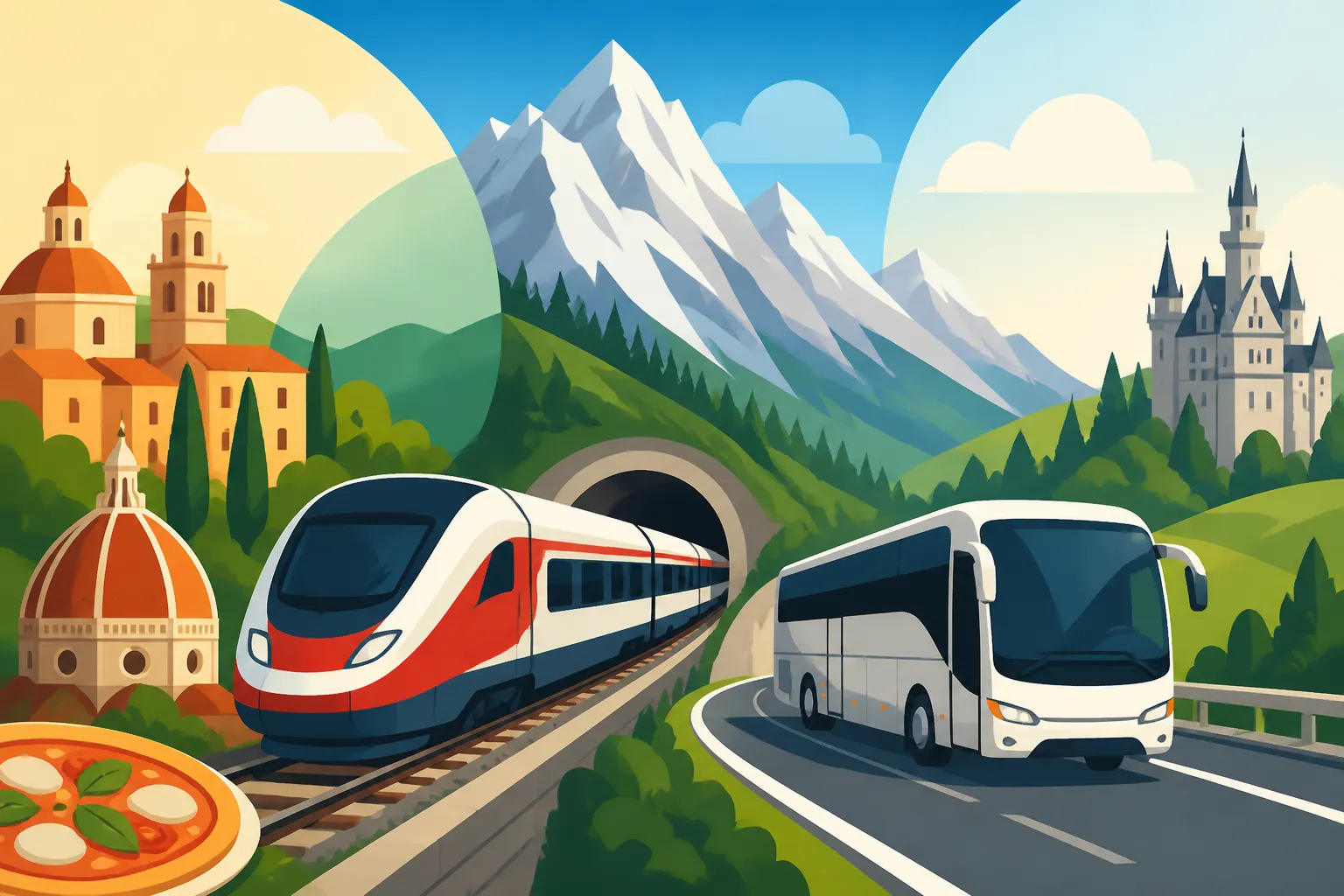
Imagine the Roman legions marching through these very mountains, or medieval merchants ferrying their precious goods. The Brenner Pass has witnessed millennia of human passage, shaping trade, culture, and migration. Today, as you traverse it, you're following in the footsteps of history. The journey itself is a feast for the senses, especially by train. As you ascend from the Italian plains, the landscape transforms from rolling vineyards and apple orchards to dramatic valleys, charming Alpine villages, and eventually, the towering, majestic peaks of the Dolomites and the Austrian Alps. Tunneling through mountains and emerging into breathtaking vistas is an experience in itself, a far cry from the mundane highways of other cross-border routes.
The Brenner railway line, inaugurated in 1867, was an engineering marvel of its time, designed to navigate the challenging topography. It's a testament to human ingenuity, cutting through mountains and bridging valleys to create a surprisingly smooth passage. Even on a bus, the views are spectacular, though perhaps a little less intimate than the train's panoramic windows.
Key Destinations Connected Through the Pass
The Brenner Pass serves as a crucial link for travelers heading in various directions. On the Italian side, major hubs like Verona and Bologna are primary connection points. From Verona, you can easily access cities throughout Italy, making it a pivotal station. As you cross into Austria, Innsbruck, the capital of Tyrol, is the first major city, a charming Alpine gem nestled amidst mountains. From there, the rail and bus networks fan out across Austria.
Continuing north, the pass leads directly towards Germany, with Munich being the most prominent and frequently serviced destination. For those of us based in Italy, a quick trip to the Munich Christmas markets, or a weekend in Innsbruck, becomes entirely feasible. The pass also opens up travel to lesser-known, equally beautiful towns in South Tyrol (Italy) like Bolzano and Bressanone, which retain a strong Austrian cultural influence, perfect for those seeking a blend of both worlds. Whether you're planning a visit to the Bavarian castles or exploring Vienna, the Brenner Pass is often your most direct and picturesque route.
Rail Travel Through the Brenner Pass: A Seamless Journey
There's something inherently romantic and undeniably practical about train travel through the Alps. No traffic jams, no confusing road signs, just sit back and watch the world glide by. For many expats, this is the preferred method of crossing the Brenner Pass.
Major Rail Operators and Routes
When you're looking at train travel through the Brenner Pass, you'll primarily be dealing with three major players: Trenitalia on the Italian side, ÖBB (Austrian Federal Railways), and Deutsche Bahn (DB) for connections into Germany. What's fantastic is that these operators often cooperate, running joint services or having agreements that make cross-border ticketing surprisingly straightforward.
For instance, direct EuroCity (EC) trains, often operated jointly by ÖBB and DB with Trenitalia connections, run several times a day connecting cities like Verona, Bologna, or even Venice directly to Innsbruck and Munich. These trains are generally comfortable, offering first and second class, and even dining cars on some longer routes. You might also find regional trains that stop at smaller towns, perfect if you're exploring the South Tyrolean valleys. The convenience of being able to board in, say, Bologna and disembark in Munich without changing trains is a huge plus, especially when you're lugging suitcases or traveling with family.
Beyond these direct routes, you can piece together journeys by combining regional trains or connecting in major hubs. For example, a Frecciarossa from Naples to Bologna, then a connecting EuroCity to Innsbruck, all bookable in one go through a platform like Omio. This seamless approach avoids the headache of navigating multiple national railway websites and potential language barriers.
Booking Your Train Tickets
Now, this is where a tool like Omio truly shines and becomes an absolute lifesaver for expats. Trying to navigate Trenitalia, ÖBB, and DB websites, comparing prices, times, and connections, can be a monumental task, especially if your Italian or German isn't quite up to snuff for intricate booking processes.
Omio aggregates all these different operators and their routes, presenting you with a clear, concise overview of all available train options for your chosen journey. You input your starting point in Italy (say, Milan) and your destination in Austria (like Innsbruck) or Germany (Munich), and Omio does the heavy lifting. It shows you the fastest routes, the cheapest tickets, and even allows you to filter by direct trains or those with minimal changes. The ability to see Trenitalia, ÖBB, and DB options side-by-side in English, with prices in your preferred currency, makes comparing and deciding so much easier.
Once you've made your choice, booking is a breeze. You pay directly through the platform, and your tickets are often sent as e-tickets to your email or directly to the Omio app. This means no scrambling to print tickets or fumbling with machines at the station. It's truly a game-changer for international travel, making your journey from Italy to Austria or Germany as simple as a few clicks. For those keen on long-distance travel, this ease of booking across borders is invaluable.
Onboard Experience and Amenities
Train travel through the Brenner Pass offers a generally pleasant and relaxing experience. The EuroCity trains are modern and well-maintained. Seating is comfortable, often with ample legroom, and you'll typically find overhead racks for smaller bags and dedicated luggage areas at the end of carriages for larger suitcases. The journey itself is part of the adventure.
Most trains offer Wi-Fi, though signal strength can vary, especially as you pass through tunnels in the mountains. Power outlets are common, allowing you to keep your devices charged. On longer routes, you might find a dining car or a bistro car (often called a ristorante or bistrò in Italy, or a Speisewagen in Germany/Austria) where you can grab a coffee, a snack, or even a hot meal. The food is usually decent and reasonably priced for train travel. If you're traveling in first class, you might enjoy slightly more spacious seating and sometimes even at-seat service.
The views, as mentioned, are unparalleled. You'll pass through charming Alpine towns, alongside roaring rivers, and through dense forests. It's the perfect opportunity to kick back with a book, catch up on some work, or simply gaze out the window and let the stunning scenery wash over you. Remember to secure your valuables, especially on busier routes, though train travel is generally very safe.
Bus Travel Over the Brenner Pass: An Economical Alternative
While trains offer speed and comfort, buses present a fantastic, often more budget-friendly, alternative for crossing the Brenner Pass into Austria and Germany. For students, budget travelers, or those simply looking to save a few euros, the bus can be an excellent choice.
Key Bus Operators and Routes
The most prominent international bus operator you'll encounter for routes over the Brenner Pass is FlixBus. They offer an extensive network connecting numerous Italian cities like Milan, Verona, Bologna, and even Rome, directly to destinations in Austria such as Innsbruck and Vienna, and further into Germany to Munich, Berlin, and many other cities. You'll also find some regional bus lines, but for cross-border journeys, FlixBus dominates.
FlixBus coaches are generally modern and comfortable, equipped with air conditioning, reclining seats, and often Wi-Fi (though, like trains, signal can be spotty in mountainous or remote areas). They usually have a toilet on board, which is a blessing on longer journeys. The routes are direct, often following major highways, including the A22 Autostrada del Brennero, meaning you bypass smaller towns and get straight to your destination. This can sometimes make the journey quicker than a train if the train has many regional stops, though generally, high-speed trains are faster overall.
Advantages and Disadvantages
The primary advantage of bus travel is, without a doubt, the cost. Bus tickets are almost invariably cheaper than train tickets for the same route, especially if you book in advance. This can make a significant difference for budget-conscious travelers or families. Another plus is that buses often have more flexible luggage policies than budget airlines, typically allowing one checked bag and one carry-on free of charge, though it's always wise to double-check the specific operator's policy before you travel.
However, there are a few trade-offs. Bus journeys can take longer than trains, particularly due to road traffic, which can be unpredictable, especially during peak holiday seasons or if there's an accident on the highway. While comfortable, seats are generally not as spacious as on a train, and the ability to get up and walk around is more limited. The scenic views are still there, but from a higher vantage point on the highway, they might feel a little less immersive than from a train window. If you're prone to motion sickness, a bus winding through mountain roads might be more challenging than a smoother train ride.
Booking Bus Tickets with Ease
Just as with trains, when it comes to booking bus tickets for your journey over the Brenner Pass, platforms like Omio prove invaluable. Rather than hopping between the FlixBus website and other potential regional operators (if any), Omio centralizes all available bus routes. You simply enter your departure and arrival points, and Omio presents you with a clear list of options, including journey times and prices.
This comparison feature is especially useful when deciding between different bus operators or even comparing bus options against train options on the same screen. It allows you to quickly assess what offers the best value for your time and money. The booking process is streamlined and secure, providing you with e-tickets that you can store on your phone. No fuss, no language barriers, just direct access to the best bus fares for your cross-border travel. This means more time enjoying Italy and less time stressing about logistics!
Practicalities for Your Journey: What Expats Need to Know
Navigating international travel, even within the Schengen Area, comes with its own set of practical considerations. As seasoned expats know, being prepared is half the battle.
Luggage and Onboard Services
Whether by train or bus, always be mindful of luggage restrictions. For trains, generally, you'll have ample space. There are overhead racks for smaller items like backpacks or briefcases, and dedicated larger areas at the end of each carriage for bigger suitcases. However, during peak travel times, these areas can fill up quickly, so boarding early is always a good strategy. Keep an eye on your bags, especially during stops. On longer journeys, if you need assistance with your luggage, look for train staff, though this is less common than in some other countries.
For buses, particularly FlixBus, the rules are usually more defined. Typically, you're allowed one piece of hand luggage that fits in the overhead compartment or under your seat, and one larger suitcase that goes in the luggage hold beneath the bus. There might be weight and size limits, so always check your ticket confirmation or the operator's website before packing. Excess luggage can incur extra fees or even be refused if the bus is full. When packing, remember that temperatures vary wildly between Italy, the Alps, Austria, and Germany. Layering is key, and bringing some entertainment for the journey, like a good book or downloaded movies, is always a good idea since Wi-Fi can be unreliable. Don't forget a travel adapter if you're coming from outside Europe!
Border Crossings and Documents
Despite the Schengen Agreement, which generally allows for free movement without systematic border checks, it's crucial to always carry valid identification. While full passport control stops are rare on trains and buses crossing the Brenner Pass, random checks do occur. Italian, Austrian, and German police or border authorities can board trains or buses at any point to check documents.
For EU citizens, a national ID card is usually sufficient. Non-EU citizens must carry their passport and their valid Italian residence permit (Permesso di Soggiorno). If you're traveling on a visa, ensure it's still valid and that you have all supporting documentation. Not having the correct documents can lead to significant delays, fines, or even being denied entry. It's a small hassle to keep your documents handy, but it saves a world of pain. If you're traveling as a tourist, remember the implications of your Italy Schengen Visa Guide: Tourist and Business Travel.
Seasonal Considerations and Delays
The Brenner Pass, being an Alpine route, is subject to weather whims, especially in winter. Heavy snowfall can lead to delays or even temporary closures of the railway or highway, though these are relatively rare for the main transport routes, which are well-maintained. Always check the weather forecast before you travel, particularly between November and March.
Summer brings its own challenges: peak tourist season. Trains and buses can be very crowded, and tickets might sell out quickly, especially on popular routes or around major holidays like Ferragosto. Booking well in advance through a platform like Omio is highly recommended during these periods to secure your seat and potentially a better price. Strikes (sciopero) are also a reality in Italy and occasionally in Austria and Germany, which can affect train and bus services. While strikes are usually announced in advance, last-minute disruptions can happen. Always check for current travel advisories and operator announcements closer to your travel date. Being flexible with your plans, if possible, is always a good strategy for travel in Europe.
Comparing Your Options: Train vs. Bus via Brenner Pass
Deciding between a train and a bus for your journey through the Brenner Pass often boils down to a few key factors: speed, cost, comfort, and the overall experience you're seeking. Both have their merits, and the "best" option really depends on your personal priorities.
Speed vs. Cost
Generally, trains are faster than buses for long-distance international journeys, especially the EuroCity services. They follow dedicated rail lines, avoiding road traffic, and can often reach higher speeds. A train from Verona to Munich, for instance, might take around 5 hours 30 minutes to 6 hours, while a bus could take 6 to 8 hours, depending on the number of stops and traffic conditions. If time is of the essence, the train often wins out.
However, if your budget is tighter, the bus is almost always the more economical choice. Bus tickets, particularly if booked in advance, can be significantly cheaper than train fares. For students or long-term travelers exploring Europe on a shoestring, those savings can really add up. So, it's a classic trade-off: pay more for speed and convenience with the train, or save money but potentially add to your travel time with the bus. Omio can help you quickly compare these price-time differences on a single screen.
Comfort and Scenic Views
In terms of pure comfort, trains usually have the upper hand. You get more space to move around, often larger seats, and the option to visit a dining car. The ride is generally smoother, which can be a big plus for those susceptible to motion sickness. The panoramic windows on trains often offer a more direct and dramatic view of the Alpine landscapes, especially as you climb and descend.
Buses, while increasingly comfortable with modern fleets, don't quite match the spaciousness of a train. You're more confined to your seat, and while the views from the highway are still stunning, they can feel a bit more distant. That said, many modern buses offer amenities like individual power outlets and Wi-Fi, which enhance the journey. For shorter routes, the comfort difference might be negligible, but on a 6+ hour journey, those extra few inches of legroom on a train can make a real difference.
Flexibility and Booking
Both train and bus networks offer considerable flexibility in terms of departure times and destinations. Major routes have multiple departures throughout the day, giving you options. The true flexibility, for us expats, comes in the booking process.
This is precisely where Omio becomes an indispensable tool. It eliminates the need to cross-reference multiple websites and languages. You can input your journey details and instantly see all available train and bus options – from various operators like Trenitalia, ÖBB, DB, and FlixBus – displayed side-by-side. This allows for direct comparison of prices, journey durations, and amenities. You can filter by direct routes, earliest departure, lowest price, and more.
Once you've made your choice, you can book directly through Omio with confidence, receiving your e-ticket promptly. This streamlines the entire process, making cross-border travel from Italy to Austria or Germany as simple as possible. Whether you're planning a trip to the Italian Lakes: Como, Garda, and Maggiore Compared or visiting the major cities, Omio simplifies comparing your Getting Around Italy: Trains, Buses, Flights, and Car Hire options.
| Feature | Train (e.g., EuroCity) | Bus (e.g., FlixBus) |
|---|---|---|
| Speed | Generally faster | Generally slower (subject to traffic) |
| Cost | Typically higher | Typically lower |
| Comfort | More spacious, smoother ride, dining | Less space, can be bumpier, basic snacks |
| Luggage Allowance | More flexible, dedicated areas | Stricter limits (checked + carry-on) |
| Scenic Views | Panoramic, immersive | Good, but often from highway vantage |
| Amenities | Wi-Fi (variable), power outlets, bistro | Wi-Fi (variable), power outlets, toilet |
| Booking Ease | Simplified via Omio across operators | Simplified via Omio across operators |
| Environmental Impact | Generally lower emissions per passenger | Higher emissions per passenger |
Disclaimer
Please note that travel information, including schedules, prices, and visa requirements, can change rapidly. Always verify the latest details with the respective transport operators, embassies, or official government websites before making any travel arrangements. This guide provides general information and recommendations based on current knowledge and typical experiences of expats in Italy.