How Much Should Coffee Cost at an Italian Bar?
One of the most jarring experiences for a newcomer in Italy is walking into a bar, drinking an espresso, and being charged one euro, only to return the next day, sit at a table, and be handed a bill for five euros. This guide demystifies the complex, often unwritten rules of Italian coffee pricing, ensuring you navigate the bar culture like a local and avoid unnecessary "tourist taxes."
Disclosure: This post may contain affiliate links. We may earn a commission at no extra cost to you if you make a purchase through these links. Read full disclosure.
Standing at the Bar vs. Sitting at a Table
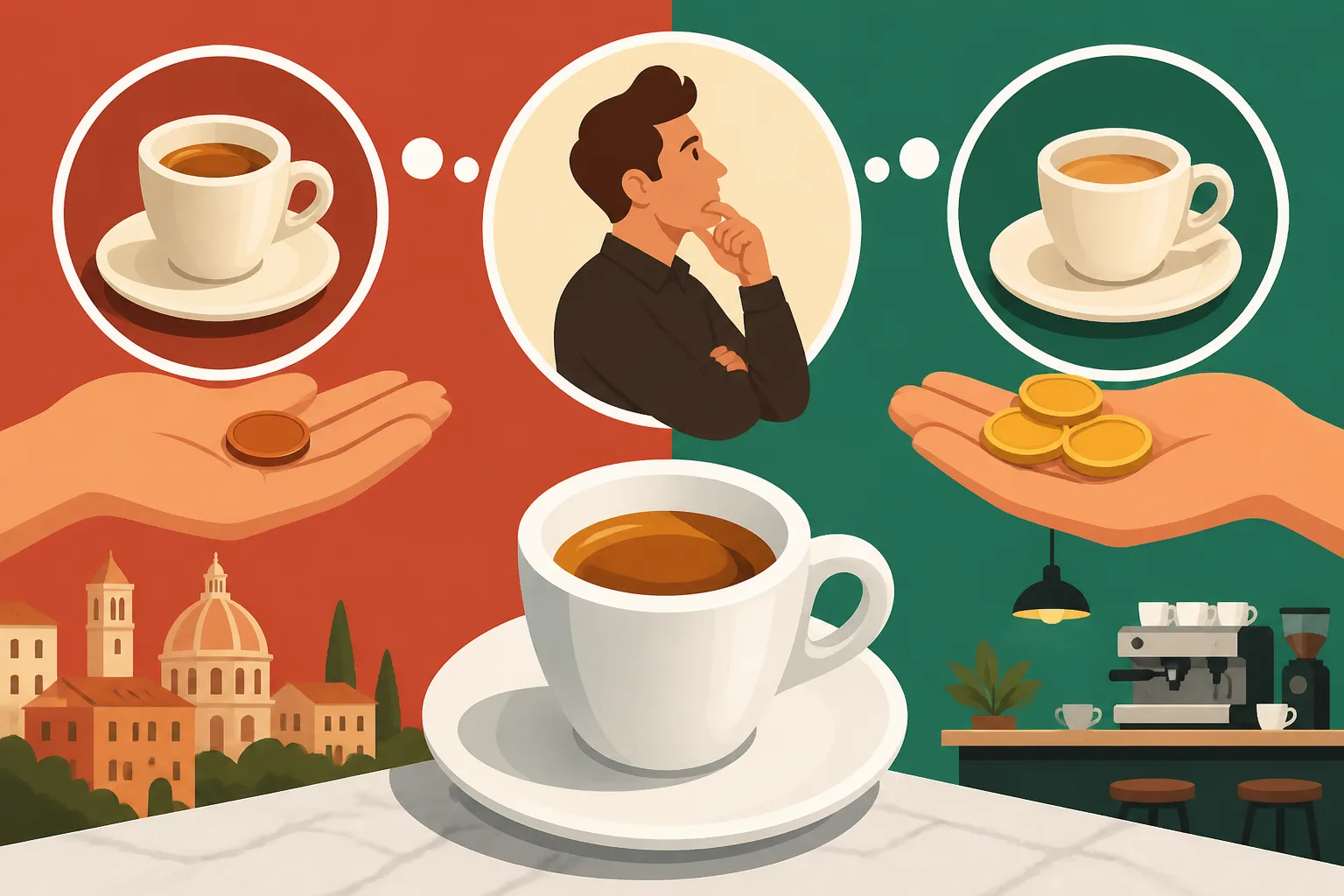
The single most important factor determining how much you pay for your coffee in Italy is your physical position within the establishment. This isn't just a matter of convenience; it is a fundamental part of the Italian social contract. In Italy, the "bar" is a community hub, and the price of an espresso taken standing up—al banco—is often seen as a basic right, almost like a public utility.
The Cultural Significance of the Banco
When you stand at the counter, you are participating in a fast-paced ritual. You'll notice locals walking in, tossing a coin on the counter, knocking back a scorching hot espresso in two sips, and leaving within three minutes. Because this occupies very little "real estate" and requires no table service, the price is kept remarkably low. In many parts of Italy, there is even local pressure, and sometimes municipal regulations, to keep the price of a standing espresso around the €1.00 to €1.20 mark.
If you are staying in a central hotel you found through Booking.com, you might be tempted to sit and people-watch, but if you want the local price, you must stay on your feet. Standing at the bar also gives you a front-row seat to the theater of Italian life. You can watch the barista handle three orders at once while debating last night’s football match. To do this smoothly, you should check out How to Order at a Bar in Italian Without Stress to ensure you don't accidentally hold up the line during the morning rush.
The Realities of Tavolo Service
The moment your posterior touches a chair, the pricing model shifts from "commodity" to "service." When you sit at a table—al tavolo—you are no longer just paying for the beans and the water; you are paying for the rent of that chair, the waiter's time, the cleaning of the table, and the privilege of lingering. In high-traffic areas like Rome’s Pantheon or Venice’s Piazza San Marco, the "sitting price" can be triple or even quadruple the "standing price."
It is also worth noting that many bars in tourist-heavy cities will include a coperto (cover charge) or a service percentage if you sit down. This is why you see locals standing even when the bar is empty. If you’ve spent the day booking your next leg of the trip on Omio and your feet are tired, by all means, sit down—just be prepared for the bill. To understand the broader context of these charges, read our guide on Restaurant Etiquette in Italy: Coperto, Courses, and the Bill so you aren't surprised when the check arrives.
A Detailed Breakdown of Coffee Prices in Italy
While prices fluctuate based on the prestige of the bar and the city you are in, there are standard ranges that define a "fair" price in 2026. If you find yourself paying significantly more than these ranges while standing at the bar, you are likely in a high-end "luxury" cafe or a place that specifically targets tourists.
| Coffee Type | Average Price (Standing) | Average Price (Sitting) |
|---|---|---|
| Caffè (Espresso) | €1.00 – €1.30 | €2.50 – €5.00 |
| Caffè Macchiato | €1.10 – €1.40 | €2.50 – €5.50 |
| Cappuccino | €1.40 – €1.80 | €3.50 – €7.00 |
| Caffè Latte | €1.50 – €2.00 | €4.00 – €7.50 |
| Caffè Americano | €1.20 – €1.60 | €3.00 – €6.00 |
| Caffè Corretto | €2.00 – €3.00 | €4.00 – €8.00 |
| Caffè Shakerato | €2.50 – €4.00 | €5.00 – €9.00 |
Espresso and Macchiato: The National Benchmarks
The simple caffè (which is always an espresso) is the baseline for the entire Italian economy. If the price of an espresso rises by ten cents, it makes the national news. Currently, in a standard neighborhood bar, you should rarely pay more than €1.20 for an espresso at the counter. A macchiato—an espresso "stained" with a tiny bit of frothed milk—usually costs the same or perhaps ten cents more.
If you are a coffee enthusiast, you might want to join a specialized food tour through GetYourGuide to visit historic roasteries where these prices might be slightly higher due to the quality of the beans, but the "standing rule" generally still applies. These small drinks are the backbone of Italian Wine, Coffee, and Aperitivo Culture, serving as the transition between different parts of the day.
Cappuccino and Milk-Based Drinks
A cappuccino involves more milk and more labor from the barista, so it naturally commands a higher price. At the counter, €1.50 is the sweet spot. However, the cappuccino is strictly a breakfast drink in Italy. If you order one after 11:00 AM, you won't necessarily be charged more, but you will definitely receive some confused looks from the staff.
For more on why this is the case, you should dive into Why You Shouldn't Order a Cappuccino After Lunch in Italy. The cost of a caffè latte or a latte macchiato follows a similar trajectory. These are larger drinks and require more time to consume, which is why many travelers prefer to pay the extra couple of euros to sit down while enjoying them.
Specialty and Seasonal Variations
During the scorching Italian summer, you will see the caffè shakerato appear on menus. This is espresso shaken with ice and sugar until it becomes frothy and cold. Because it requires manual shaking and is often served in a martini glass, it is one of the most expensive coffee items, typically starting at €2.50 even at the bar.
Similarly, a caffè corretto—an espresso "corrected" with a shot of grappa or sambuca—will cost significantly more because of the alcohol content. If you are exploring the culinary landscape, Italian Food Culture: Eating Well as a Visitor provides more insight into how these drinks fit into the daily meal cycle.
Regional Price Variations Across the Peninsula
Italy is a collection of regions with vastly different economic realities, and coffee prices are a direct reflection of this. Moving from the industrial North to the sun-drenched South will drastically change what you see on the listino prezzi (price list).
The Affordable South: Naples and Sicily
In Naples, coffee is a religion. The quality is arguably the highest in the country, yet the prices remain among the lowest. It is still possible to find a world-class espresso for €1.00 in the heart of Naples. There is also the beautiful tradition of the caffè sospeso (suspended coffee), where a customer pays for two coffees but only drinks one, leaving the second for a person in need to claim later.
If you are using Omio to plan a trip down to Sicily or Campania, prepare for a pleasant surprise at the register. The baristas in the south often serve your coffee with a small glass of sparkling water. This water is meant to cleanse your palate before you drink the coffee, and it is almost always included in that one-euro price.
The Premium North: Milan and Venice
As you move north toward Milan, Turin, and Venice, the cost of living increases, and so does the price of your caffeine fix. In Milan, the fashion and finance capital, paying €1.30 or €1.40 for a standing espresso is common. In Venice, the situation is even more extreme due to the logistics of transporting goods by boat.
If you book a hotel via Booking.com near St. Mark’s Square, you are in one of the most expensive coffee zones on earth. A coffee at the legendary Caffè Florian can cost €15.00 if you sit outside to hear the orchestra. You are paying for the history, the velvet chairs, and the view, not just the liquid. For a more realistic daily budget, check out our guide on the Cost of Living in Italy 2026: Budgeting for Expats.
Navigating the Bar Like a Veteran Expat
To avoid the frustration of feeling overcharged, you need to understand the logistics of payment and the legal protections you have as a consumer in Italy.
Understanding the Receipt and Payment Process
In many busy Italian bars, particularly in train stations or city centers, the rule is "pay first, drink later." You go to the cassa (cashier), tell them what you want (un caffè e un cornetto, per favore), pay, and then take your scontrino (receipt) to the bar. You place the receipt on the counter—often with a small 10-cent or 20-cent coin on top as a tiny tip for the barista—and they will fulfill your order.
In smaller, neighborhood bars, the process is often reversed: you drink first and pay on your way out. However, regardless of when you pay, the bar is legally required to give you a receipt. In fact, you are legally required to carry that receipt for at least 100 meters outside the establishment, as the Guardia di Finanza (tax police) occasionally perform spot checks to ensure the bar is reporting its income. If you want to brush up on the necessary lingo for this, see Survival Italian for Travelers: Key Phrases to Learn First.
Avoiding Common Pricing Pitfalls
Always look for the listino prezzi. By law, every bar must display a price list that clearly states the cost of items consumed at the bar versus those consumed at the table. It is usually posted on a wall near the entrance or the cashier. If you don't see it, don't be afraid to ask, "Quanto costa al banco?" (How much at the bar?).
Another tip is to observe the locals. If you see a crowd of Italians standing three-deep at the counter and an empty patio outside, it’s a clear signal that the patio prices are significantly higher. If you're interested in more cultural nuances, Italian Social Customs: Greetings, Gestures, and Personal Space explains why the bar is such a high-energy, crowded environment. Lastly, remember that Tipping in Italy: When, Where, and How Much is not mandatory; the change you leave on the counter is a gesture of appreciation, not a requirement.
If you are planning a trip to experience these cafes firsthand, using GetYourGuide to find a "hidden gems" walking tour can lead you to the historic bars where the prices haven't changed in a decade, offering an authentic taste of Italy without the tourist markup.
Disclaimer
The information provided in this guide is based on current market trends and personal expat experiences in Italy as of 2024-2026. Prices can vary significantly based on specific locations, inflation, and individual establishment policies. This content is for informational purposes only and does not constitute financial or legal advice. Always check the displayed price list in any establishment before ordering.