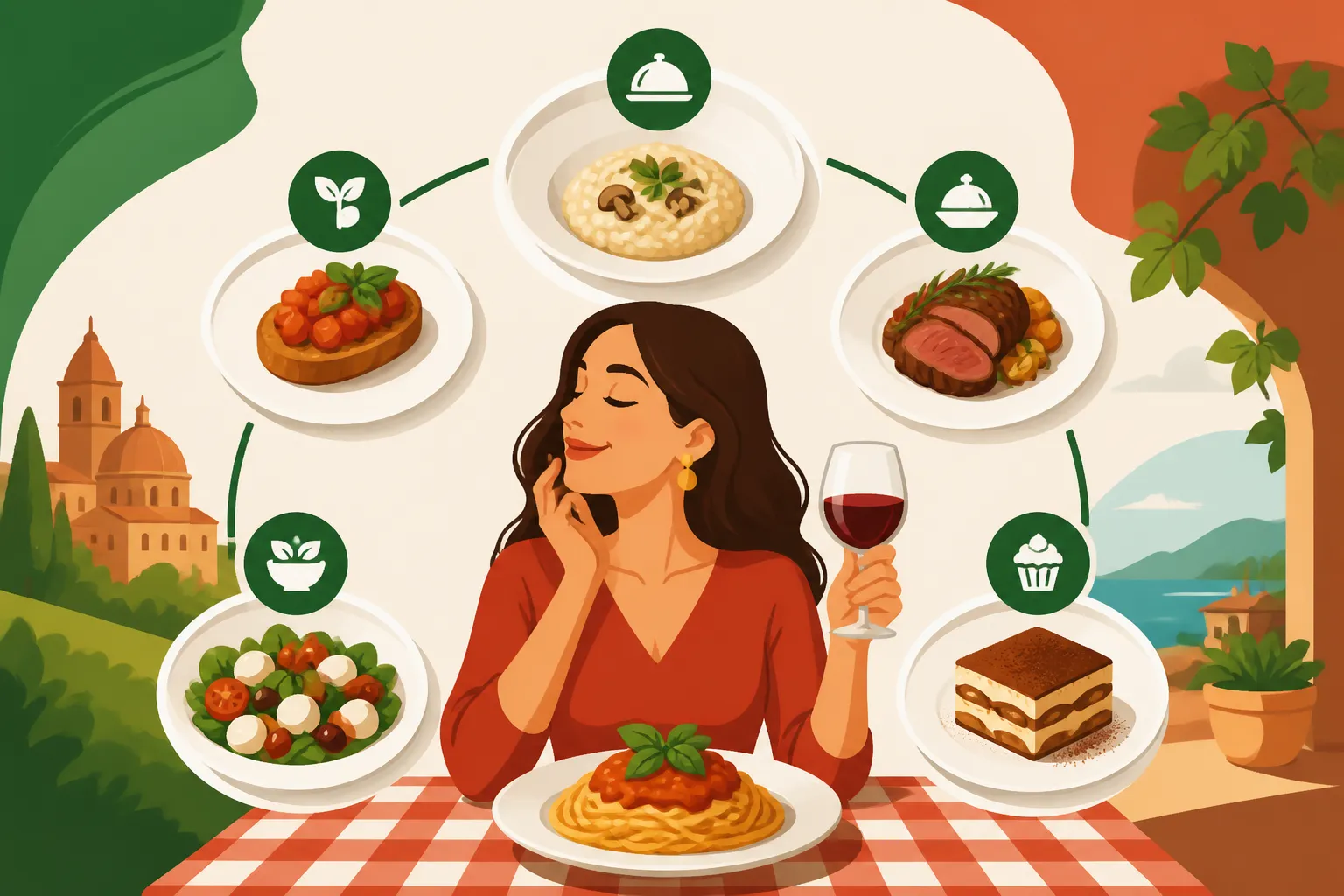
How to Order a Full Italian Meal: Courses Explained
Sitting in a traditional Italian trattoria for the first time can be an exercise in high-stakes social anxiety. You open the menu and find it divided into four or five distinct sections, and the pressure to understand the sequence while the waiter hovers can be overwhelming. This guide breaks down the historical and cultural logic behind Italian meal courses so you can navigate any menu like a seasoned resident.
Disclosure: This post may contain affiliate links. We may earn a commission at no extra cost to you if you make a purchase through these links. Read full disclosure.
The Architecture of an Italian Meal: Why So Many Courses
When I first moved to Italy, I remember the sheer exhaustion I felt after my first "full" Sunday lunch. I thought I could handle it, but by the time the meat course arrived, I was already dreaming of a nap. The traditional Italian meal structure isn't just about the volume of food; it’s a choreographed social event designed to prioritize conversation and digestion over speed. Unlike in many English-speaking cultures where we want our protein, starch, and veg on a single plate, Italians prefer to give each element its own stage.
The Cultural Philosophy of Eating Slowly
In Italy, the table is the center of the universe. It is where business is conducted, family feuds are settled, and friendships are forged. Because the meal is intended to last two, three, or even four hours, the courses are spaced out to allow for continuous conversation. If everything arrived at once, the meal would be over in twenty minutes, and the social magic would vanish. This is a fundamental part of How to Eat Like a Local in Italy: Meal Structure and Timing because it shifts your perspective from refueling to experiencing a ritual.
When you sit down, you aren't just paying for the calories; you are paying for the right to occupy that table for the afternoon or evening. This is also why you will rarely see a waiter bring the bill unless you specifically ask for it. Rushing a guest is considered the height of rudeness. If you’ve used Omio to hop between cities like Florence and Rome, you’ll notice that while the dishes change, this leisurely pace remains a constant across the peninsula.
Navigating the Traditional Sequence
The sequence is rigid but logical. It always flows from lightest to heaviest, then transitions into the palate cleansers and digestives. A full meal typically consists of an Antipasto, a Primo, a Secondo with a Contorno, and finally, the Dolce, Caffè, and Digestivo. While few people eat like this every single day—most Italians will pick just two courses for a standard Tuesday dinner—knowing the full "Long Form" is essential for Sunday lunches, weddings, or celebratory dinners.
If you are planning a trip to experience these culinary marathons, I highly recommend looking on Booking.com for accommodations near the historic centers of "foodie" cities like Bologna or Parma. Being able to walk ten minutes back to your bed after a five-course meal is a survival strategy I learned the hard way. For those truly nervous about the etiquette, booking a local food tour via GetYourGuide can provide a "safe" environment to practice ordering before you strike out on your own.
Breaking Down the Courses: From Antipasto to Dolce
The menu is your roadmap, and understanding the sections is the first step to not accidentally ordering three plates of pasta. Each section serves a specific purpose in the digestive journey, and knowing what to expect in each helps you balance your meal so you don't hit a "food wall" halfway through.
L'Antipasto: The Appetizer
The Antipasto, literally meaning "before the meal," is designed to wake up the palate. Depending on where you are, this could be a platter of cured meats, marinated vegetables, or seafood. In the North, you might find Carne Cruda (raw seasoned beef) or creamy Baccalà, while in the South, you're more likely to see fried treats or fresh buffalo mozzarella. This is often the most colorful part of the meal and sets the tone for everything that follows.
A common mistake tourists make is over-ordering here. The Antipasto should be shared or kept light. If you see a "Gran Tagliere" on the menu, that’s usually a massive board intended for the whole table. Mastering the art of the starter is part of Italian Social Customs: Greetings, Gestures, and Personal Space because it’s the most communal part of the dining experience, involving a lot of passing plates and "try this!" moments.
Il Primo Piatto: The Starch Course
This is the "First Course," and it is almost always centered around carbohydrates. Here you will find pasta, risotto, gnocchi, or soup (minestra). Unlike in the US or UK, pasta is never a side dish to meat in Italy. It is its own event. The portions are generally smaller than what you’d find at an Italian-American chain, meant to satisfy but not totally fill you, as the "main" protein is still to come.
When ordering your Primo, consider the regional specialty. If you’ve traveled via Omio to Milan, you have to try the Risotto alla Milanese. If you are in Rome, the "Big Four" pastas (Carbonara, Gricia, Amatriciana, Cacio e Pepe) are mandatory. Knowing Italian Regional Cuisine: How Food Changes Across Italy will help you identify which Primo is the star of the local show.
Il Secondo Piatto and Contorno: The Main Event
The Secondo is the "Second Course," focusing on protein. This could be meat, fish, or even a hearty frittata. However, there is a catch that catches almost every newcomer off guard: the Secondo is served entirely alone. If you order a grilled sea bass, you will get a grilled sea bass on a white plate. No potatoes, no sprig of broccoli, nothing.
This is where the Contorno (Side Dish) comes in. You must order your vegetables or potatoes separately from the Contorno section of the menu. They are usually brought out at the same time as the meat, though sometimes they arrive just a few minutes later. This separation allows the diner to control exactly how much "extra" they want. It’s a vital tip for How to Find Authentic Restaurants in Italy (Not Tourist Traps) because "tourist menus" will often bundle these together, whereas a real trattoria keeps them distinct.
Il Dolce and Beyond: Fruit, Cheese, and Sweets
After the savory courses are finished, the table is cleared for the Dolce. This could be a house-made Tiramisu, Panna Cotta, or a simple Cantucci with Vin Santo. However, many traditional families prefer to end with fresh seasonal fruit or a selection of local cheeses (formaggi). In the summer, a simple plate of chilled melon or peaches in wine is often more desirable than a heavy cake.
Ordering a dessert is the final reward, but it also signals the beginning of the end of the meal. If you’re feeling overwhelmed by the choices, don’t be afraid to ask for the "Dolce della Casa." Most veteran expats know that the house-made dessert is usually better than anything printed on a standardized menu.
The Final Flourish: Coffee and Digestive Rituals
The meal doesn't end when the last crumb of cake is gone. In fact, for many Italians, the final fifteen minutes are the most important for ensuring they don't spend the rest of the afternoon feeling like a lead balloon.
Caffè: The Espresso Rule
In Italy, "caffè" means espresso. You will almost never see an Italian order a cappuccino after a meal. There is a deeply held belief that milk inhibits digestion, and drinking a large, milky coffee after a multi-course dinner is seen as a fast track to stomach issues. You might order a Caffè Macchiato (espresso with a tiny drop of milk), but even that is pushing it.
Understanding How to Order Coffee in Italy Like a Local is a social badge of honor. It shows you respect the culinary logic of the country. If you absolutely must have your milk fix, read up on Why You Shouldn't Order a Cappuccino After Lunch in Italy to understand why you might get a confused look from your waiter.
Ammazzacaffè: The Digestivo
Finally, we have the Ammazzacaffè, which literally translates to "the coffee killer." This is a small glass of strong liqueur intended to settle the stomach. Popular choices include Limoncello (lemon-based), Grappa (grape-based), or Amaro (bitter herbal liqueur). Every region has its own version, often made with local herbs or fruits.
This is often brought to the table as a gesture of hospitality by the owner, especially if you’ve had a long, expensive meal. It’s meant to be sipped slowly while the conversation winds down. It's the perfect time to pull out your phone and use Booking.com to check out your next destination's top-rated restaurants, or perhaps browse Omio for train tickets to your next stop on the itinerary.
Practical Tips for Ordering Like a Local
Now that you understand the "what," we need to cover the "how." You don't have to follow the full sequence every time you sit down, but there are some unwritten rules about how to deviate without looking like a total amateur.
Do You Have to Order Every Course
The short answer is no. Unless you are at a formal wedding or a high-end tasting menu event, you are not required to order an Antipasto, Primo, Secondo, and Dolce. Most people at a casual lunch will pick two: either an Antipasto and a Primo, or a Primo and a Secondo.
The only thing you should generally avoid is ordering "just" a salad or "just" an appetizer as your entire dinner at a busy trattoria. Restaurants make their money on the main courses, and taking up a table for two hours on a 6-euro salad is frowned upon. If you are not very hungry, look for a Bar or a Bistrot instead of a full Ristorante or Trattoria.
Understanding the Bill and Coperto
When the bill finally arrives, you will likely see a charge for Coperto. This is not a scam; it’s a standard "cover charge" that covers the bread, the tablecloth, and the service. It’s usually between 1.50 and 3.00 euros per person. Because of this charge, tipping is not required in Italy, though rounding up to the nearest five or ten euros is a nice gesture for exceptional service.
Before you sit down, it’s worth checking What Is the Coperto on an Italian Restaurant Bill? to manage your expectations. Also, keep in mind What Time Do Italians Eat Lunch and Dinner? because if you show up at 6:00 PM expecting a full four-course meal, you’ll likely find the kitchen closed and the staff taking their own well-deserved break.
| Course Name | Primary Component | Ordering Requirement |
|---|---|---|
| Antipasto | Cured meats, cheeses, bruschetta | Optional, great for sharing |
| Primo Piatto | Pasta, Risotto, Gnocchi, Soup | Optional, but usually the "star" |
| Secondo Piatto | Meat, Fish, Poultry | Optional, served without sides |
| Contorno | Vegetables, Potatoes, Salad | Must be ordered with the Secondo |
| Dolce | Tiramisu, Fruit, Cheese | Optional, the final sweet note |
| Caffè | Espresso | Standard ending, no milk! |
| Digestivo | Limoncello, Grappa, Amaro | To "kill" the coffee and help digestion |
Disclaimer
The information provided in this guide is for educational and informational purposes only. While I strive to provide accurate and up-to-date details about Italian dining customs, regional variations are common, and individual restaurant policies may vary. Always check local menus and prices. This guide does not constitute professional culinary or legal advice regarding food safety or restaurant regulations in Italy.